Top 10 Features Every Indian Payroll Software Must Have

Managing payroll in India is complex. From ever-changing tax rules to labor regulations across multiple states, HR and finance teams spend countless hours ensuring payroll accuracy and compliance. That’s why choosing the right payroll software is crucial for Indian organizations—whether it’s a startup scaling fast or a large enterprise with distributed teams.

To help you make a confident decision, here are the Top 10 Features Every Indian Payroll Software Must Have to simplify payroll processing, ensure legal compliance, and improve employee experience.

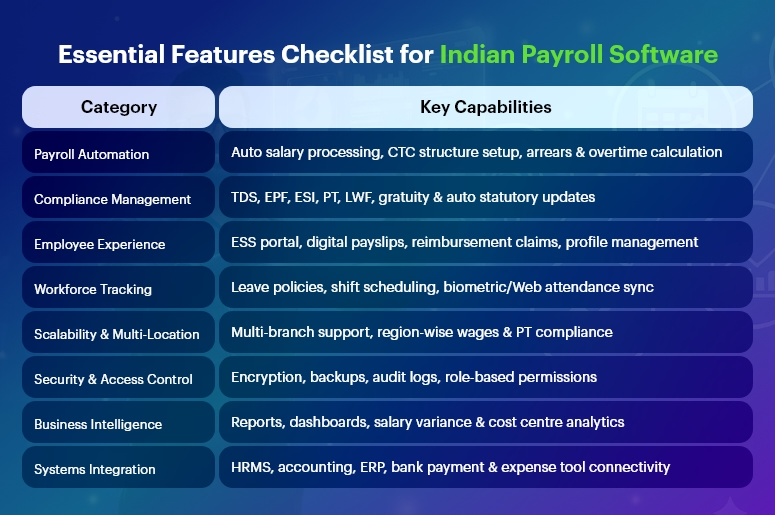
Essential Features Checklist for Indian Payroll Software

Automated Payroll Processing & Salary Calculations

Manual payroll calculations often lead to errors, late salary payments, and employee dissatisfaction. A modern payroll solution must offer:

  • Auto-calculation based on attendance data
  • Support for multiple pay cycles (monthly/weekly)
  • Automatic arrears, incentives, bonuses & overtime
  • Configurable salary structures (CTC breakup)

With automation, companies reduce repetitive work and ensure 100% accuracy every month.

Compliance With Indian Statutory Laws

Payroll compliance in India is dynamic and varies across states. A reliable payroll software must ensure seamless compliance with:

  • Income Tax / TDS
  • EPF, ESI & Labour Welfare Fund (LWF)
  • Professional Tax (PT)
  • Gratuity & Bonus Act
  • Minimum Wages Act
  • Maternity Benefit Act
  • Shops & Establishment Act regulations

It must auto-calculate contributions, generate challans, and update rules automatically to avoid penalties.

TDS, Income Tax & Investment Declarations Management

Employees should easily declare their investments for tax-saving purposes. Good payroll software should provide:

  • Automatic tax projections on salary slips
  • Section 80C & 80D declaration support
  • Proof submission tracking
  • Form 16 auto-generation

This simplifies the financial year-end chaos.

India’s #1 Free Software

Free Payroll, PF,
ESI & TDS Software

Professional compliance management for Indian businesses. 100% Free Forever.

Employee Self-Service (ESS) Portal

A self-service portal transforms employee experience by providing access to:

  • Digital payslips
  • Tax documents (Form 16, salary certificates)
  • Leave & attendance records
  • Personal information updates
  • Reimbursement claims

HR teams save significant time while employees stay empowered.

Leave & Attendance System Integration

Payroll and attendance must go hand-in-hand. A fully integrated system helps:

  • Sync biometric or web attendance in real-time
  • Auto-deduct leave without pay (LWP)
  • Manage multiple leave types and policies
  • Track shift schedules & overtime

This ensures accurate payouts every time.

Digital Reimbursements & Claims

Indian companies often offer tax-saving reimbursements like:

  • Travel allowances
  • Food coupons
  • Phone/internet bill reimbursements
  • Medical allowances

Payroll software should enable online claim submissions, approval workflows, and automatic payouts during payroll processing.

Multi-Location & Multi-State Support

Businesses expanding across states need payroll that supports:

  • Region-specific PT, local rules & wages
  • Multi-branch organization structure
  • Centralized admin dashboard
  • Multiple business units or legal entities

This ensures smooth processing for distributed workforces.

Secure Data Handling & Role-Based Access

Payroll data is highly sensitive. Security must be a top priority, including:

  • End-to-end encryption
  • Audit logs and detailed access permissions
  • Cloud-based data backups
  • ISO-compliant infrastructure

Role-based access ensures only authorized personnel can view salaries.

Comprehensive Payroll Reports & Analytics

Leadership needs insights for better decisions. The right software provides:

  • Payroll registers & compliance reports
  • Salary variance analysis
  • Cost centre-wise breakdowns
  • Reconciliation statements

Exportable reports (XLS, PDF) support audits and financial planning.

Integration With HR, Accounting & ERP Tools

Seamless integration eliminates duplicate data entry. Look for payroll that connects with:

  • HRMS, timesheet & attendance software
  • Bank payment systems for salary disbursement
  • Corporate expense management tools

This builds a connected digital workforce ecosystem.

India’s #1 Free Software

Free Payroll, PF, ESI & TDS Software

Final Thoughts

Indian payroll processing is unlike anywhere else in the world—and the right payroll software must solve challenges around regulatory compliance, multi-state management, and employee expectations.

Organizations should choose a solution that:

  • Is future-ready and scalable
  • Enables automation and compliance
  • Improves employee experience
  • Reduces manual workload for HR & finance

With the right digital payroll tool in place, companies can focus more on people and growth—and less on paperwork.

Frequently Asked Questions (FAQs)

1. What is the most important feature in Indian payroll software?

Automated statutory compliance and accurate salary calculations are the most crucial features to avoid legal issues.

2. Can payroll software handle multi-state compliance in India?

Yes, advanced solutions automatically apply state-specific rules like PT, minimum wages, and LWF.

3. Why do companies prefer cloud-based payroll?

Cloud payroll ensures security, accessibility, scalability, and real-time updates—especially for hybrid and remote teams.

4. Is payroll software useful for startups?

Absolutely! It minimizes HR workload, prevents calculation errors, and ensures compliance right from day one.

5. Can employees access payslips digitally?

Yes, through an ESS portal or mobile app, employees can download payslips anytime.

6. Does payroll software generate Form 16?

Yes, many solutions auto-generate and distribute Form 16 during tax season.

7. Is Tally integration available in Indian payroll software?

Most payroll systems offer accounting integration with Tally and ERP tools.

8. How does payroll software help in audits?

It provides standardized, exportable reports, reducing audit preparation time.

9. Can payroll software automate bank salary disbursements?

Yes, integration with bank systems enables hassle-free salary transfers.

10. What about data security in payroll software?

Modern platforms include encryption, access controls, and regular backups to secure sensitive payroll details.

Free Payroll, PF, ESI & TDS Software

The most trusted automation tool for modern Indian businesses.

How Payroll Software Changes the Life of a Tax Consultant?

In today’s fast-evolving financial landscape, tax consultants play a critical role in ensuring businesses remain compliant while optimizing their tax liabilities. They deal with salary structures, statutory deductions, income tax filings, reimbursements, benefits, and ever-changing government regulations.

But as businesses scale, so does the complexity of payroll and tax management. Manual spreadsheets, repetitive calculations, and constant regulation updates make it nearly impossible for tax consultants to stay efficient and error-free.

This is where modern payroll software — like CrmLeaf Payroll — becomes a transformative tool. It automates the entire payroll lifecycle, enhances compliance accuracy, and provides real-time insights, helping tax consultants move from being reactive to strategic advisors.

In this comprehensive guide, we’ll explore how payroll software changes the life of a tax consultant — improving productivity, accuracy, compliance, and client satisfaction.

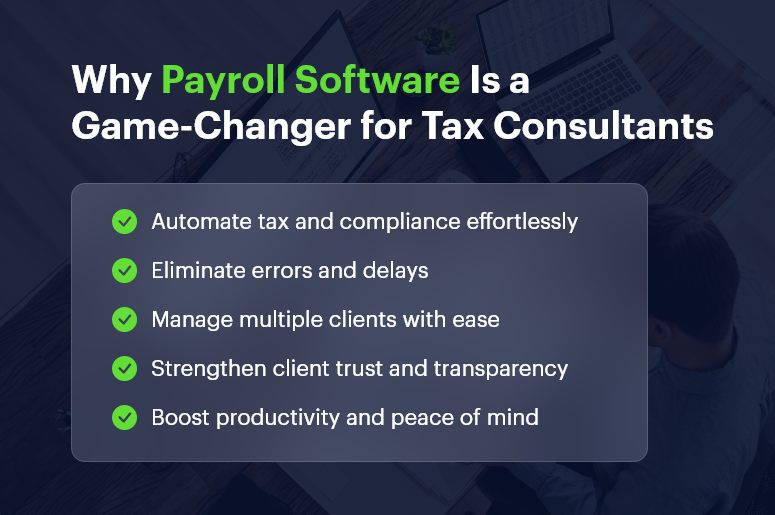
Why Payroll Software Is a Game-Changer for Tax Consultants

Eliminates Manual Payroll Hassles

For decades, payroll processing meant navigating endless spreadsheets, verifying attendance, calculating deductions, and applying tax rules manually. It was time-consuming, error-prone, and mentally exhausting.

With Payroll Software for Tax Consultants:

  • Automated Payroll Runs: Set schedules and let the system process salaries, deductions, and bonuses automatically.
  • Pre-Configured Rules: Define salary structures, tax slabs, and deductions once — the software does the rest every month.
  • Error-Free Processing: CrmLeaf’s automation eliminates manual calculation mistakes, ensuring 100% accuracy.

Result: Tax consultants spend less time crunching numbers and more time on strategic planning, client advisories, and business growth.

Automates Compliance and Tax Regulations

Tax laws are dynamic — with frequent updates in TDS rates, EPF, ESI, gratuity, or professional tax. Staying current manually is nearly impossible for consultants managing multiple clients.

CrmLeaf Payroll Keeps You Compliant Automatically:

  • Real-Time Updates: The system is auto-updated with the latest government rules and tax amendments.
  • Region-Specific Customization: Easily configure compliance settings for different states or countries.
  • Pre-Filled Forms and Returns: Generate TDS statements, Form 16, and statutory filings in seconds.

No more compliance stress. CrmLeaf ensures every payroll aligns with current tax norms — reducing legal risks and saving consultants from penalties or rework.

Streamlines Multi-Client Management

A tax consultant’s workload is rarely limited to a single organization. Managing payroll for multiple clients means handling diverse pay structures, compliance needs, and reporting formats.

How Payroll Software Simplifies Multi-Client Operations:

  • Centralized Dashboard: View all clients’ payroll data from one secure dashboard.
  • Client-Specific Rules: Configure unique salary templates and compliance settings per client.
  • Switch Effortlessly: Toggle between different client payrolls in a few clicks without confusion.

CrmLeaf Payroll allows consultants to manage multiple clients simultaneously, improving efficiency and reducing the risk of errors from juggling different data sources.

Enhances Accuracy in Tax Filings

For a tax consultant, accuracy isn’t optional — it’s the foundation of trust. Payroll software ensures consistency across all calculations and eliminates manual discrepancies.

Accuracy Benefits with CrmLeaf Payroll:

  • Automated Tax Computation: Automatically calculates tax withholdings, exemptions, and deductions.
  • Validation Checks: Flags anomalies before payroll is finalized.
  • Integrated Tax Reports: Syncs payroll data directly with accounting and tax systems.

By ensuring every figure aligns perfectly, consultants can file accurate returns, avoid audits, and maintain flawless client records.

India’s #1 Free Software

Free Payroll, PF,
ESI & TDS Software

Professional compliance management for Indian businesses. 100% Free Forever.
Provides Real-Time Reports and Analytics

Traditional payroll tools only process payments; modern payroll platforms like CrmLeaf deliver actionable insights.

Key Reporting Features:

  • Customizable Reports: Generate payroll summaries, tax liabilities, and year-end financial statements in real time.
  • Trend Analysis: Track employee costs, tax liabilities, and benefits distributions over time.
  • Forecasting Tools: Anticipate future tax implications and help clients plan proactively.

For consultants, this means transforming from a compliance manager into a data-driven financial advisor — offering smarter recommendations backed by real-time analytics.

Strengthens Data Security and Confidentiality

Payroll and tax data are highly sensitive — containing bank details, PANs, salary information, and identification documents. A single leak can destroy client trust.

CrmLeaf Payroll’s Security Protocols Include:

  • Bank-Grade Encryption: Protects data in transit and at rest.
  • Role-Based Access Controls: Restrict access by user role (consultant, accountant, admin, etc.).
  • Audit Trails: Keep a full log of every activity for transparency and accountability.
  • Cloud Backup & Recovery: Prevents data loss and ensures business continuity.

By using secure payroll software, tax consultants safeguard not just data — but their reputation and client trust.

Boosts Productivity and Saves Time

Manual payroll operations can consume 60–70% of a tax consultant’s monthly workload. Payroll software drastically reduces that time.

Productivity Gains:

  • Automated Payroll Runs: Execute multiple client payrolls simultaneously.
  • One-Click Payslips: Generate, download, or email payslips automatically.
  • Task Reminders: Get alerts for compliance deadlines and tax filings.

Time Saved = Higher Earnings + Less Stress.

Consultants can reinvest this time in acquiring new clients, upselling advisory services, or simply maintaining a healthier work-life balance.

Improves Client Communication and Transparency

Clients expect transparency — they want to see how salaries, deductions, and taxes are being managed. Payroll software helps consultants deliver this easily.

With CrmLeaf Payroll:

  • Client Dashboards: Share real-time payroll summaries and reports.
  • Custom Reports: Offer branded, professionally formatted statements for each client.
  • Automated Notifications: Keep clients informed about filings, due dates, and approvals.

Transparent reporting builds long-term client trust and differentiates a consultant from competitors relying on outdated manual systems.

Supports Remote and Hybrid Work Models

Post-pandemic, many tax consultants operate remotely or manage distributed clients. Cloud-based payroll systems ensure accessibility anytime, anywhere.

Cloud Payroll Benefits:

  • Work from Anywhere: Access client data securely from any device.
  • Team Collaboration: Multiple team members can collaborate in real time.
  • 24/7 Availability: No dependency on physical office infrastructure.

CrmLeaf Payroll enables consultants to maintain flexibility without compromising data integrity or efficiency.

Enables Scalability and Growth

As a tax consultant’s client base grows, manual payroll processes can’t scale. Payroll software, however, grows with your business.

CrmLeaf Scalability Features:

  • Unlimited Client Accounts: Manage multiple organizations simultaneously.
  • Custom Configurations: Adapt salary rules, benefits, and tax structures as clients evolve.
  • Integration Ready: Connect with CRMs, accounting platforms, and HR tools seamlessly.

With CrmLeaf, consultants can scale operations effortlessly without hiring extra staff or increasing overhead costs.

India’s #1 Free Software

Free Payroll, PF, ESI & TDS Software

Reduces Legal and Financial Risks

Non-compliance with statutory regulations can result in hefty fines and reputational damage. Payroll automation minimizes these risks.

CrmLeaf Risk Management Tools:

  • Built-in Compliance Tracker: Automatically checks for missing filings or underpayments.
  • Digital Record-Keeping: Maintains proof of all transactions for audits.
  • Alert Mechanism: Warns about upcoming deadlines or discrepancies.

With proactive compliance monitoring, consultants protect both their clients and their practice from legal trouble.

Creates a Better Work-Life Balance

One of the most overlooked benefits of payroll automation is the personal relief it offers. Consultants often work late nights during tax season — but automation changes that.

Lifestyle Benefits:

  • No repetitive manual tasks.
  • Reduced stress from compliance tracking.
  • More predictable workflows.

By cutting tedious administrative work, payroll software gives tax consultants their time and peace of mind back.

Why CrmLeaf Payroll Is the Best Choice for Tax Consultants

CrmLeaf Payroll isn’t just another payroll tool — it’s a complete payroll and compliance management ecosystem tailored for consultants, accountants, and financial experts.

Key Differentiators:

  • Integrated CRM + Payroll: Manage clients, payrolls, and communications in one unified system.
  • AI-Powered Insights: Get recommendations for compliance accuracy and tax optimization.
  • Custom Branding: White-label options to present payroll reports under your consulting firm’s name.
  • Seamless Integrations: Connect with QuickBooks, Xero, Tally, and ERP systems.
  • Global Compliance Support: Handle multi-country payrolls with localized rules.

With CrmLeaf Payroll, tax consultants can simplify, scale, and shine.

Free Payroll, PF, ESI & TDS Software

The most trusted automation tool for modern Indian businesses.

Conclusion

The life of a tax consultant has evolved from manual number-crunching to data-driven strategy — and payroll software is at the heart of that transformation.

By embracing automation through platforms like CrmLeaf Payroll, consultants can:

  • Automate compliance and tax filing
  • Improve accuracy and reduce risks
  • Boost productivity and scalability
  • Strengthen client trust
  • Enjoy better work-life balance

In short, payroll software doesn’t just simplify operations — it redefines how tax consultants deliver value.

Frequently Asked Questions

1. What is payroll software, and why do tax consultants need it?

Payroll software automates salary processing, tax deductions, and compliance management. For tax consultants, it simplifies complex calculations, ensures error-free tax filings, and saves significant time.

With payroll software like CrmLeaf Payroll, consultants can manage multiple clients effortlessly while maintaining 100% compliance accuracy.

2. How does payroll software help tax consultants with compliance?

Payroll systems automatically update themselves with the latest government tax laws, TDS rules, EPF, and ESI regulations. This means tax consultants don’t have to manually track compliance changes — the software ensures every payroll adheres to current legal requirements.

3. Can payroll software handle multiple clients for tax consultants?

Yes. CrmLeaf Payroll allows consultants to manage multiple clients simultaneously from a single dashboard. Each client can have customized salary structures, deductions, and reporting settings, making multi-client management seamless and organized.

4. Does payroll software reduce human errors in tax filings?

Absolutely. Payroll software automates calculations for income tax, deductions, reimbursements, and allowances. This eliminates manual data entry mistakes and ensures that every filing is precise, compliant, and audit-ready.

5. How does payroll automation improve client relationships for tax consultants?

By providing transparent reports, real-time dashboards, and accurate payslips, consultants can build stronger trust with their clients. CrmLeaf Payroll also enables consultants to share compliance reports and tax summaries in branded, professional formats — enhancing credibility and client satisfaction.

6. Is payroll software secure enough to handle sensitive financial data?

Yes. Modern payroll systems, especially CrmLeaf Payroll, use bank-grade encryption, role-based access control, and secure cloud backup systems. This ensures complete confidentiality and protection of client payroll and tax data from unauthorized access or breaches.

7. Can payroll software integrate with accounting and CRM systems?

Definitely. CrmLeaf Payroll integrates seamlessly with popular accounting software like Tally, QuickBooks, and Xero, as well as CRM tools. This integration enables automatic data synchronization, improving efficiency and reducing duplicate data entry.

8. Does payroll software save time for tax consultants?

Yes, it saves considerable time. Automated payroll processing, report generation, and compliance tracking drastically reduce manual effort. Consultants can process payrolls faster and focus more on strategic advisory services instead of repetitive administrative tasks.

9. How does payroll software help during audits or tax assessments?

Payroll software keeps detailed digital records of every transaction, deduction, and tax filing. During audits or assessments, consultants can easily access historical data and generate reports, making the process smooth and transparent.

10. Is payroll software suitable for both small and large tax consulting firms?

Yes. CrmLeaf Payroll is scalable — it suits individual consultants, small tax firms, and large accounting organizations. The platform grows with your business, allowing you to handle unlimited clients, employees, and compliance types as your firm expands.

India’s #1 Free Software

Free Payroll, PF,
ESI & TDS Software

Professional compliance management for Indian businesses. 100% Free Forever.
Monthly Payroll vs. Weekly Payroll: Which One Is Right for Your Business?

When it comes to payroll, frequency matters more than you might think. The decision between monthly payroll vs. weekly payroll isn’t just a preference — it’s a strategic lever that affects cash flow, compliance, morale, and operational efficiency.

For many HR professionals, finance teams, and small business owners, the question is this: How often should you pay your employees? And more importantly — how does that decision impact your team and bottom line?

In this blog, we’ll break down the differences between monthly and weekly payroll, explore how it affects various business models, and help you choose the option that aligns with your goals — backed by practical insights and powered by the flexibility of CRMLeaf’s CRM + ERP platform.

One Platform, Multiple Payroll Schedules

Why Payroll Frequency Is a Strategic Decision for Growing Businesses

Payroll isn’t just about cutting checks — it’s about financial planning, employee satisfaction, and regulatory compliance. As your business scales, choosing the right payroll schedule becomes even more critical.

1. Operational Simplicity vs. Workforce Expectations

  • Businesses often lean toward monthly payroll for its administrative simplicity and predictable cash flow cycles.
  • However, some industries require weekly payroll to meet labor expectations, especially for hourly or part-time staff.

2. Industry-Specific Norms

  • Construction, manufacturing, and retail industries often pay weekly or biweekly due to fluctuating shifts, hourly pay structures, and union rules.
  • SaaS companies, consultancies, and professional services prefer monthly payroll to reduce admin load and align payments with invoice cycles.

3. Employee Engagement and Retention

  • For many employees, pay frequency impacts satisfaction. Weekly payroll can improve morale and reduce financial stress — especially in hourly workforces.
  • On the other hand, salaried professionals often prefer predictable, consolidated monthly pay.

So, how do you decide between monthly payroll vs. weekly payroll? Let’s explore the pros and cons.

Payroll Schedule Comparison: Monthly vs. Weekly Breakdown

Here’s a clear breakdown of the advantages and trade-offs for both schedules, so you can make a confident decision.

Monthly Payroll: Advantages

  • Reduced Administrative Overhead: You only process payroll 12 times a year, saving time, effort, and resource costs.
  • Simplified Tax Filing: Fewer filings mean fewer opportunities for compliance errors and smoother reconciliation processes.
  • Cash Flow Predictability: Monthly payouts help businesses better forecast cash flow, especially when managing vendor payments and invoices.
  • Better Integration with Financial Systems: Monthly payroll aligns well with CRM + ERP platforms that also operate on monthly billing and reporting cycles.

Monthly Payroll: Potential Drawbacks

  • Delayed Earnings for Employees: Waiting 30 days for pay may cause dissatisfaction among employees, especially in lower-income or hourly roles.
  • Harder to Adjust for Mid-Cycle Changes: Bonuses, terminations, and last-minute adjustments may be harder to handle without disrupting the cycle.
  • Less Flexibility: If labor hours vary significantly, reconciling hours and calculating pay can be more challenging over longer cycles.

Weekly Payroll: Advantages

  • Boosts Employee Satisfaction: Employees receive faster access to their earnings, which can reduce financial stress and improve engagement.
  • Ideal for Hourly Workforces: Weekly payroll is perfect for businesses with fluctuating schedules and overtime payments.
  • Faster Error Correction: Mistakes can be caught and corrected more quickly, limiting the window for unresolved issues.

Weekly Payroll: Potential Drawbacks

  • Higher Administrative Load: Processing payroll 52 times a year can burden HR and finance teams — unless you automate with tools like CRMLeaf.
  • Increased Processing Costs: More frequent payroll runs can increase costs related to compliance, direct deposits, and accounting.
  • Shorter Cash Flow Windows: Weekly disbursements require tighter cash management and forecasting to avoid liquidity issues.

Best Practices: How to Choose the Right Payroll Schedule

Choosing between monthly payroll and weekly payroll depends on several factors — employee type, industry, company size, and available payroll infrastructure.

1. Align Payroll with Workforce Structure

  • If your team is largely hourly, seasonal, or shift-based, weekly payroll often works best.
  • For predominantly salaried employees, monthly payroll minimizes complexity and matches performance review or bonus cycles.

2. Evaluate Internal Resources

  • If your HR and finance teams are small or overstretched, monthly payroll might reduce workload and risk.
  • However, automation with CRMLeaf levels the playing field. You can run payroll weekly without overwhelming your team thanks to built-in workflows and tax calculators.

3. Consider Cash Flow Patterns

  • Ask: Can we maintain healthy cash reserves for weekly disbursements?
  • If not, monthly payroll may give your finance team more breathing room for planning, investing, or handling emergencies.

4. Stay Compliant with Local Laws

  • Some jurisdictions mandate weekly or biweekly payments, especially for certain industries.
  • CRMLeaf helps you stay compliant by automating regional payroll compliance and alerting you to changes in tax rules or labor laws.

Real-World Case Study: Choosing the Right Schedule with CRMLeaf

For example, ShopMax, a mid-sized retail business with 300 hourly employees, switched from monthly to weekly payroll using CRMLeaf’s CRM + ERP platform.

After automating time tracking, tax deduction, and overtime calculations:

  • Payroll errors dropped by 45%
  • Employee satisfaction scores increased by 22%
  • Time spent on payroll processing decreased by 40%

By leveraging CRMLeaf’s payroll automation and analytics, ShopMax turned payroll from a pain point into a retention advantage.

Key Takeaways: Finding Your Payroll Sweet Spot

Choosing between monthly payroll vs. weekly payroll isn’t one-size-fits-all. It’s a decision shaped by your team, your operations, and your goals.

  • Weekly payroll may suit hourly teams and high-turnover roles that require speed, transparency, and employee satisfaction.
  • Monthly payroll may suit salaried workforces, project-based companies, and cash-conscious operations.
  • The best strategy is to combine thoughtful planning with powerful automation.

With CRMLeaf’s CRM + ERP platform, you’re not stuck choosing one over the other — you get the flexibility to run different payroll schedules based on department, location, or role.

So whether you want efficiency, accuracy, or happier employees, CRMLeaf empowers your payroll process to align with business strategy.

Why Manual Payroll Processing Is Costing You More Than You Think?

On the surface, manual payroll processing might seem manageable — especially for small teams or early-stage companies. But behind the scenes, it’s a productivity drain, a compliance risk, and a hidden cost center.

In fact, the American Payroll Association found that payroll errors affect over 33% of businesses, often costing hundreds to thousands annually per employee. And yet, many companies stick with spreadsheets and legacy systems simply because “that’s how it’s always been done.”

In this blog, we’ll explore why manual payroll processing is costing you more than you think, uncover the real-world risks, and show how platforms like CRMLeaf’s CRM + ERP help modernize payroll with automation, accuracy, and insight.

The Real Cost of Manual Payroll Processing

The Real Cost of Manual Payroll: Why This Matters to Growing Businesses

Manual processes aren’t just outdated — they’re dangerous in a fast-paced, compliance-heavy, and data-driven business world. And the impact isn’t limited to just HR.

1. Manual Means Mistakes — And Mistakes Cost Money

  • Data entry errors are common: Manually inputting hours, deductions, and tax codes opens the door to mistakes. One wrong cell and your employees get underpaid or your business overpays taxes.
  • Fixing errors eats into productive time: HR and finance teams often spend hours fixing mistakes instead of focusing on strategic initiatives.

2. Hidden Compliance Risks Are Always Lurking

  • Tax laws change constantly: Staying updated manually across multiple jurisdictions increases the risk of fines and audits.
  • Late filings or misclassified employees can result in government penalties, legal trouble, and loss of trust.

3. Employee Experience Takes a Hit

  • Late payments or incorrect paychecks hurt morale: It’s hard to keep employees engaged if they’re constantly questioning their pay.
  • Manual processes reduce transparency: Employees may not know where to go for breakdowns, deductions, or past payslips.

4. Business Scalability Slows Down

  • Manual payroll doesn’t scale: The more employees you onboard, the harder it becomes to track benefits, bonuses, and time off accurately.
  • Disconnected systems stall decision-making: Without real-time integration between payroll, finance, and HR, you lose visibility.

From retail and manufacturing to tech startups and agencies, businesses in every industry face these bottlenecks — until they automate.

The True Costs of Manual Payroll Processing: Let’s Break It Down

You might think manual processing saves you software costs. But here’s what it’s costing:

1. Time Cost

  • Manual payroll can take 8–10 hours per cycle, depending on employee count, overtime tracking, tax calculations, and approvals.
  • Multiply that across 12–52 pay periods, and you’re talking about dozens of workdays lost annually to payroll administration.

2. Financial Risk

  • A simple mistake — like failing to withhold the correct tax — can cost businesses up to $845 per year per employee in penalties, according to the IRS.
  • Labor audits due to noncompliance often result in thousands in legal fees.

3. Opportunity Cost

  • Manual payroll drains time that could be spent on performance analysis, workforce planning, or improving employee engagement.
  • Delayed payroll insights mean you can’t react quickly to budget overruns or labor costs exceeding projections.

Best Practices: How to Eliminate the Hidden Costs of Manual Payroll

It’s time to stop treating payroll like a back-office burden and start managing it as a strategic function. Here’s how to make the shift:

1. Automate Data Collection with Integrated Time Tracking

  • Sync employee hours, leave records, overtime, and holidays with your payroll system using CRMLeaf’s unified CRM + ERP.
  • You’ll eliminate manual errors and gain real-time visibility across departments.

2. Implement Tax Rules & Compliance Workflows

  • Automate tax calculations and state-specific compliance checks within your payroll module.
  • CRMLeaf keeps tax rules up to date, so you’re always audit-ready without manual intervention.

3. Generate Reports Instantly

  • From payroll summaries to compliance reports, automation lets you run reports with one click instead of piecing together Excel sheets.
  • This makes it easier to justify expenses, analyze labor trends, and share insights with leadership.

4. Give Employees Self-Service Access

  • Empower employees with portals where they can access payslips, tax forms, and payment history — reducing HR queries by up to 40%.
  • CRMLeaf includes secure, role-based access so sensitive data stays protected.

5. Sync Payroll with Project Costs

  • When payroll data integrates with projects and budgets, you can track real-time labor costs per client or task.
  • This is crucial for consulting firms, marketing agencies, and any business with billable hours.

Customer Story: How One Business Slashed Payroll Costs with CRMLeaf

For example, TaskPro, a logistics company with 150+ employees, was managing payroll manually using spreadsheets and a legacy HR tool.

Once they switched to CRMLeaf’s payroll automation, the impact was immediate:

  • Payroll processing time dropped by 60%
  • Error rate reduced by 80%
  • Annual compliance fines went from $6,000 to zero

TaskPro also integrated payroll with their budgeting module — improving project profitability by understanding labor cost allocations in real-time.

Key Takeaways: Automation Isn’t Optional Anymore

Here’s the reality — manual payroll processing is draining your time, increasing risk, and limiting your growth.

To recap:

  • Manual methods introduce more errors, which cost both money and employee trust.
  • You’re losing valuable time and missing out on insights that modern automation delivers instantly.
  • Payroll should be part of your business intelligence strategy, not just a monthly task.

With CRMLeaf’s CRM + ERP platform, payroll is integrated, automated, and optimized — so your teams can focus on strategy, not spreadsheets.

End-to-End Payroll Processing Checklist for Growing Businesses

Payroll isn’t just about paying your people. It’s about staying compliant, earning trust, and keeping your team motivated. But as your business grows, managing payroll manually becomes risky, time-consuming, and error-prone. In fact, more than 33% of small businesses face penalties due to payroll errors. In this guide, we’ll walk you through a practical end-to-end payroll processing checklist — built for modern, growing businesses. You’ll learn where most companies slip up, what to fix, and how to make the entire process seamless with CRMLeaf’s CRM + ERP platform.

The Business Case: Why End-to-End Payroll Processing Matters

Managing payroll goes far beyond cutting checks. When payroll is inaccurate or non-compliant, it creates ripple effects across your business. Think employee dissatisfaction, audits, legal trouble, and financial losses.

Let’s look at why a robust payroll system is essential for growth:

  • Retail & Hospitality: High employee turnover and hourly wages make real-time payroll updates critical. Delays lead to unhappy staff and retention issues.
  • Manufacturing & Logistics: Managing overtime, shift differentials, and contract workers demands precision — or you’ll face major payroll compliance risks.
  • Professional Services: Billing hours, bonuses, and project-based compensation require automation to prevent calculation errors.

No matter the industry, streamlined payroll automation improves productivity, builds employee trust, and reduces your operational burden.

Your End-to-End Payroll Checklist

The Ultimate End-to-End Payroll Processing Checklist

Here’s your complete payroll checklist, broken down into actionable stages. Each one is critical for a smooth, accurate, and compliant payroll cycle.

1. Employee Data Collection & Classification

  • Capture full employee details: Collect tax ID, contact info, job role, bank details, and any benefits preferences at onboarding.
  • Classify employment type: Distinguish between full-time, part-time, contract, and freelance workers to ensure correct tax treatment.
  • Track working hours and shifts: Use digital timesheets or biometric systems to gather accurate work data.

2. Payroll Setup & Configuration

  • Set pay frequencies: Define weekly, bi-weekly, or monthly payroll cycles based on company structure.
  • Automate tax rates & deductions: Stay current with federal, state, and local tax laws to apply accurate deductions.
  • Integrate with attendance systems: Sync leave, holidays, and work hours from your HR tool into your payroll system.

3. Pre-Payroll Validation

  • Verify attendance data: Double-check logged work hours, approved leave, and overtime entries.
  • Audit changes in pay structure, including bonuses, commissions, and pay raises, and validate them before final processing.
  • Confirm deductions: Ensure that benefits, insurance, and loan deductions are accurate and approved.

4. Payroll Calculation & Review

  • Run gross-to-net calculations: Automatically compute gross salary, taxes, deductions, and net pay.
  • Cross-check with payroll software: Use automated payroll software to reduce human errors and eliminate spreadsheet fatigue.
  • Generate payslips: Produce detailed, downloadable payslips for employee transparency.

5. Compliance & Statutory Filings

  • Generate tax forms: Automatically create W-2s, 1099s, PF/ESI documents, and other required tax filings.
  • Meet submission deadlines: Set reminders for tax payment and reporting deadlines to avoid penalties.
  • Stay audit-ready: Maintain digital records and audit trails to comply with labor laws.

6. Payment Processing

  • Schedule timely payments: Use integrated banking or payroll software to process salary payments without delay.
  • Disburse reimbursements: Include travel or expense claims in the current cycle to avoid payment lags.
  • Reconcile bank statements: Ensure every payment matches the payroll run and accounting books.

7. Post-Payroll Reporting & Feedback

  • Share detailed reports: Provide department-wise breakdowns and payroll summaries to finance and HR teams.
  • Analyze payroll KPIs: Track payroll accuracy, error rates, cycle time, and compliance status.
  • Collect feedback: Enable employee feedback to improve future payroll runs.

How CRM + ERP Transforms Payroll for Scaling Teams

Disconnected tools lead to fragmented processes. CRMLeaf’s CRM + ERP platform brings everything — from employee onboarding to payroll disbursal — into one unified workflow.

  • HR integration: Automatically sync new hire data from your HR module into payroll setup.
  • Real-time tracking: Use dashboards to monitor payroll progress, pending validations, and payment status.
  • Custom reports: Generate audit-ready reports, salary slips, and tax documents at the click of a button.
  • Scalability: Whether you have 20 or 200 employees, the system grows with you — minus the manual work.

Customer Success

For example, Finovate Solutions, a 50-person IT services company, used CRMLeaf’s payroll automation to reduce payroll errors by 95% and cut processing time from 3 days to 4 hours. Here’s how:

  • Integrated employee timesheets with payroll
  • Enabled automatic compliance checks and tax form generation
  • Streamlined payouts and payslip generation

This shift not only saved time but boosted employee satisfaction and reduced compliance risks.

Key Takeaways & Closing

A smooth end-to-end payroll processing workflow doesn’t just prevent errors — it strengthens trust, ensures compliance, and frees up your time for strategic growth.

  • Map your payroll process: Understand each phase and identify bottlenecks.
  • Automate wherever possible: Manual work invites mistakes. Use payroll automation tools.
  • Stay compliant: Regulations change frequently. Your system must adapt in real time.
  • Unify systems: Don’t rely on disconnected HR, time tracking, and payroll apps.

With the right tools and mindset, payroll can become a growth enabler — not a back-office burden.

Top Payroll Challenges Small Businesses Face — And How to Overcome Them

Managing payroll is not just about calculating salaries and hitting “send.” It’s a critical function that impacts compliance, employee trust, and business growth. Small businesses, especially, face intense pressure to get payroll right — without the luxury of large teams or expensive systems.

In this blog, we break down the top payroll challenges faced by small businesses and show you how to overcome them with modern tools, smart workflows, and streamlined systems like a CRM + ERP platform.

Why Payroll Management Deserves More Attention

If payroll feels like a back-office task, think again. For small and mid-sized businesses, payroll can make or break operations:

  • Cash flow hinges on payroll timing. If salaries are delayed or miscalculated, it can cause employee dissatisfaction and even attrition.
  • Payroll errors often trigger legal penalties. From late filings to incorrect tax calculations, non-compliance is costly.
  • Manual payroll is time-consuming and error-prone. Many small teams still rely on spreadsheets, which are simply not scalable.

Industries like retail, manufacturing, and IT services that operate with mixed or distributed workforces often find payroll particularly tricky due to varying shifts, bonuses, and legal compliance.

Payroll Pitfalls What Slows Small Businesses Down

The Top Payroll Challenges for Small Businesses

1. Payroll Compliance and Ever-Changing Tax Regulations

Staying compliant with local, state, and national laws is exhausting. Tax slabs change, new deductions are introduced, and local labor laws evolve regularly.

  • Failure to comply can lead to hefty fines. For example, misfiling PF or ESI returns can invite audits or penalties.
  • Keeping up with changes requires continuous monitoring. Small HR teams may not have bandwidth for this.

2. Employee Misclassification (Full-Time vs. Contractual)

Many small businesses operate with a mix of full-time, part-time, and freelance workers.

  • Incorrect classification leads to incorrect tax deductions and benefit allocations.
  • This misstep can attract government scrutiny and cause reputational damage.

3. Frequent Payroll Errors and Manual Calculations

Human errors during data entry, incorrect overtime calculations, or forgetting to update deductions can all snowball quickly.

  • Incorrect payslips break employee trust. It lowers morale and could lead to disputes.
  • Fixing payroll errors consumes time and resources, especially if discovered late.

4. Delayed Salary Disbursement

Salary delays often result from approvals stuck in email threads or cash flow uncertainty.

  • Late salaries hurt employee retention. Workers expect timely payments — especially in labor-heavy sectors.
  • It also disrupts payroll reporting and statutory submissions.

5. No Integration Between HR, Payroll, and Finance Systems

Disjointed systems mean multiple logins, repeated data entry, and no single view of employee or financial data.

  • Data silos lead to inefficiencies. You may calculate leave in one system, salary in another, and taxes manually.
  • Lack of integration affects reporting accuracy.

6. Handling Bonus, Incentive, and Variable Pay

Bonuses, commissions, and performance incentives add complexity to monthly processing.

  • Without a rule-based system, calculating variable pay is confusing and inconsistent.
  • Mistakes here affect employee motivation and tax liabilities.

7. Difficulties in Tax Filing and Year-End Reports

Many businesses struggle with last-minute data compilation during TDS filing or form generation.

  • Inaccurate tax filing risks penalties and employee dissatisfaction.
  • Manually generating Form 16 or 24Q is time-consuming.

How to Overcome These Payroll Challenges

Solving these issues starts with automation, integration, and insight. Here’s how:

Adopt a Unified Payroll Platform

Replace fragmented tools with a CRM + ERP system that integrates payroll, HR, and finance.

  • Eliminates redundant data entry across departments.
  • Ensures consistency in employee classification and tax deduction rules.

Set Payroll Rules and Templates

Use configurable salary structures and templates for roles, departments, and work types.

  • Standardization reduces calculation errors.
  • Templates ensure clarity across full-time, part-time, and freelance roles.

Automate Tax Compliance and Filing

Use payroll software that supports automatic deductions, PF/ESI calculation, and timely filings.

  • Get real-time compliance alerts.
  • Avoid end-of-quarter panic.

Enable Self-Service for Employees

Give employees access to payslips, tax details, and reimbursement updates.

  • Builds transparency and reduces admin burden.
  • Empowers employees to track earnings and deductions.

Set Clear Payroll Schedules and Workflows

Avoid delays with automated approval workflows and defined processing dates.

  • Improves coordination between HR, finance, and leadership.
  • Ensures salaries are hit on time.

Case Study

For example, a retail chain implemented an integrated payroll + HR solution to streamline monthly payouts. With automated PF/ESI calculations and integrated leave tracking, they:

  • Reduced payroll processing time by 60%
  • Avoided late filing penalties completely
  • Improved employee satisfaction and retention

Key Takeaways

  • Payroll management is more than salary disbursement — it’s a business-critical operation.
  • Manual systems increase risks and drain time for small teams.
  • Compliance, classification, and tax filing are the top pain points in small business payroll.
  • Integrated systems reduce errors, delays, and missed compliance windows.

In summary, a smart, unified payroll system can transform how small businesses manage compliance, build employee trust, and save countless hours each month. As you grow, you need processes that scale without multiplying complexity.

Category: EPFO & ESI

No posts in this category.

Subcategory: EPFO

Subcategory: ESI

Category: Payroll Help

No posts in this category.

Subcategory: Employee Self-Service & Engagement

Subcategory: Introduction to Payroll

Subcategory: Payroll Analytics & Reporting

Subcategory: Payroll Automation & Technology

Subcategory: Payroll for Business Growth

Subcategory: Payroll Processing & Management

Subcategory: Taxation & Compliance

Category: User Manual

No posts in this category.

Subcategory: Company Setup

Subcategory: Employee Management

Subcategory: Getting Started

Subcategory: Glossary

Subcategory: Import & Export

Subcategory: Introduction

Subcategory: Payroll Configuration

Subcategory: Payslips & Disbursement

Subcategory: Reports & Analytics

Subcategory: Running Payroll

Subcategory: Statutory Compliance & Reports

Subcategory: Troubleshooting

Subcategory: User Management & Security