Payroll Reconciliation: A Complete Guide For Indian Employers

TL;DR: 

  • Payroll reconciliation happens after payroll processing but before payment and booking. It compares payroll output against attendance, approvals, bank files, and accounting records to catch errors before they reach employees or the ledger.
  • Most payroll discrepancies trace back to a handful of recurring causes: stale attendance data, unprocessed salary revisions, exited employees left in the run, duplicate incentives, or a mismatch between the approved payroll register and the actual bank payout file.
  • A reliable process compares payroll against source records at multiple points, not just once at the end, and every correction should be traceable to an approval.
  • Applied consistently before sign-off, a monthly payroll reconciliation checklist catches most errors that would otherwise surface only after employees receive their pay.
  • Payroll software can standardize calculations and centralize records, which reduces manual re-keying errors, but it does not replace the need for accurate source data, defined controls, and human review.
  • Treating payroll reconciliation as a routine, documented process rather than a firefighting exercise after a complaint is what separates audit-ready payroll teams from reactive ones.

Introduction

The team has processed payroll for the month, payslips are ready, and the bank file is about to go out. Then someone notices that the attendance system shows an employee on loss of pay for three days, but the salary register shows a full month’s pay. Another employee who resigned two weeks ago is still on the payout list. A manager approved an increment last month, but the payroll register still reflects the old salary.

None of this means the team processed payroll carelessly. It means they processed payroll but have not yet reconciled it. Running payroll and confirming that payroll is accurate are two different activities, and conflating them is one of the most common (and costly) habits in Indian payroll operations. Payroll reconciliation is the discipline that closes this gap: it is the systematic comparison of what payroll calculated against what should have happened, based on attendance, approvals, salary structures, and financial records.

For Indian employers, whether a 15-person startup or a multi-location company processing payroll for hundreds of employees, payroll reconciliation is not an optional finance formality. It stands between a clean monthly close and a scramble to explain a wrong salary credit. It also helps avoid a missed final settlement or a mismatch that shows up during an internal or statutory audit.

This guide walks through what payroll reconciliation means in practice and why it matters. It covers which records to compare and how to build a repeatable monthly process with a step-by-step method, a practical checklist, and an illustrative example.

🔄
Zero Reconciliation Errors

Automate Payroll Reconciliation With INDPayroll

Try It Free

What Is Payroll Reconciliation?

Payroll reconciliation is the process of comparing payroll calculations and outputs, gross pay, deductions, net pay, and the final payout against the source records that should have driven them, such as attendance, approved salary changes, and bank or accounting data. This comparison identifies and resolves discrepancies before the team finalizes or books payroll.

In simple terms, it answers the question, “Does what payroll produced actually match what should have happened this month?”

Why Is Payroll Reconciliation Important?

Payroll reconciliation matters because payroll touches money, trust, and records that other business functions depend on. Skipping it, or treating it as a glance rather than a structured check tends to surface problems at the worst possible time after money has already moved.

Salary accuracy. Reconciliation guards against overpaying or underpaying employees, or paying them on the wrong date — mistakes that quickly damage trust in HR and payroll.

Detecting duplicate or missing payments. Manual processes and multiple approval stages can let someone enter a bonus twice or miss a new joiner’s salary entirely in the first payroll cycle.

Spotting unexpected payroll variances. Comparing the current run against the previous one is often the fastest way to catch an error. A sudden jump or drop in an individual’s or a department’s payout is a signal worth investigating before payment, not after.

Keeping approved changes and payroll in sync. Teams usually approve increments, promotions, transfers, and exits in one system (HR, a spreadsheet, an email trail) and execute them in another (payroll). Reconciliation is what confirms the two are actually talking to each other.

Stronger financial records. Payroll is usually one of the largest recurring expenses a business has. Reconciling payroll against the general ledger keeps accounting records accurate and reduces the year-end scramble to explain differences.

Compliance and Audit Benefits

Better audit readiness. Audits can be internal, statutory, or requested by a lender or investor. A business that can show a documented, evidence-backed reconciliation process for every payroll cycle stands in a much stronger position than one relying on memory.

Support for accurate statutory reporting. Reconciling payroll data, correcting wages, correcting deduction amounts, correct employee counts is the foundation for statutory filings and reports. Reconciliation does not itself determine statutory compliance requirements. Relevant government bodies set those requirements, such as the Employees’ Provident Fund Organisation (EPFO), the Employees’ State Insurance Corporation (ESIC), and the Income Tax Department. However, inaccurate payroll data makes accurate statutory reporting far harder to achieve.

What Records Are Commonly Used in Payroll Reconciliation?

Payroll reconciliation depends on comparing multiple, independent sources of truth against each other. The table below outlines the records most Indian payroll teams work with. For the statutory contribution and tax record row specifically, treat the payroll system’s calculation as the internal figure to reconcile; the Ministry of Labour and Employment, EPFO, ESIC, and the Income Tax Department define the applicable rules themselves, and you should confirm them on those portals rather than assume them from a prior period.

Records to Compare During Reconciliation

Record / Data Source What to Verify Common Discrepancy
Employee master data Active/inactive status, designation, department, bank details, PAN, joining/exit dates Outdated status, incorrect bank account, duplicate employee records
Attendance and leave records Days worked, approved leave, loss-of-pay (LOP) days, overtime where applicable LOP not reflected, leave applied after payroll cutoff, attendance system not synced
Salary structure Current CTC breakup, allowances, fixed components The old salary structure is still in use after a revision
New joiner data Joining date, prorated salary, correct salary structure applied from day one Full month’s salary paid instead of a prorated amount, or vice versa
Exit and final settlement data Last working day, notice period recovery, full and final settlement components The exited employee is still included in the regular payroll run
Approved increments Effective date, revised components, approval reference Increment approved but not updated in the payroll system in time
Bonuses and incentives Approved amount, eligibility, payment period Duplicate entry, incentive paid to an ineligible employee
Deductions Loan recoveries, advances, penalties, other approved deductions Deduction applied twice, or not applied at all
Payroll register Gross-to-net breakup per employee, totals by department/cost centre Register total not matching sum of individual entries
Bank payment file/payout record Amount, account number, IFSC, payment date per employee The amount in the bank file differs from the approved payroll register
General ledger/accounting records Payroll expense booked, department-wise cost allocation Payroll expense in the ledger does not match the payroll register total
Statutory contribution and tax records Consistency between payroll-calculated statutory components and the amounts reported/remitted Mismatch between payroll deduction and the amount actually reported to the relevant authority

Payroll Reconciliation Process: Step-by-Step

Step 1: Confirm the payroll period and employee population

What to check: Confirm the exact pay period and the complete list of employees you should include: active employees, new joiners, and exits within the period.

Why it matters: Every other reconciliation step depends on starting with the right population. An incomplete or outdated employee list will produce errors that no amount of downstream checking can fully catch.

Common error to watch for: HR records include a new joiner who is not yet in the payroll system, or the payroll system still marks an exited employee as active.

Step 2: Verify employee master data changes

What to check: Any changes made during the period to designation, department, cost centre, bank account, or tax declarations, and whether the team approved them.

Why it matters: Master data changes flow directly into salary calculation and payment routing. An unverified bank account change, for instance, can misdirect an entire month’s salary.

Common error to watch for: A bank account update requested by an employee but not verified before payroll cutoff.

Step 3: Reconcile attendance, leave, and loss-of-pay inputs

What to check: Attendance data for the period against approved leave records, and confirm loss-of-pay days are correctly reflected for each employee.

Why it matters: Attendance is one of the most frequent sources of payroll variance because it changes every cycle and often comes from a separate system from payroll.

Common error to watch for: Leave applied or approved after payroll pulled the attendance data never reaches the payroll calculation.

Step 4: Check salary revisions and variable pay

What to check: Whether approved increments, promotions, and variable pay (bonuses, incentives, commissions) for the period are correctly reflected in the payroll system.

Why it matters: HR or management usually approves salary revisions outside the payroll system, which requires a manual or system update — a step that’s easy to miss in a busy cycle.

Common error to watch for: An increment approved with a specific effective date, but payroll continues to calculate on the old salary structure for that month.

Step 5: Review gross-to-net payroll calculations

What to check: That gross pay, all applicable earnings, deductions, and net pay reconcile arithmetically for each employee — i.e., the math is internally consistent.

Why it matters: Even correct inputs can produce a wrong output if a formula, rounding rule, or system configuration is off.

Common error to watch for: A configuration or formula error that affects a whole employee category (for example, everyone on a particular salary structure) rather than a single individual.

Step 6: Review applicable deductions and statutory payroll components

What to check: That deductions relevant to each employee, such as loan recoveries, advances, and applicable statutory contributions, match the approved amounts and apply consistently to that employee.

Why it matters: Deduction errors affect take-home pay directly and are one of the fastest ways to generate an employee complaint. Statutory components, in particular, need to be internally consistent before the team reports them to the relevant authority.

Common error to watch for: A one-time deduction, like an advance recovery, should stop after a certain month but keeps getting deducted anyway. Statutory rules change periodically, so confirm current requirements directly on the EPFO, ESIC, or Income Tax Department portals rather than relying on the prior period’s configuration alone.

Step 7: Compare the current payroll with the previous payroll period

What to check: Individual and total payroll figures for the current month against the prior month, looking for unexplained jumps or drops.

Why it matters: Period-over-period comparison is often the single fastest way to catch an error, because most employees’ pay does not change dramatically month to month without a known reason.

Common error to watch for: A large unexplained variance for an employee whose salary structure has not changed.

Step 8: Investigate unusual variances

What to check: Any variance flagged in Step 7 or elsewhere that does not have an obvious, documented explanation.

Why it matters: Not every variance is an error; a variance could be a legitimate bonus, a genuine LOP, or a real increment. But every variance deserves a documented explanation before the team finalizes payroll.

Common error to watch for: Assuming a variance is “probably fine” without tracing it back to a source record.

Step 9: Compare the approved payroll register with the payment output

What to check: Confirm that the final payroll register, the one the team reviewed and approved, matches exactly what’s in the bank payment file or payout instruction: same amounts, same accounts, same employees.

Why it matters: This is the last checkpoint before money actually moves. A mismatch here means the approval and the execution have diverged.

Common error to watch for: Someone corrects the payroll register at the last minute but does not carry the correction through to the bank file, or the reverse happens.

Step 10: Reconcile payroll totals with accounting records

What to check: That the total payroll expense in the general ledger matches the payroll register total, including how the team allocates it across departments or cost centres.

Why it matters: Payroll is typically a company’s highest recurring cost. A mismatch here distorts financial reporting and makes month-end close harder.

Common error to watch for: A timing difference where the team books payroll in one accounting period but pays it in another, without a clear reconciling note.

Step 11: Document corrections, approvals, and final sign-off

What to check: Record every correction made during reconciliation, what was wrong, what the team corrected, who approved it, and confirm a final sign-off before payment.

Why it matters: Documentation is what makes reconciliation defensible later, whether to an auditor, a finance leader, or the employee affected.

Common error to watch for: Corrections made verbally or informally, with no record of who approved them or why.

Payroll Reconciliation Example

The following is an illustrative, fictional example only and does not represent actual statutory rates, real company data, or specific compliance figures. Consider a fictional Indian company, “Sample Textiles Pvt Ltd,” reconciling one employee’s payroll for a month.

Item Value
Expected net pay (per approved salary structure and attendance) ₹52,000
Actual net pay (as calculated in payroll run) ₹58,000
Difference ₹6,000 (overpaid)
Possible cause The employee took 3 days of unpaid leave (loss of pay) during the month, but the attendance feed used for payroll was pulled before the leave was approved, so the loss-of-pay deduction was never applied.
Corrective action Trace the discrepancy to the attendance record, confirm the approved loss-of-pay days with the reporting manager, apply the correction in the payroll system, and re-verify the revised net pay before the payment file is generated. Document the correction and obtain sign-off before disbursal.

To independently sanity-check gross-to-net figures like this during Step 5 and Step 6, free tools such as a CTC calculator, TDS calculator, or PF calculator can serve as a quick cross-reference before a correction is finalized.

Common Payroll Reconciliation Discrepancies

  • Incorrect attendance input. The team pulled attendance data before the cutoff, or the attendance system did not sync correctly with payroll.
  • Missed loss of pay. Approved unpaid leave that never gets reflected in the salary calculation for that period.
  • Duplicate incentive. A bonus or incentive entered more than once, often when multiple people (HR, finance, a manager) each add it independently.
  • Unprocessed salary revision. The payroll team approved an increment or promotion but had not yet updated it in the payroll system by the time payroll ran.
  • Incorrect new-joiner proration. A new employee paid a full month’s salary instead of a prorated amount based on their actual joining date, or the reverse.
  • Exited employee included in payroll. An employee who has already left the organization is still appearing in the active payroll run.
  • Incorrect deduction. A loan recovery, advance, or other deduction was applied at the wrong amount, applied twice, or not stopped when it should have ended.
  • Mismatch between payroll register and bank payment file. The approved register and the actual file sent to the bank should match exactly. This kind of difference should never reach the payment stage undetected.
  • Payroll-to-ledger mismatch. The payroll expense recorded in accounting does not match the payroll register total, often due to timing differences or manual entry errors.
Audit-Ready

Turn Payroll Reconciliation Into a 10-Minute Task

Centralize records and catch discrepancies before they reach employees or the ledger.

Start Free Trial

How to Investigate a Payroll Variance

When a variance surfaces, whether during reconciliation or after a query, a consistent troubleshooting approach saves time and avoids guesswork:

  • Identify the affected employee or payroll component. Narrow down exactly which employee, department, or salary component is involved.
  • Compare with the previous period. Check whether this is a new variance or a recurring one, and how large the gap is.
  • Trace the amount back to the source input. Follow the number back to attendance, an approval record, a salary structure, or a manual entry; don’t stop at the payroll output itself.
  • Verify approval records. Confirm whether the change (if any) was actually approved, by whom, and when.
  • Correct the source where appropriate. Fix the discrepancy at its origin (attendance record, master data, approval log) rather than only adjusting the payroll number.
  • Rerun or adjust according to the organization’s controlled payroll process. Any correction should go through the same approval discipline as the original payroll run; do not push it through informally.
  • Document the reason and approval. Record what was found, what was changed, and who signed off, so the correction is auditable later.

Payroll Reconciliation Checklist

Use this checklist before every payroll sign-off.

Employee data checks

  • Active employee list matches current HR records
  • New joiners added with the correct joining date and salary structure
  • Exited employees removed from the active payroll run
  • Bank account and PAN details verified for changes made this period

Attendance and leave checks

  • Attendance data reflects the full pay period
  • All approved leave is captured, including late approvals
  • Loss-of-pay days are correctly applied

Earnings checks

  • Approved increments and promotions reflected from the correct effective date
  • Bonuses and incentives match approved amounts, with no duplicates
  • New joiner salary correctly prorated

Deduction checks

  • Loan and advance recoveries applied at the correct amount
  • One-time deductions stopped after completion
  • Statutory and other deductions are applied consistently across eligible employees

Variance checks

  • Current payroll compared against the previous period
  • Unusual variances flagged and investigated
  • Every variance has a documented explanation

Payment checks

  • The approved payroll register matches the bank payment file exactly
  • Account numbers and payment dates verified
  • No employee appears twice or is missing from the payout file

Accounting checks

  • Payroll register total matches the amount booked in the general ledger
  • Department/cost-centre allocation is accurate
  • Timing differences between booking and payment are noted

Final approval checks

  • All corrections documented with reason and approver
  • Final payroll register signed off by the designated approver
  • Reconciliation evidence is retained for future reference

Pre-Payroll vs Post-Payroll Reconciliation

Aspect Pre-Payroll Reconciliation Post-Payroll Reconciliation
Purpose Catch input errors before payroll is calculated Confirm payroll output matches approvals, payments, and accounting records
Timing Before the payroll run is processed After the payroll run, before or immediately after payment
Data checked Attendance, leave, new joiner/exit data, approved changes Payroll register, bank payment file, general ledger, statutory records
Typical issues detected Missing attendance updates, unapproved changes, incomplete employee data Payment file mismatches, ledger discrepancies, unexplained variances
Outcome A cleaner, more accurate payroll run with fewer downstream errors Confirmation that what was paid and booked matches what was approved

Manual vs Automated Payroll Reconciliation

Manual payroll reconciliation, comparing spreadsheets, attendance reports, and bank files by hand, is workable for very small teams, but it scales poorly. Every additional employee, salary structure, or approval step adds more manual cross-checking, and manual processes are inherently more prone to copy-paste and re-keying errors as volume grows.

Payroll software can reduce a meaningful share of this repetitive work by centralizing data, applying calculations consistently, and generating reports that make variances easier to spot. This generally means faster reconciliation cycles and more consistent application of rules across employees.

That said, automation is not a substitute for good source data or human judgement. Software will faithfully calculate whatever it is given. If attendance data is wrong, if an approval was never logged, or if a salary structure was never updated, automated payroll will reproduce that error accurately and consistently. Reconciliation still requires accurate inputs, defined controls, and a human review and sign-off step regardless of how much of the process is automated.

🤝
Trusted by 50,000+ Businesses

Stop Reconciling Payroll Manually

Talk to Our Consultants

Best Practices for Indian Employers

  • Define clear payroll cut-off procedures. Set a firm date that locks attendance, leave, and other inputs for the current cycle, and communicate it clearly to managers and employees.
  • Maintain controlled employee master data. Changes to bank details, salary structure, or employment status should go through a defined update and verification process, not ad hoc edits.
  • Require approval for payroll-impacting changes. Increments, bonuses, and deductions should have a clear, traceable approval before they reach payroll.
  • Use variance thresholds for review. Flag any individual or departmental payroll change above a defined percentage or amount for mandatory review before sign-off.
  • Separate preparation and approval where practical. Having the person who prepares payroll differ from the person who approves it adds a natural check, especially as team size grows. This separation matters more as team size grows.
  • Maintain reconciliation evidence. Keep records of what the team checked, what they found, and who approved corrections. This evidence is valuable for both internal review and external audits.
  • Investigate root causes instead of repeatedly correcting symptoms. Suppose the same type of error recurs every month, for example, late leave approvals. Fix the underlying process rather than just correcting the number each time.
  • Integrate attendance and payroll data where appropriate. Reducing manual re-entry between attendance and payroll systems removes one of the most common sources of variance.
  • Review the process regularly. As the organization grows or changes (new locations, new salary structures, new approval chains), revisit the reconciliation process to make sure it still fits.

How Payroll Software Can Support Reconciliation

Payroll software can meaningfully support reconciliation by addressing several of the structural causes of payroll variance:

  • Centralized payroll data –  keeping employee master data, salary structures, and payroll history in one system reduces the risk of using outdated information.
  • Attendance integration pulling attendance and leave data directly into payroll reduces manual re-entry and the errors that come with it.
  • Standardized calculations –  applying the same calculation logic to every employee- reduce the inconsistency that comes from manual, ad hoc computation.
  • Reports –  generating payroll registers, variance reports, and salary trend reports- make it easier to compare current and prior periods.
  • Change visibility –  logging who changed what, and when, supports the documentation and approval trail that reconciliation depends on.
  • Controlled payroll workflows –  structured approval steps before the team finalizes a payroll run help enforce the separation between preparation and sign-off.

INDPayroll, for instance, offers cloud-based payroll and salary processing with automated salary calculations, digital payslip generation, bulk employee data import, and payroll and salary reports that can support the kind of period-over-period comparison reconciliation relies on. Companies managing multiple entities or client portfolios can also use their multi-company payroll dashboard to centralize this further and their EPF compliance resources page for tracking regulatory updates relevant to that record type. As with any payroll software, these capabilities support a more consistent reconciliation process; they do not remove the need for accurate attendance data, timely approvals, and a documented review before sign-off.

10-Min
Reconciliation Task
Audit-Ready, Always

Turn Payroll Reconciliation Into a 10-Minute Task

Start Free Trial

Conclusion

Processing payroll and confirming that payroll is correct are two different milestones, and treating them as the same step is where most avoidable payroll problems begin. Payroll reconciliation done consistently turns a payroll run into a number you can actually trust.

This means comparing clear records at each stage and documenting every correction. That trust gets tested by an employee query, a finance review, or an audit.

Building this into a routine monthly process, rather than a reactive one, is one of the most practical steps an Indian employer can take to protect payroll accuracy, financial reporting, and employee confidence.

For teams looking to reduce the manual work behind this process, tools like INDPayroll‘s payroll processing and reporting features can help centralize the data reconciliation; you can compare plans on the pricing page, though the review, judgment, and sign-off still belong with the payroll team.
How to Generate ESI Challan Online: Complete Guide for Indian Employers 2026

TL;DR: ESI Challan Generator Guide 2026

  • ESI compliance is mandatory for eligible employees and requires employers to calculate, deposit, and report contributions accurately every month.
  • Current ESI contribution rates are 0.75% (employee) and 3.25% (employer), totaling 4% of gross wages.
  • ESI challans must be generated and paid by the 15th of the following month to avoid penalties, interest, and compliance issues.
  • Accurate eligibility checks, contribution calculations, and employee records are essential for maintaining ESIC compliance.
  • Common mistakes include calculation errors, missed deadlines, zero-contribution filing omissions, and delayed employee registration.
  • INDPayroll automates ESI calculations, challan generation, compliance tracking, and reporting, helping businesses complete ESI filing in minutes.

Introduction

Managing payroll compliance is one of the most important responsibilities for employers in India. Among various statutory requirements, Employee State Insurance (ESI) compliance plays a crucial role in protecting employees while ensuring businesses meet their legal obligations.

However, managing ESI contributions manually can be challenging. HR and payroll teams often spend significant time calculating contributions, verifying employee eligibility, generating challans, and making timely payments. Even a minor mistake can lead to compliance issues, penalties, or additional administrative work.

As organisations grow, manual payroll processes become increasingly difficult to manage. This is why businesses are adopting automated payroll solutions and ESI Challan Generators to simplify compliance, improve accuracy, and save valuable time.

In this guide, you will learn everything about ESI challan generation, contribution calculations, payment procedures, compliance requirements, and how payroll software can streamline the entire process.

India’s #1 Free Software

Free Payroll, PF, ESI & TDS Software

What Is Employee State Insurance (ESI)?

Employee State Insurance (ESI) is a social security and health insurance scheme administered by the Employees’ State Insurance Corporation (ESIC), an autonomous body under India’s Ministry of Labour and Employment, established under the Employees’ State Insurance Act, 1948.

The scheme provides financial protection and medical benefits to eligible employees and their families during:

  • Sickness
  • Maternity
  • Employment injury
  • Disability
  • Medical emergencies
  • Dependents’ support requirements

The objective of ESI is to ensure that employees have access to healthcare services and income support during difficult situations.

What Benefits Does ESI Provide to Employees?

Quick Answer: ESI provides covered employees with free medical care, sickness cash benefit at approximately 70% of wages, maternity benefit, disability compensation, dependent support, and funeral expense assistance. Benefits extend to the employee’s family. Coverage applies during employment in any ESIC-registered establishment where the employee earns up to ₹21,000 per month.

The ESI scheme offers several benefits to covered employees.

  • Medical Benefits: Employees and their dependents can access medical treatment through ESIC hospitals and dispensaries.
  • Sickness Benefits: Employees receive approximately 70% of their average daily wages during certified illness periods — for up to 91 days in two consecutive benefit periods per year.
  • Maternity Benefits: Female employees are entitled to maternity-related benefits under applicable conditions as per the ESI Act.
  • Disability Benefits: Employees who suffer work-related disabilities receive monthly compensation in accordance with ESIC guidelines.
  • Dependents’ Benefits: Family members receive monthly financial support if an employee dies from an on-the-job injury.
  • Funeral Expenses: A fixed lump sum is available for funeral-related expenses as notified by ESIC. Verify the current amount at ESIC. in.

Why Does ESI Compliance Matter for Indian Employers?

Quick Answer: ESI compliance is a statutory obligation under the Employees’ State Insurance Act, 1948. Non-compliant employers face interest at 12% per annum, damages up to 25% of arrears, ESIC inspection notices, and prosecution under Section 85 of the ESI Act. Compliance protects employees’ social security rights and shields businesses from financial penalties and legal action.

Employers covered under ESI regulations must:

  • Register eligible employees with ESIC
  • Calculate contributions accurately every month
  • Deposit contributions on time
  • Maintain payroll and contribution records
  • Generate ESI challans
  • File the half-yearly Return of Contributions (RC)
  • Preserve all compliance documentation

Failure to comply may result in:

  • Interest at 12% per annum on delayed payments
  • Damages of 5% to 25% of arrear amounts, depending on the delay period
  • Compliance notices from ESIC
  • Legal action under Section 85 of the ESI Act
  • Increased audit risks

For growing businesses, automated compliance management is the most effective way to avoid these risks.

ESI Eligibility Criteria

Employees are covered under the ESI scheme if their gross monthly wages do not exceed ₹21,000 per month.
For employees with disabilities, the wage ceiling is ₹25,000 per month.

Employers should regularly review employee payroll records to determine eligibility and maintain compliance.

Which Establishments Must Register?

Establishment Type Minimum Employees Required
Factory (power-using) 10 or more
Non-seasonal factory 10 or more
Shops, restaurants, hotels, and cinemas 10 or more
Road motor transport undertakings 10 or more

Once an establishment is registered, coverage continues even if the employee count later falls below the threshold. For a complete walkthrough of the process, see our ESI Registration Process guide for employers.

ESI Contribution Periods

The ESI scheme operates in two contribution periods every year:

Contribution Period Months Covered
1st Period 1 April – 30 September
2nd Period 1 October – 31 March

Important rule: If an employee’s salary crosses ₹21,000 mid-period, they remain covered under ESI until the end of that contribution period — not immediately. Their exclusion takes effect from the start of the next period. This is one of the most commonly misunderstood ESI rules.

ESI Contribution Rates for 2026

Both employers and employees contribute to the ESI scheme every month.

Contribution Type Rate
Employee Contribution 0.75% of gross wages
Employer Contribution 3.25% of gross wages
Total Contribution 4.00% of gross wages

These rates were revised in 2019 and remain applicable in 2026.

How to Calculate ESI Contributions

Accurate calculation is essential for generating the correct ESI challan.

Quick Answer: ESI contribution is calculated by multiplying the employee’s gross monthly wages by 0.75% for the employee share and 3.25% for the employer share. Both figures are rounded to the nearest rupee. ESIC does not accept paise values.

Example Calculations

Monthly Salary Employee Contribution (0.75%) Employer Contribution (3.25%) Total
₹18,000 ₹135 ₹585 ₹720
₹20,000 ₹150 ₹650 ₹800
₹21,000 ₹158 ₹683 ₹841

Rounding rule: ESIC rounds all contributions to the nearest rupee. For example, ₹21,000 × 0.75% = ₹157.50, which rounds to ₹158. Always round — ESIC does not accept paise values in challans.

When managing large workforces, manual calculations across dozens of employees become time-consuming and error-prone. Automated payroll software handles rounding and calculation automatically.

Free Payroll, PF, ESI & TDS Software

The most trusted automation tool for modern Indian businesses.

What Is an ESI Challan?

An ESI challan is the official monthly payment document that employers generate and submit to deposit ESI contributions with ESIC.

Quick Answer: An ESI Challan is a monthly payment document submitted by registered employers to ESIC. It records the employer contribution (3.25% of gross wages) and employee contribution (0.75% of gross wages) for all covered employees. It consolidates wage and contribution data into a single payable amount used to remit statutory ESI dues and maintain ESIC compliance records.

The challan contains essential details such as:

  • Employer code
  • Establishment information
  • Contribution period (wage month)
  • Employee-wise IP numbers, wages, and contributions
  • Employer contribution amount
  • Employee contribution amount
  • Total payable contribution
  • Payment reference information

The challan acts as legal proof that ESI contributions have been calculated and deposited correctly.

How to Generate an ESI Challan Online

Quick Answer: To generate an ESI challan online, log in to the ESIC employer portal at esic. In using your employer code and password. Navigate to Monthly Contribution → Enter Contribution. Enter employee-wise data or upload a CSV file, verify the totals, generate the challan, and pay via net banking or NEFT by the 15th of the following month.

Step 1: Collect Employee Payroll Information

Gather data including:

  • Employee salaries and gross wages
  • Attendance records and leave information
  • Overtime details
  • Employee eligibility status (who is under ₹21,000)
  • IP numbers for all covered employees

Step 2: Calculate ESI Contributions

Determine employer and employee contributions based on current rates, rounded to the nearest rupee. You can also use our Salary Components in India guide to understand which allowances form the ESI calculation base.

Step 3: Verify Employee Data

Ensure that:

  • Salary records are accurate and finalised
  • All employee details match ESIC records
  • All eligible employees are included
  • New joiners have been registered on the ESIC portal

Step 4: Generate the Challan

Log in to esic. In and navigate to Employer Login → Monthly Contribution → Enter Contribution. Enter data manually or upload a CSV file, verify the summary, and click Generate Challan.

Step 5: Complete Payment

Submit payment through net banking (SBI, PNB, or other empanelled banks), NEFT/RTGS using the challan reference number, or at a designated bank branch.

Step 6: Store Compliance Records

Maintain copies of:

  • ESI challans and payment receipts
  • Employee-wise contribution statements
  • Payroll reports for the contribution period

Proper documentation is essential for compliance and future audits.

Generate ESI Challan in Minutes with INDPayroll

Generating an ESI challan with INDPayroll is quick and helps ensure accurate ESIC compliance. Follow these steps:

  • Step 1: Log in to INDPayroll
  • Step 2: Update Employee Attendance & Salary Data
  • Step 3: Run Monthly Payroll
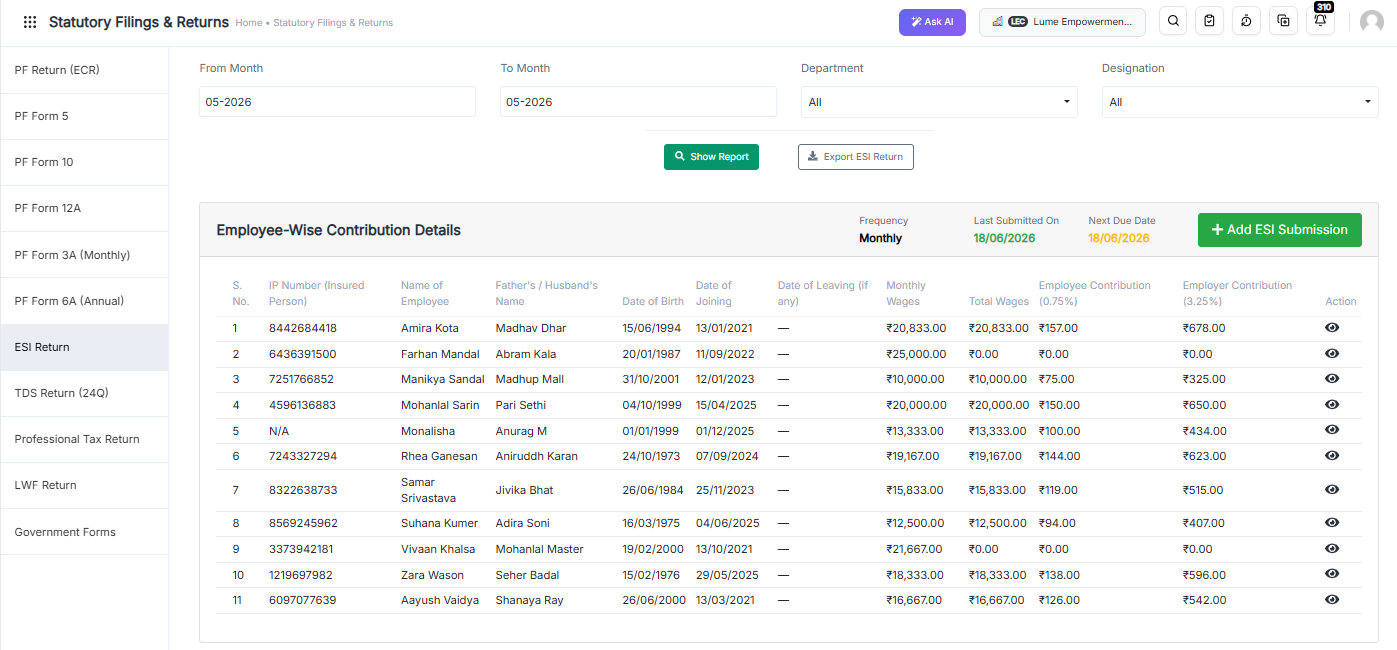
  • Step 4: Go to Statutory Filings
  • Step 5: Open the ESI Return
  • Step 6: Export the ESI Challan File
  • Step 7: Download in ESI Challan Format
  • Step 8: Upload the File to the ESIC Portal
  • Step 9: Generate the Challan Instantly

ESI Challan Generator

Key Benefits

  • No further or additional calculations are required.
  • ESI contribution data is prepared automatically.
  • Month-over-month data can be exported instantly whenever required. Use our payslip and reports generator for professional documentation.
  • Reduces manual effort and minimises compliance errors.
  • Ensures faster ESI challan generation and filing.

ESI Payment Due Date and Compliance Deadlines

Quick Answer: ESI challan is due by the 15th of the month following the wage month. For example, June 2026 contributions must be paid by 15 July 2026. If the 15th falls on a bank holiday, the next working day applies.

Monthly Challan Due Dates (2026–27)

Wage Month Challan Due Date
April 2026 15 May 2026
May 2026 15 June 2026
June 2026 15 July 2026
July 2026 15 August 2026
August 2026 15 September 2026
September 2026 15 October 2026
October 2026 15 November 2026
November 2026 15 December 2026
December 2026 15 January 2027
January 2027 15 February 2027
February 2027 15 March 2027
March 2027 15 April 2027

Half-Yearly Return of Contributions (RC)

In addition to monthly challans, employers must file a Return of Contributions (RC) twice a year. This is a separate statutory requirement that many employers overlook.

Contribution Period RC Filing Due Date
April – September 2026 11 November 2026
October 2026 – March 2027 11 May 2027

Missing the RC deadline is treated as non-compliance independently of your monthly challan payments.

Penalty for Late Payment

Delay Period Damages Levied
Less than 2 months 5% of the arrear amount
2 to 6 months 10% of the arrear amount
6 months to 1 year 15% of the arrear amount
More than 1 year 25% of the arrear amount

Plus simple interest at 12% per annum from the due date. Continued defaults can lead to prosecution under Section 85 of the ESI Act. For a broader view of payroll legal obligations, read our Payroll Compliance 101 guide.

Zero Contribution Filing: A Requirement Most Employers Miss

If your establishment had no eligible employees in a given month — because all employees exceeded the ₹21,000 wage ceiling, or due to temporary closure — you must still file a zero-contribution challan for that month.

Skipping it is treated as non-filing by ESIC and can trigger a compliance notice. This is one of the most frequently overlooked ESI obligations among Indian SMEs.

What Are the Common Challenges in ESI Challan Management?

Quick Answer: The most common ESI challan challenges are manual calculation errors (especially incorrect rounding), missed 15th-of-month deadlines, IP number mismatches on the ESIC portal, eligibility blind spots when salaries cross ₹21,000, overlooked zero-contribution months, and difficulty compiling the half-yearly Return of Contributions from scattered spreadsheet records.

Most compliance failures are not caused by ignorance of the law. They are caused by process gaps in manual workflows. Discover the top payroll automation benefits that can help your business eliminate these gaps.

Manual Calculation Errors: Incorrect contribution calculations — especially rounding errors — lead to mismatched challans and correction requests with ESIC.

Missed Deadlines Tracking the 15th-of-month deadline manually, alongside payroll close and other compliance tasks, increases the risk of delayed payments.

Employee Data Inconsistencies: IP number mismatches, name discrepancies between ESIC records and payroll systems, and salary data errors cause challan rejection on the ESIC portal.

Eligibility Blind Spots Salary revisions that push employees above ₹21,000 mid-period are easy to miss. The wage ceiling continuation rule — where the employee stays covered until the period ends — adds complexity.

Administrative Burden Manual processing consumes valuable HR and payroll resources that could be directed toward higher-value work. Learn more about why manual payroll fails growing businesses in India.

Half-Yearly Return Compilation When monthly records are stored in separate spreadsheets across six months, compiling the RC is time-consuming and prone to errors.

Common ESI Compliance Mistakes Employers Should Avoid

  • Incorrect employee eligibility determination
  • Wrong contribution calculations (especially not rounding to the nearest rupee)
  • Delayed challan generation
  • Late ESI payments
  • Skipping zero-contribution challan months
  • Not filing the half-yearly Return of Contributions (RC)
  • Missing IP number registration for new joiners
  • Ignoring contractor employee ESI liability

Automating payroll and compliance processes significantly reduces all of these risks. For a broader list of errors to watch for, see 15 payroll mistakes HR managers should avoid.

Manual ESI Management vs Automated ESI Challan Generator

Feature Manual Process Automated ESI Challan Generator
Contribution Calculation Manual, error-prone Automatic, rounded correctly
Challan Generation Time-consuming One-click generation
Error Risk High Minimal
Rounding Compliance Often missed Built-in
Eligibility Tracking Manual review Auto-flags employees above ₹21,000
Deadline Reminders Manual calendar Automated alerts
RC Filing Data Manual compilation Auto-generated from monthly data
Zero-Return Filing Easy to forget System prompts when applicable
Audit Readiness Difficult Organised digital records
Scalability Limited Highly scalable

Why Businesses Choose INDPayroll’s ESI Challan Generator

INDPayroll’s ESI Challan Generator is built specifically for Indian statutory compliance. Every feature addresses a real pain point that Indian payroll teams face every month.

Quick Answer: INDPayroll’s ESI Challan Generator automatically calculates ESI contributions, tracks employee eligibility against the ₹21,000 wage ceiling, and generates ESIC portal-compatible challan files every month. It integrates with payroll and attendance data, sends deadline alerts, and auto-compiles the half-yearly Return of Contributions — eliminating manual effort and penalty risk for Indian employers.

Key benefits include:

  • Automatic ESI contribution calculations with correct rounding
  • One-click ESI challan generation
  • Employee eligibility tracking with automatic wage ceiling alerts
  • Integrated payroll and attendance management
  • Automated deadline reminders (monthly challan and half-yearly RC)
  • Zero-contribution challan prompts when applicable
  • Centralised employee records with IP number management
  • Compliance tracking and audit-ready reporting
  • Secure cloud-based access

Businesses that switch from manual ESI filing to INDPayroll consistently report that monthly compliance preparation time drops from several hours to under 15 minutes. Read our guide on how to run payroll in minutes with INDPayroll — and that missed-deadline incidents fall to near zero once automated reminders and one-click challan generation are in place.

Whether you are a startup, SME, or growing enterprise, INDPayroll helps reduce compliance risks while improving efficiency. Explore the top 10 features every Indian payroll software must have to evaluate your compliance toolkit.

INDPayroll also integrates with Payroll Compliance Software, Attendance Management Software, PF & ESI Compliance Solutions, and Salary Management Software for end-to-end statutory compliance.

What Are the Best Practices for ESI Compliance in 2026?

  • Maintain accurate, up-to-date employee records at all times
  • Register new employees with ESIC promptly after joining
  • Automate contribution calculations to avoid rounding errors
  • Monitor the 15th-of-month deadline and the RC deadlines
  • Track salary revisions against the ₹21,000 wage ceiling
  • File zero-contribution challans when no employees are covered
  • Keep digital copies of all challans and payment receipts for at least 5 years
  • Verify contractor employee ESI liability monthly
  • Use integrated payroll software to generate ESIC portal-compatible files
  • Conduct periodic compliance reviews before ESIC contribution periods close

Simplify ESI Compliance with INDPayroll

Managing ESI compliance manually is complicated, time-consuming, and risky. INDPayroll’s ESI Challan Generator helps businesses automate calculations, generate accurate challans, meet every deadline, and reduce the risk of ESIC penalties.

Also, explore the full INDPayroll compliance suite:

India’s #1 Free Software

Free Payroll, PF,
ESI & TDS Software

Professional compliance management for Indian businesses. 100% Free Forever.

Conclusion

ESI compliance is a critical responsibility for every employer in India. Accurate contribution calculations, correct rounding, timely monthly challan payments, half-yearly RC filing, and proper record maintenance are all essential for avoiding compliance risks and ensuring employee welfare.

An automated ESI Challan Generator simplifies these processes by eliminating manual errors, applying correct rounding, tracking eligibility changes, and generating all required documents automatically. By adopting payroll automation solutions like INDPayroll, organisations can streamline ESI management, save valuable time, and focus on business growth rather than administrative complexity.

15 Proven Payroll Best Practices for Indian SMEs 2026

TL;DR: Payroll Best Practices for Indian SMEs in 2026

  • Classify employees and contractors correctly to avoid compliance penalties.
  • Build compliant salary structures aligned with wage regulations.
  • Automate PF, ESI, TDS, and Professional Tax calculations.
  • Never miss statutory filing and payment deadlines.
  • Maintain accurate payroll records, payslips, and reconciliation reports.
  • Conduct regular payroll audits and prepare for Labour Code implementation.

Nearly half of India’s small businesses have faced a payroll penalty they could have avoided. One wrong formula in a spreadsheet, one missed PF deadline, one misclassified employee — and a routine pay run turns into interest, fines, and a difficult conversation with your team. Payroll is the single largest cash outflow for most SMEs, yet it is often run on tools never designed for India’s compliance maze.

If you manage payroll for a small or mid-sized business, you already feel the pressure: shifting tax rules, the long-awaited Labour Codes, and employees who expect their salary to be correct and on time — every single month. The cost of getting it wrong is rising, and “we’ll fix it next month” is no longer a safe plan.

In this guide, you will discover the 15 payroll best practices that keep Indian SMEs compliant, accurate, and audit-ready in 2026 — without expensive consultants or fragile spreadsheets. The INDPayroll Compliance Team works with thousands of Indian businesses and CA firms to automate PF, ESI, TDS, and Professional Tax, and these payroll best practices are the habits we see in every well-run payroll.

Free Payroll, PF, ESI & TDS Software

The most trusted automation tool for modern Indian businesses.

Why payroll best practices matter for Indian SMEs in 2026

Following payroll best practices is no longer optional housekeeping — it is risk management. Indian payroll sits at the intersection of the EPFO, the ESIC, and the Income Tax Department, and each carries its own deadlines and penalties. Strong payroll best practices protect your cash flow, your compliance record, and your reputation as an employer.

What are the payroll best practices for Indian SMEs? Payroll best practices are the standardised steps a business follows to pay staff accurately and stay legally compliant. They cover correct salary structuring, automated PF, ESI, TDS and Professional Tax deductions, on-time filings, accurate payslips, and secure record-keeping. Together, they prevent penalties and build employee trust.

1. Classify every worker correctly before you pay them

Misclassification is the most expensive payroll mistake an SME can make. Whether a person is a full-time employee, a contractor, or a gig worker decides which deductions, benefits, and filings apply. Treating an employee as a “consultant” to avoid PF and ESI can trigger back-payments, interest, and penalties during an inspection.

Worker classification is the process of deciding a worker’s legal status — employee, contractor, or gig worker. It works by testing control, supervision, and the nature of the engagement. It matters because each category carries different obligations for PF, ESI, TDS, and gratuity under Indian law.

India’s four Labour Codes formally recognise gig and platform workers and tighten definitions across the board. Map every person on your payroll to the right category in writing, and review the classification whenever a role changes.

2. Build a salary structure that is compliant by design

How you split a salary is not just a tax decision — it is a compliance one. Under the Code on Wages, 2019, the statutory definition of “wages” limits how much of total pay can sit in excluded allowances. In practice, this pushes the basic-plus-DA component toward at least 50% of total remuneration, which directly affects PF, gratuity, and overtime calculations.

A compliant salary structure is a pay breakup where basic wages meet statutory thresholds and allowances stay within legal limits. It works by keeping basic plus dearness allowance at roughly half of total pay. Most SMEs use it to control PF and gratuity liability while maximising employee take-home.

Design your CTC template once, correctly, and apply it consistently. A lopsided structure that under-reports basic wages is a red flag in any audit.

3. Automate statutory deductions instead of calculating them by hand

PF, ESI, Professional Tax, and TDS each follow different rates, ceilings, and rounding rules. Calculating them manually for even 30 employees invites error — and a single decimal mistake in TDS can cascade into a wrong Form 16. Automation removes the guesswork and applies current rates consistently every month.

Statutory deductions are the legally mandated amounts withheld from salary — EPF, ESI, Professional Tax, and TDS. They work by applying fixed rates to defined wage components each pay cycle. Indian employers must deduct and deposit them on time to stay compliant and avoid interest or penalties.

This is exactly the work payroll software is built to handle. Automated compliance tools recalculate deductions whenever rates change, so you are never relying on a year-old spreadsheet formula.

4. Get EPF (Provident Fund) right, every month

The EPFO administers the Employees’ Provident Fund and is mandatory for most establishments with 20 or more employees. Both employer and employee contribute 12% of basic wages plus dearness allowance, and contributions are typically due by the 15th of the following month.

EPF is a retirement savings scheme run by the Employees’ Provident Fund Organisation. It works by collecting 12% of basic wages plus DA from both the employer and the employee each month. The employer’s share is split between the pension fund (EPS) and the provident fund, calculated on a statutory wage ceiling of Rs. 15,000.

Generate your ECR (Electronic Challan-cum-Return) and deposit on time. Late PF payments not only attract damages and interest, but they can also disqualify the expense for income-tax purposes.

5. Stay within ESI rules for eligible employees

The Employees’ State Insurance scheme, run by the ESIC, provides medical and cash benefits to lower-wage workers. It generally applies to establishments with 10 or more employees and covers staff earning up to Rs. 21,000 per month (Rs. 25,000 for employees with disabilities).

ESI is a social security scheme for employees earning up to Rs. 21,000 a month. It works through a combined contribution of 4% of wages — 0.75% from the employee and 3.25% from the employer. It funds medical care, sickness, maternity, and disability benefits for covered workers.

Track wage thresholds carefully: an employee can move in or out of ESI coverage mid-year as pay changes, and your system must handle that transition cleanly within the contribution period.

6. Run an accurate TDS on salary under Section 192

Tax Deducted at Source on salary is governed by Section 192 of the Income Tax Act. Employers must estimate each employee’s annual tax liability and deduct it proportionately every month, choosing correctly between the old and new tax regimes based on the employee’s declaration.

TDS on salary is income tax that the employer deducts before paying wages, under Section 192. It works by spreading an employee’s estimated yearly tax across 12 months. Employers deposit it with the government and report it quarterly on Form 24Q, then issue Form 16 to each employee.

The new tax regime is now the default, and recent Budgets have reshaped the slabs and rebates. Collect investment declarations early in the financial year, verify proofs before year-end, and reconcile so no employee faces a shock deduction in March. Always confirm the current year’s slabs against the Income Tax Department before finalising.

7. Treat statutory deadlines as a non-negotiable payroll best practice

Most payroll penalties come not from wrong amounts but from being late. Each statutory due date is fixed, and missing it triggers automatic interest or fees regardless of intent. Among all payroll best practices, hitting deadlines is the cheapest and highest-return habit you can build.

Obligation Typical due date
EPF contribution & ECR 15th of the following month
ESI contribution 15th of the following month
TDS deposit (salary) 7th of the following month
TDS return (Form 24Q) Quarterly
Professional Tax Varies by state
What happens if you miss a TDS deadline? Late filing of a TDS return attracts a fee of Rs. 200 per day under Section 234E until the return is filed, capped at the TDS amount. A separate interest applies for late deduction or deposit. Meeting every due date is the cheapest compliance you will ever buy.

8. Keep a single source of truth for payroll data

When salary data lives in one spreadsheet, attendance in another, and bank details in an email, errors are inevitable. Centralising employee master data — pay structure, PAN, UAN, ESI number, bank details, and tax declarations — in one system removes duplication and version-control chaos.

A single source of truth is one authoritative system holding all payroll and employee data. It works by feeding every calculation, payslip, and filing from the same records. SMEs use it to eliminate conflicting spreadsheets, reduce manual re-entry, and ensure every report reconciles.

This is where SMEs reclaim the most time. Centralised payroll processing means one update flows everywhere instead of being copied across files.

9. Issue clear, itemised payslips on time

A payslip is both a legal record and a trust signal. The Code on Wages requires employers to give employees wage slips, and a good payslip itemises earnings, each statutory deduction, and the net pay so employees can see exactly how their salary was calculated.

A payslip is a document detailing an employee’s earnings and deductions for a pay period. It works by listing gross pay, PF, ESI, TDS, and other deductions, then showing net pay. Indian employers must provide it to meet wage-transparency obligations and reduce salary disputes.

Automated, password-protected digital payslips — generated and emailed in one click — save hours and look far more professional than a manual PDF.

10. Reconcile payroll before, not after, you file

Reconciliation catches errors while they are still cheap to fix. Each month, match gross pay, deductions, and net disbursement against your bank file. Each quarter, reconcile TDS deducted against Form 24Q and the deposits reflected in Form 26AS.

Payroll reconciliation is the process of matching payroll records against bank payments and statutory filings. It works by comparing what was calculated, paid, and reported, line by line. It matters because mismatches in Form 24Q or Form 26AS create notices and corrections that are costly to unwind.

A clean monthly reconciliation makes year-end Form 16 generation almost effortless.

11. Maintain statutory registers and records

Indian labour law requires employers to keep registers and records of wages, attendance, leave, and deductions — and to retain them for several years. Inspectors can ask for these at any time, and missing documentation is itself a violation, even if your calculations were correct.

Statutory registers are the records employers must keep under labour and tax laws, covering wages, attendance, and deductions. They work as the audit trail behind every pay run. The Labour Codes aim to simplify them into fewer digital registers, but retention obligations remain firmly in place.

Digital records with a complete change history make audits straightforward and protect you if a past calculation is ever questioned.

12. Manage attendance, leave, and overtime accurately

Payroll is only as accurate as the attendance feeding it. Loss-of-pay, overtime, and leave encashment must flow correctly into each month’s calculation. Manual transcription of attendance is a common — and avoidable — source of salary errors.

Attendance-to-payroll integration is the automatic flow of worked hours, leave, and overtime into salary calculation. It works by linking your attendance system directly to payroll so nothing is keyed in twice. SMEs use it to pay precisely for time worked and to comply with overtime rules.

Define your leave policy clearly, apply it consistently, and let the system, not a person, do the arithmetic.

13. Plan gratuity and full-and-final settlements ahead of time

Gratuity is a statutory benefit under the Payment of Gratuity Act, 1972, payable to employees who complete five years of continuous service, at 15 days’ wages for each completed year, subject to the prevailing cap. Provisioning for it monthly avoids a cash shock when senior staff exit.

Gratuity is a lump-sum reward for long service under the Payment of Gratuity Act. It works out to roughly 15 days of wages for each completed year, payable after five years of continuous service. Employers should provision for it gradually rather than funding it only at exit.

Build a clear, full, and final settlement process too — recovering advances, settling leave balances, and releasing dues within the legally expected timeframe.

14. Protect payroll and employee data

Payroll holds your most sensitive data: salaries, PAN, bank accounts, and Aadhaar-linked identifiers. With the Digital Personal Data Protection Act, 2023, safeguarding this information is now a legal duty, not just good hygiene. A leaked salary sheet damages trust and can carry regulatory consequences.

Payroll data protection is the practice of securing sensitive employee and salary information. It works through access controls, encryption, and limited sharing of pay data. Under India’s DPDP Act, 2023, businesses must handle personal data responsibly, making secure payroll systems a compliance requirement, not an option.

Restrict who can view salary data, use encrypted systems with audit logs, and avoid circulating raw payroll files over email or shared drives.

15. Audit regularly: the payroll best practice that ties it all together

India’s four Labour Codes — on Wages, Social Security, Industrial Relations, and Occupational Safety — consolidate 29 central labour laws and will reshape definitions of wages, working hours, and benefits as they roll out. SMEs that treat a yearly review as a core payroll best practice avoid scrambling later.

The Labour Codes are four laws that consolidate India’s central labour legislation. They work by standardising definitions of wages, social security, and working conditions across the country. Their phased implementation changes how SMEs structure pay and benefits, so businesses should track notifications and adjust payroll settings accordingly.

Run an internal payroll audit at least once a year: review classifications, salary structures, deduction rates, deadlines, and records. Confirm the current implementation status of the Labour Codes and your state’s specific notifications, since timing and rules continue to evolve.

Trust and authority: what we see in practice

“The businesses that never face a payroll penalty are rarely the ones with the biggest finance teams — they are the ones who automated their statutory calculations and treated deadlines as fixed,” notes the INDPayroll Compliance Team, drawing on payroll runs across thousands of Indian SMEs and CA firms.

Our own data points to a clear pattern: the most common penalty is not a wrong amount but a late filing, and almost every late filing traces back to a manual, calendar-driven process that someone simply forgot. The single highest-leverage change an SME can make is to move statutory deductions and deadlines off spreadsheets and onto a system that updates rates and reminders automatically.

Payroll best practices are the standardised steps a business follows to pay staff accurately and stay legally compliant — correct salary structuring, automated PF, ESI, TDS and Professional Tax deductions, on-time filings, accurate payslips, and secure record-keeping. Together, they prevent penalties and build employee trust.

India’s #1 Free Software

Free Payroll, PF, ESI & TDS Software

Conclusion

Strong payroll in 2026 comes down to three things: structure salaries correctly, automate every statutory deduction, and never miss a deadline. Master those, keep secure records, and stay ready for the Labour Codes, and payroll stops being a monthly risk and becomes a quiet competitive advantage. These payroll best practices are not theory — they are the habits that keep Indian SMEs penalty-free and their teams paid on time.

The fastest way to put all 15 payroll best practices into action is to stop running payroll on spreadsheets. Try INDPayroll free and run your next pay cycle in minutes, fully compliant.

This article is for general information only and does not constitute legal, tax, or financial advice. Statutory rates, wage ceilings, thresholds, due dates, and the implementation status of the Labour Codes change over time and can vary by state. Always verify the current rules with official sources such as the EPFO, ESIC, and the Income Tax Department, or consult a qualified professional, before acting.

Salary Slip Format in India 2026 — Components, Sample & Free Download

A salary slip (also called a payslip or pay stub) is a document issued by an employer to an employee every month. It contains a detailed breakdown of the employee’s earnings, deductions, and net pay. Under the Payment of Wages Act, 1936, employers are legally required to provide salary slips to employees.

Salary slips serve as proof of income and are essential for loan applications, visa processing, tax filing, and employment verification.

Key Components of a Salary Slip

A standard salary slip in India contains three main sections: earnings, deductions, and summary.

India’s #1 Free Software

Free Payroll, PF, ESI & TDS Software

Earnings (Gross Pay Components)

Component Description Typical % of CTC
Basic Salary Core salary component, used to calculate PF, gratuity, and HRA 40-50%
House Rent Allowance (HRA) Allowance for rental accommodation, partially tax-exempt 20-25%
Dearness Allowance (DA) Compensates for inflation, common in government & PSU jobs Variable
Conveyance Allowance For daily commute expenses Fixed amount
Medical Allowance For healthcare expenses Fixed amount
Special Allowance Balancing component, fully taxable 15-30%
Leave Travel Allowance (LTA) For domestic travel, tax-exempt with conditions Variable
Performance Bonus Variable pay based on performance 5-20%

Deductions

Deduction Description Rate
Provident Fund (PF) Employee contribution to EPF 12% of Basic + DA
ESI (Employee State Insurance) Health insurance for employees earning ≤ Rs. 21,000/month 0.75% of gross
Professional Tax State-level tax on employment (varies by state) Rs. 150-200/month
TDS (Tax Deducted at Source) Income tax is deducted based on declared investments As per the slab
Loan Recovery EMI deductions for company-provided loans As applicable
Loss of Pay (LOP) Deduction for unauthorised absence Per day basis

Summary Section

  • Gross Earnings: Total of all earnings components
  • Total Deductions: Sum of PF + ESI + PT + TDS + other deductions
  • Net Pay (Take-Home): Gross Earnings − Total Deductions
  • Days Paid / Days in Month / LOP Days

Sample Salary Slip Format

Here is a sample salary slip for an employee with a CTC of Rs. 6,00,000 per annum:

Earnings Amount (₹) Deductions Amount (₹)
Basic Salary 25,000 Provident Fund 3,000
HRA 10,000 ESI 375
Conveyance 1,600 Professional Tax 200
Medical Allowance 1,250 TDS 2,500
Special Allowance 12,150
Gross Earnings 50,000 Total Deductions 6,075

Net Pay (Take-Home): ₹43,925

Salary Slip Format for Different Sectors

Private Sector Salary Slip

Private companies typically include Basic, HRA, Special Allowance, and variable pay. The format varies by organisation, but must include all statutory deductions (PF, ESI, PT, TDS).

Government Salary Slip

Government salary slips follow the 7th Pay Commission structure and include: Basic Pay (as per pay matrix), DA (revised twice yearly), HRA (based on city classification X/Y/Z), Transport Allowance, and NPS (National Pension Scheme) deduction instead of EPF.

Legal Requirements for Salary Slips in India

  • Payment of Wages Act, 1936: Employers must provide a wage slip showing all deductions
  • Code on Wages, 2019: Mandates salary slips to be issued in electronic or written form
  • Frequency: Must be provided every month on or before the pay date
  • Retention: Employers must maintain salary records for 3 years
  • Format: No prescribed format, but must include all earnings and deductions

How to Read Your Salary Slip

Understanding your salary slip helps you verify your pay and plan your taxes effectively:

  • Check Basic Salary: This determines your PF contribution, gratuity, and HRA exemption. Higher basic = higher PF, but also higher tax
  • Verify PF Deduction: Should be exactly 12% of Basic + DA. Match with your UAN passbook
  • Review TDS: Compare with your investment declarations. If you’ve submitted proof, TDS should reduce
  • Check LOP: Ensure leave deductions match your actual absence records
  • Match Net Pay: Verify the amount credited to your bank matches the net pay on the slip

Generate Salary Slips Automatically with INDPayroll

Creating salary slips manually in Excel every month is tedious and error-prone. INDPayroll automates the entire process:

  • Auto-calculate all components: Basic, HRA, PF, ESI, PT, TDS — all computed automatically
  • Professional PDF payslips: Branded salary slips with your company logo, generated in one click
  • Employee self-service: Employees download their own payslips from the portal anytime
  • Bulk generation: Generate payslips for all employees simultaneously
  • Compliance built-in: All statutory deductions calculated per the latest rates
  • Email distribution: Auto-email payslips to employees on pay day

Try INDPayroll Free: Generate professional salary slips for up to 5 employees at no cost.

Free Payroll, PF, ESI & TDS Software

The most trusted automation tool for modern Indian businesses.

Final Thoughts — Getting Your Salary Slip Right in 2026

A well-structured salary slip is not just a document — it is a reflection of your organisation’s payroll accuracy, legal compliance, and transparency with employees. In 2026, with the New Tax Regime as the default, updated ESI limits, and stricter labour law enforcement, getting the salary slip format right is more important than ever.

Here is a quick recap of everything covered in this guide:

  • A standard Indian salary slip has three sections: Earnings, Deductions, and Net Pay Summary
  • Basic Salary is the most important component — it determines PF, gratuity, HRA exemption, and tax liability
  • PF is 12% of Basic + DA (not gross salary)
  • ESI applies only to employees earning ₹21,000 or less per month
  • Professional Tax varies by state — up to ₹200/month
  • TDS depends on the tax regime chosen — New or Old
  • Salary slips must be issued every month as per the Code on Wages 2019
  • Employers must retain salary records for a minimum of 3 years

The biggest mistake most small businesses make is generating salary slips manually in Excel, which is error-prone, time-consuming, and hard to scale as the team grows. Missing a single calculation (wrong PF base, incorrect ESI applicability, or outdated PT slab) can lead to employee disputes and statutory compliance failures.

The smartest solution is to automate the entire process. INDPayroll automatically calculates Basic, HRA, PF, ESI, PT, and TDS
based on the latest statutory rates. It generates professional, branded PDF salary slips in one click and emails them directly to employees on pay day — for every employee, every month, without any manual effort. Start free today — generate salary slips for up to 5 employees at absolutely no cost, with no credit card required.

Frequently Asked Questions

Is a salary slip mandatory in India?

Yes. Under the Payment of Wages Act and the Code on Wages 2019, employers must provide salary slips to all employees. Failure to do so can result in penalties.

Can I use salary slips for loan applications?

Yes. Banks and NBFCs require the last 3-6 months’ salary slips as proof of income for home loans, personal loans, and credit cards. The salary slip must be on company letterhead or from an authenticated payroll system.

What is the difference between CTC and take-home salary?

CTC (Cost to Company) includes everything the company spends on you — salary, PF employer contribution, gratuity, insurance, etc. Take-home salary is what you actually receive after all deductions. Typically, take-home is 60-70% of CTC.

How many months of salary slips do I need for a visa?

Most embassies require 3-6 months of salary slips along with bank statements and Form 16 for visa applications. Some countries, like the US and UK, may ask for up to 12 months.

Can I get a salary slip from a previous employer?

Yes. You can request salary slips from your previous employer’s HR department. They are legally required to maintain salary records for at least 3 years.

Related Payroll Resources

A proper salary slip requires accurate calculation of all components. Learn about PF contribution calculation, ESI contribution rates, TDS on salary, and professional tax slabs by state. See our detailed payslip format guide for all mandatory components. Try our free payroll tools.

Top Benefits of Using the Best Payroll Software for Small Businesses

Managing employee salaries, tax deductions, and statutory compliance can be complex for growing companies. Many small businesses initially handle payroll manually, but as teams expand, the process quickly becomes time-consuming and error-prone. Therefore, investing in the best payroll software for small businesses becomes essential.

Modern payroll solutions automate calculations, generate reports, ensure compliance, and streamline salary processing. As a result, companies can focus more on growth and less on administrative tasks. In this guide, we explore the top benefits of using the best payroll software for small businesses, along with key features, implementation tips, and why automation is critical for modern organisations.

India’s #1 Free Software

Free Payroll, PF, ESI & TDS Software

What Is Payroll Software?

Payroll software is a digital system that automates the management of employee salaries, tax deductions, bonuses, benefits, and compliance filings. Instead of performing payroll calculations manually, businesses can process salaries in minutes using automated tools.

The best payroll software for small businesses typically includes features such as:

  • Salary calculation automation
  • Tax and statutory compliance management
  • Payslip generation
  • Employee data management
  • Attendance and leave integration
  • Reporting and analytics

Because payroll involves sensitive financial data, modern payroll systems also provide secure storage and encryption for employee records.

Why Small Businesses Need Payroll Automation

Small businesses often operate with limited HR staff. Consequently, manual payroll processing can create delays, errors, and compliance risks.

Using the best payroll software for small businesses helps organisations:

  • Reduce administrative workload
  • Improve payroll accuracy
  • Ensure timely salary payments
  • Maintain compliance with tax regulations

Additionally, automated payroll systems can reduce payroll errors and save significant time every month by eliminating manual calculations and paperwork.

Challenges Businesses Face Without a Dedicated Payroll System

Many small business owners still rely on spreadsheets or manual calculations to run payroll. However, this approach is both risky and inefficient. Without the right payroll software for small businesses, owners frequently face the following challenges:

  • Calculation errors in TDS, PF, and ESI that trigger government penalties
  • Missed statutory deadlines that attract interest under Section 234E
  • Hours of manual data entry that reduce productivity
  • Difficulty scaling payroll processes as the team grows
  •  Lack of a proper audit trail, which creates legal risk during assessments

Consequently, investing in payroll software for small businesses is not just a convenience — it is a strategic necessity. Now, let us examine the specific benefits in detail.

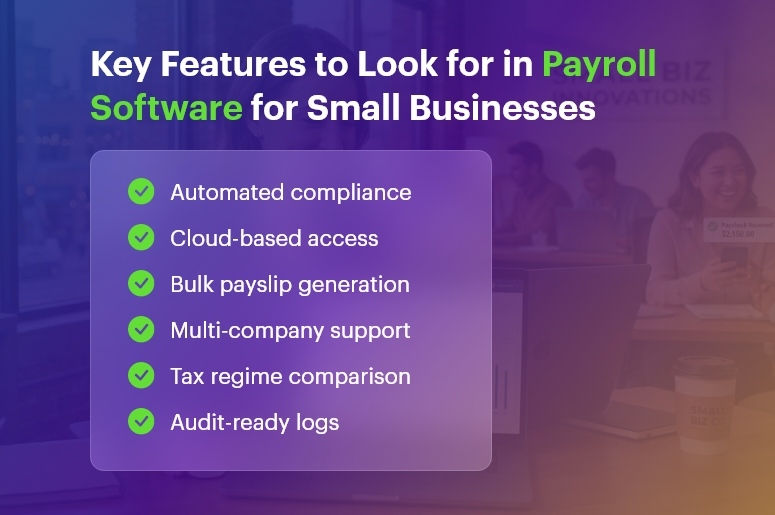
Key Features to Look for in Payroll Software for Small Businesses

Top Benefits of Payroll Software for Small Businesses

1. Significant Time Savings

The most immediate advantage of payroll software for small businesses is how dramatically it cuts processing time. Manual payroll can consume two to three working days each month. In contrast, INDPayroll lets you complete a full payroll run in just 15 minutes — freeing your team to focus on growth rather than data entry.

2. Automated Statutory Compliance

Compliance is the most critical reason businesses adopt payroll software for small businesses. Indian labour laws change frequently, and a single missed deadline can result in heavy penalties. Reliable platforms automatically calculate EPF, ESI, TDS, and Professional Tax, and generate ready-to-upload return files for ECR, challans, Form 24Q, and FVU — so you are always audit-ready and never fined.

3. Zero Calculation Errors

Human error is inevitable with spreadsheets. A single wrong formula can miscalculate salaries for your entire workforce. Automated systems use validated algorithms to deliver 100% accuracy every time. Furthermore, built-in reconciliation checks flag any discrepancies before you approve the payroll run — so your employees always receive the correct amount on time.

4. Cost Reduction and Better ROI

Many owners assume switching is an added expense. In reality, the opposite is true. Most paid payroll software for small businesses charges ₹500–₹1,000 per employee per month — that is over ₹50,000 per year for a 50-person team. INDPayroll, however, is completely free. Additionally, eliminating even one penalty from a compliance error saves far more than any software subscription.

5. Employee Self-Service Portal

A standout feature of modern payroll software for small businesses is the employee self-service portal. Employees can independently view payslips, check tax projections, download Form 16, and submit investment proofs — without raising HR queries. As a result, your team spends less time on routine requests and more time on strategic work.

6. Smart Analytics and Reporting

Beyond processing payroll, the best platforms deliver powerful reporting. Real-time dashboards give you visibility into CTC trends, department-wise costs, tax liabilities, and potential leakages. Consequently, you can make data-driven financial decisions well before the financial year ends — turning your payroll system into a genuine strategic tool.

Free Payroll, PF, ESI & TDS Software

The most trusted automation tool for modern Indian businesses.

Who Should Use Payroll Management Software?

Payroll software for small businesses is not limited to any particular industry or company size. In fact, it delivers value across a wide range of organisations:

  • Startups and SaaS companies: Automate ESOPs, TDS, and rapid headcount growth
  • Manufacturing firms: Manage complex shift rosters and ESI for factory workers
  • Construction companies: Track daily wages for on-site workers and contractors
  • CA firms and tax consultants: Manage payroll for multiple clients from one centralised dashboard
  • Educational institutions: Handle faculty pay, gratuity, and leave encashment
  • Retail chains: Process distributed outlet staff payroll efficiently

Regardless of your industry, if you pay salaries to employees, you need payroll software for a small business. Is it that straightforward?

Common Payroll Mistakes That Automated Payroll Systems Prevent

Understanding the mistakes that payroll software for small businesses prevents helps you appreciate its full value. Here are the most common payroll errors that businesses make — and how the right software eliminates them:

  • Misclassifying employees vs. contractors: Payroll software for small businesses clearly separates these categories for correct tax treatment
  • Missing PF/ESI deadlines: Automated reminders and ready-to-upload challans ensure timely filings
  • Incorrect TDS calculations: Algorithm-driven tax projections eliminate guesswork
  • Failing to update salary structures: Cloud-based payroll software for small businesses makes real-time updates simple
  • Inadequate record-keeping: Digital audit trails replace paper-based filing

How to Switch to Payroll Software: A Step-by-Step Guide

Transitioning to payroll software for a small business is simpler than most people expect. Follow these steps to get started quickly and confidently:

  • Step 1 — Choose the right payroll software for a small business: Evaluate your needs (number of employees, compliance requirements, budget) and select a solution that fits
  • Step 2 — Sign up and configure: Most cloud-based payroll software for small businesses takes fewer than 2 minutes to set up
  • Step 3 — Import employee data: Upload existing employee records, salary structures, and PF/ESI details
  • Step 4 — Configure compliance settings: Set up EPF, ESI, TDS, and PT parameters specific to your organisation
  • Step 5 — Run your first payroll: Import attendance, verify deductions, approve, and execute — done in minutes with payroll software for small business
  • Step 6 — Generate and distribute payslips: Bulk-email password-protected payslips to all employees
  • Step 7 — File statutory returns: Download ready-to-upload annexures for PF, ESI, and TDS portals

Why INDPayroll Is the Best Payroll Software for Small Businesses in India

INDPayroll stands out as the best payroll software for small businesses in India because it combines enterprise-grade features with zero cost. Here is why thousands of Indian SMEs and CA firms trust it:

  • 100% free forever: No credit card, no hidden fees
  • 2-minute setup: Start processing payroll the same day you sign up
  • India-specific compliance: Built for EPF, ESI, TDS, PT, and dual tax regimes
  • Unlimited employees: Scale from 5 to 5,000 staff at no extra cost
  • CA-friendly dashboard: Manage multiple clients from one secure login
  • 4.8-star rated: Trusted by startups, SMEs, and growing companies nationwide
India’s #1 Free Software

Free Payroll, PF,
ESI & TDS Software

Professional compliance management for Indian businesses. 100% Free Forever.

Conclusion

Choosing the right payroll software for a small business transforms one of your most tedious monthly tasks into a fast, accurate, and fully compliant process. From saving hours of manual work and eliminating calculation errors, to delivering powerful analytics and empowering employees with self-service tools, the benefits are clear and immediate.

Moreover, with INDPayroll offering completely free payroll software for small businesses, there is no financial barrier to getting started. Visit indpayroll.com today, sign up in 2 minutes, and experience why thousands of Indian businesses trust INDPayroll to handle their payroll every month.

Frequently Asked Questions

Q1. How much does payroll software for a small business cost?

Costs vary widely. While some providers charge ₹500–₹1,000 per employee per month, solutions like INDPayroll offer completely free payroll software for small businesses with no per-employee fees and no hidden charges.

Q2. Can payroll software for small businesses handle compliance automatically?

Yes. The best payroll software for small businesses automatically calculates EPF, ESI, TDS, and PT, and generates ready-to-upload return files for all relevant portals. Furthermore, it updates its algorithms whenever the government revises rules.

Q3. Is cloud-based payroll software for small businesses secure?

Reputable payroll software for small businesses uses bank-grade encryption and secure servers to protect your data. Additionally, role-based access controls ensure that only authorised personnel can view sensitive information.

Q4. How long does it take to set up payroll software for a small business?

Most cloud-based payroll software for small businesses takes under 5 minutes to set up. INDPayroll, for example, requires just 2 minutes — and you can run your first payroll cycle the same day.


How to Simplify Payroll for Contract, Gig & Remote Employees

Payroll was never designed for today’s workforce. Contract professionals, gig workers, and remote employees now power modern businesses. However, most payroll processes still assume fixed salaries, single locations, and uniform tax rules. As a result, businesses struggle with errors, compliance gaps, delayed payments, and operational stress. This is exactly why organizations must simplify payroll. In this comprehensive guide, you will learn how to simplify payroll for contract, gig, and remote employees using structured processes, automation, and a single purpose-built platform: INDPayroll, a 100% free payroll software designed for growing and distributed teams.

How-INDPayroll-Simplifies-Payroll-for-Modern-Workforces

Why Payroll Gets Complicated for Contract, Gig & Remote Workers

Before you can simplify payroll, you must understand why it becomes complex in the first place.

Contract, gig, and remote work introduces:

  • Multiple worker classifications
  • Variable pay structures
  • Location-based tax rules
  • Inconsistent working hours
  • Manual documentation overhead

Consequently, traditional payroll workflows break down. Teams spend more time fixing payroll issues than running payroll itself. Therefore, the first step to simplify payroll is removing manual complexity.

Free Payroll, PF, ESI & TDS Software

The most trusted automation tool for modern Indian businesses.

Step 1: Clearly Define Worker Categories

To simplify payroll, clarity comes first.

Every organization should explicitly define:

  • Contract employees – paid per agreement, responsible for their own taxes
  • Gig workers – task-based or milestone-based payments
  • Remote employees – salaried or hourly staff working from different locations

When these worker types are mixed without structure, payroll errors increase. However, when worker categories are clearly mapped inside a payroll system like INDPayroll, payroll instantly becomes easier to manage.

Step 2: Centralize Payroll in One System

Fragmented tools create fragmented payroll.

To simplify payroll, you need a single system that:

  • Manages multiple worker types
  • Automates calculations
  • Stores documentation
  • Tracks payments and compliance

INDPayroll centralizes payroll for contract, gig, and remote employees into one unified platform. More importantly, INDPayroll is 100% free, eliminating the cost barrier that prevents many businesses from upgrading their payroll processes.

By moving payroll into one system, organizations immediately simplify payroll operations and reduce dependency on spreadsheets and manual calculations.

Step 3: Automate Payroll Calculations

Manual payroll calculations are the biggest source of errors.

To truly simplify payroll, automation is non-negotiable.

INDPayroll automates:

  • Earnings calculations
  • Deductions and statutory components
  • Payment summaries
  • Payroll reports

As a result, payroll teams spend less time reconciling numbers and more time ensuring accuracy. Automation also ensures consistency, which is essential when handling contract and gig payments.

Step 4: Maintain Compliance Without Manual Effort

Compliance is where payroll usually fails.

Different employment types come with different legal obligations. If these are not tracked properly, businesses risk penalties and disputes. Therefore, to simplify payroll, compliance must be built into the system.

INDPayroll supports:

  • Structured payroll records
  • Transparent payment history
  • Audit-ready reports
  • Clear classification of worker types

By embedding compliance into everyday payroll workflows, INDPayroll removes uncertainty and helps organizations simplify payroll without relying on external tools.

India’s #1 Free Software

Free Payroll, PF,
ESI & TDS Software

Professional compliance management for Indian businesses. 100% Free Forever.

Step 5: Standardize Payroll Schedules

Unclear pay schedules create confusion and distrust.

To simplify payroll, organizations should establish consistent payment cycles for each worker type:

  • Monthly or biweekly payroll for remote employees
  • Agreed invoice-based cycles for contractors
  • Regular payout intervals for gig workers

INDPayroll allows businesses to manage these schedules within a single system. Consequently, payment delays reduce, disputes decline, and payroll communication becomes predictable.

Step 6: Simplify Documentation and Onboarding

Payroll does not start with payments. It starts with onboarding.

To simplify payroll, documentation must be standardized:

  • Contracts
  • Tax declarations
  • Payment terms
  • Bank details

INDPayroll enables centralized storage and access to payroll-related data. This ensures that payroll runs smoothly from day one and prevents repeated follow-ups for missing information.

Step 7: Gain Visibility Through Payroll Reporting

Visibility simplifies decision-making.

To simplify payroll, businesses must understand:

  • Total payroll cost
  • Payments by worker type
  • Monthly and annual payroll trends

INDPayroll provides clear payroll reports that help teams monitor expenses, forecast costs, and identify discrepancies early. With real-time visibility, payroll shifts from reactive to controlled.

Common Payroll Mistakes That Prevent Simplification

Many organizations unintentionally make payroll harder than it needs to be.

Here are common mistakes that stop teams from being able to simplify payroll:

  • Relying on spreadsheets
  • Managing contractors outside payroll systems
  • Manual tax calculations
  • No centralized payroll records
  • Paying for expensive payroll software unnecessarily

INDPayroll eliminates these issues by offering a 100% free, structured, and automated payroll platform.

Why INDPayroll Is the Best Way to Simplify Payroll

When evaluating payroll solutions, simplicity, cost, and reliability matter most.

INDPayroll stands out because:

  • It is 100% free payroll software
  • It supports contract, gig, and remote employees
  • It automates payroll calculations
  • It centralizes payroll data
  • It reduces compliance risk
  • It scales with growing teams

Instead of managing payroll through fragmented tools, INDPayroll enables organizations to simplify payroll without increasing costs or complexity.

How Simplified Payroll Impacts Business Growth

Payroll efficiency directly affects growth.

When you simplify payroll:

  • HR teams save time
  • Finance teams reduce errors
  • Workers receive timely payments
  • Compliance risks decrease
  • Leadership gains cost clarity

By removing friction from payroll, businesses can focus on expansion instead of administration.

India’s #1 Free Software

Free Payroll, PF, ESI & TDS Software

Final Thoughts

Payroll complexity is not a workforce problem. It is a system problem. To simplify payroll for contract, gig, and remote employees, businesses must adopt automation, clarity, and centralized control. INDPayroll delivers all three — without cost.

If your organization wants to simplify payroll, reduce errors, and support modern workforces efficiently, INDPayroll provides the most practical and cost-effective solution available today. Simple. Compliant. Scalable. And 100% Free.

FAQs

1. How can businesses simplify payroll for contract, gig, and remote employees?

Businesses can simplify payroll by using a centralized payroll system that supports multiple worker types, automates calculations, maintains compliance records, and standardizes pay schedules. INDPayroll enables all of this in one platform.

2. What makes payroll for contract and gig workers more complex?

Contract and gig workers often have variable pay, different tax responsibilities, and flexible schedules. Without automation and structured workflows, managing these differences manually leads to errors and delays.

3. Is INDPayroll suitable for both contract and remote employees?

Yes. INDPayroll is designed to manage payroll for contract workers, gig contributors, and remote employees within a single system, making it easier to handle diverse workforce models.

4. Is INDPayroll really 100% free payroll software?

Yes. INDPayroll is a 100% free payroll software that allows businesses to manage payroll without subscription fees or hidden costs.

5. How does INDPayroll help maintain payroll compliance?

INDPayroll helps maintain compliance by organizing payroll records, supporting clear worker classification, generating audit-ready reports, and ensuring consistent payroll documentation.

6. Can INDPayroll handle different payroll schedules?

Yes. INDPayroll allows businesses to manage multiple payroll schedules, making it easy to pay remote employees, contractors, and gig workers according to agreed timelines.

7. Does INDPayroll reduce payroll errors?

Yes. By automating payroll calculations and eliminating manual data entry, INDPayroll significantly reduces errors related to payments, deductions, and reporting.

8. How does INDPayroll help HR and finance teams save time?

INDPayroll streamlines payroll workflows, centralizes employee data, and automates repetitive tasks, allowing HR and finance teams to focus on strategic activities instead of payroll administration.

9. Can growing businesses scale payroll using INDPayroll?

Yes. INDPayroll is built to scale as businesses grow, supporting increasing headcount, multiple worker types, and higher payroll volumes without additional software costs.

10. Why should businesses choose INDPayroll over manual payroll methods?

Manual payroll methods increase errors, compliance risks, and administrative workload. INDPayroll simplifies payroll management, improves accuracy, and delivers these benefits as a 100% free payroll software.

Category: EPFO & ESI

No posts in this category.

Subcategory: EPFO

Subcategory: ESI

Category: Payroll Help

No posts in this category.

Subcategory: Employee Self-Service & Engagement

Subcategory: Introduction to Payroll

Subcategory: Payroll Analytics & Reporting

Subcategory: Payroll Automation & Technology

Subcategory: Payroll for Business Growth

Subcategory: Payroll Processing & Management

Subcategory: Taxation & Compliance

Category: User Manual

No posts in this category.

Subcategory: Company Setup

Subcategory: Employee Management

Subcategory: Getting Started

Subcategory: Glossary

Subcategory: Import & Export

Subcategory: Introduction

Subcategory: Payroll Configuration

Subcategory: Payslips & Disbursement

Subcategory: Reports & Analytics

Subcategory: Running Payroll

Subcategory: Statutory Compliance & Reports

Subcategory: Troubleshooting

Subcategory: User Management & Security