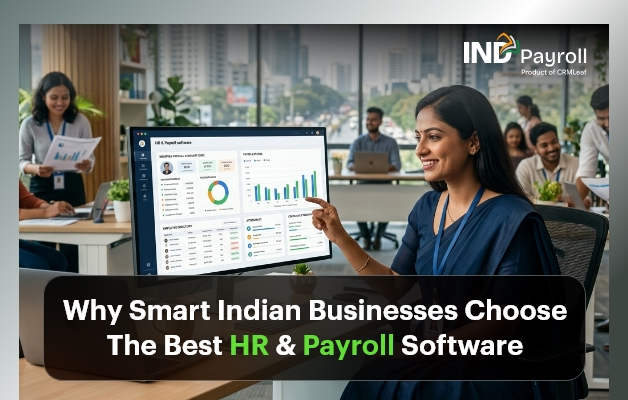
Why Smart Indian Businesses Choose The Best HR & Payroll Software

TL;DR: Why Indian Businesses Need HR Payroll Software in 2026

  • Manual payroll processing increases compliance risks, payroll errors, delayed salaries, and administrative workload for Indian businesses.
  • Modern HR payroll software automates salary calculations, PF, ESI, TDS, payslip generation, and labour law compliance from one dashboard.
  • Automated payroll systems help businesses reduce human errors, save processing time, and improve employee satisfaction with accurate salary management.
  • India-specific payroll software supports complex statutory requirements like EPF, ESI, Professional Tax, Labour Welfare Fund, and multi-state compliance.
  • Features like real-time compliance updates, reporting, payroll analytics, and secure employee data management improve operational efficiency.
  • INDPayroll helps Indian businesses automate payroll, maintain compliance, generate professional payslips, and scale HR operations more efficiently.

Running a business in India means juggling growth strategy, customer acquisition, and team management — all at once. But quietly in the background, payroll keeps ticking. Salaries must go out on time, every month. PF contributions must be filed. ESI deductions must match. Statutory compliance must be airtight.

For years, Indian businesses managed this with spreadsheets, manual calculations, and a prayer. But in 2026, that approach no longer cuts it. Labour laws change frequently. EPFO portals demand accurate digital filings. Employees expect professional payslips and transparent salary breakups. One payroll error — and you are looking at penalties, disgruntled employees, and audit nightmares.

This is exactly why smart Indian businesses are investing in the best HR payroll software. Not as a luxury. As a necessity. In this guide, we break down the real reasons behind this shift — and show you what to look for when choosing the right payroll solution for your business.

Ready to automate your payroll? Try INDPayroll free today

The Hidden Cost of Manual Payroll in Indian Businesses

Most business owners underestimate what manual payroll actually costs them. On the surface, it seems cheaper — a few spreadsheets, a dedicated HR executive, and some mental math. But the real costs run much deeper.

According to industry research, Indian SMEs spend an average of 8–12 hours per month on manual payroll processing alone. That is time your HR team could spend on talent acquisition, employee engagement, or performance management. Meanwhile, manual errors in PF and ESI calculations are among the top reasons businesses face EPFO compliance notices.

There are other hidden costs too — late salary disbursals damage employee trust and morale. Incorrect Form 16 generation leads to employee dissatisfaction during tax season. Outdated knowledge of Indian labour law changes leaves businesses exposed to legal risk.

The hard truth? Manual payroll is not just inefficient. It is actively risky for your business. The good news is that modern payroll software for Indian businesses eliminates virtually every one of these risks — automatically.

India’s #1 Free Software

Free Payroll, PF,
ESI & TDS Software

Professional compliance management for Indian businesses. 100% Free Forever.

What Is HR & Payroll Software — and Why Does It Matter for India?

HR and payroll software is a digital platform that automates the entire employee compensation lifecycle — from salary calculation and statutory deductions to payslip generation and compliance filing. For Indian businesses, this means handling PF (Provident Fund), ESI (Employee State Insurance), PT (Professional Tax), TDS, LWF, and more — all from a single dashboard.

What makes Indian payroll uniquely complex is the multi-layered compliance environment. The EPFO updates EPF regulations regularly. ESI slabs change. Minimum wages vary by state. New labour codes are reshaping how payroll must be structured. A robust payroll management system stays updated with all these changes — so you never miss a deadline or make a compliance error.

INDPayroll is purpose-built for this Indian payroll reality. It is not a generic global platform — it understands the nuances of Indian statutory compliance at its core. Explore INDPayroll’s full feature suite →

7 Reasons Smart Indian Businesses Choose the Best HR Payroll Software

1. Automated Salary Processing — Zero Errors, Every Month

Manual salary calculations are prone to human error. Arrears, bonuses, overtime, leave deductions, and CTC components all need to be computed precisely. Automated salary processing handles all of this in minutes. You define the salary structure once, and the system calculates everything correctly — month after month — without you lifting a finger. For businesses with 50 to 500 employees, this alone saves dozens of hours every payroll cycle.

2. PF & ESI Compliance — Always On Time, Always Accurate

PF and ESI filings are not optional. They are legally mandatory — and penalties for late or incorrect submissions can be severe. The best payroll software auto-calculates both employer and employee contributions, generates ECR challans, and keeps your filing history organised. With PF & ESI compliance software, you always know exactly what is due, when it is due, and how to file it correctly.

Need to estimate contributions before payroll runs? Use INDPayroll’s free PF calculator and ESI calculator to get instant figures.

3. Professional Payslip Generation in Seconds

Employees deserve clear, accurate payslips that show every component of their salary — basic pay, HRA, allowances, deductions, and net take-home. Manually creating payslips for 100 employees is a time-consuming nightmare. With an automated payslip and reports generator, every employee receives a professionally formatted payslip the moment payroll is processed. You can also use INDPayroll’s free payslip generator to create one-off payslips instantly.

4. Real-Time Labour Law Compliance Updates

India’s labour law landscape is dynamic. The four new Labour Codes — covering wages, industrial relations, social security, and occupational safety — are gradually being implemented across states. Keeping up manually is almost impossible. The best payroll software integrates labour law updates automatically, so your payroll stays compliant without you having to track every regulatory change.

5. Accurate CTC Structuring and Salary Breakup

Designing a competitive yet compliant CTC structure requires balancing HRA rules, tax exemptions, allowances, and deductions. The wrong structure costs your employees more in taxes and costs you in compliance issues. INDPayroll’s free CTC calculator helps you build optimal salary structures while the payroll engine enforces them accurately every cycle.

6. End-to-End EPF Registration, Filing, and Compliance

For businesses navigating EPF registration for the first time, or managing large workforces with complex EPF requirements, having a guided system is invaluable. INDPayroll provides a complete EPF compliance guide and automates the filing process end to end. Similarly, ESI compliance — from registration to monthly challan — is fully covered in the ESI compliance guide.

Want step-by-step help with EPF and ESI registration? Explore INDPayroll’s registration and filing tutorials — built for Indian businesses at every stage.

7. Powerful Reports for Smarter Business Decisions

Beyond compliance, the best HR payroll software gives you data. Payroll reports help you analyse employee cost trends, identify departments with high overtime costs, forecast next month’s salary liability, and prepare for audits with confidence. When your payroll data is clean, accurate, and organised — your business decisions get sharper. Explore all INDPayroll free tools to see what data-driven payroll looks like.

👉 Start your free INDPayroll trial and experience all 7 benefits today →

Key Features to Look for in the Best HR Payroll Software for India

Not all payroll software is built equal. When evaluating options for your Indian business, here is what you must look for:

India-specific statutory compliance: The software must handle PF, ESI, PT, TDS, LWF, and all state-specific deductions — not just offer them as add-ons. Look for a system that understands the latest EPF regulations and updates them automatically.

Scalability: Whether you have 10 employees or 10,000, your payroll software should scale without breaking. Growing businesses need a system that adds new employees, departments, and payroll components seamlessly.

Payslip customisation: Professional, branded payslips improve employee trust. Your software should let you customise payslip formats with your company logo, salary components, and language preferences.

Multi-location and multi-state support: Businesses operating across Indian states face different PT slabs, minimum wages, and labour law requirements. Good payroll software handles this complexity automatically.

Secure data storage and access control: Payroll data is sensitive. Role-based access controls, data encryption, and audit trails are non-negotiable features for any serious payroll platform.

Free tools and calculators: The best platforms offer value even before you subscribe. INDPayroll provides free salary, PF, ESI, and CTC calculators to help businesses plan smarter from day one.

Free Payroll, PF, ESI & TDS Software

The most trusted automation tool for modern Indian businesses.

Manual Payroll vs. Best HR Payroll Software: A Side-by-Side Comparison

Factor Manual Payroll Best HR Payroll Software
Processing Time 8–12 hours/month Under 30 minutes
Error Rate High (human error) Near zero
PF/ESI Compliance Manual tracking Fully automated
Payslip Generation Manual, time-consuming Auto-generated instantly
Labour Law Updates Manual research Auto-updated in software
Audit Readiness Difficult, scattered records Instant reports & history
Cost of Errors Penalties + reputation damage Minimal — system prevents errors

Which Indian Industries Benefit Most from Payroll Software?

The reality is that every Indian business with employees benefits from payroll automation. But a few sectors see particularly high returns on the investment:

IT and tech companies often have complex salary structures with variable pay, bonuses, ESOPs, and reimbursements. Automated payroll handles all these components with precision. Manufacturing businesses with shift-based workers, overtime, and contractor payrolls benefit enormously from accurate, rule-based payroll processing. Retail chains and franchises operating across states need multi-location payroll with varying PT and minimum wage compliance — exactly what good software manages automatically.

Startups and SMEs benefit perhaps most of all. With lean HR teams, they simply cannot afford the time or cost of manual payroll errors. The best payroll software gives a 10-person startup the same payroll capability as a 1,000-person enterprise.

If your current payroll tool is limiting your growth — or worse, keeping you up at night worrying about compliance — it may be time to switch. Check out how INDPayroll compares to popular alternatives: Keka HR alternatives, GreytHR alternatives, PagarBook alternatives, and FactoHR alternatives.

🚀 Try INDPayroll free — no credit card required

How to Choose the Best HR Payroll Software for Your Indian Business in 2026

With dozens of payroll tools available, choosing the right one requires a structured approach. Start by mapping your specific compliance requirements — which states do you operate in, how many employees do you have, and which statutory contributions are mandatory for your industry?

Next, evaluate whether the software is India-first or a global platform adapted for India. India-first platforms like INDPayroll understand the EPFO portal, ESI filing procedures, and state-specific PT slabs at a native level — not as afterthoughts. Check whether the platform offers dedicated support for EPF and ESI registration and filing.

Finally, look at the total cost of ownership. A platform that saves your HR team 10 hours per month is worth far more than its subscription fee. Factor in compliance penalty avoidance, reduced HR overhead, and improved employee satisfaction from accurate, on-time payslips.

INDPayroll ticks every box — and you can verify that yourself with a free trial. Built by the team at Andolasoft, one of India’s trusted software development companies, INDPayroll is backed by years of enterprise-grade software expertise. It also integrates seamlessly with tools like CRMLeaf for complete business automation, and pairs well with Orangescrum for project and resource management.

India’s #1 Free Software

Free Payroll, PF, ESI & TDS Software

Conclusion: The Smart Choice Is Already Clear

In 2026, running payroll manually is not just inefficient — it is a liability. Indian labour laws are complex, EPFO compliance is non-negotiable, and employees expect professional, accurate, on-time pay. The best HR payroll software for Indian businesses solves all of this in one place.

Smart Indian businesses are not waiting to make the switch. They are automating salary processing, staying ahead of PF and ESI compliance, generating professional payslips in seconds, and making data-driven HR decisions — all with a single, purpose-built payroll platform.

INDPayroll is that platform. Built for India. Designed for compliance. Trusted by businesses across sectors.

The only question left is: how much longer can you afford to do it manually?

👉 Try INDPayroll free today — and let India’s smartest payroll software do the heavy lifting for you

Or explore more at www.indpayroll.com to see why thousands of Indian businesses trust INDPayroll for their payroll and compliance needs.

Frequently Asked Questions

What is the best HR payroll software for Indian businesses?

INDPayroll is one of the best options for Indian businesses of all sizes. It automates salary processing, PF/ESI compliance, payslip generation, and labour law updates — all in one India-specific platform. Explore INDPayroll’s payroll software

Is payroll software mandatory for Indian companies?

While not legally mandatory, payroll software is effectively essential for any business that wants to remain compliant with EPFO, ESI, and Indian tax laws. Manual payroll is too error-prone to reliably meet regulatory standards at scale.

How does payroll software handle PF and ESI in India?

Good payroll software auto-calculates both employer and employee PF/ESI contributions based on the latest government slabs, generates ECR challans, and maintains a full compliance audit trail. Read more in INDPayroll’s detailed EPF compliance guide.

Can small businesses afford payroll software in India?

Yes. Modern payroll software is priced for businesses of all sizes. The cost is easily justified by time savings, error prevention, and compliance penalty avoidance. INDPayroll offers a free trial — so you can see the value before committing.

Does payroll software generate payslips automatically?

Yes. Once payroll is processed, payslips are generated instantly for all employees. You can also create individual payslips on demand using INDPayroll’s free online payslip generator.

Best Payroll Software India To Empower Your HR Team

Is your HR team still buried under mountains of spreadsheets at the end of every month? You are not alone. According to a 2024 PwC India survey, over 67% of Indian businesses still rely on semi-manual payroll systems — leading to costly errors, compliance failures, and burnt-out HR professionals. The good news? The best payroll software India has to offer can completely transform how your HR team operates.

In this guide, we break down the top features to look for, compare leading solutions, and show you why INDPayroll stands out as India’s most trusted payroll platform. Whether you manage 10 employees or 10,000, the right payroll software saves time, ensures compliance, and lets your HR team focus on what really matters — your people.

Free Payroll, PF, ESI & TDS Software

The most trusted automation tool for modern Indian businesses.

Why India’s HR Teams Struggle With Manual Payroll

Managing payroll in India is uniquely complex. Unlike many Western countries, Indian payroll involves multiple statutory deductions — EPF, ESI, professional tax, TDS, LWF — each governed by its own set of rules and deadlines. Add in state-specific variations and frequent government amendments, and you have a compliance maze that overwhelms even seasoned HR professionals.

Moreover, manual payroll processing introduces serious risks. A single miscalculation in PF or ESI compliance can attract penalties up to ₹10,000 per day under the EPF Act. Late filings trigger interest charges. And errors in salary slips damage employee trust, leading to disengagement and higher attrition.

The Real Cost of Manual Payroll Processing

Consider a mid-sized company with 200 employees processing payroll manually. Their HR team typically spends:

  • 3–5 days every month compiling salary data across departments
  • 1–2 days calculating statutory deductions manually
  • Half a day distributing salary slips and handling employee queries
  • Additional hours correcting errors discovered after disbursement

That’s nearly 10 working days lost every month — days your HR team could spend on hiring, training, or culture building. The best payroll software India offers eliminates all of this friction entirely.

What to Look for in the Best Payroll Software India Offers

Not all payroll tools are created equal. Before choosing a platform, your HR team must evaluate five critical capabilities. The right software should handle these seamlessly — without requiring manual intervention or third-party add-ons.

1. Automated Salary Processing

Top-tier payroll salary processing should support variable pay components, overtime, arrears, bonuses, and deductions. The system must auto-calculate net pay after all statutory and voluntary deductions in seconds — not hours.

Look for software that handles CTC-to-in-hand calculations automatically. Use INDPayroll’s free CTC calculator to see how salary structures break down before you even commit to a plan.

2. PF & ESI Compliance — Built In, Not Bolted On

India’s EPF and ESI regulations change frequently. The best payroll software India trusts must stay updated with every EPF regulation update automatically. Manual compliance tracking is simply not scalable.

Your software should auto-generate ECR (Electronic Challan cum Return) for PF and automatically compute ESI contributions based on the current wage ceiling. Additionally, integrated registration and filing support helps you meet all statutory deadlines without stress.

Use INDPayroll’s free PF calculator and ESI calculator to instantly verify contributions for any employee — completely free of charge.

3. Instant Payslip Generation

Employees expect accurate, professional salary slips on disbursement day. The best payroll software India delivers auto-generated, customizable payslips via email or employee self-service portals. INDPayroll’s payslip and reports generator creates branded, compliance-ready salary slips in one click.

You can also use the standalone free payslip generator tool to create professional salary slips instantly — no account required.

4. Labor Law Compliance & Updates

India’s labor laws are evolving rapidly, especially with the introduction of the four Labour Codes. Your payroll software must stay current with Indian labor law updates so your HR team never faces a compliance surprise. Built-in alerts and regulatory updates save you from costly penalties.

5. Comprehensive Reports & Analytics

CFOs and business owners need payroll data at their fingertips. The best payroll software India produces MIS reports, department-wise salary summaries, tax computation sheets, and compliance reports — all exportable to Excel or PDF. This empowers strategic HR decision-making.

INDPayroll — The Best Payroll Software India Trusts in 2026

Among all payroll platforms available in the Indian market today, INDPayroll consistently stands out for its depth of compliance coverage, ease of use, and powerful automation. Built specifically for Indian businesses, INDPayroll understands the nuances of Indian payroll law that generic global tools simply miss.

Here is what makes INDPayroll the best payroll software India has to offer:

  • 100% India-specific compliance — EPF, ESI, PT, TDS, LWF all handled automatically
  • One-click payroll processing — Run payroll for your entire workforce in minutes
  • Employee self-service portal — Staff access payslips, tax documents, and leave records anytime
  • Automated statutory filings — PF ECR, ESI returns, and Form 24Q generated without manual effort
  • Customizable salary structures — Configure HRA, DA, allowances, and deductions to match your policy
  • Real-time compliance dashboard — Track filing deadlines and compliance status at a glance
  • Multi-branch support — Manage payroll across multiple locations from a single interface
  • Integration-ready — Connects with attendance, HRMS, and accounting systems seamlessly

Thousands of Indian HR teams — from startups to enterprises — rely on INDPayroll every month. It is the comprehensive payroll software built to grow with your business.

India’s #1 Free Software

Free Payroll, PF,
ESI & TDS Software

Professional compliance management for Indian businesses. 100% Free Forever.

INDPayroll vs. Other Payroll Software in India — Honest Comparison

Choosing between platforms is difficult. Here is a straightforward comparison of INDPayroll against popular alternatives so your HR team can make an informed decision.

INDPayroll vs. Keka HR

Keka HR is a well-known HRMS with payroll functionality. However, many users find it overwhelming for businesses that only need payroll — and its pricing scales steeply for smaller teams. INDPayroll delivers deeper payroll-specific compliance features at a more accessible price point. If Keka feels too complex, explore our detailed breakdown of best Keka HR alternatives.

INDPayroll vs. GreytHR

GreytHR is a solid payroll and HR platform, but it can have a steep learning curve for first-time users. INDPayroll offers a significantly simpler onboarding experience, a cleaner interface, and more responsive customer support. Check our comparison of best GreytHR alternatives for a side-by-side look.

INDPayroll vs. PagarBook

PagarBook targets micro-businesses with very basic payroll needs. However, as businesses grow beyond 20–30 employees, PagarBook’s compliance coverage becomes insufficient. INDPayroll scales with you and handles full statutory compliance from day one. See our PagarBook alternatives guide for a comprehensive comparison.

INDPayroll vs. FactoHR

FactoHR offers good features for manufacturing companies, but its payroll module lacks the granularity Indian compliance demands. INDPayroll’s compliance engine is more robust and stays updated in real time. Learn more in our FactoHR alternatives guide.

How INDPayroll Handles EPF & ESI Compliance — Step by Step

Compliance is where most payroll tools fall short. INDPayroll’s approach is thorough and fully automated. Here is exactly how it manages statutory obligations so your HR team stays penalty-free:

  • Employee registration — INDPayroll auto-assigns UAN (Universal Account Number) and IP numbers during onboarding
  • Monthly contribution calculation — The system computes EPF (12% employee + 12% employer) and ESI (0.75% employee + 3.25% employer) based on current wage ceilings
  • ECR generation — PF Electronic Challan cum Return is auto-generated each month, ready for upload to the EPFO portal
  • ESI return filing — Half-yearly ESI returns are prepared automatically with all required data
  • Compliance calendar alerts — Your HR team receives reminders before every filing deadline

For a deep-dive into EPF requirements, visit our EPF compliance guide. For ESI details, see our ESI compliance guide.

Also, explore all of INDPayroll’s free payroll tools — including calculators and generators that save your HR team hours every month.

How to Get Started with INDPayroll in 5 Simple Steps

Switching to the best payroll software India offers does not have to be complicated. INDPayroll is designed for rapid onboarding. Most HR teams are fully operational within 24–48 hours.

  • Sign up free — Create your account in under 2 minutes. No credit card required.
  • Add your company details — Enter your business profile, PF/ESI registration numbers, and salary structure settings
  • Import employee data — Bulk upload employee information via Excel or add employees individually
  • Configure salary components — Set up your CTC components — basic, HRA, DA, allowances, and deductions
  • Run your first payroll — Click “Process Payroll,” review the summary, and disburse salaries with confidence

Your HR team will immediately notice the difference. No more manual calculations. No more compliance anxiety. Just accurate, automated payroll every month.

Real Use Cases — Who Benefits Most from INDPayroll?

The best payroll software India serves businesses across all industries. Here are real scenarios where INDPayroll delivers measurable impact:

IT & Software Companies

IT companies with variable pay structures — project bonuses, reimbursements, ESOPs — need flexible payroll components. INDPayroll handles complex variable pay effortlessly. Developers at Andolasoft, for instance, work in an environment where technology and human capital intersect — precisely where payroll accuracy is non-negotiable.

Manufacturing & Factory Units

Factories with shift workers, overtime, and attendance-linked pay need payroll software that integrates with attendance systems. INDPayroll connects seamlessly to biometric and time-tracking tools, ensuring pay accuracy for every shift pattern.

Retail & Hospitality Businesses

High-turnover industries need fast employee onboarding and offboarding payroll processing. INDPayroll handles full-and-final settlements, gratuity calculations, and experience letter generation automatically.

Remote & Distributed Teams

Post-pandemic India has seen an explosion of remote and hybrid workforces. Tools like CRMLeaf help manage distributed teams, and INDPayroll complements this by ensuring remote employees receive accurate payroll regardless of location. Similarly, project management tools like Orangescrum integrate workforce tracking data that feeds directly into payroll calculations.

Why INDPayroll Is the Smart Choice for Growing Businesses

As your team grows, your payroll complexity grows with it. The best payroll software India offers should scale without friction. INDPayroll is designed to accommodate business growth — adding new employees, new pay structures, or new office locations — without requiring expensive customization or IT support.

Moreover, INDPayroll’s pricing model is transparent and predictable. Unlike many platforms that surprise businesses with hidden fees for compliance modules, INDPayroll includes all statutory compliance features in every plan. Your HR team gets complete functionality from day one.

India’s #1 Free Software

Free Payroll, PF, ESI & TDS Software

Final Thought

Your HR team deserves better than spreadsheets and manual compliance checklists. The best payroll software India provides — INDPayroll — gives your HR professionals the automation, accuracy, and confidence they need to run payroll without stress every single month.

From automated salary processing to real-time PF and ESI compliance, from instant payslip generation to comprehensive labor law tracking — INDPayroll covers every aspect of Indian payroll in one powerful platform.

Stop letting payroll consume your HR team’s valuable time. Start today and see the difference within your very first payroll cycle.

Frequently Asked Questions

1. What is the best payroll software in India for small businesses?

INDPayroll is one of the best payroll software India offers for small businesses. It is affordable, easy to set up, and handles all statutory compliance — PF, ESI, PT — without requiring technical expertise. You can try it free to evaluate it for your team.

2. Does INDPayroll handle PF and ESI compliance automatically?

Yes. INDPayroll’s PF and ESI compliance module automatically calculates contributions, generates ECR files, and prepares ESI returns. Your HR team does not need to compute anything manually.

3. How is INDPayroll different from other payroll software in India?

INDPayroll is built specifically for Indian statutory requirements. Unlike generic HR platforms, it includes deep compliance features — EPF regulations, ESI, professional tax, LWF — all updated automatically. It also offers free tools like a payslip generator, PF calculator, and ESI calculator.

4. Can INDPayroll generate salary slips automatically?

Absolutely. INDPayroll’s payslip generator creates professional, compliant salary slips for all employees in one click. Slips are delivered via email or through the employee self-service portal.

5. Is there a free trial available for INDPayroll?

Yes. INDPayroll offers a free trial so your HR team can experience the platform before committing. Sign up here — no credit card required.

6. How does INDPayroll stay updated with Indian labor law changes?

INDPayroll’s compliance team monitors all regulatory updates — from EPF regulation changes to new labor code implementations. Updates are pushed automatically, so your HR team is always operating on the current legal framework.

7. Can INDPayroll handle multi-location payroll in India?

Yes. INDPayroll supports multi-branch payroll management. You can manage employees across different states — each with state-specific professional tax rates and compliance requirements — from a single dashboard.

8. Does INDPayroll integrate with attendance and HRMS systems?

Yes. INDPayroll integrates with leading attendance management systems, biometric devices, and HRMS platforms. This eliminates manual data transfer and ensures attendance-linked pay components like overtime and LOP are calculated accurately.

9. What reports does INDPayroll generate?

INDPayroll generates a comprehensive suite of payroll reports — salary registers, department-wise summaries, Form 16, Form 24Q, EPF/ESI challans, and customizable MIS reports. All reports are available in Excel and PDF formats for easy sharing with management and auditors.

10. Is INDPayroll suitable for startups?

Absolutely. Many Indian startups choose INDPayroll as their first payroll platform because it is easy to set up, affordable, and scales with growth. It eliminates the need for a dedicated payroll specialist in the early stages, freeing up budget for core business activities.

Salary Slip Format in India 2026 — Components, Sample & Free Download

A salary slip (also called a payslip or pay stub) is a document issued by an employer to an employee every month. It contains a detailed breakdown of the employee’s earnings, deductions, and net pay. Under the Payment of Wages Act, 1936, employers are legally required to provide salary slips to employees.

Salary slips serve as proof of income and are essential for loan applications, visa processing, tax filing, and employment verification.

Key Components of a Salary Slip

A standard salary slip in India contains three main sections: earnings, deductions, and summary.

India’s #1 Free Software

Free Payroll, PF, ESI & TDS Software

Earnings (Gross Pay Components)

Component Description Typical % of CTC
Basic Salary Core salary component, used to calculate PF, gratuity, and HRA 40-50%
House Rent Allowance (HRA) Allowance for rental accommodation, partially tax-exempt 20-25%
Dearness Allowance (DA) Compensates for inflation, common in government & PSU jobs Variable
Conveyance Allowance For daily commute expenses Fixed amount
Medical Allowance For healthcare expenses Fixed amount
Special Allowance Balancing component, fully taxable 15-30%
Leave Travel Allowance (LTA) For domestic travel, tax-exempt with conditions Variable
Performance Bonus Variable pay based on performance 5-20%

Deductions

Deduction Description Rate
Provident Fund (PF) Employee contribution to EPF 12% of Basic + DA
ESI (Employee State Insurance) Health insurance for employees earning ≤ Rs. 21,000/month 0.75% of gross
Professional Tax State-level tax on employment (varies by state) Rs. 150-200/month
TDS (Tax Deducted at Source) Income tax is deducted based on declared investments As per the slab
Loan Recovery EMI deductions for company-provided loans As applicable
Loss of Pay (LOP) Deduction for unauthorised absence Per day basis

Summary Section

  • Gross Earnings: Total of all earnings components
  • Total Deductions: Sum of PF + ESI + PT + TDS + other deductions
  • Net Pay (Take-Home): Gross Earnings − Total Deductions
  • Days Paid / Days in Month / LOP Days

Sample Salary Slip Format

Here is a sample salary slip for an employee with a CTC of Rs. 6,00,000 per annum:

Earnings Amount (₹) Deductions Amount (₹)
Basic Salary 25,000 Provident Fund 3,000
HRA 10,000 ESI 375
Conveyance 1,600 Professional Tax 200
Medical Allowance 1,250 TDS 2,500
Special Allowance 12,150
Gross Earnings 50,000 Total Deductions 6,075

Net Pay (Take-Home): ₹43,925

Salary Slip Format for Different Sectors

Private Sector Salary Slip

Private companies typically include Basic, HRA, Special Allowance, and variable pay. The format varies by organisation, but must include all statutory deductions (PF, ESI, PT, TDS).

Government Salary Slip

Government salary slips follow the 7th Pay Commission structure and include: Basic Pay (as per pay matrix), DA (revised twice yearly), HRA (based on city classification X/Y/Z), Transport Allowance, and NPS (National Pension Scheme) deduction instead of EPF.

Legal Requirements for Salary Slips in India

  • Payment of Wages Act, 1936: Employers must provide a wage slip showing all deductions
  • Code on Wages, 2019: Mandates salary slips to be issued in electronic or written form
  • Frequency: Must be provided every month on or before the pay date
  • Retention: Employers must maintain salary records for 3 years
  • Format: No prescribed format, but must include all earnings and deductions

How to Read Your Salary Slip

Understanding your salary slip helps you verify your pay and plan your taxes effectively:

  • Check Basic Salary: This determines your PF contribution, gratuity, and HRA exemption. Higher basic = higher PF, but also higher tax
  • Verify PF Deduction: Should be exactly 12% of Basic + DA. Match with your UAN passbook
  • Review TDS: Compare with your investment declarations. If you’ve submitted proof, TDS should reduce
  • Check LOP: Ensure leave deductions match your actual absence records
  • Match Net Pay: Verify the amount credited to your bank matches the net pay on the slip

Generate Salary Slips Automatically with INDPayroll

Creating salary slips manually in Excel every month is tedious and error-prone. INDPayroll automates the entire process:

  • Auto-calculate all components: Basic, HRA, PF, ESI, PT, TDS — all computed automatically
  • Professional PDF payslips: Branded salary slips with your company logo, generated in one click
  • Employee self-service: Employees download their own payslips from the portal anytime
  • Bulk generation: Generate payslips for all employees simultaneously
  • Compliance built-in: All statutory deductions calculated per the latest rates
  • Email distribution: Auto-email payslips to employees on pay day

Try INDPayroll Free: Generate professional salary slips for up to 5 employees at no cost.

Free Payroll, PF, ESI & TDS Software

The most trusted automation tool for modern Indian businesses.

Final Thoughts — Getting Your Salary Slip Right in 2026

A well-structured salary slip is not just a document — it is a reflection of your organisation’s payroll accuracy, legal compliance, and transparency with employees. In 2026, with the New Tax Regime as the default, updated ESI limits, and stricter labour law enforcement, getting the salary slip format right is more important than ever.

Here is a quick recap of everything covered in this guide:

  • A standard Indian salary slip has three sections: Earnings, Deductions, and Net Pay Summary
  • Basic Salary is the most important component — it determines PF, gratuity, HRA exemption, and tax liability
  • PF is 12% of Basic + DA (not gross salary)
  • ESI applies only to employees earning ₹21,000 or less per month
  • Professional Tax varies by state — up to ₹200/month
  • TDS depends on the tax regime chosen — New or Old
  • Salary slips must be issued every month as per the Code on Wages 2019
  • Employers must retain salary records for a minimum of 3 years

The biggest mistake most small businesses make is generating salary slips manually in Excel, which is error-prone, time-consuming, and hard to scale as the team grows. Missing a single calculation (wrong PF base, incorrect ESI applicability, or outdated PT slab) can lead to employee disputes and statutory compliance failures.

The smartest solution is to automate the entire process. INDPayroll automatically calculates Basic, HRA, PF, ESI, PT, and TDS
based on the latest statutory rates. It generates professional, branded PDF salary slips in one click and emails them directly to employees on pay day — for every employee, every month, without any manual effort. Start free today — generate salary slips for up to 5 employees at absolutely no cost, with no credit card required.

Frequently Asked Questions

Is a salary slip mandatory in India?

Yes. Under the Payment of Wages Act and the Code on Wages 2019, employers must provide salary slips to all employees. Failure to do so can result in penalties.

Can I use salary slips for loan applications?

Yes. Banks and NBFCs require the last 3-6 months’ salary slips as proof of income for home loans, personal loans, and credit cards. The salary slip must be on company letterhead or from an authenticated payroll system.

What is the difference between CTC and take-home salary?

CTC (Cost to Company) includes everything the company spends on you — salary, PF employer contribution, gratuity, insurance, etc. Take-home salary is what you actually receive after all deductions. Typically, take-home is 60-70% of CTC.

How many months of salary slips do I need for a visa?

Most embassies require 3-6 months of salary slips along with bank statements and Form 16 for visa applications. Some countries, like the US and UK, may ask for up to 12 months.

Can I get a salary slip from a previous employer?

Yes. You can request salary slips from your previous employer’s HR department. They are legally required to maintain salary records for at least 3 years.

Related Payroll Resources

A proper salary slip requires accurate calculation of all components. Learn about PF contribution calculation, ESI contribution rates, TDS on salary, and professional tax slabs by state. See our detailed payslip format guide for all mandatory components. Try our free payroll tools.

Why Businesses Are Switching to Cloud-Based Payroll Software in 2026

Payroll management has always been one of the most critical — and most time-consuming — functions in any business. From calculating salaries and deductions to ensuring statutory compliance with PF, ESI, and TDS, the monthly payroll cycle demands accuracy, speed, and up-to-date knowledge of ever-changing regulations.

For years, businesses in India relied on spreadsheets or installed desktop software to handle these tasks. These systems worked — until they didn’t. As teams grew, regulations changed, and remote work became the norm, the limitations of traditional payroll tools quickly became apparent.

That is why, in 2026, more businesses than ever are making the switch to cloud-based payroll software. It is not just a technology upgrade — it is a strategic shift in how companies manage their workforce, control costs, and stay compliant.

India’s #1 Free Software

Free Payroll, PF,
ESI & TDS Software

Professional compliance management for Indian businesses. 100% Free Forever.

What Is Cloud-Based Payroll Software?

Cloud-based payroll software is an online payroll system that processes and manages employee compensation through secure, internet-hosted servers. Unlike legacy systems that require installation on local computers or on-premises hardware, this platform is accessible from any device, anywhere, at any time.

The software provider maintains the platform, handles all updates, and ensures the system reflects the latest tax laws and compliance requirements — without your IT team lifting a finger. You simply log in, run payroll, and let the system do the heavy lifting.

For business owners and HR managers overseeing growing teams, this represents a fundamental change: from reactive, manual processing to proactive, automated payroll management. To understand the full scope of what this means, explore how INDPayroll’s payroll automation works.

Features to Look for in Cloud Payroll Software

Key Reasons Businesses Are Switching to Cloud Payroll in 2026

The migration from legacy payroll tools to modern cloud platforms is accelerating. Here is what is driving it.

Payroll Automation Saves Time and Reduces Errors

Manual payroll is error-prone. A misplaced decimal or an outdated tax slab can lead to employee dissatisfaction and regulatory penalties. An automated payroll system handles salary calculations, statutory deductions, payslip generation, and bank transfer files — reducing the processing cycle from days to hours.

With built-in payroll automation, HR teams can focus on people strategy rather than number-crunching. Learn more about INDPayroll’s automated salary processing.

Remote Access and Flexible Operations

India’s workforce is increasingly distributed. Whether your team works from home, across multiple offices, or in different states, a cloud payroll platform gives HR and finance teams the ability to process payroll from anywhere — on any device, without VPNs or dedicated office hardware.

India’s #1 Free Software

Free Payroll, PF, ESI & TDS Software

Always Up-to-Date Compliance

Tax laws, PF contribution rates, ESI rules, and professional tax slabs change frequently. Modern platforms update automatically, ensuring payroll compliance in India remains current without manual intervention. This alone is a compelling reason for finance teams to make the move. See how INDPayroll handles compliance updates automatically.

Enterprise-Grade Data Security

Payroll data is among the most sensitive information a business holds. Leading providers offer end-to-end encryption, multi-factor authentication, role-based access co ntrols, and automatic backups — protection that far exceeds what most on-premise setups can deliver.

Lower Costs, No Infrastructure Overheads

Switching to a SaaS payroll model eliminates upfront licensing costs, server maintenance, and IT support expenses. Businesses pay a predictable monthly or annual subscription and gain access to enterprise-level features — making it particularly attractive for startups and growing companies.

Benefits of Cloud-Based Payroll Software for Small Businesses

Small businesses and startups often operate with lean teams where one person handles both HR and finance. A modern online payroll solution is purpose-built for this reality.

Consider a startup with 20 employees growing to 80 within 18 months. With a scalable platform, adding new hires, updating salary structures, and managing multi-state compliance happens within the same system — no migrations, no upgrades, no disruption.

Key benefits for small businesses include:

  • Fewer manual errors: Automated calculations eliminate common payroll mistakes before they become costly.
  • Faster payroll cycles: Process the entire monthly payroll in a fraction of the time.
  • Compliance without expertise: Built-in statutory compliance means you do not need a specialist in-house.
  • Employee self-service: Staff can view payslips, download Form 16, and update personal details independently — reducing HR queries.
  • Real-time visibility: Instant reports, cost summaries, and analytics available on demand.

Why Businesses in India Need a Dedicated Payroll Compliance Solution

India’s statutory compliance landscape is one of the most complex in the world. Businesses must accurately manage:

  • Provident Fund (PF): Monthly contributions, ECR filings, and UAN management for every employee.
  • Employee State Insurance (ESI): Eligibility checks, contribution calculations, and half-yearly returns.
  • Tax Deducted at Source (TDS): Monthly deductions, quarterly filings, and annual Form 24Q submissions.
  • Professional Tax (PT): State-specific slabs applied correctly across multi-location workforces.
  • Labour Welfare Fund (LWF): Periodic contributions varying by state and employee category.

Managing all of this manually — or through software that does not update automatically — creates serious compliance risk. A missed filing, incorrect deduction, or late payment can result in penalties, employee grievances, and regulatory scrutiny.

The right HR payroll software built specifically for the Indian market removes this risk entirely. The system stays updated with regulatory changes, computes deductions accurately, and generates the filing-ready reports your finance team needs. Explore INDPayroll’s compliance management features to see this in action.

How INDPayroll Helps Businesses Manage Payroll Efficiently

INDPayroll is a cloud-based payroll software built specifically for Indian businesses — designed to make payroll fast, accurate, and fully compliant without requiring a large HR team or in-house payroll expertise.

Here is what businesses using INDPayroll experience:

  • End-to-end payroll automation: From salary inputs to payslip generation and bank transfers, the entire cycle is automated. See the full feature list.
  • Built-in Indian compliance: PF, ESI, TDS, PT, and LWF calculations are handled automatically and updated when regulations change.
  • Employee self-service portal: Employees access payslips, submit investment proofs, and view tax summaries without contacting HR.
  • Detailed payroll reports: Salary registers, cost-to-company reports, and statutory filings generated instantly.
  • Scalable for growing teams: Whether your team is 10 or 500, the platform scales without additional setup or cost
  • Responsive support: A dedicated team that understands Indian payroll complexities. Contact us anytime for guidance.

INDPayroll is designed for business owners who want payroll off their plate, HR managers who need reliable compliance management, and finance teams who need accurate data without the manual work.

Free Payroll, PF, ESI & TDS Software

The most trusted automation tool for modern Indian businesses.

Conclusion:

The shift to cloud-based payroll software is no longer optional for businesses that want to operate efficiently and stay compliant in 2026. The combination of automation, real-time compliance updates, remote accessibility, and cost efficiency makes modern payroll platforms the clear choice for Indian businesses of all sizes.

Whether you are a startup processing your first payroll or a growing company managing a distributed workforce, the right solution can transform what has always been a stressful, error-prone process into a seamless system that runs reliably in the background.

Ready to simplify payroll and stay compliant without the manual effort? Explore INDPayroll‘s features, check out our pricing plans, or request a free demo today.

Frequently Asked Questions

Q1. What is cloud-based payroll software?

Cloud-based payroll software is an online payroll system that processes employee salaries, statutory deductions, and compliance requirements through internet-hosted servers. It is accessible from any device without requiring local installation or dedicated hardware.

Q2. Is a cloud payroll platform safe for sensitive employee data?

Yes. Reputable providers use end-to-end data encryption, multi-factor authentication, and role-based access controls. Automated backups ensure data is never lost due to hardware failure or human error.

Q3. How does online payroll software handle PF, ESI, and TDS compliance in India?

A payroll compliance platform built for India automatically calculates PF, ESI, TDS, professional tax, and LWF contributions using current statutory rates. The system updates when regulations change, ensuring your filings are always accurate.

Q4. Is this type of payroll tool suitable for small businesses and startups?

Absolutely. Modern payroll platforms are especially valuable for small businesses because they remove the need for in-house payroll expertise, reduce manual errors, and scale easily as the team grows — all at an affordable subscription cost.

Q5. What features should I look for in a payroll management system?

Look for automated salary processing, built-in PF/ESI/TDS compliance, an employee self-service portal, payroll reports and analytics, multi-state support, and seamless integration with attendance and leave management tools.

Category: EPFO & ESI

No posts in this category.

Subcategory: EPFO

Subcategory: ESI

Category: Payroll Help

No posts in this category.

Subcategory: Employee Self-Service & Engagement

Subcategory: Introduction to Payroll

Subcategory: Payroll Analytics & Reporting

Subcategory: Payroll Automation & Technology

Subcategory: Payroll for Business Growth

Subcategory: Payroll Processing & Management

Subcategory: Taxation & Compliance

Category: User Manual

No posts in this category.

Subcategory: Company Setup

Subcategory: Employee Management

Subcategory: Getting Started

Subcategory: Glossary

Subcategory: Import & Export

Subcategory: Introduction

Subcategory: Payroll Configuration

Subcategory: Payslips & Disbursement

Subcategory: Reports & Analytics

Subcategory: Running Payroll

Subcategory: Statutory Compliance & Reports

Subcategory: Troubleshooting

Subcategory: User Management & Security