PF Challan Generator: How to Generate Error Free EPF Challans & ECR files in 2026

TL;DR: PF Challan Generator in 2026

  • PF Challan Generators automate EPF compliance by calculating PF contributions, generating ECR files, and creating EPFO-ready challans.
  • Employee PF contribution is 12%, while employer contributions are split between EPF, EPS, and EDLI as per EPFO regulations.
  • ECR filing and PF payment are due by the 15th of the following month, making timely payroll processing essential.
  • Common compliance errors include invalid UANs, EPS wage ceiling mistakes, duplicate employee records, and contribution mismatches.
  • Automated payroll software reduces errors, saves administrative time, and improves compliance accuracy through built-in validations and reporting.
  • INDPayroll simplifies PF filing by generating ECR files, supporting TRRN tracking, maintaining audit records, and streamlining monthly EPF compliance workflows.

Managing Provident Fund compliance is critical for HR and payroll teams in India. Every month, employers must calculate contributions, prepare ECR files, upload them to the EPFO portal, and complete payments within statutory deadlines. Manual processes result in errors, missed deadlines, and compliance complications. A PF Challan Generator is a software solution that automates this entire process—automatically calculating contributions, validating employee UANs, generating ECR files, creating EPF challans, and tracking TRRN numbers—while maintaining complete audit compliance.

This comprehensive guide covers everything HR and payroll professionals need to know about PF challan generation, ECR filing procedures, TRRN generation, and payroll automation.

What is a PF Challan Generator?

A PF Challan Generator is software that automates the process of calculating PF contributions, generating ECR (Electronic Challan cum Return) files, and creating PF challans for EPFO compliance.

Instead of manual spreadsheet work, the software calculates contributions automatically based on payroll data, validates employee UANs against the EPFO database, generates ECR-compliant files in XML/CSV format, creates challans with accurate contribution amounts, tracks TRRN numbers for payment verification, maintains compliance records centrally, and generates audit-ready reports with complete documentation trails.

The primary objective is to eliminate manual errors while ensuring timely compliance and maintaining audit trails for regulatory reviews.

India’s #1 Free Software

Free Payroll, PF, ESI & TDS Software

Why Businesses Need a PF Challan Generator

Organisations face significant challenges: manual contribution calculations are prone to errors, UAN mismatches cause ECR rejection and filing delays, duplicate employee records lead to overpayment and compliance issues, ECR formatting errors trigger portal rejection, missed deadlines can result in interest and damages, reconciliation gaps cause audit complications, and manual processes become unmanageable at 50+ employees.

As explained in our guide on 15 Payroll Mistakes HR Managers Should Avoid, even small data entry errors in PF calculations can snowball into costly compliance issues.

A modern PF Challan Generator helps address these challenges through built-in validation, error detection, and automated workflows.

Understanding PF Contributions (2026 Rates)

Employee contribution is 12% of basic salary plus dearness allowance (DA), deducted during payroll and credited to the employee’s EPF account. To understand how salary components like Basic Pay and DA are structured, refer to our detailed guide.

Employer contribution is 12% of PF wages, allocated as: Employer EPF (3.67%), Employer EPS (8.33%), and EDLI (0.5%), per EPFO Scheme 1995. You can use our free PF Calculator to instantly compute these contribution amounts.

IMPORTANT – EPS Wage Ceiling: The EPS wage ceiling is Rs. 15,000 per month (not Rs. 21,000 as commonly misunderstood). Employer EPS contribution (8.33%) is generally capped at Rs. 1,250 per month. This is a critical compliance requirement. For the full breakdown of EPF regulations and statutory rates, visit our compliance page.

For example, an employee with basic salary Rs. 25,000 and DA Rs. 5,000 generates: Employee PF = Rs. 30,000 × 12% = Rs. 3,600; Employer EPF = Rs. 30,000 × 3.67% = Rs. 1,101; Employer EPS = Rs. 15,000 × 8.33% = Rs. 1,250 (wage ceiling applied); EDLI = Rs. 30,000 × 0.5% = Rs. 150. Accurate application of these rules is critical for compliance. Our PF Calculator India 2026 guide walks through these calculations in detail.

What is an ECR File?

Electronic Challan cum Return (ECR) is the mandatory monthly return filed with EPFO containing employee-wise contribution details. The ECR system streamlined compliance reporting into a single unified submission.

An ECR file includes UAN, employee name, wages (gross, EPF, EPS, EDLI), contributions, NCP (Non-Contributory) days, and refund amounts. EPFO accepts XML or CSV formats per official specifications. Before accepting an ECR and issuing TRRN, the portal validates: UAN records against the EPFO member database, contribution amounts follow statutory percentages, wage ceiling application to EPS, NCP days don’t exceed calendar days, and file format matches the official structure.

How to Generate PF Challan Online: 10 Steps

  • Process Payroll: Finalise salary processing with accurate wage calculations per EPFO guidelines.
  • Verify Data: Check all UAN numbers against the EPFO database, employment status, and joining/exit dates.
  • Calculate Contributions: Use automated payroll software to calculate employee and employer contributions as per statutory rates.
  • Generate ECR: Export ECR in XML or CSV format from the integrated payroll system.
  • Upload to EPFO: Log into the EPFO Employer Portal and upload the ECR file.
  • Portal Validates: EPFO system checks UAN validity, contribution amounts, wage ceiling application, and file format compliance.
  • TRRN Generation: After successful validation, EPFO issues a TRRN (Temporary Return Reference Number).
  • Generate Challan: EPFO automatically creates a PF challan with TRRN, employer details, contribution amount, and payment instructions.
  • Make Payment: Pay through EPFO-authorised banks by the statutory due date to comply with filing requirements.
  • Document & Reconcile: Download receipts from the EPFO portal, maintain records, and reconcile payroll, ECR, challan, and bank amounts.

Filing Deadlines and Compliance

The statutory due date for ECR filing and PF payment is the 15th of the following month. Extensions may occasionally be announced by EPFO for specific months, but there is no standard permanent grace period. Delayed filing may result in interest under Section 7Q (typically 12% per annum) and damages under Section 14B.

To stay on top of all statutory deadlines, use our free Compliance Calendar. For a broader understanding of laws governing payroll in India, read our post on Payroll Compliance 101: Key Laws Every Business Must Follow. For the latest deadline information, refer to the EPFO Official Portal.

Common ECR Errors to Avoid

  • Invalid or inactive UANs are a major cause of ECR rejection—verify all UANs before ECR generation.
  • Wage mismatch occurs when payroll wages differ from ECR amounts—reconcile reports before upload.
  • EPS contribution errors happen when the Rs. 15,000 wage ceiling is not applied correctly—always cap EPS calculations at this limit.
  • Duplicate employee records cause overpayment—clean master data before ECR generation.
  • Incorrect NCP days result from unsynced attendance data—match leave records with payroll.
  • Contribution mismatches occur from calculation errors—perform reconciliation before upload.

Real-World Example: Why Accuracy Matters

A mid-sized manufacturing company with 150 employees filed ECR manually for 3 years, averaging 8-12 errors per month. Common issues: invalid UANs (3-4 cases), wage mismatches (2-3 cases), and NCP day errors (1-2 cases).

This resulted in Rs. 45,000 in annual penalties, 15 hours of monthly admin time, and audit complications. After implementing a PF Challan Generator, errors dropped to zero, processing time reduced drastically, and compliance became 100% certified. This demonstrates the value of automation for mid-market organisations. Similar benefits are described in our guide on 15 Proven Payroll Best Practices for Indian SMEs.

How to Generate PF Challan Using INDPayroll

Step 1 → Log in to INDPayroll
Step 2 → Update Employee PF Details (UAN, PF Number, EPS Number)
Step 3 → Configure Salary Components and group for PF eligibility
Step 4 → Add employee salary
Step 5 → Run Monthly Payroll (Payroll → Run Payroll → Generate)
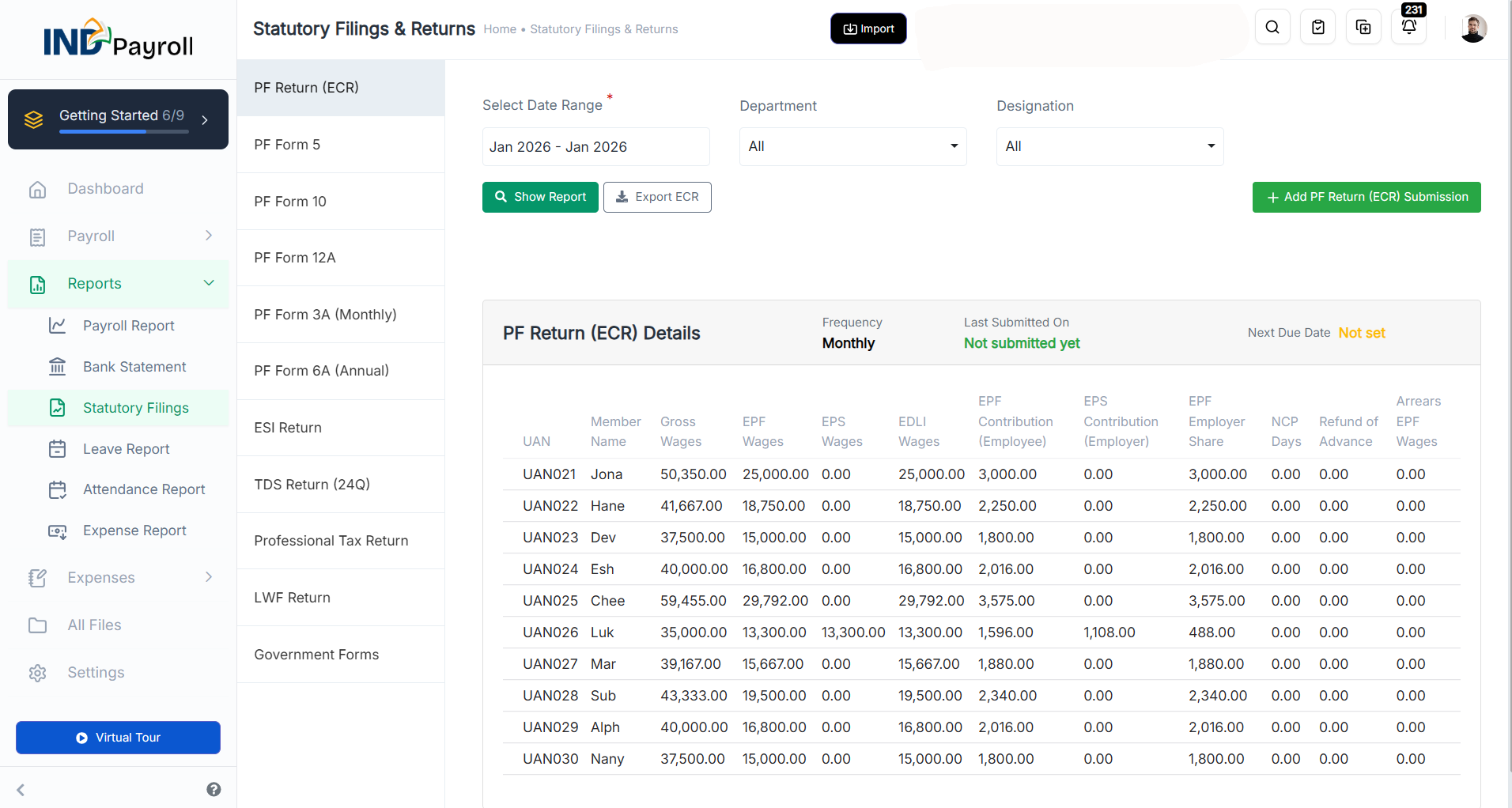
Step 6 → Go to Reports → Statutory Filings → PF Return (ECR)
Step 7 → Select Date Range, Department, Designation filters
Step 8 → Click Show Report → Verify ECR data table
Step 9 → Click Export ECR → Download .txt file
Step 10 → Upload .txt file to EPFO Portal → Get TRRN
Step 11 → Generate PF Challan on EPFO Portal
Step 12 → Make Payment (Net Banking / NEFT)
Step 13 → Record submission in INDPayroll (Add PF Return ECR Submission)
PF Challan Generator

INDPayroll also supports similar automated filing for ESI contributions. If you manage both PF and ESI for employees, refer to our guide on How to Generate ESI Challan Online for a parallel walkthrough.

Benefits of Automation

Automated systems reduce processing time compared to manual methods, improve accuracy through built-in validation, reduce manual data entry errors, prevent UAN validation failures through database verification, apply contribution rules correctly, detect errors before EPFO submission, generate audit-ready reports, and help maintain compliance records. Centralised records simplify audits, and the system scales easily for organisations of different sizes.

For HR teams looking to streamline all aspects of payroll—not just PF—our article on TDS on Salary: How to Calculate It Correctly in 2026 provides complementary guidance on managing income tax deductions alongside PF compliance.

Free Payroll, PF, ESI & TDS Software

The most trusted automation tool for modern Indian businesses.

Conclusion

PF compliance requires accuracy and timely execution at every step. Manual filing processes can lead to errors and delays. Modern payroll software helps automate calculations, validate employee data, and streamline monthly filings in accordance with EPFO standards. For organisations with multiple employees, automation can help reduce manual errors and simplify compliance processes.

Ready to eliminate PF compliance errors? Explore INDPayroll’s PF & ES Compliance module and run your first error-free ECR filing today.

15 Proven Payroll Best Practices for Indian SMEs 2026

TL;DR: Payroll Best Practices for Indian SMEs in 2026

  • Classify employees and contractors correctly to avoid compliance penalties.
  • Build compliant salary structures aligned with wage regulations.
  • Automate PF, ESI, TDS, and Professional Tax calculations.
  • Never miss statutory filing and payment deadlines.
  • Maintain accurate payroll records, payslips, and reconciliation reports.
  • Conduct regular payroll audits and prepare for Labour Code implementation.

Nearly half of India’s small businesses have faced a payroll penalty they could have avoided. One wrong formula in a spreadsheet, one missed PF deadline, one misclassified employee — and a routine pay run turns into interest, fines, and a difficult conversation with your team. Payroll is the single largest cash outflow for most SMEs, yet it is often run on tools never designed for India’s compliance maze.

If you manage payroll for a small or mid-sized business, you already feel the pressure: shifting tax rules, the long-awaited Labour Codes, and employees who expect their salary to be correct and on time — every single month. The cost of getting it wrong is rising, and “we’ll fix it next month” is no longer a safe plan.

In this guide, you will discover the 15 payroll best practices that keep Indian SMEs compliant, accurate, and audit-ready in 2026 — without expensive consultants or fragile spreadsheets. The INDPayroll Compliance Team works with thousands of Indian businesses and CA firms to automate PF, ESI, TDS, and Professional Tax, and these payroll best practices are the habits we see in every well-run payroll.

Free Payroll, PF, ESI & TDS Software

The most trusted automation tool for modern Indian businesses.

Why payroll best practices matter for Indian SMEs in 2026

Following payroll best practices is no longer optional housekeeping — it is risk management. Indian payroll sits at the intersection of the EPFO, the ESIC, and the Income Tax Department, and each carries its own deadlines and penalties. Strong payroll best practices protect your cash flow, your compliance record, and your reputation as an employer.

What are the payroll best practices for Indian SMEs? Payroll best practices are the standardised steps a business follows to pay staff accurately and stay legally compliant. They cover correct salary structuring, automated PF, ESI, TDS and Professional Tax deductions, on-time filings, accurate payslips, and secure record-keeping. Together, they prevent penalties and build employee trust.

1. Classify every worker correctly before you pay them

Misclassification is the most expensive payroll mistake an SME can make. Whether a person is a full-time employee, a contractor, or a gig worker decides which deductions, benefits, and filings apply. Treating an employee as a “consultant” to avoid PF and ESI can trigger back-payments, interest, and penalties during an inspection.

Worker classification is the process of deciding a worker’s legal status — employee, contractor, or gig worker. It works by testing control, supervision, and the nature of the engagement. It matters because each category carries different obligations for PF, ESI, TDS, and gratuity under Indian law.

India’s four Labour Codes formally recognise gig and platform workers and tighten definitions across the board. Map every person on your payroll to the right category in writing, and review the classification whenever a role changes.

2. Build a salary structure that is compliant by design

How you split a salary is not just a tax decision — it is a compliance one. Under the Code on Wages, 2019, the statutory definition of “wages” limits how much of total pay can sit in excluded allowances. In practice, this pushes the basic-plus-DA component toward at least 50% of total remuneration, which directly affects PF, gratuity, and overtime calculations.

A compliant salary structure is a pay breakup where basic wages meet statutory thresholds and allowances stay within legal limits. It works by keeping basic plus dearness allowance at roughly half of total pay. Most SMEs use it to control PF and gratuity liability while maximising employee take-home.

Design your CTC template once, correctly, and apply it consistently. A lopsided structure that under-reports basic wages is a red flag in any audit.

3. Automate statutory deductions instead of calculating them by hand

PF, ESI, Professional Tax, and TDS each follow different rates, ceilings, and rounding rules. Calculating them manually for even 30 employees invites error — and a single decimal mistake in TDS can cascade into a wrong Form 16. Automation removes the guesswork and applies current rates consistently every month.

Statutory deductions are the legally mandated amounts withheld from salary — EPF, ESI, Professional Tax, and TDS. They work by applying fixed rates to defined wage components each pay cycle. Indian employers must deduct and deposit them on time to stay compliant and avoid interest or penalties.

This is exactly the work payroll software is built to handle. Automated compliance tools recalculate deductions whenever rates change, so you are never relying on a year-old spreadsheet formula.

4. Get EPF (Provident Fund) right, every month

The EPFO administers the Employees’ Provident Fund and is mandatory for most establishments with 20 or more employees. Both employer and employee contribute 12% of basic wages plus dearness allowance, and contributions are typically due by the 15th of the following month.

EPF is a retirement savings scheme run by the Employees’ Provident Fund Organisation. It works by collecting 12% of basic wages plus DA from both the employer and the employee each month. The employer’s share is split between the pension fund (EPS) and the provident fund, calculated on a statutory wage ceiling of Rs. 15,000.

Generate your ECR (Electronic Challan-cum-Return) and deposit on time. Late PF payments not only attract damages and interest, but they can also disqualify the expense for income-tax purposes.

5. Stay within ESI rules for eligible employees

The Employees’ State Insurance scheme, run by the ESIC, provides medical and cash benefits to lower-wage workers. It generally applies to establishments with 10 or more employees and covers staff earning up to Rs. 21,000 per month (Rs. 25,000 for employees with disabilities).

ESI is a social security scheme for employees earning up to Rs. 21,000 a month. It works through a combined contribution of 4% of wages — 0.75% from the employee and 3.25% from the employer. It funds medical care, sickness, maternity, and disability benefits for covered workers.

Track wage thresholds carefully: an employee can move in or out of ESI coverage mid-year as pay changes, and your system must handle that transition cleanly within the contribution period.

6. Run an accurate TDS on salary under Section 192

Tax Deducted at Source on salary is governed by Section 192 of the Income Tax Act. Employers must estimate each employee’s annual tax liability and deduct it proportionately every month, choosing correctly between the old and new tax regimes based on the employee’s declaration.

TDS on salary is income tax that the employer deducts before paying wages, under Section 192. It works by spreading an employee’s estimated yearly tax across 12 months. Employers deposit it with the government and report it quarterly on Form 24Q, then issue Form 16 to each employee.

The new tax regime is now the default, and recent Budgets have reshaped the slabs and rebates. Collect investment declarations early in the financial year, verify proofs before year-end, and reconcile so no employee faces a shock deduction in March. Always confirm the current year’s slabs against the Income Tax Department before finalising.

7. Treat statutory deadlines as a non-negotiable payroll best practice

Most payroll penalties come not from wrong amounts but from being late. Each statutory due date is fixed, and missing it triggers automatic interest or fees regardless of intent. Among all payroll best practices, hitting deadlines is the cheapest and highest-return habit you can build.

Obligation Typical due date
EPF contribution & ECR 15th of the following month
ESI contribution 15th of the following month
TDS deposit (salary) 7th of the following month
TDS return (Form 24Q) Quarterly
Professional Tax Varies by state
What happens if you miss a TDS deadline? Late filing of a TDS return attracts a fee of Rs. 200 per day under Section 234E until the return is filed, capped at the TDS amount. A separate interest applies for late deduction or deposit. Meeting every due date is the cheapest compliance you will ever buy.

8. Keep a single source of truth for payroll data

When salary data lives in one spreadsheet, attendance in another, and bank details in an email, errors are inevitable. Centralising employee master data — pay structure, PAN, UAN, ESI number, bank details, and tax declarations — in one system removes duplication and version-control chaos.

A single source of truth is one authoritative system holding all payroll and employee data. It works by feeding every calculation, payslip, and filing from the same records. SMEs use it to eliminate conflicting spreadsheets, reduce manual re-entry, and ensure every report reconciles.

This is where SMEs reclaim the most time. Centralised payroll processing means one update flows everywhere instead of being copied across files.

9. Issue clear, itemised payslips on time

A payslip is both a legal record and a trust signal. The Code on Wages requires employers to give employees wage slips, and a good payslip itemises earnings, each statutory deduction, and the net pay so employees can see exactly how their salary was calculated.

A payslip is a document detailing an employee’s earnings and deductions for a pay period. It works by listing gross pay, PF, ESI, TDS, and other deductions, then showing net pay. Indian employers must provide it to meet wage-transparency obligations and reduce salary disputes.

Automated, password-protected digital payslips — generated and emailed in one click — save hours and look far more professional than a manual PDF.

10. Reconcile payroll before, not after, you file

Reconciliation catches errors while they are still cheap to fix. Each month, match gross pay, deductions, and net disbursement against your bank file. Each quarter, reconcile TDS deducted against Form 24Q and the deposits reflected in Form 26AS.

Payroll reconciliation is the process of matching payroll records against bank payments and statutory filings. It works by comparing what was calculated, paid, and reported, line by line. It matters because mismatches in Form 24Q or Form 26AS create notices and corrections that are costly to unwind.

A clean monthly reconciliation makes year-end Form 16 generation almost effortless.

11. Maintain statutory registers and records

Indian labour law requires employers to keep registers and records of wages, attendance, leave, and deductions — and to retain them for several years. Inspectors can ask for these at any time, and missing documentation is itself a violation, even if your calculations were correct.

Statutory registers are the records employers must keep under labour and tax laws, covering wages, attendance, and deductions. They work as the audit trail behind every pay run. The Labour Codes aim to simplify them into fewer digital registers, but retention obligations remain firmly in place.

Digital records with a complete change history make audits straightforward and protect you if a past calculation is ever questioned.

12. Manage attendance, leave, and overtime accurately

Payroll is only as accurate as the attendance feeding it. Loss-of-pay, overtime, and leave encashment must flow correctly into each month’s calculation. Manual transcription of attendance is a common — and avoidable — source of salary errors.

Attendance-to-payroll integration is the automatic flow of worked hours, leave, and overtime into salary calculation. It works by linking your attendance system directly to payroll so nothing is keyed in twice. SMEs use it to pay precisely for time worked and to comply with overtime rules.

Define your leave policy clearly, apply it consistently, and let the system, not a person, do the arithmetic.

13. Plan gratuity and full-and-final settlements ahead of time

Gratuity is a statutory benefit under the Payment of Gratuity Act, 1972, payable to employees who complete five years of continuous service, at 15 days’ wages for each completed year, subject to the prevailing cap. Provisioning for it monthly avoids a cash shock when senior staff exit.

Gratuity is a lump-sum reward for long service under the Payment of Gratuity Act. It works out to roughly 15 days of wages for each completed year, payable after five years of continuous service. Employers should provision for it gradually rather than funding it only at exit.

Build a clear, full, and final settlement process too — recovering advances, settling leave balances, and releasing dues within the legally expected timeframe.

14. Protect payroll and employee data

Payroll holds your most sensitive data: salaries, PAN, bank accounts, and Aadhaar-linked identifiers. With the Digital Personal Data Protection Act, 2023, safeguarding this information is now a legal duty, not just good hygiene. A leaked salary sheet damages trust and can carry regulatory consequences.

Payroll data protection is the practice of securing sensitive employee and salary information. It works through access controls, encryption, and limited sharing of pay data. Under India’s DPDP Act, 2023, businesses must handle personal data responsibly, making secure payroll systems a compliance requirement, not an option.

Restrict who can view salary data, use encrypted systems with audit logs, and avoid circulating raw payroll files over email or shared drives.

15. Audit regularly: the payroll best practice that ties it all together

India’s four Labour Codes — on Wages, Social Security, Industrial Relations, and Occupational Safety — consolidate 29 central labour laws and will reshape definitions of wages, working hours, and benefits as they roll out. SMEs that treat a yearly review as a core payroll best practice avoid scrambling later.

The Labour Codes are four laws that consolidate India’s central labour legislation. They work by standardising definitions of wages, social security, and working conditions across the country. Their phased implementation changes how SMEs structure pay and benefits, so businesses should track notifications and adjust payroll settings accordingly.

Run an internal payroll audit at least once a year: review classifications, salary structures, deduction rates, deadlines, and records. Confirm the current implementation status of the Labour Codes and your state’s specific notifications, since timing and rules continue to evolve.

Trust and authority: what we see in practice

“The businesses that never face a payroll penalty are rarely the ones with the biggest finance teams — they are the ones who automated their statutory calculations and treated deadlines as fixed,” notes the INDPayroll Compliance Team, drawing on payroll runs across thousands of Indian SMEs and CA firms.

Our own data points to a clear pattern: the most common penalty is not a wrong amount but a late filing, and almost every late filing traces back to a manual, calendar-driven process that someone simply forgot. The single highest-leverage change an SME can make is to move statutory deductions and deadlines off spreadsheets and onto a system that updates rates and reminders automatically.

Payroll best practices are the standardised steps a business follows to pay staff accurately and stay legally compliant — correct salary structuring, automated PF, ESI, TDS and Professional Tax deductions, on-time filings, accurate payslips, and secure record-keeping. Together, they prevent penalties and build employee trust.

India’s #1 Free Software

Free Payroll, PF, ESI & TDS Software

Conclusion

Strong payroll in 2026 comes down to three things: structure salaries correctly, automate every statutory deduction, and never miss a deadline. Master those, keep secure records, and stay ready for the Labour Codes, and payroll stops being a monthly risk and becomes a quiet competitive advantage. These payroll best practices are not theory — they are the habits that keep Indian SMEs penalty-free and their teams paid on time.

The fastest way to put all 15 payroll best practices into action is to stop running payroll on spreadsheets. Try INDPayroll free and run your next pay cycle in minutes, fully compliant.

This article is for general information only and does not constitute legal, tax, or financial advice. Statutory rates, wage ceilings, thresholds, due dates, and the implementation status of the Labour Codes change over time and can vary by state. Always verify the current rules with official sources such as the EPFO, ESIC, and the Income Tax Department, or consult a qualified professional, before acting.

Top 10 Cloud-Based Payroll Software Platforms For Businesses In 2026

Quick Answer

The top cloud payroll software for Indian businesses in 2026 are: INDPayroll (best for SMEs, CA firms, flat-rate pricing), greytHR (best for mid-sized businesses, 30,000+ clients), Zoho Payroll (best for Zoho ecosystem users), Keka (best for 10,000+ company track record), factoHR (best for manufacturing and enterprise, 4.9 G2 rating), RazorpayX Payroll (best for fintech-integrated salary disbursement), Pocket HRMS (best for SME HRMS), PeopleStrong (best for enterprise), Darwinbox (best for large enterprise), and ADP India (best for global compliance). Detailed, verified reviews follow below.

Introduction:

Running payroll manually in India is one of the highest-risk administrative decisions a business can make in 2026.

In fact, India’s payroll compliance landscape is among the most complex in the world: monthly EPF ECR filings, ESI challans, quarterly TDS returns under Form 24Q, state-specific Professional Tax rules across 28 states, dual income tax regime declarations, and annual Form 16 generation — all with tight deadlines and steep penalties for errors.

For instance, Section 234E of the Income Tax Act imposes a penalty of ₹200 per day for delayed TDS filing. EPFO interest on delayed contributions runs at 12% per annum. A single missed filing cycle can cost an SME more than a full year’s cloud-based payroll software subscription.

However, many Indian businesses — especially those with under 50 employees — still manage payroll on spreadsheets. The reasons are familiar: “It’s working fine,” “Software is expensive,” or “We don’t have time to switch.” Each of these assumptions is increasingly incorrect.

Cloud-based payroll software has crossed a threshold in 2026 where it is simultaneously more compliant, faster, and more affordable than manual processing. This article provides a verified, source-cited comparison of the ten best platforms available to Indian businesses today.

India’s #1 Free Software

Free Payroll, PF,
ESI & TDS Software

Professional compliance management for Indian businesses. 100% Free Forever.

What Is Cloud-Based Payroll Software?

Specifically, cloud-based payroll software is an online platform that automates the complete payroll cycle — from salary calculation and statutory deductions to payslip delivery and compliance filing — hosted on remote servers and accessible from any internet-connected device, without requiring local installation.

As a result, for Indian businesses, this means:

  • EPF, ESI, and TDS are calculated automatically based on the latest government-notified rates
  • ECR files and challans are generated and ready to upload to EPFO/ESIC portals.
  • Form 24Q prepared with FVU validation for income tax filings
  • Form 16 was generated and distributed digitally to employees
  • Payslips delivered securely to employees, accessible via mobile or web

Furthermore, unlike traditional desktop payroll software, cloud-based payroll software updates compliance rules automatically when the government issues new circulars — without requiring the employer to install patches or manually update tax tables.

How Cloud Payroll Works: A Simple 4-Step Process

  • Employee data sync — Employee records (salary structure, bank details, PAN, Aadhaar) are imported once and synced with attendance and leave systems.
  • Automated calculation — Next, the system calculates gross salary, applies all deductions (EPF, ESI, TDS, PT, LWF, loans), and computes net pay for each employee.
  • Approval and disbursement — HR or finance approves the payroll run; salaries are disbursed via bank transfer or generated as bank advice files.
  • Compliance filing — ECR files, challans, Form 24Q, and other statutory reports are auto-generated and ready to submit to government portals.

Benefits of Cloud-Based Payroll Software for Indian Businesses

  • Compliance automation is the most critical benefit. Cloud payroll tracks PF wage ceiling changes, ESI contribution updates, dual tax regime choices, and TDS slabs without manual intervention — eliminating the most common source of payroll penalties in India.
  • Time savings are measurable. Processing payroll manually for 50 employees typically takes 2–3 working days. A well-configured cloud system reduces this to under 30 minutes.
  • Accuracy improves by design. Automated systems eliminate VLOOKUP errors, incorrect tax regime assumptions, and manual data entry mistakes that frequently trigger demand notices from the income tax department.
  • Employee experience improves through self-service portals. Employees access payslips, Form 16, and tax projections without emailing HR — reducing administrative queries.
  • Audit readiness is built in. Every payroll change is logged with timestamps and user IDs. Digital audit trails are ready for government inspection without manual compilation.
  • Scalability means the same system handles 10 or 10,000 employees. Growing from 50 to 500 employees does not require changing software.

Cloud Payroll vs. Traditional Payroll: Clear Comparison

Factor Cloud-Based Payroll Traditional / Manual Payroll
Access Any device, anywhere Office desktop only
Compliance updates Automatic when rules change Manual — high risk of missing changes
Processing time 15–60 minutes 2–3 days
Error risk Low — automated calculations High — manual data entry
Audit trail Full digital logs Paper-based, often incomplete
Scalability Instant — no software changes Requires manual rework
Employee self-service Standard feature Not available
Penalty risk Very low High — especially for TDS/EPF delays
Data security Enterprise encryption File-based, high-loss risk
Setup Hours to days Days to weeks

How to Choose Cloud-Based Payroll Software for Your Indian Business: 8 Key Criteria

  • Indian Statutory Compliance Coverage: Verify the platform covers: EPF with ECR generation, ESI challans, TDS with both old and new tax regime support, PT with state-specific rules, Form 16, Form 24Q with FVU validation, and Labour Welfare Fund.
  • Pricing Model: Per-employee-per-month pricing can become expensive as you hire. A 100-person company paying ₹50/employee/month spends ₹60,000/year just in software fees. Flat-rate plans offer predictability. Calculate your cost at your 2-year projected headcount.
  • Compliance Update Frequency: The government updates PF slabs, ESI ceilings, and TDS formats regularly. Ask the vendor: How quickly are compliance changes reflected in the system?
  • Employee Self-Service A dedicated portal for payslip downloads, investment declarations, Form 16, and IT projections reduces HR query volume and improves employee transparency.
  • Multi-Company Support CA firms and group companies managing multiple entities need a single dashboard — not separate logins for each company. Verify this capability before purchasing.
  • Integration with Attendance and HR Manual reconciliation between attendance and payroll creates errors. Native integration between attendance, leave, and payroll is significantly more reliable.
  • Data Security and Hosting For Indian businesses, look for: 256-bit TLS encryption, India-based data hosting (important under the DPDP Act), ISO 27001 certification, and SOC 2 compliance.
    Support Quality During Filing Deadlines. TDS filing deadlines fall on the 7th and 31st of each month. ESI and EPF due dates cluster around the 15th. Evaluate whether the vendor offers phone or chat support during these critical windows.

Top 10 Cloud-Based Payroll Software Solutions for Indian Businesses in 2026

All information below is sourced from official vendor websites. Pricing marked as “not publicly available” reflects vendor websites that do not publish public pricing — not an editorial judgment.

1. INDPayroll

INDPayroll is a cloud payroll platform built specifically for Indian statutory compliance, with particular focus on the needs of SMEs and chartered accountant firms. It is the only platform in this list offering a permanently free plan with genuine compliance features — not a time-limited trial.

Notably, the platform is trusted by 5,000+ Indian businesses and 300+ CA firms (source: indpayroll.com), and carries a 4.8/5 rating on SoftwareSuggest.

Key Features

  • Automated monthly payroll runs
  • Full statutory compliance: EPF (with ECR generation), ESI, TDS (old and new regime), Professional Tax
  • Dual tax regime optimisation — automatically recommends which regime (old vs. new) maximises employee take-home
  • One-click Form 16 generation with bulk email delivery
  • ECR and PF challan generation — ready-to-upload files for EPFO portal
  • Employee Self-Service portal: payslips, tax projections, investment proof submissions
  • Multi-company management dashboard — single login for multiple entities/clients
  • Advanced attendance with geo-tagging (Ultimate and Enterprise plans)
  • Arrears and bonus calculations
  • Shift scheduling and roster management (Ultimate plan)
  • API access for third-party integrations (Ultimate plan)
  • Custom report builder (Ultimate plan)
  • 256-bit TLS encryption, India-based data hosting
  • Free tools: Payslip Generator, CTC Calculator, TDS Calculator, PF Calculator, Gratuity Calculator

Pricing

Plan Monthly Price Employee Limit Key Inclusions
Free ₹0 (forever) Up to 25 Payroll runs, payslips, basic PF, leave tracking, mobile read-only
Essentials ₹399/month flat Up to 200 Full TDS, ESI, PT, Form 16, ECR generation, priority email support
Ultimate ₹3,199/month flat (limited-time offer; was ₹15,000) Unlimited Advanced attendance, arrears, shift scheduling, API access, 24/7 support
Enterprise Custom Unlimited Biometric sync, ERP bridge (SAP/Oracle), SSO/SAML, on-premise option

Pros

  • Only platform with a permanently free plan covering genuine Indian compliance
  • Flat-rate pricing eliminates cost surprises as headcount grows
  • Purpose-built for Indian statutory compliance — not a global platform with India added on
  • A multi-client dashboard is a genuine differentiator for CA firms
  • Dual tax regime optimisation automates one of the most complex annual HR decisions

Cons

  • India-only; not suitable for multi-country payroll
  • Advanced features (biometric, ERP bridge) require the Enterprise plan

Best For

Indian SMEs, startups (up to 200 employees), CA firms managing multiple clients, manufacturing companies, retail chains, and any business prioritising compliance without per-employee pricing.

2. greytHR

greytHR is one of India’s most established cloud HR and payroll platforms, trusted by 30,000+ companies (source: greythr.com/pricing). The platform claims 99.5% uptime and positions its ESS portal as reducing administrative workload by 80%.

Key Features

  • Highly customizable salary structures with unlimited salary components
  • Configurable payroll engine handling complex use cases
  • Statutory compliance: PF with ECR generation, ESI with challans, PT with all state-specific rules built in, TDS with
  • comprehensive eTDS returns, one-click Form 24Q with automatic FVU validation, digitally signed Form 16 and 12BA,
  • bonus calculations, Labour Welfare Fund deductions
  • greytHR PayNow: Direct salary transfer from within the application (direct debit facility)
  • Electronic bank-transfer formats for all major Indian banks
  • ESS portal: reimbursement claims, investment declarations (PIT), proof of investment (POI), YTD statements, IT statements, payslips, Form 16s
  • Workflows and helpdesk for employee servicing
  • AI-powered chatbot (Navos AI, included in all plans)
  • Geo-fencing, GPS live tracking (add-ons)

Pricing

Plan Base Price Includes Per Additional Employee
Essential ₹2,495/month 50 employees ₹45/employee/month
Growth ₹4,495/month 50 employees ₹85/employee/month
Premium Custom Unlimited Contact sales

Pros

  • One of the most comprehensive compliance engines in India
  • Form 24Q with FVU validation — a rare feature that eliminates manual TRACES uploads
  • GreytHR PayNow direct debit is a genuine time-saver for salary disbursement
  • Navos AI chatbot included in all plans

Cons

  • Per-employee pricing above 50 employees can become expensive at scale
  • Full feature set requires Growth or Premium — some key features are add-ons on Essential
  • Premium plan pricing requires a sales call

Best For

Mid-sized Indian businesses (50–500 employees), companies needing the most comprehensive statutory compliance automation, and organisations that want an all-in-one HR + payroll platform.

3. Zoho Payroll

Zoho Payroll is the payroll module within Zoho’s broader business software ecosystem. It is particularly well-suited for businesses already using Zoho Books (accounting) or Zoho People (HR), as the native integration eliminates manual data sync.

Key Features

  • PF, ESI, LWF, PT, and IT compliance across 28 Indian states — automated adjustments when tax laws change
  • Tax forms: 12BB, 24Q, TDS, Form 16 — all downloadable instantly with e-signature capability
  • Leave and attendance management built into the platform (no third-party integration required)
  • Employee self-service portal: payslips, tax worksheets, Form 16 — accessible on web and mobile app
  • Salary notifications are sent automatically on payday
  • Contractor management: TDS handled automatically, managed alongside employees in one workflow
  • Multi-level payroll approval workflows for process integrity
  • Formula-based earnings: apply formulas to salary components for automated calculation
  • Reporting tags for custom payroll cost allocation
  • Scheduled earnings: configure future bonuses or variable pay in advance
  • Integration with Zoho Books (accounting), Zoho People (HRMS), Zoho CRM, and other Zoho apps
  • Custom integrations with Workday, SAP, Oracle, UKG, and Microsoft (enterprise)

Pricing

Contact Zoho directly or visit zoho.com/in/payroll/pricing)

Pros

  • Deepest integration within the Zoho ecosystem — ideal for businesses using Zoho Books or Zoho People
  • 28-state compliance coverage across all statutory obligations
  • High app ratings (4.8 App Store) indicate a strong mobile user experience
  • An e-signature on Form 16 is a genuine convenience feature

Cons

  • Best value only if already in the Zoho ecosystem
  • Pricing not publicly available — requires a demo or trial to evaluate cost
  • Less specialised for CA multi-client management than INDPayroll

Best For

Indian businesses already using Zoho Books, Zoho People, or other Zoho apps; companies wanting a natively integrated accounting + payroll + HR stack; businesses in 28-state multi-location operations.

4. Keka

Keka is an Indian HR platform with payroll as a core module, serving a large and well-documented customer base.

Key Features

  • 4-step payroll process: import data → automated calculations → disburse salaries → auto-file compliance reports
  • Statutory compliance: PF, ESIC, TDS, PT — calculations with latest rates; ECR, 24Q, and 26Q reports generated; challans ready for filing with audit trails
  • Salary & Payout Automation: payroll across entities, branches, and pay groups; salary revisions, arrears, bulk payouts; off-cycle payouts
  • Attendance & Leave Integration: payroll pulls directly from attendance data — LOP, shifts, and overtime auto-accounted
  • Employee Self-Service: payslips, Form 16, investment declarations, tax summaries — web and mobile
  • Expense & Reimbursement Management: claim submission, manager approval with policy checks, auto-sync to payroll
  • Loans & Advances Management: custom loan policies, EMI tracking, payroll-aligned repayments
  • Multi-entity payroll with state-specific compliance
  • Integration: Tally, QuickBooks, Zoho Books, SAP, API connectivity
  • GPS/mobile attendance, shift management (via Time & Attendance module)
  • Performance management, recruiting, LMS (separate modules)
  • Security: role-based access, maker-checker approvals, bank account verification, encrypted data

Pricing

free trial and demo available at keka.com/signup

Pros

  • 10,000+ company track record and 35M+ payroll runs provide strong reliability evidence
  • Supports all workforce types: full-time, contractors, interns, gig workers
  • Loans and advances management is a feature rarely found in competing platforms
  • Strong accounting integrations (Tally, QuickBooks, SAP)

Cons

  • Pricing not publicly available — requires demo
  • A full HRMS platform means users pay for modules they may not need
  • Implementation can take time for larger organisations

Best For

Mid-market Indian companies (50–2,000 employees) needing a unified HRMS + payroll platform; businesses with complex workforce types; organisations needing integrated loans and expense management.

Free Payroll, PF, ESI & TDS Software

The most trusted automation tool for modern Indian businesses.

5. factoHR

FactoHR is an AI-powered HR and payroll platform with a strong presence in manufacturing, retail, and enterprise segments.

Key Features

  • Full suite: Recruitment, HR, Onboarding, Attendance, Payroll, Leave, Performance (OKR-based), LMS, Travel & Expense, ESS, Mobile App, Timesheet
  • Retirement Benefits module (unique in this list): Provident Fund trust management, Benevolent Fund, Superannuation,
  • Pension Management, General Provident Fund, Unexempted PF, Gratuity
  • Mobile app features: Contactless attendance, AI-powered Face Recognition, Geo-fencing, Employee chatbot
  • Payroll with a wizard-driven approach and integrated data inputs
  • Statutory compliance for Indian labour laws
  • Employee Self-Service portal
  • Scalable from startups to large enterprises

Pricing

FactoHR pricing is listed on their website. (Visit factohr.com/plans/ for current pricing — specific plan amounts not included here as they may change) A free trial/demo is available.

Pros

  • Highest verified review ratings in this list: 4.9 G2, 5.0 Capterra
  • The Retirement Benefits module (PF trust, Superannuation, Gratuity) is unique and valuable for large organisations
  • Face recognition and geo-fencing for attendance — strong for manufacturing/field staff
  • SAP and Microsoft Azure partnerships indicate enterprise-grade credibility

Cons

  • A full platform may be more than SMEs need
  • Pricing requires checking the vendor website directly
  • Primarily optimised for larger organisations, SME-friendliness is lower than INDPayroll

Best For

Manufacturing companies with complex attendance needs, large enterprises needing PF trust and retirement benefit management, and organisations with field/shop-floor workers requiring biometric and face recognition attendance.

6. RazorpayX Payroll

RazorpayX Payroll is part of Razorpay’s business banking suite, integrating payroll directly with RazorpayX’s current accounts. Its key differentiator is tight integration between payroll processing and real-time salary disbursement.

Key Features

  • Direct salary disbursement through RazorpayX current account integration
  • Automated statutory compliance: PF, ESI, Professional Tax, TDS
  • Payslip generation and employee communication
  • Compliance with Indian labour law requirements
  • Connected with Razorpay’s broader fintech infrastructure

Pricing

Contact Razorpay directly for current pricing

Pros

  • Native integration with RazorpayX’s current account simplifies salary disbursement
  • Familiar brand for startups and digital businesses already using Razorpay for payments
  • Part of a broader fintech ecosystem, including expense management, invoicing, and working capital

Cons

  • Best value only if using RazorpayX banking — less compelling as a standalone payroll tool
  • Compliance depth may be less comprehensive than dedicated payroll platforms like greytHR or INDPayroll

Best For

Startups and digital-first businesses already using RazorpayX for banking; companies want integrated payroll + business banking in a single platform.

7. Pocket HRMS

Pocket HRMS is an Indian cloud HRMS and payroll platform positioned for SMEs and mid-sized businesses seeking an affordable all-in-one solution.

Key Features

  • Automated payroll processing with statutory compliance
  • TDS, PF, ESI, and Professional Tax calculations
  • Payslip generation
  • Employee self-service portal
  • Attendance and leave integration with payroll
  • Mobile application for HR and employees
  • Reports and compliance documentation

Pricing

Pricing is available 

Pros

  • Designed for SMEs — simpler interface than enterprise platforms
  • Integrated HRMS beyond payroll (attendance, leave, ESS)
  • Indian compliance coverage

Cons

  • Less market presence and verified customer statistics than category leaders
  • Full pricing requires a demo or trial

Best For

Small to mid-sized Indian businesses (10–200 employees) looking for an affordable, integrated HRMS + payroll solution.

8. PeopleStrong

PeopleStrong is an enterprise-grade Indian HR technology platform serving large organisations across Asia.

Key Features

  • End-to-end payroll management and automation
  • Indian statutory compliance (PF, ESI, TDS, PT)
  • Cloud-based payroll management system
  • Salary processing and tax management
  • Employee self-service

Pricing

enterprise custom pricing

Pros

  • Enterprise-grade platform designed for large, complex organisations
  • Strong presence in the Asia-Pacific market
  • Comprehensive HR suite beyond payroll

Cons

  • Not designed for SMEs — minimum viable size is typically 500+ employees
  • Pricing requires enterprise engagement
  • Implementation timelines can be extended for large organisations

Best For

Large Indian enterprises (500+ employees), multi-location organisations across India and Asia-Pacific, and businesses needing a full enterprise HCM suite.

9. Darwinbox

Darwinbox is a Hyderabad-headquartered enterprise HR platform that has grown significantly across Asia and the Middle East, particularly among large corporates.

Pricing

enterprise custom pricing

Best For

Large Indian enterprises and multinational organisations need a modern, mobile-first enterprise HCM platform.
For verified, current feature and pricing information, visit darwinbox.com directly.

10. ADP India

ADP is a global payroll and HR services leader with 1.1 million clients worldwide (source: adp.com), including a dedicated India operation serving multinationals and large Indian enterprises.

Pricing

custom enterprise pricing for India

Pros

  • Unmatched global reliability and institutional trust — 1.1M clients
  • Best choice for multinationals needing India + global payroll in one system
  • Deep ERP integrations (SAP, Oracle, Workday)
  • ADP’s compliance team tracks India regulatory changes proactively

Cons

  • Significantly more expensive than Indian-native platforms
  • Designed for large enterprises — not cost-effective for SMEs
  • Implementation can take months for complex configurations

Best For

Multinational corporations with India operations needing local + global payroll, large Indian enterprises requiring ERP integration, and companies with 500+ employees needing global compliance.

Cloud-Based Payroll Software Master Comparison Table

Platform Target Size India Compliance Free Plan Pricing Model Key Rating Unique Strength
INDPayroll SME, Startup, CA ✅ Full (PF, ESI, TDS, PT) ✅ Up to 25 employees Flat-rate 4.8 SoftwareSuggest CA multi-client, flat pricing
greytHR SME to Mid-market ✅ Full ✅ 7-day trial Per-employee above 50 30,000+ clients Form 24Q FVU, PayNow
Zoho Payroll SME to Mid ✅ 28 states ✅ 14-day trial Not published 4.8 App Store Zoho ecosystem integration
Keka Mid-market ✅ Full Free trial Not published 10,000+ companies Loans, multi-entity payroll
factoHR Mid to Enterprise ✅ Full Free trial Listed on site 4.9 G2, 5.0 Capterra PF trust, face recognition
RazorpayX Payroll Startup, SME ✅ Partial Not listed Not published Razorpay ecosystem Banking + payroll integration
Pocket HRMS SME ✅ Partial Free trial Not published Not verified SME affordability
PeopleStrong Enterprise ✅ Full No Custom Enterprise Asia-Pacific HCM
Darwinbox Enterprise ✅ Full No Custom Enterprise Mobile-first enterprise HCM
ADP India Enterprise, MNC ✅ Full + Global No Custom 1.1M clients globally Global + India payroll

Future Trends in Cloud-Based Payroll Software Technology

AI-assisted compliance monitoring is emerging across platforms. greytHR’s Navos AI and Keka’s automation capabilities represent early implementations. Expect AI to flag compliance anomalies proactively and suggest optimal tax structures.

Real-time salary disbursement via UPI and IMPS integration is becoming standard. RazorpayX Payroll’s banking-integrated model represents where the market is heading — salary runs are completed within minutes of approval.

DPDP Act compliance (Digital Personal Data Protection Act, 2023) will become a vendor differentiator. Platforms that offer consent management, data principal rights workflows, and breach notification systems will have an advantage as enforcement increases.

Earned Wage Access (EWA) — allowing employees to access a portion of their earned salary before payday — is gaining traction in India, particularly for blue-collar workers. Expect this feature to appear in more Indian payroll platforms by 2027.

Integrated gig and contract worker payroll is growing as more Indian businesses engage gig workers at scale. Platforms that handle TDS on contractor payments alongside regular employee payroll will be better positioned.

Expert Recommendations

For SMEs and startups (up to 200 employees): Start with INDPayroll’s free or Essentials plan. The permanently free plan covers genuine compliance for up to 25 employees — there is no cost justification for a spreadsheet-based alternative at this scale.

For CA firms managing multiple clients: INDPayroll’s multi-client dashboard and greytHR’s multi-company support (Growth and Premium plans) are the two verified options built for this use case.

For mid-sized businesses (200–1,000 employees): greytHR provides the most comprehensive compliance automation with verified uptime and a 30,000+ customer base. Keka is worth evaluating for businesses needing stronger workforce management features alongside payroll.

For manufacturing and blue-collar-intensive businesses: factoHR’s face recognition attendance and geo-fencing are purpose-built for this segment. The 4.9 G2 rating and Cycle Agarbatti / GHCL case studies demonstrate real manufacturing deployment.

Finally, for enterprise and multinational organisations: ADP India for businesses requiring global payroll. Darwinbox or PeopleStrong for India-centric large enterprises. Budget for implementation time and custom pricing engagement.

Additionally, for Zoho users: Zoho Payroll is the obvious choice. The native Zoho Books and Zoho People integration eliminates reconciliation effort that would otherwise consume significant HR and accounting time.

India’s #1 Free Software

Free Payroll, PF, ESI & TDS Software

Conclusion

Cloud-based payroll software has become an essential business tool in 2026. By automating salary processing, improving compliance, and enhancing employee experience, payroll platforms help organisations save time, reduce errors, and focus on growth.

However, while enterprise organisations may benefit from solutions like Workday, ADP, and Darwinbox, small and medium-sized businesses often require a more practical and cost-effective platform. For businesses operating in India, INDPayroll stands out as a strong option due to its focus on payroll automation, statutory compliance, employee self-service, attendance integration, and SME-friendly approach.

Therefore, the right cloud-based payroll software should align with your organisation’s size, compliance requirements, growth plans, and operational needs. By evaluating features, scalability, and support carefully, businesses can select a payroll platform that delivers long-term value and efficiency.

How To Choose The Right Payroll Software In India 2026

Every HR manager in India knows the pain — manual salary calculations, missed PF deadlines, and compliance errors that cost the company money. In 2026, the stakes are even higher. The right payroll software in India can eliminate these headaches overnight. The wrong choice can make them worse.

According to a 2026 NASSCOM report, over 62% of Indian SMEs still rely on spreadsheets for payroll. As a result, compliance errors cost them an average of ₹1.4 lakh per year in penalties. That number is entirely avoidable. Furthermore, with India’s labor laws evolving rapidly, businesses need software that adapts in real time.

In this guide, you will learn exactly how to choose payroll software in India that fits your team size, budget, and compliance needs — so you never miss a deadline again.

How to Choose Payroll Software in India (2026)

  • Payroll in India is complex due to PF, ESI, TDS, and evolving labour laws
  • Many SMEs still rely on spreadsheets, leading to costly errors and compliance risks
  • Choosing the wrong payroll software increases penalties and operational inefficiency
  • Key factors include compliance automation, salary flexibility, integrations, and scalability
  • Common mistakes include ignoring compliance depth, skipping trials, and overlooking security
  • Solutions like INDPayroll offer end-to-end automation tailored for Indian businesses
India’s #1 Free Software

Free Payroll, PF, ESI & TDS Software

Why Choosing the Right Payroll Software Matters in India 2026

India’s payroll landscape is uniquely complex. Businesses must manage EPF regulations, ESI contributions, TDS deductions, professional tax, and state-specific labor laws — all at the same time. One missed filing can trigger EPFO notices and financial penalties.

Moreover, India’s workforce is diverse. You may have salaried employees, contract workers, and consultants on the same payroll. The right payroll software must handle all of these scenarios seamlessly. Therefore, the selection process deserves serious thought — not a rushed decision.

Beyond compliance, the right tool also boosts employee trust. When salaries are processed on time and payslips are accurate, employee satisfaction rises. In contrast, errors in salary crediting damage morale and increase attrition. So investing in good payroll software is also an investment in your people.

10 Key Factors to Evaluate Payroll Software in India

1. PF & ESI Compliance Automation

This is non-negotiable. Your software must auto-calculate and file PF and ESI every month without manual intervention. Look for a platform that covers PF & ESI compliance end-to-end — from contribution calculation to challan generation and filing. Additionally, it should send alerts for upcoming deadlines so your team is never caught off-guard.

Use our free PF calculator and ESI calculator to validate your current numbers before switching platforms.

2. Accurate and Flexible Salary Processing

Salary structures in India vary widely. Startups use flat CTC models. Manufacturing units use complex allowance breakups. Your payroll software must support all of these. Look for a solution with configurable salary heads, LOP (Loss of Pay) calculations, and arrear processing. INDPayroll’s salary processing module handles all these cases out of the box.

You can also use the free CTC calculator to structure cost-to-company packages for new hires accurately.

3. Payslip Generation & Reports

Employees expect professional, itemized payslips every month. Your software should generate them in one click — downloadable as PDFs, shareable via email, and branded with your company logo. INDPayroll’s payslip and reports generator does exactly that. You can also use the standalone payslip generator tool to create payslips instantly — even without logging in.

4. Compliance with Indian Labor Laws

India’s labor laws change frequently. The four new Labour Codes — on wages, social security, industrial relations, and occupational safety — are reshaping how companies handle payroll. Your software must stay updated with these changes automatically. Check whether the vendor provides real-time labor law updates and whether their compliance engine reflects the latest rules.

Also verify that the software supports proper registration and filing workflows for EPFO and ESIC portals. Manual portal submissions are error-prone and time-consuming.

5. EPF and ESI Compliance Depth

Go beyond basic calculations. Your software should support UAN generation, ECR filing, EPFO portal sync, and Form 16A generation. Similarly, for ESI, it should handle Form 6, half-yearly returns, and IP generation. Review INDPayroll’s EPF compliance guide and ESI compliance guide to understand exactly what full compliance looks like.

6. User Interface & Ease of Use

Even the most feature-rich software fails if your HR team cannot use it comfortably. Look for a clean dashboard, minimal clicks to run payroll, and guided workflows for first-time users. During your free trial, ask the HR executive who will use it daily — not just the IT manager. Their feedback matters most. A complex UI leads to workarounds and errors over time.

7. Integration with HR and Accounting Tools

Your payroll software should not work in isolation. It must integrate with attendance management, leave management, and accounting software like Tally or Zoho Books. This prevents double data entry and reduces errors. At Andolasoft, the team behind INDPayroll, integrations are built with enterprise-grade reliability.

If you also manage projects and remote teams, linking payroll with a tool like Orangescrum can give you full visibility into resource costs alongside project budgets.

8. Scalability for Growing Teams

Your company will grow. Your payroll software must grow with it. Check whether the platform supports multi-location payroll, multiple pay structures, and bulk employee imports. A system that works for 10 employees must work equally well for 500. Look for tiered pricing plans that scale without locking you into expensive long-term contracts.

9. Customer Support & Onboarding

Payroll errors are time-sensitive. A delayed salary run impacts real people. Therefore, choose a vendor with responsive support — preferably with chat, email, and phone options. Check user reviews on platforms like G2 and Capterra. Specifically, look for reviews that mention support quality during the first month of onboarding. That is when your team needs the most guidance.

10. Pricing Transparency

Many payroll platforms in India use confusing pricing structures. They advertise low base prices but charge extra for compliance modules, reports, or employee count overages. Always ask for a fully-loaded price — including all features you need. Compare it against the cost of your current manual process (staff hours + penalty risk). The ROI math usually favors automation clearly.

Free Payroll, PF, ESI & TDS Software

The most trusted automation tool for modern Indian businesses.

Common Mistakes When Selecting Payroll Software in India

Many HR teams rush the software selection process. They pick a tool based on price alone, or because a colleague recommended it. Here are the mistakes to avoid:

  • Ignoring compliance depth: Some tools calculate PF but do not generate EPFO-compatible files. Always verify end-to-end compliance capability.
  • Skipping the free trial: Never commit without running a full payroll cycle on the free trial. Edge cases surface only during real use.
  • Not checking update frequency: Indian tax laws change often. A vendor that updates their software quarterly is too slow.
  • Choosing based on features you do not need: A 10-person startup does not need enterprise-grade HRMS. Focus on payroll-first features.
  • Overlooking data security: Payroll data is sensitive. Verify SSL encryption, role-based access, and data backup policies before signing up.

INDPayroll vs Other Payroll Software in India

There are several payroll platforms available in India. However, not all of them are built with the same focus on compliance and simplicity. If you are evaluating alternatives, here are some comparison resources:

INDPayroll stands out because it is purpose-built for Indian compliance. It handles PF, ESI, TDS, PT, and LWF in a single unified platform — without requiring separate add-ons. Additionally, it is designed for non-technical HR professionals. You do not need an IT background to run a full payroll cycle.

You can also explore the full suite of free payroll tools before you even sign up — including calculators for PF, ESI, CTC, and payslip generation. Meanwhile, if you’re exploring broader business automation, CRMLeaf offers integrated CRM and payroll workflows for growing teams.

Real-World Use Case: How a 150-Person IT Firm Saved 40 Hours/Month

A Bengaluru-based IT services company with 150 employees was spending 40+ hours every month on manual payroll processing. Their HR team used Excel sheets to calculate PF, ESI, and TDS — and still faced EPFO mismatches every quarter.

After switching to INDPayroll in early 2025, they automated the entire payroll cycle. PF challans are now generated automatically on the 7th of every month. ESI returns are filed with one click. The HR team reclaimed those 40 hours — and now focuses on hiring and employee engagement instead of spreadsheets.

This is not an isolated story. Remote-first startups, manufacturing units, and NGOs across India are making the same shift. The common thread: they chose payroll software built specifically for Indian compliance — not a generic HR tool with compliance bolt-ons.

India’s #1 Free Software

Free Payroll, PF,
ESI & TDS Software

Professional compliance management for Indian businesses. 100% Free Forever.

Conclusion: Choose Smart, Comply Confidently

Choosing the right payroll software in India in 2026 is not just a technology decision — it is a compliance and people decision. The software you pick will determine whether your HR team spends time on strategy or on fixing spreadsheet errors.

To summarize: prioritize compliance automation (PF, ESI, TDS), salary flexibility, payslip generation, and strong support. Avoid tools that bolt compliance onto a generic HR platform. And always run a free trial before you commit.

INDPayroll is built from the ground up for Indian businesses. It covers every compliance requirement, supports every salary structure, and is designed for HR professionals — not IT specialists. Thousands of companies across India trust it to run payroll without stress.

Frequently Asked Questions

What is the best payroll software in India for small businesses?

INDPayroll is one of the best payroll software options in India for small businesses. It offers an easy setup, automated PF & ESI compliance, payslip generation, and affordable pricing — making it ideal for teams of 5 to 500 employees.

Is payroll software mandatory for Indian companies?

Payroll software is not legally mandatory. However, the compliance obligations it fulfills — PF filing, ESI contributions, TDS deductions — are mandatory. Using software dramatically reduces the risk of errors and penalties.

How does payroll software handle PF compliance in India?

Good payroll software automatically calculates employee and employer PF contributions, generates ECR (Electronic Challan cum Return) files, and syncs with the EPFO portal. INDPayroll covers all of these steps natively.

Can I switch payroll software mid-year?

Yes. Most payroll platforms allow mid-year migration. You will need to import historical salary data and YTD (year-to-date) figures. INDPayroll’s onboarding team assists with this migration at no extra cost.

What is the difference between payroll software and HRMS?

HRMS (Human Resource Management System) covers the full employee lifecycle — recruitment, onboarding, performance, and payroll. Payroll software focuses specifically on salary processing and statutory compliance. For most SMEs in India, a dedicated payroll software is more cost-effective than a full HRMS.

Top 10 Payroll Challenges HR Teams Face & How To Fix

Managing payroll in India is no small task. HR teams handle complex salary structures, ever-changing PF and ESI regulations, tax deductions, and dozens of compliance deadlines — all at once. One small error can lead to penalties, employee dissatisfaction, or even legal trouble.

In 2025, a survey by SHRM India found that 67% of HR professionals rank payroll compliance as their top operational challenge. Yet most companies still rely on spreadsheets or outdated tools that create more problems than they solve.

This guide covers the top 10 payroll challenges HR teams face today — and actionable fixes for each. Whether you run a startup or a mid-size company, these solutions will save you time, reduce errors, and keep your team compliant.

Ready to simplify payroll? Try INDPayroll free and see how automation transforms your HR workflow.

Payroll Challenges in India (2026)

  • Payroll involves complex compliance requirements like PF, ESI, TDS, and labour laws
  • Manual processes increase the risk of salary errors and compliance penalties
  • Attendance mismatches and lack of system integration slow down payroll processing
  • Data security risks increase when payroll is managed through spreadsheets
  • Automation significantly improves accuracy, efficiency, and compliance
  • Scalable payroll software supports business growth without increasing HR workload
India’s #1 Free Software

Free Payroll, PF,
ESI & TDS Software

Professional compliance management for Indian businesses. 100% Free Forever.

1. Manual Salary Calculation Errors

Manual salary processing is the biggest source of payroll errors. HR teams spend hours calculating basic pay, HRA, allowances, and deductions — all manually. A single formula mistake in a spreadsheet can cascade across hundreds of employee records.

According to the American Payroll Association, payroll errors cost businesses up to 1.2% of total payroll annually. For a company with 100 employees, that adds up fast.

The Fix: Automate salary calculations with payroll salary processing software. INDPayroll auto-calculates gross pay, net pay, PF, ESI, and TDS in seconds. No formulas. No manual errors. Just accurate payslips every month.

With automated payroll software, you can process 500 employees in under 10 minutes. That’s not just faster — it’s error-free.

2. PF & ESI Compliance Failures

EPF (Employees’ Provident Fund) and ESI (Employees’ State Insurance) compliance is non-negotiable in India. Missing contribution deadlines, wrong deduction rates, or incorrect challan submissions can result in heavy fines and legal notices from the EPFO or ESIC.

Many HR teams manually track PF wages, ESI eligibility, and filing dates — a process riddled with risk. Regulations also change frequently, making it hard to stay current without dedicated tools.

The Fix: Use dedicated PF & ESI compliance software that auto-calculates contributions, generates challans, and tracks filing deadlines. INDPayroll’s compliance module keeps you updated with the latest EPFO rules.

You can also use our free PF calculator and ESI calculator to verify deductions instantly. Pair that with our EPF compliance guide for a complete understanding of your obligations.

3. Late or Incorrect Payslip Generation

Employees expect accurate payslips on time — every month. Delays cause frustration and erode trust. Worse, incorrect payslips create tax filing problems for employees and expose your company to disputes.

Many HR teams generate payslips manually using Word or Excel templates. This process is slow, inconsistent, and prone to formatting errors. Sending 200 individual payslip emails manually is simply not scalable.

The Fix: Automate payslip generation with INDPayroll’s payslip & reports generator. Generate professional, branded payslips in bulk and deliver them directly to employee inboxes in one click.

You can also use the free payslip generator for quick, on-demand salary slips. It’s fast, accurate, and professionally formatted.

4. Tax Deduction & TDS Calculation Mistakes

TDS (Tax Deducted at Source) on salary is governed by Section 192 of the Income Tax Act. Incorrect TDS calculations — either over-deducting or under-deducting — create problems for both employees and employers during ITR filing season.

HR teams must account for employee investments, exemptions (HRA, LTA, Section 80C), and the tax regime chosen (old vs. new). Doing this manually for every employee is complex and error-prone.

The Fix: Use payroll software that integrates TDS calculations directly into the salary run. INDPayroll handles tax computation for both old and new tax regimes, factoring in all employee declarations automatically.

The CTC calculator is also a great starting point for understanding salary breakups and tax implications before you process payroll.

5. Managing Complex Salary Structures

Modern salary structures in India are multi-layered. They include basic pay, HRA, special allowance, medical allowance, LTA, performance bonuses, and more. Each component has different tax implications and PF treatment rules.

When HR teams build these structures manually, inconsistencies creep in. Some employees may have incorrect HRA percentages. Others may have PF calculated on the wrong base. These errors compound over time and are hard to audit.

The Fix: Build flexible salary templates in INDPayroll. You can define custom components, set calculation rules, and apply different structures to different employee groups. Our free payroll tools help you model salary breakups before finalising structures.

Try INDPayroll free and set up your first salary template in under 5 minutes.

6. Keeping Up With Indian Labor Law Changes

Indian labor laws change regularly. The four new Labour Codes — covering wages, industrial relations, social security, and occupational safety — are still being implemented across states. Gratuity rules, minimum wages, and leave encashment policies also vary by state.

HR teams that rely on outdated knowledge risk non-compliance even when they think they’re doing everything right. This is especially risky for companies operating across multiple states.

The Fix: Stay updated through INDPayroll’s labor law updates page. Our platform also auto-updates compliance parameters when regulations change — so you don’t have to manually track every notification from the Ministry of Labour.

Read our latest EPF regulations guide to stay ahead of EPFO policy changes that affect your payroll every quarter.

India’s #1 Free Software

Free Payroll, PF, ESI & TDS Software

7. Attendance & Leave Integration Issues

Payroll accuracy depends on accurate attendance data. When attendance systems don’t sync with payroll software, HR teams manually reconcile leave records, absent days, and overtime hours. This creates delays and errors in the final salary calculation.

Remote and hybrid teams make this even harder. Tracking attendance across locations — without a centralised system — is a genuine operational headache for growing companies.

The Fix: Choose payroll software with built-in attendance and leave management or seamless integrations with your existing systems. INDPayroll’s salary processing module pulls attendance data directly into payroll calculations, reducing manual intervention significantly.

This integration alone can save HR teams 4–6 hours per payroll cycle.

8. Handling Full & Final Settlements

When an employee exits, HR must calculate their full and final (F&F) settlement accurately. This includes pending salary, earned leave encashment, gratuity (if eligible), deductions for notice period shortfall, and TDS on the settlement amount.

F&F errors create disputes, delay experience letters, and — in some cases — result in legal action from former employees. Most HR teams handle this manually, leaving room for miscalculations.

The Fix: Automate F&F settlements through a structured payroll workflow. INDPayroll handles all F&F components in one place, generates accurate settlement statements, and even computes the applicable TDS — saving time and reducing risk.

Check our registration & filing compliance section to understand the documentation required during employee exit.

9. Data Security & Payroll Confidentiality

Payroll data is among the most sensitive information a company holds. Salary details, bank account numbers, PAN cards, and tax data must be protected from unauthorized access. A data breach in payroll can lead to regulatory penalties and reputational damage.

Many SMEs in India still store payroll data in shared Excel sheets or unencrypted email attachments — a serious security risk in 2025.

The Fix: Use cloud-based payroll software with role-based access controls, data encryption, and audit trails. INDPayroll stores data securely in the cloud with enterprise-grade encryption. Only authorised HR personnel can access sensitive payroll records.

This is especially important for companies transitioning from legacy HRMS platforms like Keka or GreytHR. Read our Keka HR alternatives guide to see how INDPayroll compares on security and features.

10. Scaling Payroll With Business Growth

As your company grows from 20 to 200 employees, your payroll complexity grows exponentially. New joiners, varied compensation structures, multi-state compliance, and multiple payroll runs per month become the norm. Manual payroll systems break down under this scale.

Many HR teams struggle to scale because their tools weren’t built for growth. They end up hiring more HR staff just to manage payroll — when automation could do the job better.

The Fix: Choose a scalable payroll software built for Indian companies at every stage. INDPayroll scales from 10 to 10,000 employees without any change in workflow. You add employees, define their salary structure, and the system handles the rest.

Growing fast? Try INDPayroll free and scale your payroll operations without scaling your headcount.

Payroll Challenges vs. INDPayroll Fixes — Quick Reference

# Payroll Challenge INDPayroll Fix
1 Manual salary calculation errors Auto salary processing engine
2 PF & ESI compliance failures Built-in PF/ESI compliance module
3 Late payslip generation One-click bulk payslip delivery
4 TDS calculation mistakes Auto TDS for old/new tax regime
5 Complex salary structures Flexible salary template builder
6 Labour law updates Auto-updated compliance engine
7 Attendance integration issues Seamless attendance-payroll sync
8 F&F settlement errors Automated F&F workflow
9 Payroll data security risks Cloud security + role-based access
10 Scaling payroll complexity Scalable from 10 to 10,000 employees

How INDPayroll Compares to Other Payroll Tools

If you’re currently using tools like GreytHR, PagarBook, or FactoHR, you may already be experiencing some of the challenges above. While these are established platforms, INDPayroll offers a more affordable, India-specific solution with deep compliance coverage and an intuitive UI.

INDPayroll is purpose-built for Indian SMEs — with local PF, ESI, TDS, and labour law compliance built in from day one. No complex setup. No expensive per-module pricing. Just one platform that handles everything.

Learn more on our INDPayroll homepage or visit our ESI compliance guide for detailed ESIC coverage.

What Payroll Experts Recommend in 2026

Leading HR consultants agree: automation is no longer optional for Indian payroll teams. The combination of new Labour Codes, increasing EPFO enforcement, and digital-first employee expectations means HR teams must modernise their payroll operations now.

According to Andolasoft, a leading software development firm, companies that automate payroll report a 40% reduction in HR processing time and a 60% drop in compliance errors within the first quarter of adoption.

Similarly, platforms like CRMLeaf highlight that integrated HR-payroll systems dramatically improve employee experience and reduce HR ticket volume related to salary queries.

For project-driven companies, Orangescrum recommends pairing payroll automation with project management tools to align resource costs with actual project delivery data.

Free Payroll, PF, ESI & TDS Software

The most trusted automation tool for modern Indian businesses.

Conclusion: Fix Your Payroll Challenges Today

Payroll challenges are not just an HR headache — they’re a business risk. From compliance penalties to employee dissatisfaction, the cost of getting payroll wrong is higher than most companies realise.

The good news? Every challenge on this list has a clear, practical solution. And INDPayroll brings all those solutions together in one platform — built specifically for Indian businesses.

Whether you’re dealing with PF compliance, TDS errors, or scaling your team, INDPayroll gives you the tools to process payroll accurately, on time, every time.

Ready to eliminate payroll challenges for good? Try INDPayroll free today — no credit card required. Your first payroll run is on us.

Visit www.indpayroll.com to learn more, or explore our free payroll tools to get started right now.

Frequently Asked Questions

What are the most common payroll challenges in India?

The most common payroll challenges in India include PF and ESI compliance errors, incorrect TDS calculations, late payslip generation, manual salary processing mistakes, and difficulty keeping up with labour law changes. Automated payroll software solves most of these issues instantly.

How can HR teams avoid payroll compliance errors?

HR teams can avoid compliance errors by using dedicated PF & ESI compliance software, staying updated with the latest EPF regulations, and automating challan generation and filing reminders.

What is the best payroll software for Indian SMEs?

INDPayroll is one of the best payroll software solutions for Indian SMEs. It offers end-to-end salary processing, built-in PF/ESI compliance, automated payslip generation, and TDS calculations — all in one platform.

How do I generate payslips automatically?

You can generate payslips automatically using INDPayroll’s payslip reports generator. Alternatively, try the free payslip generator tool for quick salary slips on demand.

How does payroll software help with labour law compliance?

Good payroll software auto-updates when labour laws change, calculates correct deductions based on current rules, and generates compliance reports. INDPayroll tracks Indian labour law updates and adjusts your payroll calculations accordingly.

How to Reduce Payroll Processing Time by 80% in 2026

Are you still spending 6 to 8 hours every payroll cycle on manual calculations, data entry, and compliance checks? You are not alone. Thousands of Indian HR teams waste precious time every month on payroll processing tasks that modern software can handle in minutes.

In 2026, there is no reason to let slow payroll processing time hurt your team’s productivity. This guide will show you exactly how to cut your payroll processing time by up to 80% — with the right tools, smart automation, and zero compromise on compliance.

Why Does Payroll Processing Take So Long?

Before fixing the problem, you need to understand the root cause. Most HR teams in India spend excessive time on payroll because of outdated, manual processes. Here are the top three reasons your payroll processing time is eating up your workweek.

1. Manual Data Entry and Human Errors

When HR teams enter attendance, leave, and salary data manually, mistakes happen. A single typo in a salary figure can trigger a cascade of recalculations. This wastes hours every cycle. Studies show that manual payroll processing has an error rate of up to 30%, which means one in three payroll runs requires corrections. Automation eliminates this problem almost entirely.

Free Payroll, PF, ESI & TDS Software

The most trusted automation tool for modern Indian businesses.

2. Complex PF and ESI Calculations

India’s PF and ESI rules are detailed and frequently updated. Calculating contributions accurately for each employee — especially for variable pay structures — takes significant time when done manually. A single compliance mistake can also lead to penalties and audits. You can simplify this with our PF & ESI Compliance module, which handles all calculations automatically.

3. Generating and Distributing Payslips Manually

Creating payslips for 50, 100, or 500 employees one by one is exhausting. Then distributing them through email adds more time. Our Payslip & Reports Generator automates the entire process — from generation to distribution — in a single click.

What Does “80% Faster Payroll Processing” Actually Mean?

Let us put this in real numbers. If your team currently spends 8 hours per payroll cycle, an 80% reduction means you finish in just 96 minutes. For a team of 200 employees, that translates to saving over 70 hours per month — time you can redirect toward strategic HR work, employee engagement, and business growth.

According to research by the American Payroll Association, companies that automate payroll reduce processing costs by up to 80% and cut error rates by 90%. In India, where compliance requirements are increasingly complex, automated payroll software is no longer a luxury — it is a necessity.

Furthermore, the technology company behind INDPayroll, has helped hundreds of businesses across India transition from manual to fully automated payroll — with measurable results within the first month.

7 Proven Ways to Reduce Payroll Processing Time by 80%

Here are the most effective strategies to dramatically cut your payroll processing time in 2026. Each of these steps is actionable, measurable, and tested by real HR teams across India.

Step 1: Switch to Automated Payroll Software

This is the single most impactful change you can make. Automated payroll software handles salary calculations, tax deductions, and compliance reporting without any manual input. INDPayroll processes payroll for hundreds of employees in minutes, not hours. It integrates attendance, leave, and HR data seamlessly — so you never have to copy data between spreadsheets again.

Step 2: Automate PF and ESI Compliance

Compliance is one of the biggest time sinks in Indian payroll. With automated PF & ESI compliance tools, you can auto-calculate contributions, generate challans, and file returns without manual effort. Stay current with latest EPF regulations and never miss a deadline again. You can also refer to our EPF compliance guide for step-by-step instructions.

Step 3: Use a Digital Payslip Generator

Stop creating payslips one by one. Our free payslip generator lets you create professional, compliant payslips for your entire workforce in seconds. You can customise the format, include all statutory deductions, and email payslips directly from the platform. This single change can save HR teams 2 to 3 hours every payroll cycle.

Step 4: Streamline Salary Processing

Manual salary processing involves verifying attendance, calculating gross pay, applying deductions, and processing net pay — all separately. Our salary processing module consolidates all these steps into one automated workflow. You simply review and approve — the system handles everything else. Additionally, use our free CTC calculator to accurately structure employee compensation packages.

Step 5: Use Free Payroll Calculators

Before finalising payroll, use our suite of free payroll tools to verify calculations instantly. Our PF calculator and ESI calculator give you accurate contribution figures in seconds. These tools eliminate the need for manual spreadsheet formulas and reduce verification time significantly.

Step 6: Stay Updated on Indian Labor Laws

Outdated knowledge of labor law leads to incorrect payroll and time-consuming corrections. Bookmark our labor law updates page and our registration and filing tutorials to stay compliant at all times. When laws change, your payroll software updates automatically — so you never have to adjust calculations manually.

Step 7: Integrate ESI Compliance Seamlessly

ESI calculations and filings can be complex, especially when employee salaries fluctuate. With INDPayroll’s automated ESI module, you get full compliance without extra effort. Read our detailed ESI compliance guide to understand how automation handles every edge case — from new joiners to mid-month resignations.

India’s #1 Free Software

Free Payroll, PF,
ESI & TDS Software

Professional compliance management for Indian businesses. 100% Free Forever.

Real-World Use Case: How an IT Firm Cut Payroll Time from 8 Hours to 90 Minutes

A Bengaluru-based IT services company with 220 employees was spending 8 hours every month on payroll. Their HR team manually calculated salaries in Excel, computed PF and ESI contributions separately, and emailed payslips one by one. Errors were common, and compliance reporting took an additional 3 hours.

After switching to INDPayroll, their results were remarkable:

  • Payroll processing time dropped from 8 hours to 90 minutes
  • Payslip generation time reduced from 2 hours to 3 minutes
  • PF and ESI compliance errors fell to zero
  • The HR team redirected 6+ hours monthly to strategic initiatives

This is the power of automated payroll software. It is not just about saving time — it is about transforming how your HR team operates.

Teams managing projects alongside payroll can also benefit from tools like Orangescrum for project tracking, and CRMLeaf for end-to-end HR and CRM management.

INDPayroll vs Manual Payroll: Side-by-Side Comparison

Feature Manual Payroll INDPayroll (Automated)
Processing Time per Cycle 6–10 hours Under 2 hours
Error Rate Up to 30% Less than 1%
PF & ESI Compliance Manual, error-prone Fully automated
Payslip Generation 1–2 hours Under 5 minutes
Labour Law Updates Manual tracking required Auto-updated in software
Reporting Manual spreadsheets One-click reports
Cost High (time + errors) Low (flat subscription)

Is INDPayroll the Right Choice? Compare Alternatives

If you are currently using another payroll or HR platform, it is worth doing a comparison before deciding. We have put together detailed alternative guides to help you make an informed decision:

Each guide provides a detailed feature comparison, pricing breakdown, and use-case recommendations — so you can choose the platform that best fits your company’s needs.

How to Get Started with INDPayroll in 3 Simple Steps

Reducing your payroll processing time by 80% is easier than you think. Here is how to get started today:

  • Sign Up Free: Create your free account at INDPayroll Signup. No credit card required. Setup takes less than 10 minutes.
  • Configure Your Payroll: Add your employees, set salary structures, and configure PF and ESI settings. The onboarding wizard guides you through every step.
  • Run Your First Payroll: Process payroll for your entire team in minutes. Generate payslips, download compliance reports, and send salary credits — all from one dashboard.

Explore all the features on the INDPayroll homepage or browse our blog for more tips on payroll management, compliance, and HR automation.

Conclusion

In 2026, long and error-prone payroll processing time is a problem you simply do not need to have. The right payroll automation software eliminates manual data entry, ensures full PF and ESI compliance, generates payslips instantly, and keeps you up to date with every labor law change — automatically.

INDPayroll is designed specifically for Indian businesses. It is powerful enough for enterprise-level payroll and simple enough for growing SMEs. Whether you process payroll for 10 employees or 10,000, you can cut your processing time by up to 80% from day one.

Stop wasting time. Start automating. Your HR team deserves better — and so does your business.

India’s #1 Free Software

Free Payroll, PF, ESI & TDS Software

Frequently Asked Questions

1. How can I reduce payroll processing time in my company?

The most effective way to reduce payroll processing time is to switch from manual processes to automated payroll software like INDPayroll. Automation handles salary calculations, PF & ESI compliance, payslip generation, and reporting — cutting processing time by up to 80%.

2. What is the average payroll processing time in India?

For companies using manual or semi-automated payroll, the average processing time is 6 to 10 hours per month. With fully automated payroll software, this drops to under 2 hours — regardless of team size.

3. Is automated payroll software safe for PF and ESI compliance?

Yes. Reputable payroll software like INDPayroll is built around Indian statutory compliance. It automatically calculates PF and ESI contributions based on the latest government rules, minimising risk and eliminating manual errors. Learn more in our EPF compliance guide.

4. Can small businesses benefit from payroll automation?

Absolutely. Even businesses with 5 to 10 employees benefit from payroll automation. It saves time, reduces errors, and ensures compliance — regardless of company size. INDPayroll offers affordable plans for startups and SMEs.

5. What is the best payroll software for Indian companies in 2026?

INDPayroll is one of the top choices for Indian businesses in 2026. It offers end-to-end salary processing, PF & ESI compliance, payslip generation, and free tools — all in one platform.

6. How does automated payslip generation save time?

Instead of creating payslips manually for each employee, automated tools like our payslip generator generate and distribute payslips for your entire workforce in seconds. This alone saves 2 to 3 hours per payroll cycle.

7. What happens when labor laws change?

When Indian labor laws change, INDPayroll updates its calculation engine automatically. You always run payroll using the latest rules — without manually tracking labor law updates yourself.

8. Can I use INDPayroll for ESI compliance?

Yes. INDPayroll includes a full PF & ESI compliance module. It auto-calculates ESI contributions, generates challans, and helps with return filing. You can also refer to our ESI compliance guide for detailed help.

9. How long does it take to set up INDPayroll?

Most businesses are up and running within 30 minutes. The onboarding wizard guides you through adding employees, setting salary structures, and configuring compliance settings — step by step.

10. Is there a free trial available?

Yes! You can sign up for free and start processing payroll immediately. No credit card is required to get started. Try it today and experience the difference automated payroll makes.

Category: EPFO & ESI

No posts in this category.

Subcategory: EPFO

Subcategory: ESI

Category: Payroll Help

No posts in this category.

Subcategory: Employee Self-Service & Engagement

Subcategory: Introduction to Payroll

Subcategory: Payroll Analytics & Reporting

Subcategory: Payroll Automation & Technology

Subcategory: Payroll for Business Growth

Subcategory: Payroll Processing & Management

Subcategory: Taxation & Compliance

Category: User Manual

No posts in this category.

Subcategory: Company Setup

Subcategory: Employee Management

Subcategory: Getting Started

Subcategory: Glossary

Subcategory: Import & Export

Subcategory: Introduction

Subcategory: Payroll Configuration

Subcategory: Payslips & Disbursement

Subcategory: Reports & Analytics

Subcategory: Running Payroll

Subcategory: Statutory Compliance & Reports

Subcategory: Troubleshooting

Subcategory: User Management & Security