Best Payroll Software in India for 2026: Top 10 Solutions Compared

Choosing payroll software in India is no longer a back-office decision. It now sits at the intersection of finance, HR, statutory compliance, and employee experience. As a result, it has become one of the most important business tools for Indian companies. Get it right, and salary day becomes a 15-minute task. Get it wrong, and a single decimal error in a TDS calculation can trigger penalties, interest, and an unhappy workforce.

Consequently, this guide compares the 10 best payroll software solutions in India for 2026. It is built for HR managers, payroll managers, business owners, startup founders, finance teams, chartered accountants, and tax consultants who need a clear, honest, and practical comparison — not marketing noise.

Specifically, by the end, you will know what payroll software does, how to evaluate it, which tool fits your business size, and how the leading platforms stack up on automation, compliance, pricing, and support.

What Is Payroll Software?

Payroll software is an application that automates the calculation, processing, and disbursement of employee salaries while ensuring statutory compliance with tax and labour laws. In the Indian context, it therefore automatically computes PF, ESI, TDS, and Professional Tax, generates payslips, files statutory returns, and maintains audit-ready records. Moreover, it ensures that your business stays compliant with India’s complex statutory requirements.

Specifically, payroll software is a digital system that calculates gross-to-net salary (earnings minus statutory and voluntary deductions). Furthermore, it produces compliant payslips and reports, files government returns, and pays employees accurately and on time. Modern payroll software is usually cloud-based and integrates attendance, leave, and tax compliance into a single platform.

What Payroll Software Does

In essence, modern payroll software handles the following core functions automatically:

  • Calculates gross salary, deductions, and net pay for every employee.
  • Computes statutory contributions: PF, ESI, TDS, PT, and gratuity.
  • Generates digital payslips and Form 16.
  • Produces ready-to-file returns such as ECR (PF), ESI challans, and Form 24Q (TDS).
  • Maintains employee records, salary history, and audit trails.
  • Provides self-service portals for payslips, tax declarations, and reimbursements.

The Typical Payroll Workflow

Typically, a monthly payroll cycle follows these sequential steps:

  • Set up employee records and salary structures (Basic, HRA, allowances, deductions).
  • Capture inputs — attendance, leave, overtime, arrears, and one-time payments.
  • Calculate gross-to-net pay, including all statutory deductions.
  • Review and approve the payroll run.
  • Disburse salaries via bank transfer or integration.
  • File and report — generate ECR, ESI, PT, and TDS returns, and issue payslips.

Quick Answer: Payroll software is a tool that automates salary calculation, tax and statutory deductions (PF, ESI, TDS, PT), payslip generation, and compliance filing, helping Indian businesses pay employees accurately and stay legally compliant.

India’s #1 Free Software

Free Payroll, PF,
ESI & TDS Software

Professional compliance management for Indian businesses. 100% Free Forever.

Why Businesses Need Payroll Software in 2026

Businesses need payroll software in 2026 because manual payroll is too slow, too error-prone, and too risky to keep up with India’s compliance requirements at scale. Furthermore, as regulations become more stringent, the cost of errors continues to rise. Automation reduces errors, saves time, lowers penalty risk, and improves the employee experience.

Specifically, here are the key factors that drive payroll software adoption in India today:

  • Compliance complexity. Specifically, PF, ESI, TDS, and PT rules change frequently and differ by state. Software updated for the latest slabs removes guesswork and the risk of penalties under provisions such as Section 234E for late filing.
  • Workforce growth. As headcount rises, manual processing time grows linearly while error risk compounds. Software keeps processing time flat.
  • Remote and distributed work. Cloud payroll lets HR and finance run payroll from anywhere and supports multi-location, multi-state teams.
  • Automation requirements. For example, bulk payslip generation, auto-calculated arrears, and one-click statutory reports replace days of spreadsheet work.
  • Cost savings. Avoided penalties, reclaimed staff hours, and reduced reliance on external consultants add up quickly — often paying for the software many times over.

Quick stat: Notably, companies that switch from spreadsheets to dedicated payroll software commonly report cutting monthly payroll processing from several days to under an hour, while sharply reducing statutory errors.

How We Evaluated the Best Payroll Software in India

To keep this comparison fair and useful, we assessed each platform against the criteria that matter most to Indian businesses. Therefore, we weighted India-specific compliance heavily because that is where most payroll risk lives.

Criteria What we looked for
Payroll automation One-click salary runs, auto-calculated deductions, arrears and bonus handling
PF management Auto EPF computation, ECR file generation, and PF challan generation
ESI management Accurate ESI eligibility, contribution calculation, ESI challan generation, and reporting
TDS management Old vs new regime support, Form 24Q, Form 16 generation
Employee self-service Payslip access, tax declarations, reimbursement claims
Attendance integration Native or integrated attendance, geo-tagging, shifts
Leave management Configurable policies, approvals, and leave encashment
Reporting & analytics Statutory reports, custom report builders, and salary analytics
Scalability Performance from a handful of employees to thousands
Pricing Transparency and value (flat vs per-employee models)
Customer support Availability, India-tax expertise, and onboarding help

A note on trust: all competitor prices in this guide were verified directly from each vendor’s pricing page in June 2026 and exclude GST unless stated. Payroll pricing changes frequently — always confirm current rates with the vendor before purchasing.

Quick Comparison Table of the Top Payroll Software Solutions

Rank

Software Best for Pricing  India compliance

Free plan

1 INDPayroll SMEs, startups & CA firms Flat rate; Essentials ₹499/mo, Ultimate ₹3,999/mo Full, India-native Yes — free up to 25 employees
2 Zoho Payroll SMBs in the Zoho ecosystem Per-org + per-employee; Standard ₹1,250/mo (monthly) Full Yes — free up to 10 employees
3 greytHR Mid-market HR + payroll Base + per-employee; Essential ₹2,495/mo (50 emp) Full No — 7-day trial
4 Keka Mid-to-large, HR-led teams Quote-based; setup fee applies Full No — free trial
5 RazorpayX Payroll Startups wanting auto-disbursal Tiered; Prime ₹2,499/mo (≤20 emp) +GST Full No (free tier discontinued)
6 Pocket HRMS SMEs wanting HRMS + payroll Base + per-employee; Standard ₹2,995/mo (50 emp) Full No — demo; min 50 emp
7 HROne Mid-to-large enterprises Per-user; base ₹4,950/mo (₹99/extra user) Full No — free trial
8 factoHR Growing & mid-market firms Base + per-employee; Core ₹4,999/mo Full Yes — free plan for small teams
9 HRMantra Large enterprises, deep customization Quote-based (ROI-led) Full No — demo
10 Spine Payroll Desktop/on-prem traditionalists License / quote-based Full No — demo

Summary: Best Payroll Software for Indian Businesses

Prices verified from each vendor’s pricing page in June 2026, excluding GST unless noted. Tiers and rates change; confirm before purchasing.

Direct answer: For most Indian SMEs, startups, and CA firms in 2026, INDPayroll offers the strongest combination of India-native compliance automation, flat-rate pricing with no per-employee penalty, and a genuinely free tier for up to 25 employees — notably more generous than Zoho Payroll’s free-up-to-10 plan and the trial-only or quote-based models used by most rivals.

Top 10 Payroll Software Solutions in India for 2026

1. INDPayroll

INDPayroll is a cloud-based payroll and compliance platform built specifically for Indian businesses. Developed by CRMLeaf Software, it focuses squarely on the realities of Indian statutory payroll — PF, ESI, TDS, and Professional Tax — and is designed for SMEs, startups, and the chartered accountants and tax consultants who manage payroll for many clients. According to the company, it is used by 5,000+ Indian businesses and 300+ CA firms. Consequently, it has established itself as a trusted solution across the country.

Furthermore, what sets it apart is its pricing philosophy. While most competitors charge per employee per month or by quote, INDPayroll offers flat-rate plans — including a genuinely free tier for up to 25 employees — so growing your team never inflates your software bill.

Key Features

  • Automated payroll processing — consequently, you can calculate salaries, deductions, arrears, and bonuses in one click.
  • India-native compliance — specifically, it automates PF, ESI, TDS (old and new regime), and Professional Tax calculations.
  • Statutory filings — furthermore, it generates Form 24Q, Form 16, Form 12BB, and ready-to-upload PF/ESI/TDS files.
  • Challan generation – PF Challan Generator, ESI Challan Generator, and ECR file generation for faster compliance processing. Payroll platforms commonly position PF challan, ESI challan, and ECR generation as core compliance features rather than standalone calculators.
  • Employee Self-Service (ESS) portal — employees view tax projections, download payslips, and submit investment proofs.
  • Multi-company / multi-client dashboard — manage many entities or clients from a single master login, ideal for CA firms.
  • Attendance with geo-tagging, shift scheduling, and leave management (on higher plans).
  • Professional, password-protected digital payslips with bulk email.
  • Smart analytics — reports on CTC leakage, tax liability, and salary trends.
  • Dual tax regime optimisation to help maximise employee take-home pay.
  • Audit-ready logs with full change tracking, plus 256-bit TLS encryption and data hosted in India.

Pros

  • Notably, it is genuinely free for up to 25 employees, forever — specifically, it is the most generous free tier in this comparison.
  • Furthermore, flat-rate paid plans mean no per-employee fees as you scale.
  • Moreover, it is purpose-built for Indian statutory compliance.
  • Additionally, a multi-client dashboard makes it strong for CA and consulting firms.
  • Furthermore, it includes a large suite of free payroll calculators and tools.

Cons

  • However, it is primarily focused on India, so it is not built for multi-country global payroll.
  • However, some advanced features (geo-tagging attendance, biometric sync, ERP bridges) sit on higher or enterprise tiers.
  • Additionally, the mobile app on the free plan is read-only.

Best For

Indian SMEs, startups, micro-businesses, and CA/tax consulting firms that want full statutory compliance without per-employee pricing. In other words, it is ideal for teams that are currently stuck on spreadsheets.

Pricing Information

In terms of pricing, INDPayroll offers four tiers to match different business needs:

  • Specifically, the Free plan costs ₹0 forever, covering up to 25 employees — automated monthly payroll, digital payslips, Form 12BB, basic PF compliance, basic leave tracking.
  • Furthermore, the Essentials plan costs ₹499/month (billed monthly), covering up to 200 employees — full TDS/income tax, ESI & PT, Form 16, ECR & PF challan, custom pay components.
  • Moreover, the Ultimate plan costs ₹3,999/month (billed annually) with unlimited employees at a flat rate — advanced attendance with geo-tagging, arrears & bonus, shift scheduling, API access, multi-organisation management, 24/7 support. (A limited-time offer lists Ultimate at ₹3,199 against a ₹15,000 reference price.)
  • Enterprise: custom pricing — biometric/face-recognition sync, SSO/SAML, ERP bridges (SAP, Oracle, MS Dynamics), on-premise option, dedicated success manager.

2. Zoho Payroll

In contrast to standalone tools, Zoho Payroll is the payroll module within the broader Zoho business suite. It is a strong fit for companies already using Zoho Books, Zoho People, or other Zoho apps, offering tight integration across finance and HR. In addition, the native integrations reduce data entry errors significantly.

Key Features

  • Automated salary, PF, ESI, TDS, and PT calculations.
  • Additionally, it generates an automatic TDS worksheet, Form 16 (with digital signature) and Form 24Q.
  • Employee self-service portal, mobile app, and 40+ built-in payroll reports.
  • Native integration with Zoho Books, Zoho People, and Zoho Expense.
  • Direct salary deposit through partner banks.

Pros

  • Clean, modern interface and a genuine free plan (up to 10 employees).
  • Excellent if you already use the Zoho ecosystem.
  • Solid compliance coverage for Indian statutory needs.

Cons

  • However, costs rise with per-additional-employee charges above plan limits.
  • Furthermore, it is most valuable when combined with other (paid) Zoho products.
  • Attendance and leave management only appear on the higher Premium plan.

Best For

Overall, small and mid-sized businesses already invested in Zoho will find this the best fit. Similarly, those wanting a polished, integrated finance-and-payroll stack will benefit greatly.

Pricing Information

Specifically, there is a free plan for up to 10 employees (free forever). Moreover, the Standard ₹1,000/organisation/month billed annually (₹1,250 monthly), including 25 employees, then ₹40/additional employee. Professional ₹3,000/month and Premium ₹4,000/month (annual), each including 50 employees. Prices exclude GST.

3. greytHR

For example, greytHR is one of India’s most established HR and payroll platforms, widely adopted across the mid-market, with 30,000+ companies on the platform. It combines payroll with a broad HR feature set. Therefore, it is a natural choice for companies looking for a proven solution.

Key Features

  • Specifically, it offers comprehensive payroll with statutory compliance (PF, ESI, TDS, PT).
  • Moreover, it provides leave management with unlimited leave types and employee self-onboarding.
  • Employee self-service and mobile app, plus an AI assistant (NAVOS).
  • Furthermore, it includes a wide library of compliance reports and letters.
  • Add-ons for attendance, performance, expenses, and recruitment.

Pros

  • Overall, it is mature, reliable, and widely used.
  • Additionally, it has strong compliance and reporting depth.
  • ISO 27001 / SOC 2 certified with a large support ecosystem.

Cons

  • However, pricing combines a base fee with per-employee charges, plus paid add-ons.
  • Furthermore, there is no permanent free tier — only a 7-day trial.
  • The interface can feel dense for first-time users.

Best For

Specifically, mid-market companies that want a proven, full-featured HR-plus-payroll platform will find greytHR ideal.

Pricing Information 

For pricing, the Essential plan costs ₹2,495/month (base, includes 50 employees; ₹45/additional employee/month). Furthermore, the Growth ₹4,495/month (includes 50 employees; ₹85/additional). Premium is custom-priced. Many modules (PMS, expenses, GPS tracking, and recruitment) are paid add-ons. Free access is a 7-day trial only.

4. Keka

Similarly, Keka is a popular HR-led platform that pairs modern, user-friendly HR and performance tools with payroll. Trusted by 10,000+ organisations, it is favoured by companies that want strong employee experience alongside compliance.

Key Features
In terms of functionality, Keka offers:

  • Specifically, Keka offers payroll automation with full Indian statutory compliance (PF, ESI, LWF, TDS).
  • Additionally, it provides employee tax management with declarations, Form 16, and Form 24Q.
  • Furthermore, it includes strong attendance, leave, gamified tracking, geo-fencing, and shift management.
  • Performance management, OKRs, and HR analytics.
  • Polished employee self-service and mobile experience.

Pros

  • Notably, Keka offers an excellent user experience and design.
  • Furthermore, it has strong HR and performance modules beyond payroll.
  • Good analytics and reporting.

Cons

  • However, pricing is no longer published publicly — therefore, you must request a quote.
  • A nominal setup/implementation fee applies.
  • However, it may be more than some small businesses need if payroll is the only goal.

Best For

Overall, mid-to-large, HR-led organisations that want payroll bundled with strong people management will find Keka a strong match.

Pricing Information

Keka no longer lists numeric pricing on its site; plans (Foundation, Strength, Growth) are quote-based, and a nominal setup/implementation fee applies. A free trial is available. Request a quote from .

5. RazorpayX Payroll

Notably, RazorpayX Payroll focuses on automated salary disbursal and compliance, leveraging Razorpay’s payments backbone. As a result, it delivers some of the fastest payment processing in the market. Its standout feature is hands-off salary and statutory payments.

Key Features
Notably, RazorpayX Payroll offers these automation capabilities:

  • Automated salary disbursal directly to bank accounts.
  • Furthermore, it provides automated compliance calculation, payment, and filing (TDS, PF, ESI, PT).
  • Payslip generation, one-time payments, and salary adjustments.
  • Moreover, it includes employee self-onboarding and self-service features.
  • Time, attendance, and integrations on higher tiers.

Pros

  • Notably, it offers excellent automation of payments and compliance deposits.
  • Moreover, it offers a fast setup for startups.
  • Furthermore, it offers transparent, tiered pricing.

Cons

  • However, the previously free plan has been discontinued — consequently, the entry price is now ₹2,499/month.
  • However, it is best suited to startups and smaller teams.
  • Additionally, it has fewer deep HR features than a full HRMS.

Best For

In short, startups and small businesses that want payroll and statutory payments to be fully automated will find RazorpayX Payroll a compelling option.

Pricing Information

Regarding pricing, the Prime plan costs ₹2,499/month (up to 20 employees); similarly, the Elite plan is ₹5,499/month (50 employees, ₹150/additional employee/month); Enterprise custom. All plans plus 18% GST. The free plan has been discontinued.

Free Payroll, PF, ESI & TDS Software

The most trusted automation tool for modern Indian businesses.

6. Pocket HRMS

Meanwhile, Pocket HRMS is a cloud HRMS and payroll platform aimed at SMEs. Specifically, it offers an AI assistant (smHRty) and a broad HR feature set alongside payroll, which makes it ideal for growing businesses.

Key Features

  • Specifically, it offers smHRt payroll with statutory compliance (PF, ESI, PT, TDS) and old/new regime support.
  • Furthermore, it includes attendance with AI face recognition, geo-tagging, and leave management.
  • Furthermore, it provides employee self-service via web and mobile, with tax projection.
  • Additionally, it includes an AI chatbot, document management, and MIS reports.
  • Additionally, there are add-ons for expenses, recruitment, learning, and WhatsApp payslips.

Pros

  • Overall, it is a good all-round HRMS for SMEs.
  • AI-assisted features at a competitive price point.
  • Useful self-service and mobile features.

Cons

  • However, it requires a minimum of 50 employees.
  • Per-additional-employee charges above plan limits, plus a one-time implementation fee.
  • Furthermore, there is no permanent free tier — therefore, you can only request a demo.

Best For

In summary, SMEs with 50+ employees that want a combined HRMS and payroll tool with self-service should consider Pocket HRMS.

Pricing Information 

Standard ₹2,995/month (up to 50 employees, ₹60/additional); Professional ₹4,495/month (₹90/additional); Premium custom (minimum 100+ employees). A minimum of 50 employees is required, and a one-time implementation fee applies. Free demo, not a free tier.

7. HROne

On the other hand, HROne is a comprehensive HCM (Human Capital Management) suite with strong payroll capabilities. Consequently, it is particularly well-suited to mid-to-large enterprises that want a unified HR system.

Key Features

  • Specifically, it provides end-to-end payroll with statutory compliance.
  • Full HCM: recruitment, onboarding, attendance, performance, expenses.
  • Moreover, it delivers a mobile-first employee experience.
  • Furthermore, it offers workflow automation and analytics.
  • Feature- and user-based plans with add-ons.

Pros

  • Specifically, it offers a broad, enterprise-grade HR feature set.
  • Strong mobile app and automation.
  • No setup fee on standard plans (implementation cost may apply for enterprise).

Cons

  • However, per-user pricing scales with headcount.
  • Can be more than smaller businesses need.
  • Implementation effort for the full suite.

Best For

To summarise, mid-to-large enterprises that want a single unified platform for HR and payroll will find HROne a strong choice.

Pricing Information

Two standard base plans: ₹4,950/month (additional user ₹99/month) and ₹6,500/month (additional user ₹130/month); Enterprise is custom/quote-based. HROne describes the model as feature- and user-based (roughly ₹85–115/user/month). Free trial available.

8. factoHR

Furthermore, factoHR is a mobile-first HR and payroll platform serving 4,000+ businesses across India. Notably, it has built a strong reputation for attendance and workforce management features.

Key Features

  • Payroll with full statutory compliance.
  • Robust attendance, including mobile and biometric options.
  • Additionally, it includes leave, expense, and performance management.
  • Furthermore, employees benefit from a self-service portal and mobile app.
  • Additionally, it includes configurable workflows and integrations.

Pros

  • Notably, it offers a genuine free plan for small teams.
  • Strong attendance and workforce management.
  • Scales from growing to mid-market firms.

Cons

  • However, paid tiers use a base + per-employee model billed quarterly.
  • Feature breadth can require configuration.
  • Some advanced modules sit on higher tiers.

Best For

Ultimately, growing and mid-market companies that need strong attendance plus payroll will find factoHR well-suited. Furthermore, small teams wanting a free starting point will appreciate the free plan.

Pricing Information 

Free plan (₹0 forever) for small teams. Core ₹4,999/month (₹69/additional employee, billed quarterly); Premium ₹5,999/month (₹89/additional); Ultimate ₹6,999/month (₹119/additional).

9. HRMantra

In contrast, HRMantra is a long-established, highly configurable HR and payroll suite operating since 1999. Therefore, it is specifically aimed at larger enterprises that need deep customisation and extensive workflow control.

Key Features

  • Specifically, it includes payroll with comprehensive statutory compliance.
  • Extensive, configurable HR workflows.
  • Furthermore, it offers attendance, leave, travel, and expense modules.
  • Detailed reporting and analytics.
  • Cloud and on-premise options.

Pros

  • Specifically, it offers deep configurability for complex requirements.
  • Furthermore, it has a broad enterprise feature set with a long track record.
  • ROI-focused enterprise positioning.

Cons

  • However, there is no public pricing — it is a quote only.
  • Additionally, the interface feels dated compared with newer tools.
  • Steeper learning curve; better suited to larger firms.

Best For

In essence, large enterprises that need highly customizable HR and payroll workflows should consider HRMantra.

Pricing Information 

HRMantra does not publish pricing; it uses an ROI-led, quote-based model. Contact the vendor for a quote.

10. Spine Payroll

Finally, Spine Payroll is a traditional payroll solution. In particular, it is popular with businesses and consultants who prefer a desktop or on-premise model alongside optional cloud access.

Key Features

  • Specifically, it handles payroll processing with statutory compliance (PF, ESI, TDS, PT).
  • Moreover, it supports loan, advance, and arrears handling.
  • Statutory reports and Form 16.
  • Leave and attendance modules.
  • Desktop and on-premise deployment options.

Pros

  • Specifically, it is reliable for traditional, on-premise needs.
  • Moreover, it has good statutory report coverage.
  • Familiar to many accountants and consultants.

Cons

  • However, it is less modern than cloud-first platforms.
  • Additionally, it offers limited self-service and mobile experience.
  • No public pricing; quote/license-based.

Best For

In particular, businesses and consultants who prefer an established, desktop or on-premise payroll tool will find Spine Payroll a reliable option.

Pricing Information

Spine Payroll does not publish pricing; it is license- or quote-based depending on deployment. Confirm directly with the vendor.

Why INDPayroll Stands Out

As a result, INDPayroll stands out because it pairs India-native compliance automation with flat-rate pricing and a genuinely free tier — a combination that none of the other nine tools matches. Furthermore, its flat-rate model means your costs stay predictable as you grow. For SMEs, startups, and CA firms, that means full statutory coverage without the base-plus-per-employee cost that punishes growth.

Key Strengths of INDPayroll

Here, in particular, is where it leads:

  • Payroll automation. Specifically, one-click salary runs handle arrears, bonuses, and deductions automatically — consequently, what took days on spreadsheets now takes minutes.
  • PF Challan Generator. Specifically, it generates EPF challans and ECR files automatically for faster EPFO compliance.
  • ESI Challan Generator. Furthermore, it automatically creates ESIC challans with accurate contribution calculations and reporting.
  • PF automation. Auto-computed EPF contributions and ready-to-upload ECR files for the EPFO portal.
  • ESI automation. Accurate eligibility and contribution calculations with automated challan reporting.
  • TDS management. Moreover, income tax is computed under both old and new regimes, with Form 24Q and Form 16 generation, including Section 80C and 80D handling.
  • Employee self-service portal. Additionally, staff can view tax projections, download payslips, and submit investment proofs without HR back-and-forth.
  • Attendance integration. Additionally, geo-tagged attendance, shift scheduling, and roster management are available on higher plans.
  • Leave management. Furthermore, it offers configurable leave tracking, with encashment handled correctly.
  • Payroll reports & analytics. Specifically, it provides insights on CTC leakage, tax liability, and salary trends.
  • Multi-company management. Moreover, a single master dashboard lets you run many entities or clients — consequently, it is purpose-built for CA firms.
  • Compliance tracking. Additionally, it includes a monthly-updated compliance engine plus audit-ready logs and India-hosted, encrypted data.

The honest caveat: if you need true multi-country global payroll, INDPayroll’s India focus is a limitation. For Indian operations, that same focus is its biggest strength.

Free Payroll Tools Offered by INDPayroll

One key reason INDPayroll ranks highly is its suite of free calculators. Specifically, these tools let you handle common payroll tasks before committing to full automation. As a result, they are useful for small teams, consultants, and anyone double-checking a figure.

  • Payslip Generator — create professional PDF payslips in minutes. Use case: a small business issuing compliant payslips without a full system.
  • PF Calculator — compute EPF contributions instantly. Use case: verifying employer/employee PF splits.
  • ESI Calculator — check ESI eligibility and contributions. Use case: confirming deductions for employees near the wage threshold.
  • TDS Calculator — estimate income tax deductions under both regimes. Use case: projecting an employee’s monthly TDS.
  • Moreover, the Salary Calculator helps you break down gross-to-net pay. Use case: answering “what will my take-home be?”
  • CTC Calculator — convert gross CTC to in-hand salary. Use case: structuring offers and explaining packages to candidates.
  • Compliance Calendar — track statutory due dates. Use case: never missing a PF, ESI, or TDS deadline.
  • Full & Final Settlement Calculator — compute exit settlements accurately. Use case: processing a resigning employee’s final dues, including leave encashment.

Consequently, these tools double as lead generators and trust builders. In particular, they demonstrate the platform’s compliance expertise before a business ever signs up.

How to Choose the Right Payroll Software

To choose the right payroll software, you should first match the tool to your team size, compliance needs, budget model, and growth plans. Then, validate your choice with a trial. Specifically, follow these steps to make the right decision:

  • Define your headcount and growth. Specifically, if you expect to scale, prefer flat-rate pricing over base-plus-per-employee models that grow your bill with your team.
  • List your statutory needs. In particular, confirm the tool fully automates PF, ESI, TDS, and the Professional Tax slabs for your states.
  • Check filing support. In particular, look for ECR generation, ESI challans, Form 24Q, and Form 16 — not just calculations.
  • Assess employee self-service. As a result, a good ESS portal cuts HR workload and improves staff satisfaction.
  • Evaluate attendance and leave. Additionally, decide whether you need native attendance, geo-tagging, or integration with existing tools.
  • Review reporting. Additionally, ensure you can export the statutory and management reports you actually need.
  • Test support quality. For instance, India-tax expertise and responsive onboarding matter more than generic ticketing.
  • Run a trial or free tier. Moreover, process a real (or sample) payroll cycle before committing.
  • Confirm pricing transparency. Furthermore, watch for implementation fees, per-employee charges, GST, and module add-ons.
  • Plan for scale. Ultimately, choose a platform that fits today and the next two to three years.

Rule of thumb: Micro-businesses and CA firms should prioritise free tiers and flat-rate pricing; mid-market firms should weigh HR depth and integrations; enterprises should focus on customisation, SSO, and ERP bridges.

Payroll Trends in India for 2026

Payroll is evolving quickly. Specifically, these are the key trends shaping platform choices this year:

  • AI-powered payroll. For instance, AI now flags anomalies, suggests the optimal tax regime per employee, and assists employees through chat-based queries (greytHR’s NAVOS and Pocket HRMS’s smHRty are examples).
  • Automated compliance. As a result, engines update automatically for changing PF/ESI ceilings, tax slabs, and the rollout of the four Labour Codes, reducing manual rework.
  • In addition, employee self-service is now standard. Self-service for payslips, declarations, and reimbursements is now an expectation, not a premium feature.
  • Cloud-first and mobile-first. As a result, distributed teams have made cloud payroll the default, with mobile apps for approvals and access on the go.
  • Real-time payroll analytics. Furthermore, dashboards on CTC leakage, tax liability, and salary trends help finance teams make decisions, not just process pay.
  • On-demand and faster pay cycles. Notably, interest in earned-wage access and more flexible disbursal continues to grow.

Therefore, businesses choosing software in 2026 should favour platforms that are cloud-based, automatically updated for compliance, and built around self-service.

India’s #1 Free Software

Free Payroll, PF, ESI & TDS Software

Conclusion

In summary, the best payroll software in India for 2026 is the one that fully automates your statutory compliance, fits your team’s size and budget, and scales without penalising growth. Across this comparison, every platform handles core Indian compliance. However, they diverge sharply on pricing model, HR depth, and target customer.

Key findings:

  • Specifically, INDPayroll leads for SMEs, startups, and CA firms thanks to India-native compliance, flat-rate pricing, and the most generous free tier (up to 25 employees).
  • Additionally, Zoho Payroll and factoHR also offer genuine free plans (up to 10 employees, and small teams, respectively).
  • greytHR, Keka, Pocket HRMS, and HROne are strong when you want broader HR features, and most use base-plus-per-employee or quote-based pricing.
  • Furthermore, RazorpayX Payroll excels at automated disbursal for startups (now paid from ₹2,499/month + GST).
  • Finally, HRMantra and Spine Payroll suit enterprises and traditionalists needing deep customisation or on-premise deployment, with quote-based pricing.

Therefore, if you are choosing today, start by matching the pricing model to your growth plans. Additionally, confirm full PF/ESI/TDS/PT automation, and trial the tool with a real payroll cycle.

For Indian businesses that want zero-error compliance without per-employee costs, INDPayroll is well worth evaluating — its free plan lets you run compliant payroll for up to 25 employees at no cost. Start free at indpayroll.com or explore its free payroll calculators before you commit.
Top 10 Cloud-Based Payroll Software Platforms For Businesses In 2026

Quick Answer

The top cloud payroll software for Indian businesses in 2026 are: INDPayroll (best for SMEs, CA firms, flat-rate pricing), greytHR (best for mid-sized businesses, 30,000+ clients), Zoho Payroll (best for Zoho ecosystem users), Keka (best for 10,000+ company track record), factoHR (best for manufacturing and enterprise, 4.9 G2 rating), RazorpayX Payroll (best for fintech-integrated salary disbursement), Pocket HRMS (best for SME HRMS), PeopleStrong (best for enterprise), Darwinbox (best for large enterprise), and ADP India (best for global compliance). Detailed, verified reviews follow below.

Introduction:

Running payroll manually in India is one of the highest-risk administrative decisions a business can make in 2026.

In fact, India’s payroll compliance landscape is among the most complex in the world: monthly EPF ECR filings, ESI challans, quarterly TDS returns under Form 24Q, state-specific Professional Tax rules across 28 states, dual income tax regime declarations, and annual Form 16 generation — all with tight deadlines and steep penalties for errors.

For instance, Section 234E of the Income Tax Act imposes a penalty of ₹200 per day for delayed TDS filing. EPFO interest on delayed contributions runs at 12% per annum. A single missed filing cycle can cost an SME more than a full year’s cloud-based payroll software subscription.

However, many Indian businesses — especially those with under 50 employees — still manage payroll on spreadsheets. The reasons are familiar: “It’s working fine,” “Software is expensive,” or “We don’t have time to switch.” Each of these assumptions is increasingly incorrect.

Cloud-based payroll software has crossed a threshold in 2026 where it is simultaneously more compliant, faster, and more affordable than manual processing. This article provides a verified, source-cited comparison of the ten best platforms available to Indian businesses today.

India’s #1 Free Software

Free Payroll, PF,
ESI & TDS Software

Professional compliance management for Indian businesses. 100% Free Forever.

What Is Cloud-Based Payroll Software?

Specifically, cloud-based payroll software is an online platform that automates the complete payroll cycle — from salary calculation and statutory deductions to payslip delivery and compliance filing — hosted on remote servers and accessible from any internet-connected device, without requiring local installation.

As a result, for Indian businesses, this means:

  • EPF, ESI, and TDS are calculated automatically based on the latest government-notified rates
  • ECR files and challans are generated and ready to upload to EPFO/ESIC portals.
  • Form 24Q prepared with FVU validation for income tax filings
  • Form 16 was generated and distributed digitally to employees
  • Payslips delivered securely to employees, accessible via mobile or web

Furthermore, unlike traditional desktop payroll software, cloud-based payroll software updates compliance rules automatically when the government issues new circulars — without requiring the employer to install patches or manually update tax tables.

How Cloud Payroll Works: A Simple 4-Step Process

  • Employee data sync — Employee records (salary structure, bank details, PAN, Aadhaar) are imported once and synced with attendance and leave systems.
  • Automated calculation — Next, the system calculates gross salary, applies all deductions (EPF, ESI, TDS, PT, LWF, loans), and computes net pay for each employee.
  • Approval and disbursement — HR or finance approves the payroll run; salaries are disbursed via bank transfer or generated as bank advice files.
  • Compliance filing — ECR files, challans, Form 24Q, and other statutory reports are auto-generated and ready to submit to government portals.

Benefits of Cloud-Based Payroll Software for Indian Businesses

  • Compliance automation is the most critical benefit. Cloud payroll tracks PF wage ceiling changes, ESI contribution updates, dual tax regime choices, and TDS slabs without manual intervention — eliminating the most common source of payroll penalties in India.
  • Time savings are measurable. Processing payroll manually for 50 employees typically takes 2–3 working days. A well-configured cloud system reduces this to under 30 minutes.
  • Accuracy improves by design. Automated systems eliminate VLOOKUP errors, incorrect tax regime assumptions, and manual data entry mistakes that frequently trigger demand notices from the income tax department.
  • Employee experience improves through self-service portals. Employees access payslips, Form 16, and tax projections without emailing HR — reducing administrative queries.
  • Audit readiness is built in. Every payroll change is logged with timestamps and user IDs. Digital audit trails are ready for government inspection without manual compilation.
  • Scalability means the same system handles 10 or 10,000 employees. Growing from 50 to 500 employees does not require changing software.

Cloud Payroll vs. Traditional Payroll: Clear Comparison

Factor Cloud-Based Payroll Traditional / Manual Payroll
Access Any device, anywhere Office desktop only
Compliance updates Automatic when rules change Manual — high risk of missing changes
Processing time 15–60 minutes 2–3 days
Error risk Low — automated calculations High — manual data entry
Audit trail Full digital logs Paper-based, often incomplete
Scalability Instant — no software changes Requires manual rework
Employee self-service Standard feature Not available
Penalty risk Very low High — especially for TDS/EPF delays
Data security Enterprise encryption File-based, high-loss risk
Setup Hours to days Days to weeks

How to Choose Cloud-Based Payroll Software for Your Indian Business: 8 Key Criteria

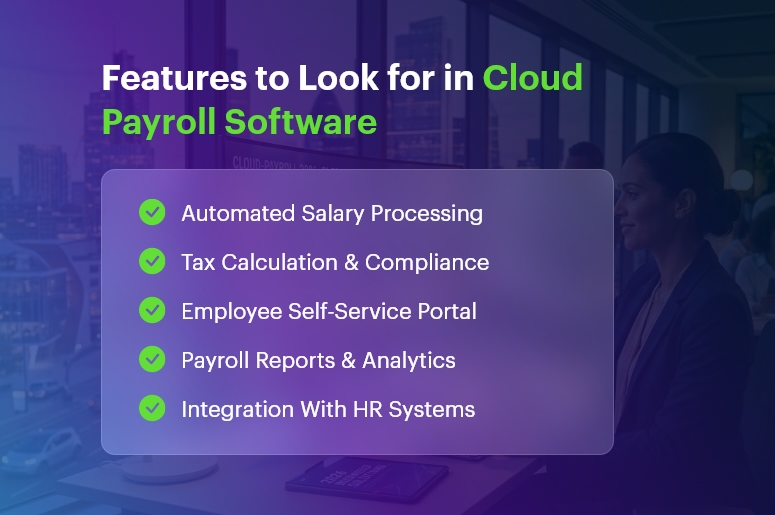
  • Indian Statutory Compliance Coverage: Verify the platform covers: EPF with ECR generation, ESI challans, TDS with both old and new tax regime support, PT with state-specific rules, Form 16, Form 24Q with FVU validation, and Labour Welfare Fund.
  • Pricing Model: Per-employee-per-month pricing can become expensive as you hire. A 100-person company paying ₹50/employee/month spends ₹60,000/year just in software fees. Flat-rate plans offer predictability. Calculate your cost at your 2-year projected headcount.
  • Compliance Update Frequency: The government updates PF slabs, ESI ceilings, and TDS formats regularly. Ask the vendor: How quickly are compliance changes reflected in the system?
  • Employee Self-Service A dedicated portal for payslip downloads, investment declarations, Form 16, and IT projections reduces HR query volume and improves employee transparency.
  • Multi-Company Support CA firms and group companies managing multiple entities need a single dashboard — not separate logins for each company. Verify this capability before purchasing.
  • Integration with Attendance and HR Manual reconciliation between attendance and payroll creates errors. Native integration between attendance, leave, and payroll is significantly more reliable.
  • Data Security and Hosting For Indian businesses, look for: 256-bit TLS encryption, India-based data hosting (important under the DPDP Act), ISO 27001 certification, and SOC 2 compliance.
    Support Quality During Filing Deadlines. TDS filing deadlines fall on the 7th and 31st of each month. ESI and EPF due dates cluster around the 15th. Evaluate whether the vendor offers phone or chat support during these critical windows.

Top 10 Cloud-Based Payroll Software Solutions for Indian Businesses in 2026

All information below is sourced from official vendor websites. Pricing marked as “not publicly available” reflects vendor websites that do not publish public pricing — not an editorial judgment.

1. INDPayroll

INDPayroll is a cloud payroll platform built specifically for Indian statutory compliance, with particular focus on the needs of SMEs and chartered accountant firms. It is the only platform in this list offering a permanently free plan with genuine compliance features — not a time-limited trial.

Notably, the platform is trusted by 5,000+ Indian businesses and 300+ CA firms (source: indpayroll.com), and carries a 4.8/5 rating on SoftwareSuggest.

Key Features

  • Automated monthly payroll runs
  • Full statutory compliance: EPF (with ECR generation), ESI, TDS (old and new regime), Professional Tax
  • Dual tax regime optimisation — automatically recommends which regime (old vs. new) maximises employee take-home
  • One-click Form 16 generation with bulk email delivery
  • ECR and PF challan generation — ready-to-upload files for EPFO portal
  • Employee Self-Service portal: payslips, tax projections, investment proof submissions
  • Multi-company management dashboard — single login for multiple entities/clients
  • Advanced attendance with geo-tagging (Ultimate and Enterprise plans)
  • Arrears and bonus calculations
  • Shift scheduling and roster management (Ultimate plan)
  • API access for third-party integrations (Ultimate plan)
  • Custom report builder (Ultimate plan)
  • 256-bit TLS encryption, India-based data hosting
  • Free tools: Payslip Generator, CTC Calculator, TDS Calculator, PF Calculator, Gratuity Calculator

Pricing

Plan Monthly Price Employee Limit Key Inclusions
Free ₹0 (forever) Up to 25 Payroll runs, payslips, basic PF, leave tracking, mobile read-only
Essentials ₹399/month flat Up to 200 Full TDS, ESI, PT, Form 16, ECR generation, priority email support
Ultimate ₹3,199/month flat (limited-time offer; was ₹15,000) Unlimited Advanced attendance, arrears, shift scheduling, API access, 24/7 support
Enterprise Custom Unlimited Biometric sync, ERP bridge (SAP/Oracle), SSO/SAML, on-premise option

Pros

  • Only platform with a permanently free plan covering genuine Indian compliance
  • Flat-rate pricing eliminates cost surprises as headcount grows
  • Purpose-built for Indian statutory compliance — not a global platform with India added on
  • A multi-client dashboard is a genuine differentiator for CA firms
  • Dual tax regime optimisation automates one of the most complex annual HR decisions

Cons

  • India-only; not suitable for multi-country payroll
  • Advanced features (biometric, ERP bridge) require the Enterprise plan

Best For

Indian SMEs, startups (up to 200 employees), CA firms managing multiple clients, manufacturing companies, retail chains, and any business prioritising compliance without per-employee pricing.

2. greytHR

greytHR is one of India’s most established cloud HR and payroll platforms, trusted by 30,000+ companies (source: greythr.com/pricing). The platform claims 99.5% uptime and positions its ESS portal as reducing administrative workload by 80%.

Key Features

  • Highly customizable salary structures with unlimited salary components
  • Configurable payroll engine handling complex use cases
  • Statutory compliance: PF with ECR generation, ESI with challans, PT with all state-specific rules built in, TDS with
  • comprehensive eTDS returns, one-click Form 24Q with automatic FVU validation, digitally signed Form 16 and 12BA,
  • bonus calculations, Labour Welfare Fund deductions
  • greytHR PayNow: Direct salary transfer from within the application (direct debit facility)
  • Electronic bank-transfer formats for all major Indian banks
  • ESS portal: reimbursement claims, investment declarations (PIT), proof of investment (POI), YTD statements, IT statements, payslips, Form 16s
  • Workflows and helpdesk for employee servicing
  • AI-powered chatbot (Navos AI, included in all plans)
  • Geo-fencing, GPS live tracking (add-ons)

Pricing

Plan Base Price Includes Per Additional Employee
Essential ₹2,495/month 50 employees ₹45/employee/month
Growth ₹4,495/month 50 employees ₹85/employee/month
Premium Custom Unlimited Contact sales

Pros

  • One of the most comprehensive compliance engines in India
  • Form 24Q with FVU validation — a rare feature that eliminates manual TRACES uploads
  • GreytHR PayNow direct debit is a genuine time-saver for salary disbursement
  • Navos AI chatbot included in all plans

Cons

  • Per-employee pricing above 50 employees can become expensive at scale
  • Full feature set requires Growth or Premium — some key features are add-ons on Essential
  • Premium plan pricing requires a sales call

Best For

Mid-sized Indian businesses (50–500 employees), companies needing the most comprehensive statutory compliance automation, and organisations that want an all-in-one HR + payroll platform.

3. Zoho Payroll

Zoho Payroll is the payroll module within Zoho’s broader business software ecosystem. It is particularly well-suited for businesses already using Zoho Books (accounting) or Zoho People (HR), as the native integration eliminates manual data sync.

Key Features

  • PF, ESI, LWF, PT, and IT compliance across 28 Indian states — automated adjustments when tax laws change
  • Tax forms: 12BB, 24Q, TDS, Form 16 — all downloadable instantly with e-signature capability
  • Leave and attendance management built into the platform (no third-party integration required)
  • Employee self-service portal: payslips, tax worksheets, Form 16 — accessible on web and mobile app
  • Salary notifications are sent automatically on payday
  • Contractor management: TDS handled automatically, managed alongside employees in one workflow
  • Multi-level payroll approval workflows for process integrity
  • Formula-based earnings: apply formulas to salary components for automated calculation
  • Reporting tags for custom payroll cost allocation
  • Scheduled earnings: configure future bonuses or variable pay in advance
  • Integration with Zoho Books (accounting), Zoho People (HRMS), Zoho CRM, and other Zoho apps
  • Custom integrations with Workday, SAP, Oracle, UKG, and Microsoft (enterprise)

Pricing

Contact Zoho directly or visit zoho.com/in/payroll/pricing)

Pros

  • Deepest integration within the Zoho ecosystem — ideal for businesses using Zoho Books or Zoho People
  • 28-state compliance coverage across all statutory obligations
  • High app ratings (4.8 App Store) indicate a strong mobile user experience
  • An e-signature on Form 16 is a genuine convenience feature

Cons

  • Best value only if already in the Zoho ecosystem
  • Pricing not publicly available — requires a demo or trial to evaluate cost
  • Less specialised for CA multi-client management than INDPayroll

Best For

Indian businesses already using Zoho Books, Zoho People, or other Zoho apps; companies wanting a natively integrated accounting + payroll + HR stack; businesses in 28-state multi-location operations.

4. Keka

Keka is an Indian HR platform with payroll as a core module, serving a large and well-documented customer base.

Key Features

  • 4-step payroll process: import data → automated calculations → disburse salaries → auto-file compliance reports
  • Statutory compliance: PF, ESIC, TDS, PT — calculations with latest rates; ECR, 24Q, and 26Q reports generated; challans ready for filing with audit trails
  • Salary & Payout Automation: payroll across entities, branches, and pay groups; salary revisions, arrears, bulk payouts; off-cycle payouts
  • Attendance & Leave Integration: payroll pulls directly from attendance data — LOP, shifts, and overtime auto-accounted
  • Employee Self-Service: payslips, Form 16, investment declarations, tax summaries — web and mobile
  • Expense & Reimbursement Management: claim submission, manager approval with policy checks, auto-sync to payroll
  • Loans & Advances Management: custom loan policies, EMI tracking, payroll-aligned repayments
  • Multi-entity payroll with state-specific compliance
  • Integration: Tally, QuickBooks, Zoho Books, SAP, API connectivity
  • GPS/mobile attendance, shift management (via Time & Attendance module)
  • Performance management, recruiting, LMS (separate modules)
  • Security: role-based access, maker-checker approvals, bank account verification, encrypted data

Pricing

free trial and demo available at keka.com/signup

Pros

  • 10,000+ company track record and 35M+ payroll runs provide strong reliability evidence
  • Supports all workforce types: full-time, contractors, interns, gig workers
  • Loans and advances management is a feature rarely found in competing platforms
  • Strong accounting integrations (Tally, QuickBooks, SAP)

Cons

  • Pricing not publicly available — requires demo
  • A full HRMS platform means users pay for modules they may not need
  • Implementation can take time for larger organisations

Best For

Mid-market Indian companies (50–2,000 employees) needing a unified HRMS + payroll platform; businesses with complex workforce types; organisations needing integrated loans and expense management.

Free Payroll, PF, ESI & TDS Software

The most trusted automation tool for modern Indian businesses.

5. factoHR

FactoHR is an AI-powered HR and payroll platform with a strong presence in manufacturing, retail, and enterprise segments.

Key Features

  • Full suite: Recruitment, HR, Onboarding, Attendance, Payroll, Leave, Performance (OKR-based), LMS, Travel & Expense, ESS, Mobile App, Timesheet
  • Retirement Benefits module (unique in this list): Provident Fund trust management, Benevolent Fund, Superannuation,
  • Pension Management, General Provident Fund, Unexempted PF, Gratuity
  • Mobile app features: Contactless attendance, AI-powered Face Recognition, Geo-fencing, Employee chatbot
  • Payroll with a wizard-driven approach and integrated data inputs
  • Statutory compliance for Indian labour laws
  • Employee Self-Service portal
  • Scalable from startups to large enterprises

Pricing

FactoHR pricing is listed on their website. (Visit factohr.com/plans/ for current pricing — specific plan amounts not included here as they may change) A free trial/demo is available.

Pros

  • Highest verified review ratings in this list: 4.9 G2, 5.0 Capterra
  • The Retirement Benefits module (PF trust, Superannuation, Gratuity) is unique and valuable for large organisations
  • Face recognition and geo-fencing for attendance — strong for manufacturing/field staff
  • SAP and Microsoft Azure partnerships indicate enterprise-grade credibility

Cons

  • A full platform may be more than SMEs need
  • Pricing requires checking the vendor website directly
  • Primarily optimised for larger organisations, SME-friendliness is lower than INDPayroll

Best For

Manufacturing companies with complex attendance needs, large enterprises needing PF trust and retirement benefit management, and organisations with field/shop-floor workers requiring biometric and face recognition attendance.

6. RazorpayX Payroll

RazorpayX Payroll is part of Razorpay’s business banking suite, integrating payroll directly with RazorpayX’s current accounts. Its key differentiator is tight integration between payroll processing and real-time salary disbursement.

Key Features

  • Direct salary disbursement through RazorpayX current account integration
  • Automated statutory compliance: PF, ESI, Professional Tax, TDS
  • Payslip generation and employee communication
  • Compliance with Indian labour law requirements
  • Connected with Razorpay’s broader fintech infrastructure

Pricing

Contact Razorpay directly for current pricing

Pros

  • Native integration with RazorpayX’s current account simplifies salary disbursement
  • Familiar brand for startups and digital businesses already using Razorpay for payments
  • Part of a broader fintech ecosystem, including expense management, invoicing, and working capital

Cons

  • Best value only if using RazorpayX banking — less compelling as a standalone payroll tool
  • Compliance depth may be less comprehensive than dedicated payroll platforms like greytHR or INDPayroll

Best For

Startups and digital-first businesses already using RazorpayX for banking; companies want integrated payroll + business banking in a single platform.

7. Pocket HRMS

Pocket HRMS is an Indian cloud HRMS and payroll platform positioned for SMEs and mid-sized businesses seeking an affordable all-in-one solution.

Key Features

  • Automated payroll processing with statutory compliance
  • TDS, PF, ESI, and Professional Tax calculations
  • Payslip generation
  • Employee self-service portal
  • Attendance and leave integration with payroll
  • Mobile application for HR and employees
  • Reports and compliance documentation

Pricing

Pricing is available 

Pros

  • Designed for SMEs — simpler interface than enterprise platforms
  • Integrated HRMS beyond payroll (attendance, leave, ESS)
  • Indian compliance coverage

Cons

  • Less market presence and verified customer statistics than category leaders
  • Full pricing requires a demo or trial

Best For

Small to mid-sized Indian businesses (10–200 employees) looking for an affordable, integrated HRMS + payroll solution.

8. PeopleStrong

PeopleStrong is an enterprise-grade Indian HR technology platform serving large organisations across Asia.

Key Features

  • End-to-end payroll management and automation
  • Indian statutory compliance (PF, ESI, TDS, PT)
  • Cloud-based payroll management system
  • Salary processing and tax management
  • Employee self-service

Pricing

enterprise custom pricing

Pros

  • Enterprise-grade platform designed for large, complex organisations
  • Strong presence in the Asia-Pacific market
  • Comprehensive HR suite beyond payroll

Cons

  • Not designed for SMEs — minimum viable size is typically 500+ employees
  • Pricing requires enterprise engagement
  • Implementation timelines can be extended for large organisations

Best For

Large Indian enterprises (500+ employees), multi-location organisations across India and Asia-Pacific, and businesses needing a full enterprise HCM suite.

9. Darwinbox

Darwinbox is a Hyderabad-headquartered enterprise HR platform that has grown significantly across Asia and the Middle East, particularly among large corporates.

Pricing

enterprise custom pricing

Best For

Large Indian enterprises and multinational organisations need a modern, mobile-first enterprise HCM platform.
For verified, current feature and pricing information, visit darwinbox.com directly.

10. ADP India

ADP is a global payroll and HR services leader with 1.1 million clients worldwide (source: adp.com), including a dedicated India operation serving multinationals and large Indian enterprises.

Pricing

custom enterprise pricing for India

Pros

  • Unmatched global reliability and institutional trust — 1.1M clients
  • Best choice for multinationals needing India + global payroll in one system
  • Deep ERP integrations (SAP, Oracle, Workday)
  • ADP’s compliance team tracks India regulatory changes proactively

Cons

  • Significantly more expensive than Indian-native platforms
  • Designed for large enterprises — not cost-effective for SMEs
  • Implementation can take months for complex configurations

Best For

Multinational corporations with India operations needing local + global payroll, large Indian enterprises requiring ERP integration, and companies with 500+ employees needing global compliance.

Cloud-Based Payroll Software Master Comparison Table

Platform Target Size India Compliance Free Plan Pricing Model Key Rating Unique Strength
INDPayroll SME, Startup, CA ✅ Full (PF, ESI, TDS, PT) ✅ Up to 25 employees Flat-rate 4.8 SoftwareSuggest CA multi-client, flat pricing
greytHR SME to Mid-market ✅ Full ✅ 7-day trial Per-employee above 50 30,000+ clients Form 24Q FVU, PayNow
Zoho Payroll SME to Mid ✅ 28 states ✅ 14-day trial Not published 4.8 App Store Zoho ecosystem integration
Keka Mid-market ✅ Full Free trial Not published 10,000+ companies Loans, multi-entity payroll
factoHR Mid to Enterprise ✅ Full Free trial Listed on site 4.9 G2, 5.0 Capterra PF trust, face recognition
RazorpayX Payroll Startup, SME ✅ Partial Not listed Not published Razorpay ecosystem Banking + payroll integration
Pocket HRMS SME ✅ Partial Free trial Not published Not verified SME affordability
PeopleStrong Enterprise ✅ Full No Custom Enterprise Asia-Pacific HCM
Darwinbox Enterprise ✅ Full No Custom Enterprise Mobile-first enterprise HCM
ADP India Enterprise, MNC ✅ Full + Global No Custom 1.1M clients globally Global + India payroll

Future Trends in Cloud-Based Payroll Software Technology

AI-assisted compliance monitoring is emerging across platforms. greytHR’s Navos AI and Keka’s automation capabilities represent early implementations. Expect AI to flag compliance anomalies proactively and suggest optimal tax structures.

Real-time salary disbursement via UPI and IMPS integration is becoming standard. RazorpayX Payroll’s banking-integrated model represents where the market is heading — salary runs are completed within minutes of approval.

DPDP Act compliance (Digital Personal Data Protection Act, 2023) will become a vendor differentiator. Platforms that offer consent management, data principal rights workflows, and breach notification systems will have an advantage as enforcement increases.

Earned Wage Access (EWA) — allowing employees to access a portion of their earned salary before payday — is gaining traction in India, particularly for blue-collar workers. Expect this feature to appear in more Indian payroll platforms by 2027.

Integrated gig and contract worker payroll is growing as more Indian businesses engage gig workers at scale. Platforms that handle TDS on contractor payments alongside regular employee payroll will be better positioned.

Expert Recommendations

For SMEs and startups (up to 200 employees): Start with INDPayroll’s free or Essentials plan. The permanently free plan covers genuine compliance for up to 25 employees — there is no cost justification for a spreadsheet-based alternative at this scale.

For CA firms managing multiple clients: INDPayroll’s multi-client dashboard and greytHR’s multi-company support (Growth and Premium plans) are the two verified options built for this use case.

For mid-sized businesses (200–1,000 employees): greytHR provides the most comprehensive compliance automation with verified uptime and a 30,000+ customer base. Keka is worth evaluating for businesses needing stronger workforce management features alongside payroll.

For manufacturing and blue-collar-intensive businesses: factoHR’s face recognition attendance and geo-fencing are purpose-built for this segment. The 4.9 G2 rating and Cycle Agarbatti / GHCL case studies demonstrate real manufacturing deployment.

Finally, for enterprise and multinational organisations: ADP India for businesses requiring global payroll. Darwinbox or PeopleStrong for India-centric large enterprises. Budget for implementation time and custom pricing engagement.

Additionally, for Zoho users: Zoho Payroll is the obvious choice. The native Zoho Books and Zoho People integration eliminates reconciliation effort that would otherwise consume significant HR and accounting time.

India’s #1 Free Software

Free Payroll, PF, ESI & TDS Software

Conclusion

Cloud-based payroll software has become an essential business tool in 2026. By automating salary processing, improving compliance, and enhancing employee experience, payroll platforms help organisations save time, reduce errors, and focus on growth.

However, while enterprise organisations may benefit from solutions like Workday, ADP, and Darwinbox, small and medium-sized businesses often require a more practical and cost-effective platform. For businesses operating in India, INDPayroll stands out as a strong option due to its focus on payroll automation, statutory compliance, employee self-service, attendance integration, and SME-friendly approach.

Therefore, the right cloud-based payroll software should align with your organisation’s size, compliance requirements, growth plans, and operational needs. By evaluating features, scalability, and support carefully, businesses can select a payroll platform that delivers long-term value and efficiency.

Payroll ROI: Unlock How Automation Increases Your Profits!

What if your payroll process is silently draining thousands of rupees every month — and you don’t even know it? Most business owners and HR managers focus on payroll as a compliance task, not a profit lever. But here’s the truth: the ROI of payroll automation is one of the most overlooked financial wins in modern businesses.

Manual payroll is slow, error-prone, and expensive. Between recalculations, compliance penalties, and hours of staff time — the hidden costs pile up fast. This guide will show you exactly how payroll software turns those costs into measurable profit gains — with real data, real use cases, and a clear roadmap to smarter payroll.

Ready to see what automated payroll can really do for your bottom line? Let’s break it down. Try it free and experience the ROI shift yourself.

Free Payroll, PF, ESI & TDS Software

The most trusted automation tool for modern Indian businesses.

What Is Payroll ROI and Why Does It Matter?

Payroll ROI (Return on Investment) measures the financial gains your business earns by optimizing your payroll process — compared to the time, money, and resources you spend running it. In simpler terms: how much are you saving (or losing) by the way you currently handle payroll?

For most SMEs in India, payroll is processed manually or with outdated tools. That means:

  • HR teams spending 10–15 hours per month on manual data entry
  • Frequent errors in salary slip generation and tax deductions
  • Compliance risks with EPF, ESI, and TDS miscalculations
  • High employee dissatisfaction from delayed or incorrect pay

When you introduce automated payroll software, each of these pain points is eliminated — and that elimination translates directly into rupees saved and profits recovered.

ROI Formula for Payroll:

Payroll ROI = (Total Cost Saved – Cost of Payroll Software) ÷ Cost of Payroll Software × 100

If your team was spending ₹50,000/month in combined staff hours and compliance penalties, and INDPayroll costs ₹3,000/month — your ROI is over 1,500%. That’s not a typo.

The Real Costs of Manual Payroll Processing

Before you can appreciate the ROI of automation, you need to understand what manual payroll actually costs. Most businesses see only the surface — the software license fee or accountant’s salary. The real iceberg runs much deeper.

1. Lost Staff Hours

According to industry benchmarks, HR teams in SMEs spend an average of 12–18 hours per month on payroll-related tasks — data collection, entry, verification, and corrections. At an average HR salary of ₹35,000/month, that’s roughly ₹10,000+ in pure labor cost just for payroll processing — every single month.

With automated salary processing, this drops to under 2 hours. That’s 80%+ time saved.

2. Compliance Penalties and Errors

India’s payroll compliance landscape is complex. EPF, ESI, TDS, PT — each has its own filing schedule, rate changes, and penalties. A single miscalculation can result in penalties from ₹5,000 to ₹25,000 or more. With manual systems, errors are inevitable.

INDPayroll’s PF & ESI compliance module auto-calculates contributions based on the latest EPF regulations, eliminating this risk entirely.

3. Payslip Generation Delays

Delayed payslips frustrate employees and create HR bottlenecks. With manual methods, generating 50+ payslips takes hours of formatting, checking, and emailing. Our free payslip generator automates this in minutes — with professional formatting and complete salary breakdowns.

4. Audit and Reconciliation Costs

Manual payroll creates inconsistent records that are hard to audit. Year-end reconciliations consume significant time and often require external accountants. Automated payroll keeps a clean, timestamped audit trail — saving ₹15,000–₹50,000 in annual audit prep costs for mid-sized teams.

How Payroll Automation Directly Increases Your Profits

Let’s get specific. Here are the five core ways payroll automation generates measurable ROI for Indian businesses:

1. Massive Reduction in Processing Time

With INDPayroll’s payroll software, what took a full day now takes under 30 minutes. HR teams get their time back — time they can reinvest in recruitment, employee engagement, and strategic HR work that actually drives business growth.

Real-World Example: A 100-person IT firm in Bengaluru was spending 3 full working days every month on payroll. After switching to INDPayroll, they cut that to 4 hours — freeing up nearly ₹60,000/month in combined HR productivity.

2. Zero Compliance Penalties

INDPayroll automatically stays updated with the latest Indian labor law updates, EPF ceiling changes, and ESI rate revisions. Use our PF calculator and ESI calculator to instantly verify contributions. This means no surprise penalties, no late filing fees, and no compliance anxiety.

3. Accurate Salary Breakup Every Time

Errors in salary computation cause downstream problems — incorrect TDS, wrong Form 16, disputed payslips. INDPayroll’s CTC calculator and salary breakup engine ensures every component — Basic, HRA, LTA, PF, ESI, PT — is calculated precisely, automatically, and consistently.

Explore our free payroll tools to see how accurate your current setup is.

4. Reduced Payroll Fraud Risk

Manual payroll creates opportunities for ghost employees, inflated claims, and unauthorized changes. Automated payroll software has built-in access controls, approval workflows, and audit logs — significantly reducing fraud risk. For a 200-person company, even a 0.1% payroll fraud rate could mean ₹1–2 lakhs lost annually.

5. Happier Employees = Higher Retention

This is the ROI that most spreadsheets miss. When employees receive accurate, on-time salary slips and transparent salary breakdowns — trust improves. Employee satisfaction surveys consistently show that payroll accuracy is among the top 3 factors in workplace satisfaction. High retention saves ₹50,000–₹2,00,000 per employee in recruitment and onboarding costs.

Start your free trial and see the difference accurate, on-time payroll makes for your team.

Payroll ROI Calculator: Estimate Your Savings

Not sure what your payroll ROI looks like? Here’s a simplified model based on common SME metrics:

Cost Area Manual Payroll (Monthly) With INDPayroll (Monthly) Monthly Savings
HR Staff Time ₹12,000 ₹2,000 ₹10,000
Compliance Penalties ₹8,000 (avg) ₹0 ₹8,000
Payslip Generation ₹3,000 ₹500 ₹2,500
Error Corrections ₹4,000 ₹200 ₹3,800
Audit/Reconciliation ₹5,000 ₹500 ₹4,500
Total ₹32,000 ₹3,200 ₹28,800/month

That’s over ₹3,45,600 in annual savings for a 50–100 person company — just by switching to automated payroll.

INDPayroll vs Manual Payroll: Feature-by-Feature Comparison

Speed and Accuracy

Manual payroll requires human data entry, verification, and re-entry — all prone to error. INDPayroll’s salary processing engine runs calculations in seconds with 100% accuracy. No rounding errors, no missed deductions, no formatting mistakes on payslips.

Compliance Automation

Manual payroll depends on the HR team staying current with every regulation change. INDPayroll integrates directly with the latest EPF compliance guidelines and ESI compliance guide, so your filings are always current — automatically.

Reporting and Analytics

Manual payroll generates reports only when someone builds them. INDPayroll’s payslip and reports generator provides instant, customizable reports for management, finance, and compliance — on demand, any time.

Scalability

Hiring 10 more employees with manual payroll means 10x more work. With INDPayroll, adding employees takes minutes — with no added complexity or cost per task.

India’s #1 Free Software

Free Payroll, PF,
ESI & TDS Software

Professional compliance management for Indian businesses. 100% Free Forever.

Who Benefits Most from Payroll Automation ROI?

Startups and SMEs (10–200 employees)

This segment gains the most from payroll automation ROI. Lean teams can’t afford HR headcount dedicated purely to payroll. INDPayroll replaces a part-time payroll executive with software that costs a fraction of the salary — and works 24/7 without errors.

IT Companies and Remote Teams

Distributed teams with employees across states face multi-state PT compliance, varying allowances, and remote attendance tracking. INDPayroll handles all of it centrally, making it ideal for tech firms managing hybrid or remote workforces.

Manufacturing and Retail Businesses

High headcounts, shift-based attendance, and complex wage structures make manual payroll a nightmare. Automation streamlines everything from wage calculation to PF/ESI filing — including registration and filing tutorials.

Agencies and Professional Services

Client-billing agencies and professional firms often have variable pay structures — bonuses, commissions, and project-based compensation. INDPayroll handles this flexibility while maintaining compliance and clean records.

Comparing INDPayroll with Other Payroll Solutions

Wondering how INDPayroll compares to competitors? We’ve done the homework:

INDPayroll consistently delivers stronger ROI through superior compliance automation, lower pricing tiers, and India-specific payroll intelligence that generic HR tools simply can’t match.

Step-by-Step: How to Start Maximizing Payroll ROI with INDPayroll

Step 1: Audit Your Current Payroll Costs

Use the ROI table above as a baseline. Log how many hours your HR team spends on payroll, how many compliance penalties you’ve paid in the last 12 months, and how frequently salary errors occur.

Step 2: Sign Up for INDPayroll

Visit INDPayroll and create your account. Setup takes under 15 minutes — including importing your employee data and configuring your salary structure.

Step 3: Configure Your Salary Structure

Use the CTC calculator to set up each employee’s salary breakup. INDPayroll supports custom pay components, variable pay, and India-specific statutory deductions.

Step 4: Run Your First Payroll

Process your first payroll in minutes using INDPayroll’s salary processing module. Review automatically generated payslips, compliance reports, and payment summaries — all in one dashboard.

Step 5: Monitor ROI Monthly

Use INDPayroll’s reporting suite to track time saved, errors reduced, and compliance maintained. Most businesses hit full ROI within the first 2–3 months of using INDPayroll.

Try INDPayroll free today — no credit card required.

Real Results: What INDPayroll Customers Are Saying

“We were spending almost 3 working days a month on payroll. INDPayroll cut that down to a few hours. The compliance automation alone saved us from two potential PF penalties last quarter.” — HR Manager, 120-person software firm, Pune

“The salary slip generation is flawless. Our employees love receiving professional payslips on time. It’s improved trust in our payroll process significantly.” — Operations Head, logistics startup, Hyderabad

“We switched from a generic tool and the difference in India-specific compliance handling is night and day. INDPayroll actually knows EPF, ESI, and PT — not just basic salary math.” — Founder, digital agency, Delhi NCR

Key Metrics to Measure Payroll Automation ROI

Once you’ve automated payroll, track these KPIs monthly to quantify your ROI:

  • Payroll Processing Time: Hours spent per payroll cycle (target: under 2 hours)
  • Error Rate: Number of payroll corrections per month (target: 0)
  • Compliance Penalty Rate: EPF/ESI/TDS penalties in the last 12 months (target: ₹0)
  • Employee Payslip Satisfaction: From your employee feedback surveys
  • HR Productivity Index: Hours freed for strategic HR work
  • Payroll Cost as % of Revenue: Benchmark this quarterly to track improvement

Read our INDPayroll blog for monthly benchmarks and payroll best practices tailored to Indian businesses.

India’s #1 Free Software

Free Payroll, PF, ESI & TDS Software

Conclusion: Your Payroll Is a Profit Center Waiting to Happen

Payroll automation isn’t a luxury — it’s a financial strategy. The ROI is clear, the implementation is fast, and the benefits compound over time. Every month you delay automating payroll is another month of avoidable costs, compliance risks, and wasted HR hours.

With INDPayroll, you get India’s most compliance-forward payroll software — built specifically for businesses that want to grow without being held back by manual HR processes. From PF & ESI compliance to instant payslip generation — everything you need is in one platform.

Stop treating payroll as a cost center. Start treating it as a ROI engine.

Frequently Asked Questions

1. What is payroll ROI and how is it calculated?

Payroll ROI measures the financial return you get from investing in payroll automation. It’s calculated as: (Total Cost Saved – Cost of Payroll Software) ÷ Cost of Payroll Software × 100. Most businesses using INDPayroll see ROI within 60–90 days.

2. How much can a business save by automating payroll in India?

Depending on company size, businesses typically save ₹20,000–₹60,000 per month by switching from manual to automated payroll — factoring in time, compliance penalties, and error correction costs.

3. Does payroll automation help with EPF and ESI compliance?

Yes. INDPayroll’s PF & ESI compliance module auto-calculates contributions, stays updated with regulation changes, and generates filing-ready reports — eliminating compliance risk.

4. Is INDPayroll suitable for small businesses?

Absolutely. INDPayroll is built for Indian SMEs with 10–500 employees. It’s affordable, easy to set up, and handles all India-specific payroll requirements out of the box.

5. How quickly can I set up INDPayroll?

Most businesses are fully set up within 1 business day. You can import employee data, configure salary structures, and run your first payroll in under 15 minutes using INDPayroll’s guided setup.

6. Can INDPayroll generate salary slips automatically?

Yes. INDPayroll’s payslip generator creates professional, compliant salary slips in seconds — for all employees, all at once, with full salary breakup details.

7. How does payroll automation improve employee retention?

Accurate, on-time salary payments and transparent payslips significantly improve employee trust and satisfaction. This directly reduces attrition — saving ₹50,000–₹2,00,000 per replaced employee in recruitment and training costs.

8. What’s the difference between INDPayroll and manual Excel payroll?

Excel payroll is error-prone, time-intensive, and not compliance-aware. INDPayroll automates calculations, stays updated with Indian labor laws, generates reports, and processes payslips automatically — saving hours every month.

9. Does INDPayroll handle multi-state payroll compliance?

Yes. INDPayroll supports Professional Tax (PT) rates across Indian states, making it ideal for businesses with employees in multiple states or remote/hybrid teams spread across India.

10. Where can I try INDPayroll for free?

You can start your free trial — no credit card required. Explore all features, process a test payroll, and see the ROI difference firsthand.

Why Businesses Are Switching to Cloud-Based Payroll Software in 2026

Payroll management has always been one of the most critical — and most time-consuming — functions in any business. From calculating salaries and deductions to ensuring statutory compliance with PF, ESI, and TDS, the monthly payroll cycle demands accuracy, speed, and up-to-date knowledge of ever-changing regulations.

For years, businesses in India relied on spreadsheets or installed desktop software to handle these tasks. These systems worked — until they didn’t. As teams grew, regulations changed, and remote work became the norm, the limitations of traditional payroll tools quickly became apparent.

That is why, in 2026, more businesses than ever are making the switch to cloud-based payroll software. It is not just a technology upgrade — it is a strategic shift in how companies manage their workforce, control costs, and stay compliant.

India’s #1 Free Software

Free Payroll, PF,
ESI & TDS Software

Professional compliance management for Indian businesses. 100% Free Forever.

What Is Cloud-Based Payroll Software?

Cloud-based payroll software is an online payroll system that processes and manages employee compensation through secure, internet-hosted servers. Unlike legacy systems that require installation on local computers or on-premises hardware, this platform is accessible from any device, anywhere, at any time.

The software provider maintains the platform, handles all updates, and ensures the system reflects the latest tax laws and compliance requirements — without your IT team lifting a finger. You simply log in, run payroll, and let the system do the heavy lifting.

For business owners and HR managers overseeing growing teams, this represents a fundamental change: from reactive, manual processing to proactive, automated payroll management. To understand the full scope of what this means, explore how INDPayroll’s payroll automation works.

Features to Look for in Cloud Payroll Software

Key Reasons Businesses Are Switching to Cloud Payroll in 2026

The migration from legacy payroll tools to modern cloud platforms is accelerating. Here is what is driving it.

Payroll Automation Saves Time and Reduces Errors

Manual payroll is error-prone. A misplaced decimal or an outdated tax slab can lead to employee dissatisfaction and regulatory penalties. An automated payroll system handles salary calculations, statutory deductions, payslip generation, and bank transfer files — reducing the processing cycle from days to hours.

With built-in payroll automation, HR teams can focus on people strategy rather than number-crunching. Learn more about INDPayroll’s automated salary processing.

Remote Access and Flexible Operations

India’s workforce is increasingly distributed. Whether your team works from home, across multiple offices, or in different states, a cloud payroll platform gives HR and finance teams the ability to process payroll from anywhere — on any device, without VPNs or dedicated office hardware.

India’s #1 Free Software

Free Payroll, PF, ESI & TDS Software

Always Up-to-Date Compliance

Tax laws, PF contribution rates, ESI rules, and professional tax slabs change frequently. Modern platforms update automatically, ensuring payroll compliance in India remains current without manual intervention. This alone is a compelling reason for finance teams to make the move. See how INDPayroll handles compliance updates automatically.

Enterprise-Grade Data Security

Payroll data is among the most sensitive information a business holds. Leading providers offer end-to-end encryption, multi-factor authentication, role-based access co ntrols, and automatic backups — protection that far exceeds what most on-premise setups can deliver.

Lower Costs, No Infrastructure Overheads

Switching to a SaaS payroll model eliminates upfront licensing costs, server maintenance, and IT support expenses. Businesses pay a predictable monthly or annual subscription and gain access to enterprise-level features — making it particularly attractive for startups and growing companies.

Benefits of Cloud-Based Payroll Software for Small Businesses

Small businesses and startups often operate with lean teams where one person handles both HR and finance. A modern online payroll solution is purpose-built for this reality.

Consider a startup with 20 employees growing to 80 within 18 months. With a scalable platform, adding new hires, updating salary structures, and managing multi-state compliance happens within the same system — no migrations, no upgrades, no disruption.

Key benefits for small businesses include:

  • Fewer manual errors: Automated calculations eliminate common payroll mistakes before they become costly.
  • Faster payroll cycles: Process the entire monthly payroll in a fraction of the time.
  • Compliance without expertise: Built-in statutory compliance means you do not need a specialist in-house.
  • Employee self-service: Staff can view payslips, download Form 16, and update personal details independently — reducing HR queries.
  • Real-time visibility: Instant reports, cost summaries, and analytics available on demand.

Why Businesses in India Need a Dedicated Payroll Compliance Solution

India’s statutory compliance landscape is one of the most complex in the world. Businesses must accurately manage:

  • Provident Fund (PF): Monthly contributions, ECR filings, and UAN management for every employee.
  • Employee State Insurance (ESI): Eligibility checks, contribution calculations, and half-yearly returns.
  • Tax Deducted at Source (TDS): Monthly deductions, quarterly filings, and annual Form 24Q submissions.
  • Professional Tax (PT): State-specific slabs applied correctly across multi-location workforces.
  • Labour Welfare Fund (LWF): Periodic contributions varying by state and employee category.

Managing all of this manually — or through software that does not update automatically — creates serious compliance risk. A missed filing, incorrect deduction, or late payment can result in penalties, employee grievances, and regulatory scrutiny.

The right HR payroll software built specifically for the Indian market removes this risk entirely. The system stays updated with regulatory changes, computes deductions accurately, and generates the filing-ready reports your finance team needs. Explore INDPayroll’s compliance management features to see this in action.

How INDPayroll Helps Businesses Manage Payroll Efficiently

INDPayroll is a cloud-based payroll software built specifically for Indian businesses — designed to make payroll fast, accurate, and fully compliant without requiring a large HR team or in-house payroll expertise.

Here is what businesses using INDPayroll experience:

  • End-to-end payroll automation: From salary inputs to payslip generation and bank transfers, the entire cycle is automated. See the full feature list.
  • Built-in Indian compliance: PF, ESI, TDS, PT, and LWF calculations are handled automatically and updated when regulations change.
  • Employee self-service portal: Employees access payslips, submit investment proofs, and view tax summaries without contacting HR.
  • Detailed payroll reports: Salary registers, cost-to-company reports, and statutory filings generated instantly.
  • Scalable for growing teams: Whether your team is 10 or 500, the platform scales without additional setup or cost
  • Responsive support: A dedicated team that understands Indian payroll complexities. Contact us anytime for guidance.

INDPayroll is designed for business owners who want payroll off their plate, HR managers who need reliable compliance management, and finance teams who need accurate data without the manual work.

Free Payroll, PF, ESI & TDS Software

The most trusted automation tool for modern Indian businesses.

Conclusion:

The shift to cloud-based payroll software is no longer optional for businesses that want to operate efficiently and stay compliant in 2026. The combination of automation, real-time compliance updates, remote accessibility, and cost efficiency makes modern payroll platforms the clear choice for Indian businesses of all sizes.

Whether you are a startup processing your first payroll or a growing company managing a distributed workforce, the right solution can transform what has always been a stressful, error-prone process into a seamless system that runs reliably in the background.

Ready to simplify payroll and stay compliant without the manual effort? Explore INDPayroll‘s features, check out our pricing plans, or request a free demo today.

Frequently Asked Questions

Q1. What is cloud-based payroll software?

Cloud-based payroll software is an online payroll system that processes employee salaries, statutory deductions, and compliance requirements through internet-hosted servers. It is accessible from any device without requiring local installation or dedicated hardware.

Q2. Is a cloud payroll platform safe for sensitive employee data?

Yes. Reputable providers use end-to-end data encryption, multi-factor authentication, and role-based access controls. Automated backups ensure data is never lost due to hardware failure or human error.

Q3. How does online payroll software handle PF, ESI, and TDS compliance in India?

A payroll compliance platform built for India automatically calculates PF, ESI, TDS, professional tax, and LWF contributions using current statutory rates. The system updates when regulations change, ensuring your filings are always accurate.

Q4. Is this type of payroll tool suitable for small businesses and startups?

Absolutely. Modern payroll platforms are especially valuable for small businesses because they remove the need for in-house payroll expertise, reduce manual errors, and scale easily as the team grows — all at an affordable subscription cost.

Q5. What features should I look for in a payroll management system?

Look for automated salary processing, built-in PF/ESI/TDS compliance, an employee self-service portal, payroll reports and analytics, multi-state support, and seamless integration with attendance and leave management tools.

How Payroll Software Changes the Life of a Tax Consultant?

In today’s fast-evolving financial landscape, tax consultants play a critical role in ensuring businesses remain compliant while optimizing their tax liabilities. They deal with salary structures, statutory deductions, income tax filings, reimbursements, benefits, and ever-changing government regulations.

But as businesses scale, so does the complexity of payroll and tax management. Manual spreadsheets, repetitive calculations, and constant regulation updates make it nearly impossible for tax consultants to stay efficient and error-free.

This is where modern payroll software — like CrmLeaf Payroll — becomes a transformative tool. It automates the entire payroll lifecycle, enhances compliance accuracy, and provides real-time insights, helping tax consultants move from being reactive to strategic advisors.

In this comprehensive guide, we’ll explore how payroll software changes the life of a tax consultant — improving productivity, accuracy, compliance, and client satisfaction.

Why Payroll Software Is a Game-Changer for Tax Consultants

Eliminates Manual Payroll Hassles

For decades, payroll processing meant navigating endless spreadsheets, verifying attendance, calculating deductions, and applying tax rules manually. It was time-consuming, error-prone, and mentally exhausting.

With Payroll Software for Tax Consultants:

  • Automated Payroll Runs: Set schedules and let the system process salaries, deductions, and bonuses automatically.
  • Pre-Configured Rules: Define salary structures, tax slabs, and deductions once — the software does the rest every month.
  • Error-Free Processing: CrmLeaf’s automation eliminates manual calculation mistakes, ensuring 100% accuracy.

Result: Tax consultants spend less time crunching numbers and more time on strategic planning, client advisories, and business growth.

Free Payroll, PF, ESI & TDS Software

The most trusted automation tool for modern Indian businesses.

Automates Compliance and Tax Regulations

Tax laws are dynamic, with frequent updates in TDS rates, EPF, ESI, gratuity, and professional tax. Staying current manually is nearly impossible for consultants managing multiple clients.

CRMLeaf Payroll Keeps You Compliant Automatically:

  • Real-Time Updates: The system is auto-updated with the latest government rules and tax amendments.
  • Region-Specific Customization: Easily configure compliance settings for different states or countries.
  • Pre-Filled Forms and Returns: Generate TDS statements, Form 16, and statutory filings in seconds.

No more compliance stress. CrmLeaf ensures every payroll aligns with current tax norms — reducing legal risks and saving consultants from penalties or rework.

Streamlines Multi-Client Management

A tax consultant’s workload is rarely limited to a single organization. Managing payroll for multiple clients means handling diverse pay structures, compliance needs, and reporting formats.

How Payroll Software Simplifies Multi-Client Operations:

  • Centralized Dashboard: View all clients’ payroll data from one secure dashboard.
  • Client-Specific Rules: Configure unique salary templates and compliance settings per client.
  • Switch Effortlessly: Toggle between different client payrolls in a few clicks without confusion.

CRMLeaf Payroll allows consultants to manage multiple clients simultaneously, improving efficiency and reducing the risk of errors from juggling different data sources.

Enhances Accuracy in Tax Filings

For a tax consultant, accuracy isn’t optional — it’s the foundation of trust. Payroll software ensures consistency across all calculations and eliminates manual discrepancies.

Accuracy Benefits with CRMLeaf Payroll:

  • Automated Tax Computation: Automatically calculates tax withholdings, exemptions, and deductions.
  • Validation Checks: Flags anomalies before payroll is finalized.
  • Integrated Tax Reports: Syncs payroll data directly with accounting and tax systems.

By ensuring every figure aligns perfectly, consultants can file accurate returns, avoid audits, and maintain flawless client records.

Provides Real-Time Reports and Analytics

Traditional payroll tools only process payments; modern payroll platforms like CrmLeaf deliver actionable insights.

Key Reporting Features:

  • Customizable Reports: Generate payroll summaries, tax liabilities, and year-end financial statements in real time.
  • Trend Analysis: Track employee costs, tax liabilities, and benefits distributions over time.
  • Forecasting Tools: Anticipate future tax implications and help clients plan proactively.

For consultants, this means transforming from a compliance manager into a data-driven financial advisor — offering smarter recommendations backed by real-time analytics.

India’s #1 Free Software

Free Payroll, PF, ESI & TDS Software

Strengthens Data Security and Confidentiality

Payroll and tax data are highly sensitive — containing bank details, PANs, salary information, and identification documents. A single leak can destroy client trust.

CRMLeaf Payroll’s Security Protocols Include:

  • Bank-Grade Encryption: Protects data in transit and at rest.
  • Role-Based Access Controls: Restrict access by user role (consultant, accountant, admin, etc.).
  • Audit Trails: Keep a full log of every activity for transparency and accountability.
  • Cloud Backup & Recovery: Prevents data loss and ensures business continuity.

By using secure payroll software, tax consultants safeguard not just data, but their reputation and client trust.

Boosts Productivity and Saves Time

Manual payroll operations can consume 60–70% of a tax consultant’s monthly workload. Payroll software drastically reduces that time.

Productivity Gains:

  • Automated Payroll Runs: Execute multiple client payrolls simultaneously.
  • One-Click Payslips: Generate, download, or email payslips automatically.
  • Task Reminders: Get alerts for compliance deadlines and tax filings.

Time Saved = Higher Earnings + Less Stress.

Consultants can reinvest this time in acquiring new clients, upselling advisory services, or simply maintaining a healthier work-life balance.

Improves Client Communication and Transparency

Clients expect transparency — they want to see how salaries, deductions, and taxes are being managed. Payroll software helps consultants deliver this easily.

With CrmLeaf Payroll:

  • Client Dashboards: Share real-time payroll summaries and reports.
  • Custom Reports: Offer branded, professionally formatted statements for each client.
  • Automated Notifications: Keep clients informed about filings, due dates, and approvals.

Transparent reporting builds long-term client trust and differentiates a consultant from competitors relying on outdated manual systems.

Supports Remote and Hybrid Work Models

Post-pandemic, many tax consultants operate remotely or manage distributed clients. Cloud-based payroll systems ensure accessibility anytime, anywhere.

Cloud Payroll Benefits:

  • Work from Anywhere: Access client data securely from any device.
  • Team Collaboration: Multiple team members can collaborate in real time.
  • 24/7 Availability: No dependency on physical office infrastructure.

CRMLeaf Payroll enables consultants to maintain flexibility without compromising data integrity or efficiency.

Enables Scalability and Growth

As a tax consultant’s client base grows, manual payroll processes can’t scale. Payroll software, however, grows with your business.

CRMLeaf Scalability Features:

  • Unlimited Client Accounts: Manage multiple organizations simultaneously.
  • Custom Configurations: Adapt salary rules, benefits, and tax structures as clients evolve.
  • Integration Ready: Connect with CRMs, accounting platforms, and HR tools seamlessly.

With CrmLeaf, consultants can scale operations effortlessly without hiring extra staff or increasing overhead costs.

Reduces Legal and Financial Risks

Non-compliance with statutory regulations can result in hefty fines and reputational damage. Payroll automation minimizes these risks.

CRM Leaf Risk Management Tools:

  • Built-in Compliance Tracker: Automatically checks for missing filings or underpayments.
  • Digital Record-Keeping: Maintains proof of all transactions for audits.
  • Alert Mechanism: Warns about upcoming deadlines or discrepancies.

With proactive compliance monitoring, consultants protect both their clients and their practice from legal trouble.

Creates a Better Work-Life Balance

One of the most overlooked benefits of payroll automation is the personal relief it offers. Consultants often work late nights during tax season — but automation changes that.

Lifestyle Benefits:

  • No repetitive manual tasks.
  • Reduced stress from compliance tracking.
  • More predictable workflows.

By cutting tedious administrative work, payroll software gives tax consultants their time and peace of mind back.

Why CRMLeaf Payroll Is the Best Choice for Tax Consultants

CrmLeaf Payroll isn’t just another payroll tool — it’s a complete payroll and compliance management ecosystem tailored for consultants, accountants, and financial experts.

Key Differentiators:

  • Integrated CRM + Payroll: Manage clients, payroll, and communications in one unified system.
  • AI-Powered Insights: Get recommendations for compliance accuracy and tax optimization.
  • Custom Branding: White-label options to present payroll reports under your consulting firm’s name.
  • Seamless Integrations: Connect with QuickBooks, Xero, Tally, and ERP systems.
  • Global Compliance Support: Handle multi-country payrolls with localized rules.

With CrmLeaf Payroll, tax consultants can simplify, scale, and shine.

India’s #1 Free Software

Free Payroll, PF,
ESI & TDS Software

Professional compliance management for Indian businesses. 100% Free Forever.

Conclusion

The life of a tax consultant has evolved from manual number-crunching to data-driven strategy — and payroll software is at the heart of that transformation.

By embracing automation through platforms like CRMLeaf Payroll, consultants can:

  • Automate compliance and tax filing
  • Improve accuracy and reduce risks
  • Boost productivity and scalability
  • Strengthen client trust
  • Enjoy a better work-life balance

In short, payroll software doesn’t just simplify operations — it redefines how tax consultants deliver value.

Frequently Asked Questions

1. What is payroll software, and why do tax consultants need it?

Payroll software automates salary processing, tax deductions, and compliance management. For tax consultants, it simplifies complex calculations, ensures error-free tax filings, and saves significant time.

With payroll software like CrmLeaf Payroll, consultants can manage multiple clients effortlessly while maintaining 100% compliance accuracy.

2. How does payroll software help tax consultants with compliance?

Payroll systems automatically update themselves with the latest government tax laws, TDS rules, EPF, and ESI regulations. This means tax consultants don’t have to manually track compliance changes — the software ensures every payroll adheres to current legal requirements.

3. Can payroll software handle multiple clients for tax consultants?

Yes. CRMLeaf Payroll allows consultants to manage multiple clients simultaneously from a single dashboard. Each client can have customized salary structures, deductions, and reporting settings, making multi-client management seamless and organized.

4. Does payroll software reduce human errors in tax filings?

Absolutely. Payroll software automates calculations for income tax, deductions, reimbursements, and allowances. This eliminates manual data entry mistakes and ensures that every filing is precise, compliant, and audit-ready.

5. How does payroll automation improve client relationships for tax consultants?

By providing transparent reports, real-time dashboards, and accurate payslips, consultants can build stronger trust with their clients. CrmLeaf Payroll also enables consultants to share compliance reports and tax summaries in branded, professional formats — enhancing credibility and client satisfaction.

6. Is payroll software secure enough to handle sensitive financial data?

Yes. Modern payroll systems, especially CrmLeaf Payroll, use bank-grade encryption, role-based access control, and secure cloud backup systems. This ensures complete confidentiality and protection of client payroll and tax data from unauthorized access or breaches.

7. Can payroll software integrate with accounting and CRM systems?

Definitely. CrmLeaf Payroll integrates seamlessly with popular accounting software like Tally, QuickBooks, and Xero, as well as CRM tools. This integration enables automatic data synchronization, improving efficiency and reducing duplicate data entry.

8. Does payroll software save time for tax consultants?

Yes, it saves considerable time. Automated payroll processing, report generation, and compliance tracking drastically reduce manual effort. Consultants can process payrolls faster and focus more on strategic advisory services instead of repetitive administrative tasks.

9. How does payroll software help during audits or tax assessments?

Payroll software keeps detailed digital records of every transaction, deduction, and tax filing. During audits or assessments, consultants can easily access historical data and generate reports, making the process smooth and transparent.

10. Is payroll software suitable for both small and large tax consulting firms?

Yes. CRMLeaf Payroll is scalable — it suits individual consultants, small tax firms, and large accounting organizations. The platform grows with your business, allowing you to handle unlimited clients, employees, and compliance types as your firm expands.

Category: EPFO & ESI

No posts in this category.

Subcategory: EPFO

Subcategory: ESI

Category: Payroll Help

No posts in this category.

Subcategory: Employee Self-Service & Engagement

Subcategory: Introduction to Payroll

Subcategory: Payroll Analytics & Reporting

Subcategory: Payroll Automation & Technology

Subcategory: Payroll for Business Growth

Subcategory: Payroll Processing & Management

Subcategory: Taxation & Compliance

Category: User Manual

No posts in this category.

Subcategory: Company Setup

Subcategory: Employee Management

Subcategory: Getting Started

Subcategory: Glossary

Subcategory: Import & Export

Subcategory: Introduction

Subcategory: Payroll Configuration

Subcategory: Payslips & Disbursement

Subcategory: Reports & Analytics

Subcategory: Running Payroll

Subcategory: Statutory Compliance & Reports

Subcategory: Troubleshooting

Subcategory: User Management & Security