TL;DR: ESI Challan Generator Guide 2026
- ESI compliance is mandatory for eligible employees and requires employers to calculate, deposit, and report contributions accurately every month.
- Current ESI contribution rates are 0.75% (employee) and 3.25% (employer), totaling 4% of gross wages.
- ESI challans must be generated and paid by the 15th of the following month to avoid penalties, interest, and compliance issues.
- Accurate eligibility checks, contribution calculations, and employee records are essential for maintaining ESIC compliance.
- Common mistakes include calculation errors, missed deadlines, zero-contribution filing omissions, and delayed employee registration.
- INDPayroll automates ESI calculations, challan generation, compliance tracking, and reporting, helping businesses complete ESI filing in minutes.
Introduction
Managing payroll compliance is one of the most important responsibilities for employers in India. Among various statutory requirements, Employee State Insurance (ESI) compliance plays a crucial role in protecting employees while ensuring businesses meet their legal obligations.
However, managing ESI contributions manually can be challenging. HR and payroll teams often spend significant time calculating contributions, verifying employee eligibility, generating challans, and making timely payments. Even a minor mistake can lead to compliance issues, penalties, or additional administrative work.
As organisations grow, manual payroll processes become increasingly difficult to manage. This is why businesses are adopting automated payroll solutions and ESI Challan Generators to simplify compliance, improve accuracy, and save valuable time.
In this guide, you will learn everything about ESI challan generation, contribution calculations, payment procedures, compliance requirements, and how payroll software can streamline the entire process.
Free Payroll, PF, ESI & TDS Software
What Is Employee State Insurance (ESI)?
Employee State Insurance (ESI) is a social security and health insurance scheme administered by the Employees’ State Insurance Corporation (ESIC), an autonomous body under India’s Ministry of Labour and Employment, established under the Employees’ State Insurance Act, 1948.
The scheme provides financial protection and medical benefits to eligible employees and their families during:
- Sickness
- Maternity
- Employment injury
- Disability
- Medical emergencies
- Dependents’ support requirements
The objective of ESI is to ensure that employees have access to healthcare services and income support during difficult situations.
What Benefits Does ESI Provide to Employees?
Quick Answer: ESI provides covered employees with free medical care, sickness cash benefit at approximately 70% of wages, maternity benefit, disability compensation, dependent support, and funeral expense assistance. Benefits extend to the employee’s family. Coverage applies during employment in any ESIC-registered establishment where the employee earns up to ₹21,000 per month.
The ESI scheme offers several benefits to covered employees.
- Medical Benefits: Employees and their dependents can access medical treatment through ESIC hospitals and dispensaries.
- Sickness Benefits: Employees receive approximately 70% of their average daily wages during certified illness periods — for up to 91 days in two consecutive benefit periods per year.
- Maternity Benefits: Female employees are entitled to maternity-related benefits under applicable conditions as per the ESI Act.
- Disability Benefits: Employees who suffer work-related disabilities receive monthly compensation in accordance with ESIC guidelines.
- Dependents’ Benefits: Family members receive monthly financial support if an employee dies from an on-the-job injury.
- Funeral Expenses: A fixed lump sum is available for funeral-related expenses as notified by ESIC. Verify the current amount at ESIC. in.
Why Does ESI Compliance Matter for Indian Employers?
Quick Answer: ESI compliance is a statutory obligation under the Employees’ State Insurance Act, 1948. Non-compliant employers face interest at 12% per annum, damages up to 25% of arrears, ESIC inspection notices, and prosecution under Section 85 of the ESI Act. Compliance protects employees’ social security rights and shields businesses from financial penalties and legal action.
Employers covered under ESI regulations must:
- Register eligible employees with ESIC
- Calculate contributions accurately every month
- Deposit contributions on time
- Maintain payroll and contribution records
- Generate ESI challans
- File the half-yearly Return of Contributions (RC)
- Preserve all compliance documentation
Failure to comply may result in:
- Interest at 12% per annum on delayed payments
- Damages of 5% to 25% of arrear amounts, depending on the delay period
- Compliance notices from ESIC
- Legal action under Section 85 of the ESI Act
- Increased audit risks
For growing businesses, automated compliance management is the most effective way to avoid these risks.
ESI Eligibility Criteria
Employees are covered under the ESI scheme if their gross monthly wages do not exceed ₹21,000 per month.
For employees with disabilities, the wage ceiling is ₹25,000 per month.
Employers should regularly review employee payroll records to determine eligibility and maintain compliance.
Which Establishments Must Register?
| Establishment Type | Minimum Employees Required |
| Factory (power-using) | 10 or more |
| Non-seasonal factory | 10 or more |
| Shops, restaurants, hotels, and cinemas | 10 or more |
| Road motor transport undertakings | 10 or more |
Once an establishment is registered, coverage continues even if the employee count later falls below the threshold. For a complete walkthrough of the process, see our ESI Registration Process guide for employers.
ESI Contribution Periods
The ESI scheme operates in two contribution periods every year:
| Contribution Period | Months Covered |
| 1st Period | 1 April – 30 September |
| 2nd Period | 1 October – 31 March |
Important rule: If an employee’s salary crosses ₹21,000 mid-period, they remain covered under ESI until the end of that contribution period — not immediately. Their exclusion takes effect from the start of the next period. This is one of the most commonly misunderstood ESI rules.
ESI Contribution Rates for 2026
Both employers and employees contribute to the ESI scheme every month.
| Contribution Type | Rate |
| Employee Contribution | 0.75% of gross wages |
| Employer Contribution | 3.25% of gross wages |
| Total Contribution | 4.00% of gross wages |
These rates were revised in 2019 and remain applicable in 2026.
How to Calculate ESI Contributions
Accurate calculation is essential for generating the correct ESI challan.
Quick Answer: ESI contribution is calculated by multiplying the employee’s gross monthly wages by 0.75% for the employee share and 3.25% for the employer share. Both figures are rounded to the nearest rupee. ESIC does not accept paise values.
Example Calculations
| Monthly Salary | Employee Contribution (0.75%) | Employer Contribution (3.25%) | Total |
| ₹18,000 | ₹135 | ₹585 | ₹720 |
| ₹20,000 | ₹150 | ₹650 | ₹800 |
| ₹21,000 | ₹158 | ₹683 | ₹841 |
Rounding rule: ESIC rounds all contributions to the nearest rupee. For example, ₹21,000 × 0.75% = ₹157.50, which rounds to ₹158. Always round — ESIC does not accept paise values in challans.
When managing large workforces, manual calculations across dozens of employees become time-consuming and error-prone. Automated payroll software handles rounding and calculation automatically.
Free Payroll, PF, ESI & TDS Software
The most trusted automation tool for modern Indian businesses.
What Is an ESI Challan?
An ESI challan is the official monthly payment document that employers generate and submit to deposit ESI contributions with ESIC.
Quick Answer: An ESI Challan is a monthly payment document submitted by registered employers to ESIC. It records the employer contribution (3.25% of gross wages) and employee contribution (0.75% of gross wages) for all covered employees. It consolidates wage and contribution data into a single payable amount used to remit statutory ESI dues and maintain ESIC compliance records.
The challan contains essential details such as:
- Employer code
- Establishment information
- Contribution period (wage month)
- Employee-wise IP numbers, wages, and contributions
- Employer contribution amount
- Employee contribution amount
- Total payable contribution
- Payment reference information
The challan acts as legal proof that ESI contributions have been calculated and deposited correctly.
How to Generate an ESI Challan Online
Quick Answer: To generate an ESI challan online, log in to the ESIC employer portal at esic. In using your employer code and password. Navigate to Monthly Contribution → Enter Contribution. Enter employee-wise data or upload a CSV file, verify the totals, generate the challan, and pay via net banking or NEFT by the 15th of the following month.
Step 1: Collect Employee Payroll Information
Gather data including:
- Employee salaries and gross wages
- Attendance records and leave information
- Overtime details
- Employee eligibility status (who is under ₹21,000)
- IP numbers for all covered employees
Step 2: Calculate ESI Contributions
Determine employer and employee contributions based on current rates, rounded to the nearest rupee. You can also use our Salary Components in India guide to understand which allowances form the ESI calculation base.
Step 3: Verify Employee Data
Ensure that:
- Salary records are accurate and finalised
- All employee details match ESIC records
- All eligible employees are included
- New joiners have been registered on the ESIC portal
Step 4: Generate the Challan
Log in to esic. In and navigate to Employer Login → Monthly Contribution → Enter Contribution. Enter data manually or upload a CSV file, verify the summary, and click Generate Challan.
Step 5: Complete Payment
Submit payment through net banking (SBI, PNB, or other empanelled banks), NEFT/RTGS using the challan reference number, or at a designated bank branch.
Step 6: Store Compliance Records
Maintain copies of:
- ESI challans and payment receipts
- Employee-wise contribution statements
- Payroll reports for the contribution period
Proper documentation is essential for compliance and future audits.
Generate ESI Challan in Minutes with INDPayroll
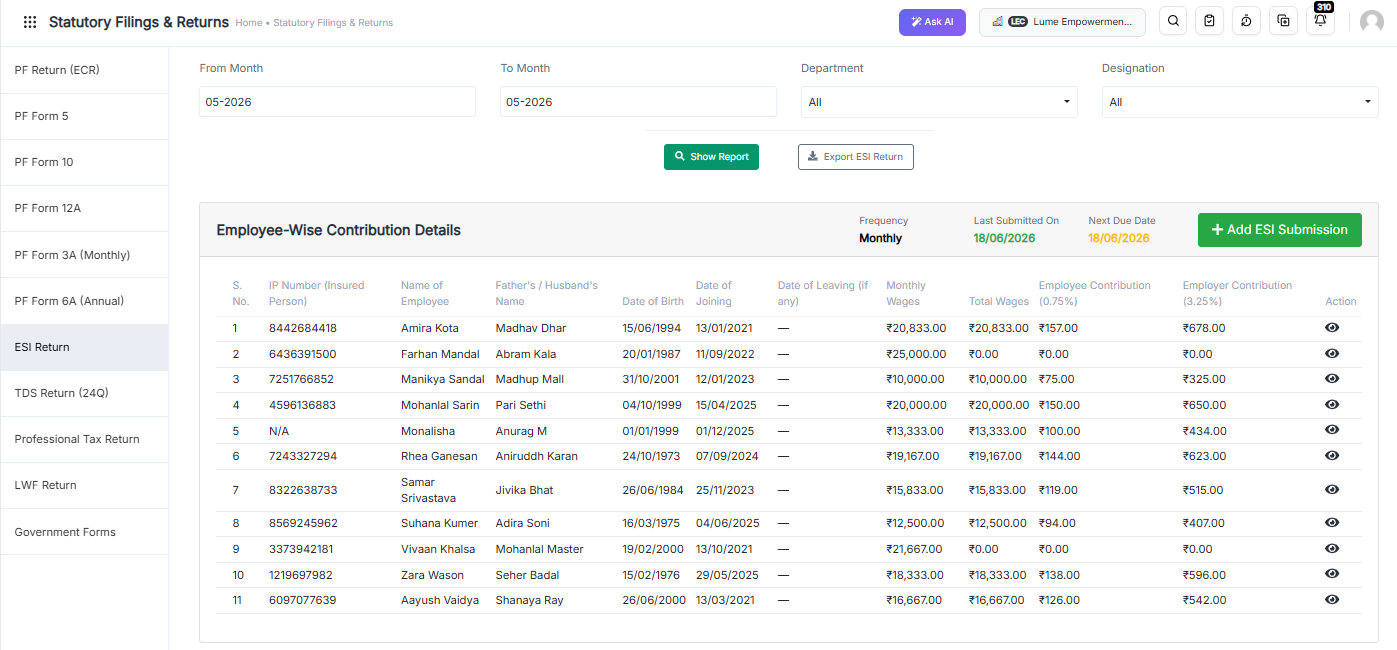
Generating an ESI challan with INDPayroll is quick and helps ensure accurate ESIC compliance. Follow these steps:
- Step 1: Log in to INDPayroll
- Step 2: Update Employee Attendance & Salary Data
- Step 3: Run Monthly Payroll
- Step 4: Go to Statutory Filings
- Step 5: Open the ESI Return
- Step 6: Export the ESI Challan File
- Step 7: Download in ESI Challan Format
- Step 8: Upload the File to the ESIC Portal
- Step 9: Generate the Challan Instantly
Key Benefits
- No further or additional calculations are required.
- ESI contribution data is prepared automatically.
- Month-over-month data can be exported instantly whenever required. Use our payslip and reports generator for professional documentation.
- Reduces manual effort and minimises compliance errors.
- Ensures faster ESI challan generation and filing.
ESI Payment Due Date and Compliance Deadlines
Quick Answer: ESI challan is due by the 15th of the month following the wage month. For example, June 2026 contributions must be paid by 15 July 2026. If the 15th falls on a bank holiday, the next working day applies.
Monthly Challan Due Dates (2026–27)
| Wage Month | Challan Due Date |
| April 2026 | 15 May 2026 |
| May 2026 | 15 June 2026 |
| June 2026 | 15 July 2026 |
| July 2026 | 15 August 2026 |
| August 2026 | 15 September 2026 |
| September 2026 | 15 October 2026 |
| October 2026 | 15 November 2026 |
| November 2026 | 15 December 2026 |
| December 2026 | 15 January 2027 |
| January 2027 | 15 February 2027 |
| February 2027 | 15 March 2027 |
| March 2027 | 15 April 2027 |
Half-Yearly Return of Contributions (RC)
In addition to monthly challans, employers must file a Return of Contributions (RC) twice a year. This is a separate statutory requirement that many employers overlook.
| Contribution Period | RC Filing Due Date |
| April – September 2026 | 11 November 2026 |
| October 2026 – March 2027 | 11 May 2027 |
Missing the RC deadline is treated as non-compliance independently of your monthly challan payments.
Penalty for Late Payment
| Delay Period | Damages Levied |
| Less than 2 months | 5% of the arrear amount |
| 2 to 6 months | 10% of the arrear amount |
| 6 months to 1 year | 15% of the arrear amount |
| More than 1 year | 25% of the arrear amount |
Plus simple interest at 12% per annum from the due date. Continued defaults can lead to prosecution under Section 85 of the ESI Act. For a broader view of payroll legal obligations, read our Payroll Compliance 101 guide.
Zero Contribution Filing: A Requirement Most Employers Miss
If your establishment had no eligible employees in a given month — because all employees exceeded the ₹21,000 wage ceiling, or due to temporary closure — you must still file a zero-contribution challan for that month.
Skipping it is treated as non-filing by ESIC and can trigger a compliance notice. This is one of the most frequently overlooked ESI obligations among Indian SMEs.
What Are the Common Challenges in ESI Challan Management?
Quick Answer: The most common ESI challan challenges are manual calculation errors (especially incorrect rounding), missed 15th-of-month deadlines, IP number mismatches on the ESIC portal, eligibility blind spots when salaries cross ₹21,000, overlooked zero-contribution months, and difficulty compiling the half-yearly Return of Contributions from scattered spreadsheet records.
Most compliance failures are not caused by ignorance of the law. They are caused by process gaps in manual workflows. Discover the top payroll automation benefits that can help your business eliminate these gaps.
Manual Calculation Errors: Incorrect contribution calculations — especially rounding errors — lead to mismatched challans and correction requests with ESIC.
Missed Deadlines Tracking the 15th-of-month deadline manually, alongside payroll close and other compliance tasks, increases the risk of delayed payments.
Employee Data Inconsistencies: IP number mismatches, name discrepancies between ESIC records and payroll systems, and salary data errors cause challan rejection on the ESIC portal.
Eligibility Blind Spots Salary revisions that push employees above ₹21,000 mid-period are easy to miss. The wage ceiling continuation rule — where the employee stays covered until the period ends — adds complexity.
Administrative Burden Manual processing consumes valuable HR and payroll resources that could be directed toward higher-value work. Learn more about why manual payroll fails growing businesses in India.
Half-Yearly Return Compilation When monthly records are stored in separate spreadsheets across six months, compiling the RC is time-consuming and prone to errors.
Common ESI Compliance Mistakes Employers Should Avoid
- Incorrect employee eligibility determination
- Wrong contribution calculations (especially not rounding to the nearest rupee)
- Delayed challan generation
- Late ESI payments
- Skipping zero-contribution challan months
- Not filing the half-yearly Return of Contributions (RC)
- Missing IP number registration for new joiners
- Ignoring contractor employee ESI liability
Automating payroll and compliance processes significantly reduces all of these risks. For a broader list of errors to watch for, see 15 payroll mistakes HR managers should avoid.
Manual ESI Management vs Automated ESI Challan Generator
| Feature | Manual Process | Automated ESI Challan Generator |
| Contribution Calculation | Manual, error-prone | Automatic, rounded correctly |
| Challan Generation | Time-consuming | One-click generation |
| Error Risk | High | Minimal |
| Rounding Compliance | Often missed | Built-in |
| Eligibility Tracking | Manual review | Auto-flags employees above ₹21,000 |
| Deadline Reminders | Manual calendar | Automated alerts |
| RC Filing Data | Manual compilation | Auto-generated from monthly data |
| Zero-Return Filing | Easy to forget | System prompts when applicable |
| Audit Readiness | Difficult | Organised digital records |
| Scalability | Limited | Highly scalable |
Why Businesses Choose INDPayroll’s ESI Challan Generator
INDPayroll’s ESI Challan Generator is built specifically for Indian statutory compliance. Every feature addresses a real pain point that Indian payroll teams face every month.
Quick Answer: INDPayroll’s ESI Challan Generator automatically calculates ESI contributions, tracks employee eligibility against the ₹21,000 wage ceiling, and generates ESIC portal-compatible challan files every month. It integrates with payroll and attendance data, sends deadline alerts, and auto-compiles the half-yearly Return of Contributions — eliminating manual effort and penalty risk for Indian employers.
Key benefits include:
- Automatic ESI contribution calculations with correct rounding
- One-click ESI challan generation
- Employee eligibility tracking with automatic wage ceiling alerts
- Integrated payroll and attendance management
- Automated deadline reminders (monthly challan and half-yearly RC)
- Zero-contribution challan prompts when applicable
- Centralised employee records with IP number management
- Compliance tracking and audit-ready reporting
- Secure cloud-based access
Businesses that switch from manual ESI filing to INDPayroll consistently report that monthly compliance preparation time drops from several hours to under 15 minutes. Read our guide on how to run payroll in minutes with INDPayroll — and that missed-deadline incidents fall to near zero once automated reminders and one-click challan generation are in place.
Whether you are a startup, SME, or growing enterprise, INDPayroll helps reduce compliance risks while improving efficiency. Explore the top 10 features every Indian payroll software must have to evaluate your compliance toolkit.
INDPayroll also integrates with Payroll Compliance Software, Attendance Management Software, PF & ESI Compliance Solutions, and Salary Management Software for end-to-end statutory compliance.
What Are the Best Practices for ESI Compliance in 2026?
- Maintain accurate, up-to-date employee records at all times
- Register new employees with ESIC promptly after joining
- Automate contribution calculations to avoid rounding errors
- Monitor the 15th-of-month deadline and the RC deadlines
- Track salary revisions against the ₹21,000 wage ceiling
- File zero-contribution challans when no employees are covered
- Keep digital copies of all challans and payment receipts for at least 5 years
- Verify contractor employee ESI liability monthly
- Use integrated payroll software to generate ESIC portal-compatible files
- Conduct periodic compliance reviews before ESIC contribution periods close
Simplify ESI Compliance with INDPayroll
Managing ESI compliance manually is complicated, time-consuming, and risky. INDPayroll’s ESI Challan Generator helps businesses automate calculations, generate accurate challans, meet every deadline, and reduce the risk of ESIC penalties.
Also, explore the full INDPayroll compliance suite:
- Payroll Software — end-to-end salary processing
- Attendance Management Software — real-time attendance synced with payroll
- PF & ESI Compliance Solutions — unified PF, ESI, PT, and TDS compliance
- PF Challan Generator — automate EPF/EPS/EDLI challan creation and ECR filing
- Payroll Compliance Software — stay audit-ready year-round
- Salary Management Software — CTC structuring, revisions, and payslips
Free Payroll, PF,
ESI & TDS Software
Professional compliance management for Indian businesses. 100% Free Forever.
Conclusion
ESI compliance is a critical responsibility for every employer in India. Accurate contribution calculations, correct rounding, timely monthly challan payments, half-yearly RC filing, and proper record maintenance are all essential for avoiding compliance risks and ensuring employee welfare.
An automated ESI Challan Generator simplifies these processes by eliminating manual errors, applying correct rounding, tracking eligibility changes, and generating all required documents automatically. By adopting payroll automation solutions like INDPayroll, organisations can streamline ESI management, save valuable time, and focus on business growth rather than administrative complexity.