How to Generate ESI Challan Online: Complete Guide for Indian Employers 2026

TL;DR: ESI Challan Generator Guide 2026

  • ESI compliance is mandatory for eligible employees and requires employers to calculate, deposit, and report contributions accurately every month.
  • Current ESI contribution rates are 0.75% (employee) and 3.25% (employer), totaling 4% of gross wages.
  • ESI challans must be generated and paid by the 15th of the following month to avoid penalties, interest, and compliance issues.
  • Accurate eligibility checks, contribution calculations, and employee records are essential for maintaining ESIC compliance.
  • Common mistakes include calculation errors, missed deadlines, zero-contribution filing omissions, and delayed employee registration.
  • INDPayroll automates ESI calculations, challan generation, compliance tracking, and reporting, helping businesses complete ESI filing in minutes.

Introduction

Managing payroll compliance is one of the most important responsibilities for employers in India. Among various statutory requirements, Employee State Insurance (ESI) compliance plays a crucial role in protecting employees while ensuring businesses meet their legal obligations.

However, managing ESI contributions manually can be challenging. HR and payroll teams often spend significant time calculating contributions, verifying employee eligibility, generating challans, and making timely payments. Even a minor mistake can lead to compliance issues, penalties, or additional administrative work.

As organisations grow, manual payroll processes become increasingly difficult to manage. This is why businesses are adopting automated payroll solutions and ESI Challan Generators to simplify compliance, improve accuracy, and save valuable time.

In this guide, you will learn everything about ESI challan generation, contribution calculations, payment procedures, compliance requirements, and how payroll software can streamline the entire process.

India’s #1 Free Software

Free Payroll, PF, ESI & TDS Software

What Is Employee State Insurance (ESI)?

Employee State Insurance (ESI) is a social security and health insurance scheme administered by the Employees’ State Insurance Corporation (ESIC), an autonomous body under India’s Ministry of Labour and Employment, established under the Employees’ State Insurance Act, 1948.

The scheme provides financial protection and medical benefits to eligible employees and their families during:

  • Sickness
  • Maternity
  • Employment injury
  • Disability
  • Medical emergencies
  • Dependents’ support requirements

The objective of ESI is to ensure that employees have access to healthcare services and income support during difficult situations.

What Benefits Does ESI Provide to Employees?

Quick Answer: ESI provides covered employees with free medical care, sickness cash benefit at approximately 70% of wages, maternity benefit, disability compensation, dependent support, and funeral expense assistance. Benefits extend to the employee’s family. Coverage applies during employment in any ESIC-registered establishment where the employee earns up to ₹21,000 per month.

The ESI scheme offers several benefits to covered employees.

  • Medical Benefits: Employees and their dependents can access medical treatment through ESIC hospitals and dispensaries.
  • Sickness Benefits: Employees receive approximately 70% of their average daily wages during certified illness periods — for up to 91 days in two consecutive benefit periods per year.
  • Maternity Benefits: Female employees are entitled to maternity-related benefits under applicable conditions as per the ESI Act.
  • Disability Benefits: Employees who suffer work-related disabilities receive monthly compensation in accordance with ESIC guidelines.
  • Dependents’ Benefits: Family members receive monthly financial support if an employee dies from an on-the-job injury.
  • Funeral Expenses: A fixed lump sum is available for funeral-related expenses as notified by ESIC. Verify the current amount at ESIC. in.

Why Does ESI Compliance Matter for Indian Employers?

Quick Answer: ESI compliance is a statutory obligation under the Employees’ State Insurance Act, 1948. Non-compliant employers face interest at 12% per annum, damages up to 25% of arrears, ESIC inspection notices, and prosecution under Section 85 of the ESI Act. Compliance protects employees’ social security rights and shields businesses from financial penalties and legal action.

Employers covered under ESI regulations must:

  • Register eligible employees with ESIC
  • Calculate contributions accurately every month
  • Deposit contributions on time
  • Maintain payroll and contribution records
  • Generate ESI challans
  • File the half-yearly Return of Contributions (RC)
  • Preserve all compliance documentation

Failure to comply may result in:

  • Interest at 12% per annum on delayed payments
  • Damages of 5% to 25% of arrear amounts, depending on the delay period
  • Compliance notices from ESIC
  • Legal action under Section 85 of the ESI Act
  • Increased audit risks

For growing businesses, automated compliance management is the most effective way to avoid these risks.

ESI Eligibility Criteria

Employees are covered under the ESI scheme if their gross monthly wages do not exceed ₹21,000 per month.
For employees with disabilities, the wage ceiling is ₹25,000 per month.

Employers should regularly review employee payroll records to determine eligibility and maintain compliance.

Which Establishments Must Register?

Establishment Type Minimum Employees Required
Factory (power-using) 10 or more
Non-seasonal factory 10 or more
Shops, restaurants, hotels, and cinemas 10 or more
Road motor transport undertakings 10 or more

Once an establishment is registered, coverage continues even if the employee count later falls below the threshold. For a complete walkthrough of the process, see our ESI Registration Process guide for employers.

ESI Contribution Periods

The ESI scheme operates in two contribution periods every year:

Contribution Period Months Covered
1st Period 1 April – 30 September
2nd Period 1 October – 31 March

Important rule: If an employee’s salary crosses ₹21,000 mid-period, they remain covered under ESI until the end of that contribution period — not immediately. Their exclusion takes effect from the start of the next period. This is one of the most commonly misunderstood ESI rules.

ESI Contribution Rates for 2026

Both employers and employees contribute to the ESI scheme every month.

Contribution Type Rate
Employee Contribution 0.75% of gross wages
Employer Contribution 3.25% of gross wages
Total Contribution 4.00% of gross wages

These rates were revised in 2019 and remain applicable in 2026.

How to Calculate ESI Contributions

Accurate calculation is essential for generating the correct ESI challan.

Quick Answer: ESI contribution is calculated by multiplying the employee’s gross monthly wages by 0.75% for the employee share and 3.25% for the employer share. Both figures are rounded to the nearest rupee. ESIC does not accept paise values.

Example Calculations

Monthly Salary Employee Contribution (0.75%) Employer Contribution (3.25%) Total
₹18,000 ₹135 ₹585 ₹720
₹20,000 ₹150 ₹650 ₹800
₹21,000 ₹158 ₹683 ₹841

Rounding rule: ESIC rounds all contributions to the nearest rupee. For example, ₹21,000 × 0.75% = ₹157.50, which rounds to ₹158. Always round — ESIC does not accept paise values in challans.

When managing large workforces, manual calculations across dozens of employees become time-consuming and error-prone. Automated payroll software handles rounding and calculation automatically.

Free Payroll, PF, ESI & TDS Software

The most trusted automation tool for modern Indian businesses.

What Is an ESI Challan?

An ESI challan is the official monthly payment document that employers generate and submit to deposit ESI contributions with ESIC.

Quick Answer: An ESI Challan is a monthly payment document submitted by registered employers to ESIC. It records the employer contribution (3.25% of gross wages) and employee contribution (0.75% of gross wages) for all covered employees. It consolidates wage and contribution data into a single payable amount used to remit statutory ESI dues and maintain ESIC compliance records.

The challan contains essential details such as:

  • Employer code
  • Establishment information
  • Contribution period (wage month)
  • Employee-wise IP numbers, wages, and contributions
  • Employer contribution amount
  • Employee contribution amount
  • Total payable contribution
  • Payment reference information

The challan acts as legal proof that ESI contributions have been calculated and deposited correctly.

How to Generate an ESI Challan Online

Quick Answer: To generate an ESI challan online, log in to the ESIC employer portal at esic. In using your employer code and password. Navigate to Monthly Contribution → Enter Contribution. Enter employee-wise data or upload a CSV file, verify the totals, generate the challan, and pay via net banking or NEFT by the 15th of the following month.

Step 1: Collect Employee Payroll Information

Gather data including:

  • Employee salaries and gross wages
  • Attendance records and leave information
  • Overtime details
  • Employee eligibility status (who is under ₹21,000)
  • IP numbers for all covered employees

Step 2: Calculate ESI Contributions

Determine employer and employee contributions based on current rates, rounded to the nearest rupee. You can also use our Salary Components in India guide to understand which allowances form the ESI calculation base.

Step 3: Verify Employee Data

Ensure that:

  • Salary records are accurate and finalised
  • All employee details match ESIC records
  • All eligible employees are included
  • New joiners have been registered on the ESIC portal

Step 4: Generate the Challan

Log in to esic. In and navigate to Employer Login → Monthly Contribution → Enter Contribution. Enter data manually or upload a CSV file, verify the summary, and click Generate Challan.

Step 5: Complete Payment

Submit payment through net banking (SBI, PNB, or other empanelled banks), NEFT/RTGS using the challan reference number, or at a designated bank branch.

Step 6: Store Compliance Records

Maintain copies of:

  • ESI challans and payment receipts
  • Employee-wise contribution statements
  • Payroll reports for the contribution period

Proper documentation is essential for compliance and future audits.

Generate ESI Challan in Minutes with INDPayroll

Generating an ESI challan with INDPayroll is quick and helps ensure accurate ESIC compliance. Follow these steps:

  • Step 1: Log in to INDPayroll
  • Step 2: Update Employee Attendance & Salary Data
  • Step 3: Run Monthly Payroll
  • Step 4: Go to Statutory Filings
  • Step 5: Open the ESI Return
  • Step 6: Export the ESI Challan File
  • Step 7: Download in ESI Challan Format
  • Step 8: Upload the File to the ESIC Portal
  • Step 9: Generate the Challan Instantly
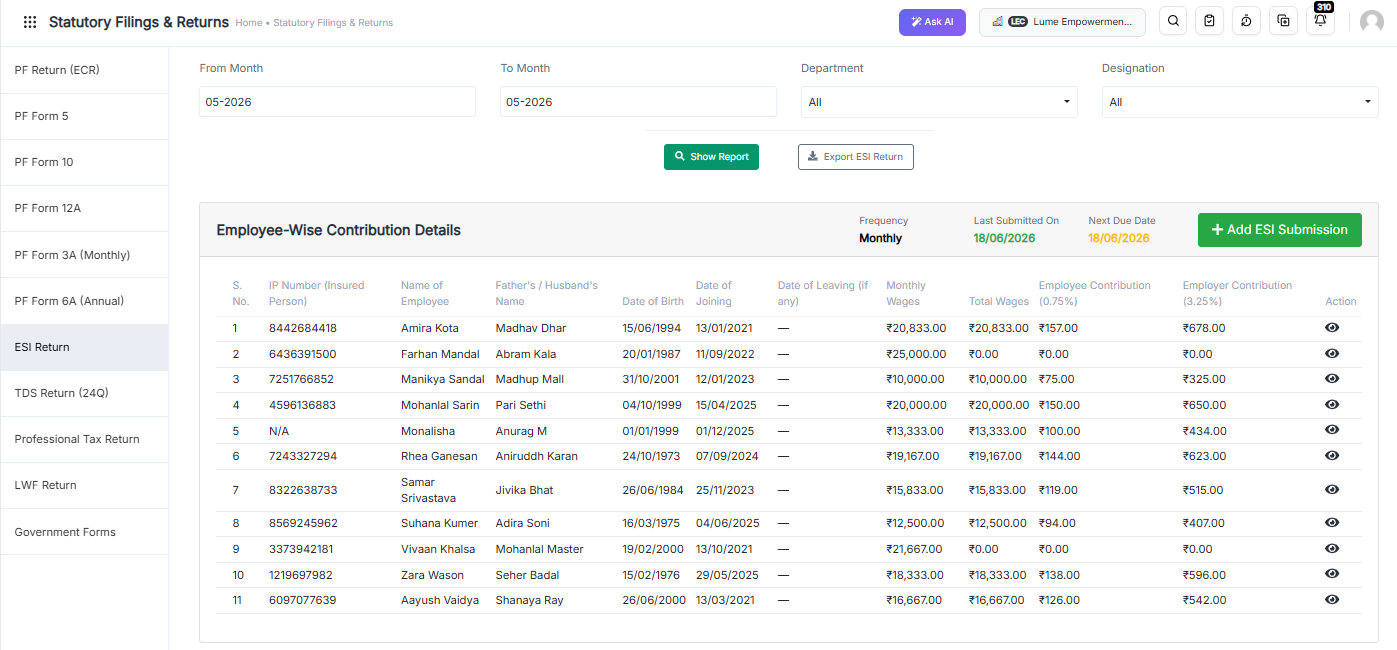
ESI Challan Generator

Key Benefits

  • No further or additional calculations are required.
  • ESI contribution data is prepared automatically.
  • Month-over-month data can be exported instantly whenever required. Use our payslip and reports generator for professional documentation.
  • Reduces manual effort and minimises compliance errors.
  • Ensures faster ESI challan generation and filing.

ESI Payment Due Date and Compliance Deadlines

Quick Answer: ESI challan is due by the 15th of the month following the wage month. For example, June 2026 contributions must be paid by 15 July 2026. If the 15th falls on a bank holiday, the next working day applies.

Monthly Challan Due Dates (2026–27)

Wage Month Challan Due Date
April 2026 15 May 2026
May 2026 15 June 2026
June 2026 15 July 2026
July 2026 15 August 2026
August 2026 15 September 2026
September 2026 15 October 2026
October 2026 15 November 2026
November 2026 15 December 2026
December 2026 15 January 2027
January 2027 15 February 2027
February 2027 15 March 2027
March 2027 15 April 2027

Half-Yearly Return of Contributions (RC)

In addition to monthly challans, employers must file a Return of Contributions (RC) twice a year. This is a separate statutory requirement that many employers overlook.

Contribution Period RC Filing Due Date
April – September 2026 11 November 2026
October 2026 – March 2027 11 May 2027

Missing the RC deadline is treated as non-compliance independently of your monthly challan payments.

Penalty for Late Payment

Delay Period Damages Levied
Less than 2 months 5% of the arrear amount
2 to 6 months 10% of the arrear amount
6 months to 1 year 15% of the arrear amount
More than 1 year 25% of the arrear amount

Plus simple interest at 12% per annum from the due date. Continued defaults can lead to prosecution under Section 85 of the ESI Act. For a broader view of payroll legal obligations, read our Payroll Compliance 101 guide.

Zero Contribution Filing: A Requirement Most Employers Miss

If your establishment had no eligible employees in a given month — because all employees exceeded the ₹21,000 wage ceiling, or due to temporary closure — you must still file a zero-contribution challan for that month.

Skipping it is treated as non-filing by ESIC and can trigger a compliance notice. This is one of the most frequently overlooked ESI obligations among Indian SMEs.

What Are the Common Challenges in ESI Challan Management?

Quick Answer: The most common ESI challan challenges are manual calculation errors (especially incorrect rounding), missed 15th-of-month deadlines, IP number mismatches on the ESIC portal, eligibility blind spots when salaries cross ₹21,000, overlooked zero-contribution months, and difficulty compiling the half-yearly Return of Contributions from scattered spreadsheet records.

Most compliance failures are not caused by ignorance of the law. They are caused by process gaps in manual workflows. Discover the top payroll automation benefits that can help your business eliminate these gaps.

Manual Calculation Errors: Incorrect contribution calculations — especially rounding errors — lead to mismatched challans and correction requests with ESIC.

Missed Deadlines Tracking the 15th-of-month deadline manually, alongside payroll close and other compliance tasks, increases the risk of delayed payments.

Employee Data Inconsistencies: IP number mismatches, name discrepancies between ESIC records and payroll systems, and salary data errors cause challan rejection on the ESIC portal.

Eligibility Blind Spots Salary revisions that push employees above ₹21,000 mid-period are easy to miss. The wage ceiling continuation rule — where the employee stays covered until the period ends — adds complexity.

Administrative Burden Manual processing consumes valuable HR and payroll resources that could be directed toward higher-value work. Learn more about why manual payroll fails growing businesses in India.

Half-Yearly Return Compilation When monthly records are stored in separate spreadsheets across six months, compiling the RC is time-consuming and prone to errors.

Common ESI Compliance Mistakes Employers Should Avoid

  • Incorrect employee eligibility determination
  • Wrong contribution calculations (especially not rounding to the nearest rupee)
  • Delayed challan generation
  • Late ESI payments
  • Skipping zero-contribution challan months
  • Not filing the half-yearly Return of Contributions (RC)
  • Missing IP number registration for new joiners
  • Ignoring contractor employee ESI liability

Automating payroll and compliance processes significantly reduces all of these risks. For a broader list of errors to watch for, see 15 payroll mistakes HR managers should avoid.

Manual ESI Management vs Automated ESI Challan Generator

Feature Manual Process Automated ESI Challan Generator
Contribution Calculation Manual, error-prone Automatic, rounded correctly
Challan Generation Time-consuming One-click generation
Error Risk High Minimal
Rounding Compliance Often missed Built-in
Eligibility Tracking Manual review Auto-flags employees above ₹21,000
Deadline Reminders Manual calendar Automated alerts
RC Filing Data Manual compilation Auto-generated from monthly data
Zero-Return Filing Easy to forget System prompts when applicable
Audit Readiness Difficult Organised digital records
Scalability Limited Highly scalable

Why Businesses Choose INDPayroll’s ESI Challan Generator

INDPayroll’s ESI Challan Generator is built specifically for Indian statutory compliance. Every feature addresses a real pain point that Indian payroll teams face every month.

Quick Answer: INDPayroll’s ESI Challan Generator automatically calculates ESI contributions, tracks employee eligibility against the ₹21,000 wage ceiling, and generates ESIC portal-compatible challan files every month. It integrates with payroll and attendance data, sends deadline alerts, and auto-compiles the half-yearly Return of Contributions — eliminating manual effort and penalty risk for Indian employers.

Key benefits include:

  • Automatic ESI contribution calculations with correct rounding
  • One-click ESI challan generation
  • Employee eligibility tracking with automatic wage ceiling alerts
  • Integrated payroll and attendance management
  • Automated deadline reminders (monthly challan and half-yearly RC)
  • Zero-contribution challan prompts when applicable
  • Centralised employee records with IP number management
  • Compliance tracking and audit-ready reporting
  • Secure cloud-based access

Businesses that switch from manual ESI filing to INDPayroll consistently report that monthly compliance preparation time drops from several hours to under 15 minutes. Read our guide on how to run payroll in minutes with INDPayroll — and that missed-deadline incidents fall to near zero once automated reminders and one-click challan generation are in place.

Whether you are a startup, SME, or growing enterprise, INDPayroll helps reduce compliance risks while improving efficiency. Explore the top 10 features every Indian payroll software must have to evaluate your compliance toolkit.

INDPayroll also integrates with Payroll Compliance Software, Attendance Management Software, PF & ESI Compliance Solutions, and Salary Management Software for end-to-end statutory compliance.

What Are the Best Practices for ESI Compliance in 2026?

  • Maintain accurate, up-to-date employee records at all times
  • Register new employees with ESIC promptly after joining
  • Automate contribution calculations to avoid rounding errors
  • Monitor the 15th-of-month deadline and the RC deadlines
  • Track salary revisions against the ₹21,000 wage ceiling
  • File zero-contribution challans when no employees are covered
  • Keep digital copies of all challans and payment receipts for at least 5 years
  • Verify contractor employee ESI liability monthly
  • Use integrated payroll software to generate ESIC portal-compatible files
  • Conduct periodic compliance reviews before ESIC contribution periods close

Simplify ESI Compliance with INDPayroll

Managing ESI compliance manually is complicated, time-consuming, and risky. INDPayroll’s ESI Challan Generator helps businesses automate calculations, generate accurate challans, meet every deadline, and reduce the risk of ESIC penalties.

Also, explore the full INDPayroll compliance suite:

India’s #1 Free Software

Free Payroll, PF,
ESI & TDS Software

Professional compliance management for Indian businesses. 100% Free Forever.

Conclusion

ESI compliance is a critical responsibility for every employer in India. Accurate contribution calculations, correct rounding, timely monthly challan payments, half-yearly RC filing, and proper record maintenance are all essential for avoiding compliance risks and ensuring employee welfare.

An automated ESI Challan Generator simplifies these processes by eliminating manual errors, applying correct rounding, tracking eligibility changes, and generating all required documents automatically. By adopting payroll automation solutions like INDPayroll, organisations can streamline ESI management, save valuable time, and focus on business growth rather than administrative complexity.

15 Proven Payroll Best Practices for Indian SMEs 2026

TL;DR: Payroll Best Practices for Indian SMEs in 2026

  • Classify employees and contractors correctly to avoid compliance penalties.
  • Build compliant salary structures aligned with wage regulations.
  • Automate PF, ESI, TDS, and Professional Tax calculations.
  • Never miss statutory filing and payment deadlines.
  • Maintain accurate payroll records, payslips, and reconciliation reports.
  • Conduct regular payroll audits and prepare for Labour Code implementation.

Nearly half of India’s small businesses have faced a payroll penalty they could have avoided. One wrong formula in a spreadsheet, one missed PF deadline, one misclassified employee — and a routine pay run turns into interest, fines, and a difficult conversation with your team. Payroll is the single largest cash outflow for most SMEs, yet it is often run on tools never designed for India’s compliance maze.

If you manage payroll for a small or mid-sized business, you already feel the pressure: shifting tax rules, the long-awaited Labour Codes, and employees who expect their salary to be correct and on time — every single month. The cost of getting it wrong is rising, and “we’ll fix it next month” is no longer a safe plan.

In this guide, you will discover the 15 payroll best practices that keep Indian SMEs compliant, accurate, and audit-ready in 2026 — without expensive consultants or fragile spreadsheets. The INDPayroll Compliance Team works with thousands of Indian businesses and CA firms to automate PF, ESI, TDS, and Professional Tax, and these payroll best practices are the habits we see in every well-run payroll.

Free Payroll, PF, ESI & TDS Software

The most trusted automation tool for modern Indian businesses.

Why payroll best practices matter for Indian SMEs in 2026

Following payroll best practices is no longer optional housekeeping — it is risk management. Indian payroll sits at the intersection of the EPFO, the ESIC, and the Income Tax Department, and each carries its own deadlines and penalties. Strong payroll best practices protect your cash flow, your compliance record, and your reputation as an employer.

What are the payroll best practices for Indian SMEs? Payroll best practices are the standardised steps a business follows to pay staff accurately and stay legally compliant. They cover correct salary structuring, automated PF, ESI, TDS and Professional Tax deductions, on-time filings, accurate payslips, and secure record-keeping. Together, they prevent penalties and build employee trust.

1. Classify every worker correctly before you pay them

Misclassification is the most expensive payroll mistake an SME can make. Whether a person is a full-time employee, a contractor, or a gig worker decides which deductions, benefits, and filings apply. Treating an employee as a “consultant” to avoid PF and ESI can trigger back-payments, interest, and penalties during an inspection.

Worker classification is the process of deciding a worker’s legal status — employee, contractor, or gig worker. It works by testing control, supervision, and the nature of the engagement. It matters because each category carries different obligations for PF, ESI, TDS, and gratuity under Indian law.

India’s four Labour Codes formally recognise gig and platform workers and tighten definitions across the board. Map every person on your payroll to the right category in writing, and review the classification whenever a role changes.

2. Build a salary structure that is compliant by design

How you split a salary is not just a tax decision — it is a compliance one. Under the Code on Wages, 2019, the statutory definition of “wages” limits how much of total pay can sit in excluded allowances. In practice, this pushes the basic-plus-DA component toward at least 50% of total remuneration, which directly affects PF, gratuity, and overtime calculations.

A compliant salary structure is a pay breakup where basic wages meet statutory thresholds and allowances stay within legal limits. It works by keeping basic plus dearness allowance at roughly half of total pay. Most SMEs use it to control PF and gratuity liability while maximising employee take-home.

Design your CTC template once, correctly, and apply it consistently. A lopsided structure that under-reports basic wages is a red flag in any audit.

3. Automate statutory deductions instead of calculating them by hand

PF, ESI, Professional Tax, and TDS each follow different rates, ceilings, and rounding rules. Calculating them manually for even 30 employees invites error — and a single decimal mistake in TDS can cascade into a wrong Form 16. Automation removes the guesswork and applies current rates consistently every month.

Statutory deductions are the legally mandated amounts withheld from salary — EPF, ESI, Professional Tax, and TDS. They work by applying fixed rates to defined wage components each pay cycle. Indian employers must deduct and deposit them on time to stay compliant and avoid interest or penalties.

This is exactly the work payroll software is built to handle. Automated compliance tools recalculate deductions whenever rates change, so you are never relying on a year-old spreadsheet formula.

4. Get EPF (Provident Fund) right, every month

The EPFO administers the Employees’ Provident Fund and is mandatory for most establishments with 20 or more employees. Both employer and employee contribute 12% of basic wages plus dearness allowance, and contributions are typically due by the 15th of the following month.

EPF is a retirement savings scheme run by the Employees’ Provident Fund Organisation. It works by collecting 12% of basic wages plus DA from both the employer and the employee each month. The employer’s share is split between the pension fund (EPS) and the provident fund, calculated on a statutory wage ceiling of Rs. 15,000.

Generate your ECR (Electronic Challan-cum-Return) and deposit on time. Late PF payments not only attract damages and interest, but they can also disqualify the expense for income-tax purposes.

5. Stay within ESI rules for eligible employees

The Employees’ State Insurance scheme, run by the ESIC, provides medical and cash benefits to lower-wage workers. It generally applies to establishments with 10 or more employees and covers staff earning up to Rs. 21,000 per month (Rs. 25,000 for employees with disabilities).

ESI is a social security scheme for employees earning up to Rs. 21,000 a month. It works through a combined contribution of 4% of wages — 0.75% from the employee and 3.25% from the employer. It funds medical care, sickness, maternity, and disability benefits for covered workers.

Track wage thresholds carefully: an employee can move in or out of ESI coverage mid-year as pay changes, and your system must handle that transition cleanly within the contribution period.

6. Run an accurate TDS on salary under Section 192

Tax Deducted at Source on salary is governed by Section 192 of the Income Tax Act. Employers must estimate each employee’s annual tax liability and deduct it proportionately every month, choosing correctly between the old and new tax regimes based on the employee’s declaration.

TDS on salary is income tax that the employer deducts before paying wages, under Section 192. It works by spreading an employee’s estimated yearly tax across 12 months. Employers deposit it with the government and report it quarterly on Form 24Q, then issue Form 16 to each employee.

The new tax regime is now the default, and recent Budgets have reshaped the slabs and rebates. Collect investment declarations early in the financial year, verify proofs before year-end, and reconcile so no employee faces a shock deduction in March. Always confirm the current year’s slabs against the Income Tax Department before finalising.

7. Treat statutory deadlines as a non-negotiable payroll best practice

Most payroll penalties come not from wrong amounts but from being late. Each statutory due date is fixed, and missing it triggers automatic interest or fees regardless of intent. Among all payroll best practices, hitting deadlines is the cheapest and highest-return habit you can build.

Obligation Typical due date
EPF contribution & ECR 15th of the following month
ESI contribution 15th of the following month
TDS deposit (salary) 7th of the following month
TDS return (Form 24Q) Quarterly
Professional Tax Varies by state
What happens if you miss a TDS deadline? Late filing of a TDS return attracts a fee of Rs. 200 per day under Section 234E until the return is filed, capped at the TDS amount. A separate interest applies for late deduction or deposit. Meeting every due date is the cheapest compliance you will ever buy.

8. Keep a single source of truth for payroll data

When salary data lives in one spreadsheet, attendance in another, and bank details in an email, errors are inevitable. Centralising employee master data — pay structure, PAN, UAN, ESI number, bank details, and tax declarations — in one system removes duplication and version-control chaos.

A single source of truth is one authoritative system holding all payroll and employee data. It works by feeding every calculation, payslip, and filing from the same records. SMEs use it to eliminate conflicting spreadsheets, reduce manual re-entry, and ensure every report reconciles.

This is where SMEs reclaim the most time. Centralised payroll processing means one update flows everywhere instead of being copied across files.

9. Issue clear, itemised payslips on time

A payslip is both a legal record and a trust signal. The Code on Wages requires employers to give employees wage slips, and a good payslip itemises earnings, each statutory deduction, and the net pay so employees can see exactly how their salary was calculated.

A payslip is a document detailing an employee’s earnings and deductions for a pay period. It works by listing gross pay, PF, ESI, TDS, and other deductions, then showing net pay. Indian employers must provide it to meet wage-transparency obligations and reduce salary disputes.

Automated, password-protected digital payslips — generated and emailed in one click — save hours and look far more professional than a manual PDF.

10. Reconcile payroll before, not after, you file

Reconciliation catches errors while they are still cheap to fix. Each month, match gross pay, deductions, and net disbursement against your bank file. Each quarter, reconcile TDS deducted against Form 24Q and the deposits reflected in Form 26AS.

Payroll reconciliation is the process of matching payroll records against bank payments and statutory filings. It works by comparing what was calculated, paid, and reported, line by line. It matters because mismatches in Form 24Q or Form 26AS create notices and corrections that are costly to unwind.

A clean monthly reconciliation makes year-end Form 16 generation almost effortless.

11. Maintain statutory registers and records

Indian labour law requires employers to keep registers and records of wages, attendance, leave, and deductions — and to retain them for several years. Inspectors can ask for these at any time, and missing documentation is itself a violation, even if your calculations were correct.

Statutory registers are the records employers must keep under labour and tax laws, covering wages, attendance, and deductions. They work as the audit trail behind every pay run. The Labour Codes aim to simplify them into fewer digital registers, but retention obligations remain firmly in place.

Digital records with a complete change history make audits straightforward and protect you if a past calculation is ever questioned.

12. Manage attendance, leave, and overtime accurately

Payroll is only as accurate as the attendance feeding it. Loss-of-pay, overtime, and leave encashment must flow correctly into each month’s calculation. Manual transcription of attendance is a common — and avoidable — source of salary errors.

Attendance-to-payroll integration is the automatic flow of worked hours, leave, and overtime into salary calculation. It works by linking your attendance system directly to payroll so nothing is keyed in twice. SMEs use it to pay precisely for time worked and to comply with overtime rules.

Define your leave policy clearly, apply it consistently, and let the system, not a person, do the arithmetic.

13. Plan gratuity and full-and-final settlements ahead of time

Gratuity is a statutory benefit under the Payment of Gratuity Act, 1972, payable to employees who complete five years of continuous service, at 15 days’ wages for each completed year, subject to the prevailing cap. Provisioning for it monthly avoids a cash shock when senior staff exit.

Gratuity is a lump-sum reward for long service under the Payment of Gratuity Act. It works out to roughly 15 days of wages for each completed year, payable after five years of continuous service. Employers should provision for it gradually rather than funding it only at exit.

Build a clear, full, and final settlement process too — recovering advances, settling leave balances, and releasing dues within the legally expected timeframe.

14. Protect payroll and employee data

Payroll holds your most sensitive data: salaries, PAN, bank accounts, and Aadhaar-linked identifiers. With the Digital Personal Data Protection Act, 2023, safeguarding this information is now a legal duty, not just good hygiene. A leaked salary sheet damages trust and can carry regulatory consequences.

Payroll data protection is the practice of securing sensitive employee and salary information. It works through access controls, encryption, and limited sharing of pay data. Under India’s DPDP Act, 2023, businesses must handle personal data responsibly, making secure payroll systems a compliance requirement, not an option.

Restrict who can view salary data, use encrypted systems with audit logs, and avoid circulating raw payroll files over email or shared drives.

15. Audit regularly: the payroll best practice that ties it all together

India’s four Labour Codes — on Wages, Social Security, Industrial Relations, and Occupational Safety — consolidate 29 central labour laws and will reshape definitions of wages, working hours, and benefits as they roll out. SMEs that treat a yearly review as a core payroll best practice avoid scrambling later.

The Labour Codes are four laws that consolidate India’s central labour legislation. They work by standardising definitions of wages, social security, and working conditions across the country. Their phased implementation changes how SMEs structure pay and benefits, so businesses should track notifications and adjust payroll settings accordingly.

Run an internal payroll audit at least once a year: review classifications, salary structures, deduction rates, deadlines, and records. Confirm the current implementation status of the Labour Codes and your state’s specific notifications, since timing and rules continue to evolve.

Trust and authority: what we see in practice

“The businesses that never face a payroll penalty are rarely the ones with the biggest finance teams — they are the ones who automated their statutory calculations and treated deadlines as fixed,” notes the INDPayroll Compliance Team, drawing on payroll runs across thousands of Indian SMEs and CA firms.

Our own data points to a clear pattern: the most common penalty is not a wrong amount but a late filing, and almost every late filing traces back to a manual, calendar-driven process that someone simply forgot. The single highest-leverage change an SME can make is to move statutory deductions and deadlines off spreadsheets and onto a system that updates rates and reminders automatically.

Payroll best practices are the standardised steps a business follows to pay staff accurately and stay legally compliant — correct salary structuring, automated PF, ESI, TDS and Professional Tax deductions, on-time filings, accurate payslips, and secure record-keeping. Together, they prevent penalties and build employee trust.

India’s #1 Free Software

Free Payroll, PF, ESI & TDS Software

Conclusion

Strong payroll in 2026 comes down to three things: structure salaries correctly, automate every statutory deduction, and never miss a deadline. Master those, keep secure records, and stay ready for the Labour Codes, and payroll stops being a monthly risk and becomes a quiet competitive advantage. These payroll best practices are not theory — they are the habits that keep Indian SMEs penalty-free and their teams paid on time.

The fastest way to put all 15 payroll best practices into action is to stop running payroll on spreadsheets. Try INDPayroll free and run your next pay cycle in minutes, fully compliant.

This article is for general information only and does not constitute legal, tax, or financial advice. Statutory rates, wage ceilings, thresholds, due dates, and the implementation status of the Labour Codes change over time and can vary by state. Always verify the current rules with official sources such as the EPFO, ESIC, and the Income Tax Department, or consult a qualified professional, before acting.

The Ultimate Payroll Software To Simplify Tax Compliance

TL;DR — The Ultimate Payroll Software To Simplify Tax Compliance

  • Automate PF & ESI Compliance: INDPayroll calculates Provident Fund and ESI contributions every month — no manual effort, no errors, and no missed EPFO or ESIC deadlines.
  • Built-In TDS Management: TDS is computed per employee based on live declarations and current income tax slabs, keeping your business audit-ready all year long.
  • One-Click Payslip Generation: Generate professional, compliant payslips for every employee in seconds using the payslip and reports generator — including CTC, deductions, and net pay.
  • Real-Time Compliance Updates: INDPayroll automatically tracks the latest EPF regulations and labour law changes — your payroll always runs under current Indian law.
  • Free Compliance Verification Tools: Check PF, ESI, and CTC figures instantly using the free PF calculator, ESI calculator, and CTC calculator — no login required.
  • Cuts Compliance Time by Up to 80%: From ECR file generation to Form 16, INDPayroll automates every statutory task and saves HR teams 15–20 hours per month.

Indeed, tax compliance is not optional in India — it is the law. Yet every month, thousands of HR teams scramble through spreadsheets, chase approvals, and manually compute PF, ESI, and TDS deductions. One miscalculation can trigger a notice from EPFO or ESIC and cost your business far more than the original error.

However, the root cause is almost always the same: outdated tools or manual processes. If your payroll software cannot handle India’s statutory requirements automatically, your compliance risk grows every pay cycle.

Fortunately, INDPayroll changes that. Built exclusively for Indian businesses, this payroll software handles every tax and statutory obligation from contribution calculations to challan generation — automatically, accurately, and on time.

Therefore, in this guide, you will learn exactly how INDPayroll simplifies tax compliance, who it is built for, and how to get started today.

Why Tax Compliance Breaks Most Indian HR Teams

To understand why, note that Indian payroll compliance is genuinely complex. Every business must navigate a layered system of statutory requirements. These include Employees’ Provident Fund (EPF) contributions, Employee State Insurance (ESI) deductions, Tax Deducted at Source (TDS), Professional Tax, and Labour Welfare Fund — each with its own calculation rules, filing deadlines, and penalty structures.

According to EPFO data, compliance defaults are most common among SMEs that rely on manual processing. The reasons are predictable: incorrect contribution calculations, missed filing dates, mismatched UAN records, and poor documentation. Each error invites scrutiny, penalties, and reputational risk.

Moreover, the situation worsens as businesses scale. A team of 20 is manageable on a spreadsheet. A team of 200 is not. And with India’s labour law updates happening frequently, keeping pace with regulatory changes alone is a full-time job.

Consequently, the solution is not to hire more compliance staff. The solution is smarter payroll software.

India’s #1 Free Software

Free Payroll, PF, ESI & TDS Software

What Makes INDPayroll the Ultimate Payroll Software for Tax Compliance?

INDPayroll is a cloud-based, India-first payroll software that automates every aspect of salary processing and statutory compliance. It is not a global tool adapted for India — it is built ground-up for Indian payroll law, Indian salary structures, and Indian filing requirements.

Here are six reasons why INDPayroll stands out as the ultimate payroll software for simplifying tax compliance in 2026:

  • Automated PF & ESI Calculations: INDPayroll computes Provident Fund and ESI contributions in real time on every payroll run. It applies the correct contribution percentages, respects wage ceiling limits, and generates challans ready for EPFO and ESIC submission — with zero manual intervention. Explore the full PF & ESI compliance module to see how it works.
  • Built-In TDS Management: The software calculates TDS automatically based on the employee’s income declarations, HRA exemptions, investment proofs, and the current income tax slabs. Every employee’s tax liability is recomputed each month, so your deductions are always accurate. No more year-end surprises or excess deductions to reconcile.
  • One-Click Professional Payslip Generation: Every employee deserves a compliant, detailed payslip on pay day. INDPayroll’s payslip and reports generator creates fully formatted payslips — including CTC, gross pay, all deductions, PF/ESI breakdown, and net pay — in seconds. You can also use the standalone free payslip generator for quick single-employee slips.
  • Real-Time Compliance Updates: India’s payroll regulations change frequently. INDPayroll monitors the latest EPF regulations and pushes updates to the platform automatically. You always process payroll under current law — without reading government circulars or manually adjusting rates.
  • Free Compliance Verification Tools: Before running payroll, verify your numbers using INDPayroll’s suite of free tools: the PF calculator, ESI calculator, and CTC calculator. These are available to anyone — no account needed — making them ideal for HR professionals who want to double-check figures before finalising salary runs.
  • Detailed Salary Breakup & Audit-Ready Reports: INDPayroll generates granular salary breakup reports for every employee. These reports include component-wise breakdowns, month-on-month comparisons, and statutory summaries — giving your finance team everything it needs for audits, appraisals, and board reporting without a single additional spreadsheet.

Key Features That Simplify Tax Compliance End-to-End

Furthermore, understanding individual features is useful, but what matters most is how they work together as a system. Here is how INDPayroll’s core modules connect to create a seamless compliance workflow.

PF & ESI Compliance — Fully Automated

Managing PF & ESI compliance is the single biggest compliance risk for most Indian businesses. EPFO and ESIC both have strict timelines — contributions must be deposited by the 15th of each month. Delays attract interest and penalties.

In detail, INDPayroll automates the full compliance cycle. It calculates employer and employee contributions, generates ECR (Electronic Challan cum Return) files for EPFO, and produces ESIC contribution statements — all formatted for direct submission. Follow the detailed EPF compliance guide and ESI compliance guide to understand the exact steps the software handles on your behalf.

For teams that want to cross-verify contributions before processing, the PF calculator and ESI calculator are available free and require no login.

Salary Processing — Accurate, Fast, Flexible

India’s salary structures are not simple. Most companies use multi-component pay packages that include basic salary, HRA, conveyance, special allowance, LTA, and variable performance pay. Each component has different tax implications and PF/ESI applicability rules.

INDPayroll’s salary processing module handles all of this natively. It supports arrear calculations, mid-month joiners, full-and-final settlements, loss-of-pay adjustments, and bonus processing. Every salary run is reconciled before finalisation, giving you confidence that what you approve is what gets paid — and reported.

Payslip Generation and Statutory Reports

Importantly, payslips are legal documents in India. Under the Payment of Wages Act, employers must issue payslips to employees on or before payday. INDPayroll’s payslip reports generator creates compliant, professional payslips for every employee with one click.

Beyond payslips, the platform generates Form 16, monthly salary registers, PF contribution statements, ESI contribution reports, and TDS summaries — all downloadable for your records and ready for submission to relevant authorities.

Registration & Filing Guidance

Moreover, new businesses often struggle with the initial compliance setup — registering under EPFO, ESIC, and Professional Tax authorities. INDPayroll’s registration and filing module walks you through each requirement step by step. It generates the forms, documents, and challans you need for timely registration and ongoing statutory filing.

India’s #1 Free Software

Free Payroll, PF,
ESI & TDS Software

Professional compliance management for Indian businesses. 100% Free Forever.

Real Use Cases: Who Benefits Most from INDPayroll?

Importantly, INDPayroll is not a niche solution. It is purpose-built to serve businesses across industries and team sizes. Here are three scenarios where it delivers the highest impact.

Startups and Remote Teams

For example, growing startups often operate across multiple states, each with different Professional Tax slabs. They hire quickly, offer equity, and structure CTC creatively to attract talent. Managing multi-state payroll compliance manually is nearly impossible without dedicated payroll expertise.

As a result, INDPayroll handles multi-state payroll natively. It applies the correct Professional Tax rates by state, supports equity and variable component tracking, and gives distributed HR teams a single dashboard to manage compliance across every location.

Manufacturing and Production Businesses

Similarly, factories deal with shift-based attendance, overtime calculations, contract worker management, and large blue-collar workforces. ESI applicability is critical in this sector — and errors in ESI contribution can trigger ESIC audits.

Therefore, INDPayroll automates attendance-linked salary processing, applies the correct ESI contributions for eligible employees, and generates the exact reports ESIC inspectors look for during audits. It saves manufacturing HR teams hours of monthly work and significantly reduces compliance risk.

IT Companies and Service Agencies

Additionally, IT firms offer complex CTC structures with multiple allowances, performance bonuses, and tax-saving reimbursements. Finance teams at IT companies often spend days each month reconciling payroll data with accounting systems.

Consequently, INDPayroll integrates TDS management, investment proof collection, and Form 16 generation into a single workflow. Finance teams can close payroll in hours instead of days — and employees get transparent payslips that clearly explain every deduction.

INDPayroll vs. Other Payroll Software: Why Teams Are Switching

In practice, many businesses evaluate INDPayroll after running into limitations with their current tools. Global payroll platforms often require heavy customisation to handle Indian statutory requirements. Spreadsheets break at scale. Older India-focused tools lack modern usability or cloud access.

Compared to platforms covered in our guides on Keka HR alternatives, GreytHR alternatives, PagarBook alternatives, and FactoHR alternatives, INDPayroll consistently wins on three dimensions: India-first compliance automation, a simpler and cleaner user interface, and more transparent pricing for growing teams.

INDPayroll is developed by Andolasoft, a trusted technology company with deep expertise in HR and enterprise software. It integrates smoothly with productivity and CRM tools like CRMLeaf and project management platforms like Orangescrum — so your HR data flows seamlessly across your business stack.

How INDPayroll Cuts Compliance Time by Up to 80%

In fact, most HR teams spend 15 to 20 hours per month on compliance-related payroll tasks. With INDPayroll, this drops dramatically — and here is exactly why.

First of all, the software auto-calculates all statutory deductions during every payroll run. There is no manual rate lookup, no formula copying, and no risk of outdated tax tables. Second, it generates challans and ECR files that are ready for EPFO submission with a single download. Third, it tracks upcoming filing deadlines and sends automated reminders before due dates — so nothing slips through the cracks.

Additionally, the compliance dashboard gives a real-time status view of every obligation: what has been filed, what is pending, and what is due soon. Your HR team always knows exactly where things stand — without chasing emails or digging through folders.

You can start exploring compliance tools before you even sign up. Visit the free tools library for instant access to calculators and guides that help you audit your current process.

How to Get Started with INDPayroll in 4 Simple Steps

Step 1 — Create Your Account: Visit INDPayroll and sign up for free. No credit card is required. The onboarding wizard guides you through your company profile setup in minutes.

Step 2 — Configure Your Payroll Structure: Add your employees, define salary components, and configure PF and ESI eligibility. INDPayroll’s smart setup detects common Indian salary structures and pre-fills most settings automatically.

Step 3 — Run Your First Payroll Cycle: Process your first salary run with one click. INDPayroll calculates all deductions, generates payslips, and prepares statutory reports — automatically. Review the summary, approve it, and you are done.

Step 4 — File Compliance Returns on Time: Download ECR files, challans, and statutory reports directly from your dashboard. Submit them to EPFO and ESIC on or before the 15th of every month, without stress.

Free Payroll, PF, ESI & TDS Software

The most trusted automation tool for modern Indian businesses.

Conclusion: The Smarter Way to Handle Tax Compliance in 2026

Ultimately, tax compliance should not be a source of stress for your HR team. With the right payroll software, every statutory obligation — from PF and ESI contributions to TDS, payslips, and annual filings — runs on autopilot. Your team focuses on people, not paperwork.

Indeed, INDPayroll is the India-first payroll software that makes this possible. It is accurate, automated, and built to keep your business compliant under every change in Indian payroll law. Whether you are a 10-person startup or a 500-employee enterprise, INDPayroll delivers the compliance confidence you need to scale without worry.

Meanwhile, thousands of Indian businesses have already made the switch. The question is: how much longer will you rely on manual processes that cost you time, money, and peace of mind?

Frequently Asked Questions

What is payroll software, and why does a business need it?

Payroll software automates salary calculation, statutory deductions (PF, ESI, TDS), and payslip generation for a business. Indian businesses need it to comply with EPFO, ESIC, and Income Tax Act requirements accurately and on time — reducing manual errors and penalty risk.

How does INDPayroll handle PF and ESI compliance?

INDPayroll calculates employer and employee PF and ESI contributions automatically every month. It generates ECR files and challans for direct submission to EPFO and ESIC, and tracks deadlines to ensure you never miss a filing date. Read the full EPF compliance guide for detailed steps.

Can INDPayroll manage TDS for salaried employees?

Yes. INDPayroll computes TDS based on each employee’s income declarations, applicable tax regime, and current income tax slabs. It adjusts TDS every month as declarations or income changes, and generates Form 16 at the end of the financial year.

Is INDPayroll suitable for small businesses with fewer than 20 employees?

Absolutely. INDPayroll is designed for businesses of all sizes — from startups with five employees to enterprises with thousands. Pricing is flexible and scales with your headcount, so small businesses only pay for what they need.

How does INDPayroll stay updated with changing Indian labour laws?

INDPayroll’s compliance team actively monitors all changes to EPF, ESI, Professional Tax, and income tax regulations. Platform updates are pushed automatically, so your payroll always reflects the latest EPF regulations and labour law changes — without any action from your team.

What free tools does INDPayroll provide?

INDPayroll offers a comprehensive free tools library, including a PF calculator, ESI calculator, CTC calculator, and payslip generator — all available free without requiring a login.

How to Reduce Payroll Processing Time by 80% in 2026

Are you still spending 6 to 8 hours every payroll cycle on manual calculations, data entry, and compliance checks? You are not alone. Thousands of Indian HR teams waste precious time every month on payroll processing tasks that modern software can handle in minutes.

In 2026, there is no reason to let slow payroll processing time hurt your team’s productivity. This guide will show you exactly how to cut your payroll processing time by up to 80% — with the right tools, smart automation, and zero compromise on compliance.

Why Does Payroll Processing Take So Long?

Before fixing the problem, you need to understand the root cause. Most HR teams in India spend excessive time on payroll because of outdated, manual processes. Here are the top three reasons your payroll processing time is eating up your workweek.

1. Manual Data Entry and Human Errors

When HR teams enter attendance, leave, and salary data manually, mistakes happen. A single typo in a salary figure can trigger a cascade of recalculations. This wastes hours every cycle. Studies show that manual payroll processing has an error rate of up to 30%, which means one in three payroll runs requires corrections. Automation eliminates this problem almost entirely.

Free Payroll, PF, ESI & TDS Software

The most trusted automation tool for modern Indian businesses.

2. Complex PF and ESI Calculations

India’s PF and ESI rules are detailed and frequently updated. Calculating contributions accurately for each employee — especially for variable pay structures — takes significant time when done manually. A single compliance mistake can also lead to penalties and audits. You can simplify this with our PF & ESI Compliance module, which handles all calculations automatically.

3. Generating and Distributing Payslips Manually

Creating payslips for 50, 100, or 500 employees one by one is exhausting. Then distributing them through email adds more time. Our Payslip & Reports Generator automates the entire process — from generation to distribution — in a single click.

What Does “80% Faster Payroll Processing” Actually Mean?

Let us put this in real numbers. If your team currently spends 8 hours per payroll cycle, an 80% reduction means you finish in just 96 minutes. For a team of 200 employees, that translates to saving over 70 hours per month — time you can redirect toward strategic HR work, employee engagement, and business growth.

According to research by the American Payroll Association, companies that automate payroll reduce processing costs by up to 80% and cut error rates by 90%. In India, where compliance requirements are increasingly complex, automated payroll software is no longer a luxury — it is a necessity.

Furthermore, the technology company behind INDPayroll, has helped hundreds of businesses across India transition from manual to fully automated payroll — with measurable results within the first month.

7 Proven Ways to Reduce Payroll Processing Time by 80%

Here are the most effective strategies to dramatically cut your payroll processing time in 2026. Each of these steps is actionable, measurable, and tested by real HR teams across India.

Step 1: Switch to Automated Payroll Software

This is the single most impactful change you can make. Automated payroll software handles salary calculations, tax deductions, and compliance reporting without any manual input. INDPayroll processes payroll for hundreds of employees in minutes, not hours. It integrates attendance, leave, and HR data seamlessly — so you never have to copy data between spreadsheets again.

Step 2: Automate PF and ESI Compliance

Compliance is one of the biggest time sinks in Indian payroll. With automated PF & ESI compliance tools, you can auto-calculate contributions, generate challans, and file returns without manual effort. Stay current with latest EPF regulations and never miss a deadline again. You can also refer to our EPF compliance guide for step-by-step instructions.

Step 3: Use a Digital Payslip Generator

Stop creating payslips one by one. Our free payslip generator lets you create professional, compliant payslips for your entire workforce in seconds. You can customise the format, include all statutory deductions, and email payslips directly from the platform. This single change can save HR teams 2 to 3 hours every payroll cycle.

Step 4: Streamline Salary Processing

Manual salary processing involves verifying attendance, calculating gross pay, applying deductions, and processing net pay — all separately. Our salary processing module consolidates all these steps into one automated workflow. You simply review and approve — the system handles everything else. Additionally, use our free CTC calculator to accurately structure employee compensation packages.

Step 5: Use Free Payroll Calculators

Before finalising payroll, use our suite of free payroll tools to verify calculations instantly. Our PF calculator and ESI calculator give you accurate contribution figures in seconds. These tools eliminate the need for manual spreadsheet formulas and reduce verification time significantly.

Step 6: Stay Updated on Indian Labor Laws

Outdated knowledge of labor law leads to incorrect payroll and time-consuming corrections. Bookmark our labor law updates page and our registration and filing tutorials to stay compliant at all times. When laws change, your payroll software updates automatically — so you never have to adjust calculations manually.

Step 7: Integrate ESI Compliance Seamlessly

ESI calculations and filings can be complex, especially when employee salaries fluctuate. With INDPayroll’s automated ESI module, you get full compliance without extra effort. Read our detailed ESI compliance guide to understand how automation handles every edge case — from new joiners to mid-month resignations.

India’s #1 Free Software

Free Payroll, PF,
ESI & TDS Software

Professional compliance management for Indian businesses. 100% Free Forever.

Real-World Use Case: How an IT Firm Cut Payroll Time from 8 Hours to 90 Minutes

A Bengaluru-based IT services company with 220 employees was spending 8 hours every month on payroll. Their HR team manually calculated salaries in Excel, computed PF and ESI contributions separately, and emailed payslips one by one. Errors were common, and compliance reporting took an additional 3 hours.

After switching to INDPayroll, their results were remarkable:

  • Payroll processing time dropped from 8 hours to 90 minutes
  • Payslip generation time reduced from 2 hours to 3 minutes
  • PF and ESI compliance errors fell to zero
  • The HR team redirected 6+ hours monthly to strategic initiatives

This is the power of automated payroll software. It is not just about saving time — it is about transforming how your HR team operates.

Teams managing projects alongside payroll can also benefit from tools like Orangescrum for project tracking, and CRMLeaf for end-to-end HR and CRM management.

INDPayroll vs Manual Payroll: Side-by-Side Comparison

Feature Manual Payroll INDPayroll (Automated)
Processing Time per Cycle 6–10 hours Under 2 hours
Error Rate Up to 30% Less than 1%
PF & ESI Compliance Manual, error-prone Fully automated
Payslip Generation 1–2 hours Under 5 minutes
Labour Law Updates Manual tracking required Auto-updated in software
Reporting Manual spreadsheets One-click reports
Cost High (time + errors) Low (flat subscription)

Is INDPayroll the Right Choice? Compare Alternatives

If you are currently using another payroll or HR platform, it is worth doing a comparison before deciding. We have put together detailed alternative guides to help you make an informed decision:

Each guide provides a detailed feature comparison, pricing breakdown, and use-case recommendations — so you can choose the platform that best fits your company’s needs.

How to Get Started with INDPayroll in 3 Simple Steps

Reducing your payroll processing time by 80% is easier than you think. Here is how to get started today:

  • Sign Up Free: Create your free account at INDPayroll Signup. No credit card required. Setup takes less than 10 minutes.
  • Configure Your Payroll: Add your employees, set salary structures, and configure PF and ESI settings. The onboarding wizard guides you through every step.
  • Run Your First Payroll: Process payroll for your entire team in minutes. Generate payslips, download compliance reports, and send salary credits — all from one dashboard.

Explore all the features on the INDPayroll homepage or browse our blog for more tips on payroll management, compliance, and HR automation.

Conclusion

In 2026, long and error-prone payroll processing time is a problem you simply do not need to have. The right payroll automation software eliminates manual data entry, ensures full PF and ESI compliance, generates payslips instantly, and keeps you up to date with every labor law change — automatically.

INDPayroll is designed specifically for Indian businesses. It is powerful enough for enterprise-level payroll and simple enough for growing SMEs. Whether you process payroll for 10 employees or 10,000, you can cut your processing time by up to 80% from day one.

Stop wasting time. Start automating. Your HR team deserves better — and so does your business.

India’s #1 Free Software

Free Payroll, PF, ESI & TDS Software

Frequently Asked Questions

1. How can I reduce payroll processing time in my company?

The most effective way to reduce payroll processing time is to switch from manual processes to automated payroll software like INDPayroll. Automation handles salary calculations, PF & ESI compliance, payslip generation, and reporting — cutting processing time by up to 80%.

2. What is the average payroll processing time in India?

For companies using manual or semi-automated payroll, the average processing time is 6 to 10 hours per month. With fully automated payroll software, this drops to under 2 hours — regardless of team size.

3. Is automated payroll software safe for PF and ESI compliance?

Yes. Reputable payroll software like INDPayroll is built around Indian statutory compliance. It automatically calculates PF and ESI contributions based on the latest government rules, minimising risk and eliminating manual errors. Learn more in our EPF compliance guide.

4. Can small businesses benefit from payroll automation?

Absolutely. Even businesses with 5 to 10 employees benefit from payroll automation. It saves time, reduces errors, and ensures compliance — regardless of company size. INDPayroll offers affordable plans for startups and SMEs.

5. What is the best payroll software for Indian companies in 2026?

INDPayroll is one of the top choices for Indian businesses in 2026. It offers end-to-end salary processing, PF & ESI compliance, payslip generation, and free tools — all in one platform.

6. How does automated payslip generation save time?

Instead of creating payslips manually for each employee, automated tools like our payslip generator generate and distribute payslips for your entire workforce in seconds. This alone saves 2 to 3 hours per payroll cycle.

7. What happens when labor laws change?

When Indian labor laws change, INDPayroll updates its calculation engine automatically. You always run payroll using the latest rules — without manually tracking labor law updates yourself.

8. Can I use INDPayroll for ESI compliance?

Yes. INDPayroll includes a full PF & ESI compliance module. It auto-calculates ESI contributions, generates challans, and helps with return filing. You can also refer to our ESI compliance guide for detailed help.

9. How long does it take to set up INDPayroll?

Most businesses are up and running within 30 minutes. The onboarding wizard guides you through adding employees, setting salary structures, and configuring compliance settings — step by step.

10. Is there a free trial available?

Yes! You can sign up for free and start processing payroll immediately. No credit card is required to get started. Try it today and experience the difference automated payroll makes.

Category: EPFO & ESI

No posts in this category.

Subcategory: EPFO

Subcategory: ESI

Category: Payroll Help

No posts in this category.

Subcategory: Employee Self-Service & Engagement

Subcategory: Introduction to Payroll

Subcategory: Payroll Analytics & Reporting

Subcategory: Payroll Automation & Technology

Subcategory: Payroll for Business Growth

Subcategory: Payroll Processing & Management

Subcategory: Taxation & Compliance

Category: User Manual

No posts in this category.

Subcategory: Company Setup

Subcategory: Employee Management

Subcategory: Getting Started

Subcategory: Glossary

Subcategory: Import & Export

Subcategory: Introduction

Subcategory: Payroll Configuration

Subcategory: Payslips & Disbursement

Subcategory: Reports & Analytics

Subcategory: Running Payroll

Subcategory: Statutory Compliance & Reports

Subcategory: Troubleshooting

Subcategory: User Management & Security