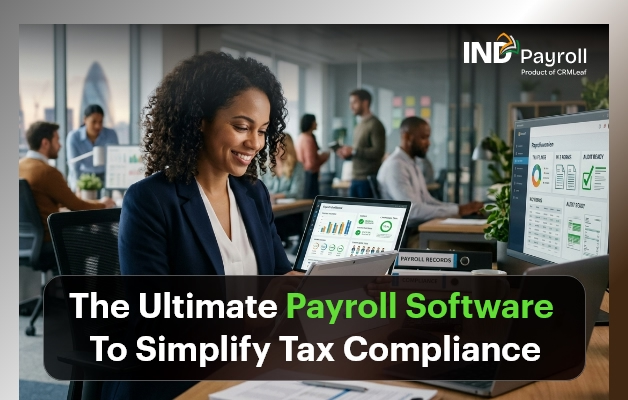
TL;DR — The Ultimate Payroll Software To Simplify Tax Compliance
- Automate PF & ESI Compliance: INDPayroll calculates Provident Fund and ESI contributions every month — no manual effort, no errors, and no missed EPFO or ESIC deadlines.
- Built-In TDS Management: TDS is computed per employee based on live declarations and current income tax slabs, keeping your business audit-ready all year long.
- One-Click Payslip Generation: Generate professional, compliant payslips for every employee in seconds using the payslip and reports generator — including CTC, deductions, and net pay.
- Real-Time Compliance Updates: INDPayroll automatically tracks the latest EPF regulations and labour law changes — your payroll always runs under current Indian law.
- Free Compliance Verification Tools: Check PF, ESI, and CTC figures instantly using the free PF calculator, ESI calculator, and CTC calculator — no login required.
- Cuts Compliance Time by Up to 80%: From ECR file generation to Form 16, INDPayroll automates every statutory task and saves HR teams 15–20 hours per month.
Indeed, tax compliance is not optional in India — it is the law. Yet every month, thousands of HR teams scramble through spreadsheets, chase approvals, and manually compute PF, ESI, and TDS deductions. One miscalculation can trigger a notice from EPFO or ESIC and cost your business far more than the original error.
However, the root cause is almost always the same: outdated tools or manual processes. If your payroll software cannot handle India’s statutory requirements automatically, your compliance risk grows every pay cycle.
Fortunately, INDPayroll changes that. Built exclusively for Indian businesses, this payroll software handles every tax and statutory obligation from contribution calculations to challan generation — automatically, accurately, and on time.
Therefore, in this guide, you will learn exactly how INDPayroll simplifies tax compliance, who it is built for, and how to get started today.
Why Tax Compliance Breaks Most Indian HR Teams
To understand why, note that Indian payroll compliance is genuinely complex. Every business must navigate a layered system of statutory requirements. These include Employees’ Provident Fund (EPF) contributions, Employee State Insurance (ESI) deductions, Tax Deducted at Source (TDS), Professional Tax, and Labour Welfare Fund — each with its own calculation rules, filing deadlines, and penalty structures.
According to EPFO data, compliance defaults are most common among SMEs that rely on manual processing. The reasons are predictable: incorrect contribution calculations, missed filing dates, mismatched UAN records, and poor documentation. Each error invites scrutiny, penalties, and reputational risk.
Moreover, the situation worsens as businesses scale. A team of 20 is manageable on a spreadsheet. A team of 200 is not. And with India’s labour law updates happening frequently, keeping pace with regulatory changes alone is a full-time job.
Consequently, the solution is not to hire more compliance staff. The solution is smarter payroll software.
Free Payroll, PF, ESI & TDS Software
What Makes INDPayroll the Ultimate Payroll Software for Tax Compliance?
INDPayroll is a cloud-based, India-first payroll software that automates every aspect of salary processing and statutory compliance. It is not a global tool adapted for India — it is built ground-up for Indian payroll law, Indian salary structures, and Indian filing requirements.
Here are six reasons why INDPayroll stands out as the ultimate payroll software for simplifying tax compliance in 2026:
- Automated PF & ESI Calculations: INDPayroll computes Provident Fund and ESI contributions in real time on every payroll run. It applies the correct contribution percentages, respects wage ceiling limits, and generates challans ready for EPFO and ESIC submission — with zero manual intervention. Explore the full PF & ESI compliance module to see how it works.
- Built-In TDS Management: The software calculates TDS automatically based on the employee’s income declarations, HRA exemptions, investment proofs, and the current income tax slabs. Every employee’s tax liability is recomputed each month, so your deductions are always accurate. No more year-end surprises or excess deductions to reconcile.
- One-Click Professional Payslip Generation: Every employee deserves a compliant, detailed payslip on pay day. INDPayroll’s payslip and reports generator creates fully formatted payslips — including CTC, gross pay, all deductions, PF/ESI breakdown, and net pay — in seconds. You can also use the standalone free payslip generator for quick single-employee slips.
- Real-Time Compliance Updates: India’s payroll regulations change frequently. INDPayroll monitors the latest EPF regulations and pushes updates to the platform automatically. You always process payroll under current law — without reading government circulars or manually adjusting rates.
- Free Compliance Verification Tools: Before running payroll, verify your numbers using INDPayroll’s suite of free tools: the PF calculator, ESI calculator, and CTC calculator. These are available to anyone — no account needed — making them ideal for HR professionals who want to double-check figures before finalising salary runs.
- Detailed Salary Breakup & Audit-Ready Reports: INDPayroll generates granular salary breakup reports for every employee. These reports include component-wise breakdowns, month-on-month comparisons, and statutory summaries — giving your finance team everything it needs for audits, appraisals, and board reporting without a single additional spreadsheet.
Key Features That Simplify Tax Compliance End-to-End
Furthermore, understanding individual features is useful, but what matters most is how they work together as a system. Here is how INDPayroll’s core modules connect to create a seamless compliance workflow.
PF & ESI Compliance — Fully Automated
Managing PF & ESI compliance is the single biggest compliance risk for most Indian businesses. EPFO and ESIC both have strict timelines — contributions must be deposited by the 15th of each month. Delays attract interest and penalties.
In detail, INDPayroll automates the full compliance cycle. It calculates employer and employee contributions, generates ECR (Electronic Challan cum Return) files for EPFO, and produces ESIC contribution statements — all formatted for direct submission. Follow the detailed EPF compliance guide and ESI compliance guide to understand the exact steps the software handles on your behalf.
For teams that want to cross-verify contributions before processing, the PF calculator and ESI calculator are available free and require no login.
Salary Processing — Accurate, Fast, Flexible
India’s salary structures are not simple. Most companies use multi-component pay packages that include basic salary, HRA, conveyance, special allowance, LTA, and variable performance pay. Each component has different tax implications and PF/ESI applicability rules.
INDPayroll’s salary processing module handles all of this natively. It supports arrear calculations, mid-month joiners, full-and-final settlements, loss-of-pay adjustments, and bonus processing. Every salary run is reconciled before finalisation, giving you confidence that what you approve is what gets paid — and reported.
Payslip Generation and Statutory Reports
Importantly, payslips are legal documents in India. Under the Payment of Wages Act, employers must issue payslips to employees on or before payday. INDPayroll’s payslip reports generator creates compliant, professional payslips for every employee with one click.
Beyond payslips, the platform generates Form 16, monthly salary registers, PF contribution statements, ESI contribution reports, and TDS summaries — all downloadable for your records and ready for submission to relevant authorities.
Registration & Filing Guidance
Moreover, new businesses often struggle with the initial compliance setup — registering under EPFO, ESIC, and Professional Tax authorities. INDPayroll’s registration and filing module walks you through each requirement step by step. It generates the forms, documents, and challans you need for timely registration and ongoing statutory filing.
Free Payroll, PF,
ESI & TDS Software
Professional compliance management for Indian businesses. 100% Free Forever.
Real Use Cases: Who Benefits Most from INDPayroll?
Importantly, INDPayroll is not a niche solution. It is purpose-built to serve businesses across industries and team sizes. Here are three scenarios where it delivers the highest impact.
Startups and Remote Teams
For example, growing startups often operate across multiple states, each with different Professional Tax slabs. They hire quickly, offer equity, and structure CTC creatively to attract talent. Managing multi-state payroll compliance manually is nearly impossible without dedicated payroll expertise.
As a result, INDPayroll handles multi-state payroll natively. It applies the correct Professional Tax rates by state, supports equity and variable component tracking, and gives distributed HR teams a single dashboard to manage compliance across every location.
Manufacturing and Production Businesses
Similarly, factories deal with shift-based attendance, overtime calculations, contract worker management, and large blue-collar workforces. ESI applicability is critical in this sector — and errors in ESI contribution can trigger ESIC audits.
Therefore, INDPayroll automates attendance-linked salary processing, applies the correct ESI contributions for eligible employees, and generates the exact reports ESIC inspectors look for during audits. It saves manufacturing HR teams hours of monthly work and significantly reduces compliance risk.
IT Companies and Service Agencies
Additionally, IT firms offer complex CTC structures with multiple allowances, performance bonuses, and tax-saving reimbursements. Finance teams at IT companies often spend days each month reconciling payroll data with accounting systems.
Consequently, INDPayroll integrates TDS management, investment proof collection, and Form 16 generation into a single workflow. Finance teams can close payroll in hours instead of days — and employees get transparent payslips that clearly explain every deduction.
INDPayroll vs. Other Payroll Software: Why Teams Are Switching
In practice, many businesses evaluate INDPayroll after running into limitations with their current tools. Global payroll platforms often require heavy customisation to handle Indian statutory requirements. Spreadsheets break at scale. Older India-focused tools lack modern usability or cloud access.
Compared to platforms covered in our guides on Keka HR alternatives, GreytHR alternatives, PagarBook alternatives, and FactoHR alternatives, INDPayroll consistently wins on three dimensions: India-first compliance automation, a simpler and cleaner user interface, and more transparent pricing for growing teams.
INDPayroll is developed by Andolasoft, a trusted technology company with deep expertise in HR and enterprise software. It integrates smoothly with productivity and CRM tools like CRMLeaf and project management platforms like Orangescrum — so your HR data flows seamlessly across your business stack.
How INDPayroll Cuts Compliance Time by Up to 80%
In fact, most HR teams spend 15 to 20 hours per month on compliance-related payroll tasks. With INDPayroll, this drops dramatically — and here is exactly why.
First of all, the software auto-calculates all statutory deductions during every payroll run. There is no manual rate lookup, no formula copying, and no risk of outdated tax tables. Second, it generates challans and ECR files that are ready for EPFO submission with a single download. Third, it tracks upcoming filing deadlines and sends automated reminders before due dates — so nothing slips through the cracks.
Additionally, the compliance dashboard gives a real-time status view of every obligation: what has been filed, what is pending, and what is due soon. Your HR team always knows exactly where things stand — without chasing emails or digging through folders.
You can start exploring compliance tools before you even sign up. Visit the free tools library for instant access to calculators and guides that help you audit your current process.
How to Get Started with INDPayroll in 4 Simple Steps
Step 1 — Create Your Account: Visit INDPayroll and sign up for free. No credit card is required. The onboarding wizard guides you through your company profile setup in minutes.
Step 2 — Configure Your Payroll Structure: Add your employees, define salary components, and configure PF and ESI eligibility. INDPayroll’s smart setup detects common Indian salary structures and pre-fills most settings automatically.
Step 3 — Run Your First Payroll Cycle: Process your first salary run with one click. INDPayroll calculates all deductions, generates payslips, and prepares statutory reports — automatically. Review the summary, approve it, and you are done.
Step 4 — File Compliance Returns on Time: Download ECR files, challans, and statutory reports directly from your dashboard. Submit them to EPFO and ESIC on or before the 15th of every month, without stress.
Free Payroll, PF, ESI & TDS Software
The most trusted automation tool for modern Indian businesses.
Conclusion: The Smarter Way to Handle Tax Compliance in 2026
Ultimately, tax compliance should not be a source of stress for your HR team. With the right payroll software, every statutory obligation — from PF and ESI contributions to TDS, payslips, and annual filings — runs on autopilot. Your team focuses on people, not paperwork.
Indeed, INDPayroll is the India-first payroll software that makes this possible. It is accurate, automated, and built to keep your business compliant under every change in Indian payroll law. Whether you are a 10-person startup or a 500-employee enterprise, INDPayroll delivers the compliance confidence you need to scale without worry.
Meanwhile, thousands of Indian businesses have already made the switch. The question is: how much longer will you rely on manual processes that cost you time, money, and peace of mind?
Frequently Asked Questions
What is payroll software, and why does a business need it?
Payroll software automates salary calculation, statutory deductions (PF, ESI, TDS), and payslip generation for a business. Indian businesses need it to comply with EPFO, ESIC, and Income Tax Act requirements accurately and on time — reducing manual errors and penalty risk.
How does INDPayroll handle PF and ESI compliance?
INDPayroll calculates employer and employee PF and ESI contributions automatically every month. It generates ECR files and challans for direct submission to EPFO and ESIC, and tracks deadlines to ensure you never miss a filing date. Read the full EPF compliance guide for detailed steps.
Can INDPayroll manage TDS for salaried employees?
Yes. INDPayroll computes TDS based on each employee’s income declarations, applicable tax regime, and current income tax slabs. It adjusts TDS every month as declarations or income changes, and generates Form 16 at the end of the financial year.
Is INDPayroll suitable for small businesses with fewer than 20 employees?
Absolutely. INDPayroll is designed for businesses of all sizes — from startups with five employees to enterprises with thousands. Pricing is flexible and scales with your headcount, so small businesses only pay for what they need.
How does INDPayroll stay updated with changing Indian labour laws?
INDPayroll’s compliance team actively monitors all changes to EPF, ESI, Professional Tax, and income tax regulations. Platform updates are pushed automatically, so your payroll always reflects the latest EPF regulations and labour law changes — without any action from your team.
What free tools does INDPayroll provide?
INDPayroll offers a comprehensive free tools library, including a PF calculator, ESI calculator, CTC calculator, and payslip generator — all available free without requiring a login.