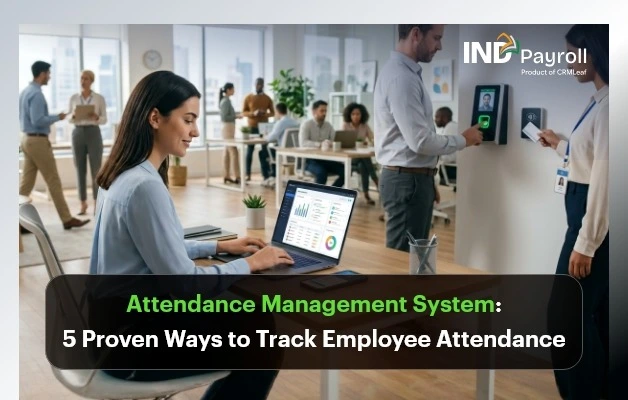
Attendance Management System: 5 Proven Ways to Track Employee Attendance

TL;DR: 

  • An Attendance Management System centralizes attendance capture, shift data, and leave records, then connects them directly to payroll.
  • INDPayroll supports five practical attendance tracking methods: biometric devices, bulk attendance import, mobile GPS/geo-fencing, web-based manual entry, and facial recognition.
  • Attendance flows through a clear six-step path: attendance settings, shift assignment, capture, calendar view, reports, and payroll with no manual re-entry.
  •  Attendance reports provide HR with present, absent, late, half-day, and hours-clocked data that are export-ready and payroll-ready.
  • Different teams (office, factory, retail, field, construction, remote) often need different capture methods. A good system supports all of them together instead of forcing one method on every employee.

Introduction

An Attendance Management System keeps attendance data accurate, and accurate attendance data is the foundation of correct payroll. When someone records working days, late arrivals, half days, or overtime incorrectly, salaries go wrong too. This leads to employee disputes, compliance exposure, and rework for HR and payroll teams every single month. Attendance errors rarely stay contained to one payslip. They tend to repeat until someone catches them, which usually happens only after an employee complains.

Beyond payroll accuracy, attendance data provides operations and HR managers with real visibility into who is working, where, and for how long. A manufacturing supervisor needs to know who reported to the factory floor on time. A construction site manager needs proof that workers actually checked in at the site. A sales head needs to confirm that field executives visited their assigned locations. A single, one-size-fits-all attendance method cannot solve any of these needs.

HR managers, payroll managers, business owners, and operations managers run offices, factories, retail outlets, construction sites, or remote and hybrid teams. For all of them, attendance tracking has to be flexible enough to match how each type of employee actually works.

This blog explains what an Attendance Management System does and walks through the exact workflow that attendance data follows before it reaches payroll. It also covers five proven ways INDPayroll helps businesses track employee attendance accurately, without maintaining separate systems for separate teams.

India’s #1 Free Software

Track Attendance Smarter

Simplify employee attendance tracking

What Is an Attendance Management System?

An Attendance Management System is software that records when employees start and end work and tracks their assigned shifts. It also consolidates this information for HR and payroll use. Instead of maintaining paper registers, biometric device exports, and separate spreadsheets that someone has to manually reconcile every month, a modern Attendance Management System centralizes attendance records in one place.

INDPayroll’s Attendance Management System connects attendance directly with shift schedules, leave records, and payroll processing. This means HR does not need to manually match attendance sheets against payroll inputs every cycle. Employees can capture attendance through biometric devices, mobile check-ins, or manual entry. Once captured, it becomes available for shift review, attendance reporting, and payroll calculation without duplicate data entry anywhere in the process.

This centralization matters most for businesses managing mixed workforces. Some employees punch in at a biometric device at the factory gate, and some check in from a client site using a mobile phone. A supervisor marks others manually because they are temporary staff or because they missed a punch. A system that only supports one of these methods forces HR to maintain workarounds for everyone else. A system that supports all of them keeps every employee’s attendance inside the same report and the same payroll run.

Attendance Management System: 5 Proven Ways to Track Employee Attendance

Different teams need different ways to record attendance, and no single method covers every scenario well. A factory floor cannot rely on mobile GPS because production workers are not carrying phones with location services on all day. A field sales team cannot use a fingerprint scanner because they are never at a fixed device. A small business with five employees does not need to invest in biometric hardware at all.

INDPayroll addresses this by supporting five attendance capture methods within one system. This allows businesses to mix and match based on workforce type, budget, and how much control they need over location verification.

1. Biometric Attendance Tracking

Biometric attendance uses physical verification, fingerprint devices, or iris scanners to record entry and exit times. INDPayroll integrates with widely used biometric device brands, including ZKTeco, Hikvision, ESSL, and Matrix, along with other industry-standard biometric devices, through SDK and API connections.

This means businesses that already have biometric hardware installed at their office, factory, or warehouse do not need to replace it to start using INDPayroll. The existing devices connect to the software instead.

INDPayroll builds the integration on standard SDK and API connections rather than a single proprietary device. This means it also supports businesses running more than one biometric brand across different locations.

For example, a business might use one device model at the head office and a different one at a factory unit. Attendance from both feeds into the same central system. INDPayroll provides a step-by-step device configuration guide to help HR and IT teams set up this connection without needing a dedicated technical integration specialist.

Where Biometric Attendance Works Best

This method suits office premises, factories, and manufacturing units well, where employees report to a fixed location daily. It also works well where accountability for exact in-and-out times matters.

This method ties attendance to a physical identity check, rather than a card, code, or manual sign-in. This removes the possibility of buddy punching. Buddy punching is a common problem where one employee marks attendance for another who has not actually arrived. The device logs entry and exit times automatically the moment it verifies the employee. This gives accurate records without a supervisor having to watch the entrance or manually note down timings.

For manufacturing units in particular, biometric attendance also supports shift-based operations well. When production runs in fixed shifts, biometric logs give an unambiguous record of who was present for which shift. This record becomes important both for payroll accuracy and for safety and compliance audits on the factory floor.

2. Bulk Attendance Import

This applies to businesses with large teams or to cases where attendance data originates from external biometric machines that do not directly connect to INDPayroll. In these situations, the Attendance Management System supports importing attendance in bulk rather than entering it one employee at a time.

This is especially useful right after exporting logs from a standalone biometric device. It also helps when a business is onboarding a large workforce’s attendance for a payroll cycle for the first time.

In practice, this method matters most for HR teams handling attendance for a hundred or more employees. Instead of opening each employee’s record and updating it individually, HR can prepare the data once, often directly from the biometric device’s own export file.

HR can then upload it in a single action through the Import button under Payroll → Attendance → Mark Attendance.

The Attendance Management System validates the uploaded data as it comes in, flagging inconsistencies such as missing employee IDs or improperly formatted dates before they reach payroll. This way, errors do not sit undetected until payroll calculates salaries.

Bulk import does not replace daily attendance capture; it complements it. A business might use biometric devices for daily capture and still need bulk import once a month. This could be to bring in attendance from a satellite office that uses a separate, non-integrated device, or to correct a batch of records after a device malfunction.

Either way, it saves considerable manual effort compared to retyping attendance data for dozens or hundreds of employees. It also reduces the kind of typing errors that are easy to make and hard to catch when entering attendance one row at a time.

3. Mobile Attendance with GPS / Geo-Fencing

Not every employee works from a fixed office. Field sales staff, construction site workers, remote employees, and hybrid teams all need a way to mark attendance from wherever they happen to be working that day.

INDPayroll’s mobile GPS check-in and check-out capture the employee’s location at the exact time they punch in or out. This gives HR and managers a location-stamped attendance record instead of a blind self-declaration.

Geo-fencing adds a further layer of control by restricting attendance marking to approved locations. Businesses use this to confirm that a field employee actually checked in from a client site, a construction site, or another pre-approved work zone. It rules out check-ins from home, a coffee shop, or somewhere unrelated to the day’s assignment.

For a construction company, this might mean an employee can only mark attendance once they are physically within the boundary of the project site. For a field sales team, this might mean the Attendance Management System only accepts check-ins within a defined radius of the client locations assigned for that day.

This location verification gives operations and HR managers real confidence that attendance reflects actual, on-site presence rather than a punch made from anywhere. It is particularly valuable for construction firms managing multiple sites at once. The same applies to field sales organizations where reps are constantly moving between client locations. It also applies to businesses running remote or hybrid teams where there is no office entry point to observe in person.

4. Web-Based Manual Attendance

INDPayroll also allows HR and other authorized team members to record attendance manually through the web portal, without requiring any device or mobile app.

This method works well for small businesses that do not yet need hardware-based tracking. It is equally useful as a fallback for larger businesses. HR can use it for correcting missing punches, marking attendance for temporary or short-term employees who do not yet have biometric device access, or handling one-off exceptions that automated methods cannot capture on their own.

A common real-world scenario is a biometric device going offline for part of a day. Another is a new employee joining before completing fingerprint enrollment on the device. In both cases, an authorized user can step in and mark attendance manually through Payroll → Attendance → Mark Attendance. This way, the attendance calendar does not show a blank day. This method can also regularize missed punches, reflecting the correction in the same records used for reporting and payroll.

This option keeps attendance tracking accessible for smaller teams from day one. Businesses do not need to invest in devices before they can use an attendance system at all. It still feeds directly into the same shift, calendar, report, and payroll workflow as biometric or GPS-based methods. No employee’s attendance sits in a separate system just because it happened to be entered manually.

5. Facial Recognition Attendance

INDPayroll also supports AI-powered facial recognition as a touchless way to mark attendance, available on the premium plan. Instead of touching a fingerprint scanner or a shared device, an employee simply faces the camera and is verified automatically. Entry and exit times are logged the moment the match is confirmed.

This method suits workplaces that want the accountability of biometric verification without physical contact with a shared device. Examples include healthcare facilities, food processing units, or any workplace where hygiene standards make a shared fingerprint scanner less desirable. Like fingerprint-based biometric attendance, facial recognition ties the attendance record to a verified identity. This removes the possibility of one employee marking attendance for another.

Because it is a premium-plan feature, businesses evaluating this option should confirm it is included in their plan before rolling it out across a location. They can pair it with one of the other four methods for locations or teams that do not need it.

Method Best For Key Benefit
Biometric Attendance Office, factory, manufacturing Eliminates buddy punching
Bulk Attendance Import Large workforces, monthly uploads Saves HR time with validated data
Mobile GPS / Geo-Fencing Field sales, construction, remote teams Verifies on-site presence
Web-Based Manual Attendance Small businesses, corrections, and temporary staff Simple, no hardware needed
Facial Recognition Hygiene-sensitive workplaces, high-security offices Touchless, identity-verified marking

Real-Time Visibility and an Audit-Ready Trail

Capturing attendance through any of the five methods above is only half the value. INDPayroll also gives HR and operations managers a live dashboard. It shows who is present, late, or absent across offices and field locations at any point during the day. This is a real change from a picture that only becomes available at month-end.

For a business running multiple locations, this real-time view makes it possible to notice attendance problems, like an unusually high number of absences at one site. There is still time to act on them.

Every punch, attendance regularization, and shift change is also logged with a timestamp and, where applicable, the approver’s details. This creates an audit trail that HR teams can rely on if attendance records are ever questioned internally or reviewed during a compliance check. The history of who changed what and when is preserved automatically, rather than depending on someone’s memory or a side note in an email.

How Attendance Data Flows into Payroll

INDPayroll follows a clear, six-step workflow so attendance data reaches payroll without manual reconciliation at the end of the month. Each step depends on the one before it, which is why the order matters as much as the steps themselves.

Step 1 — Settings

Path: Settings → Attendance Settings

Configure attendance settings such as work hours and grace period. This step defines what “on time,” “late,” and a full working day actually mean for your business before any attendance is captured. As a result, every later calculation is measured against the correct baseline.

Step 2 — Shift Roster

Path: Payroll → Shift Roster → Assign Bulk Shifts

Assign shifts to all employees before attendance capture begins. Employees need a defined shift before their attendance can be evaluated correctly. Without it, the Attendance Management System has no reference point to determine whether a punch was on time, late, or outside working hours.

Step 3 — Mark Attendance

Path: Payroll → Attendance → Mark Attendance

Enter daily attendance manually or import bulk attendance using the Import button (Excel upload). This is where the five capture methods discussed above come into play. They can be used either individually or in combination, depending on the employee and the day.

Step 4 — View Calendar

Check attendance status on the monthly calendar grid, which shows Holiday, Day Off, Present, Half Day, Late, Absent, and On Leave for each employee. This calendar view gives HR a visual, day-by-day picture of the month before generating any reports. This makes it easy to spot gaps or unusual patterns early, rather than after payroll has already been run.

Step 5 — Attendance Report

Path: Reports → Attendance Report

Generate and review the attendance report for the month. This is the checkpoint where HR confirms the data is accurate before it becomes the basis for salary calculations.

Step 6 — Export & Run Payroll

Path: Payroll → Run Payroll

Use the verified attendance data to run payroll. Once attendance has been reviewed at Step 5, it flows directly into payroll. There is no need to re-enter working days, late counts, or overtime hours separately. See how this step works in detail on the INDPayroll salary processing page.

What Attendance Data Calculates in Payroll

This sequence flows in a fixed order: settings first, then shifts, then capture, then a calendar review, then a report, and only then payroll. Because of this, the attendance data used for salary calculations has already been verified by the time payroll is run. From this data, INDPayroll calculates:

  • Working days
  • Late arrivals
  • Half days
  • Loss of Pay (LOP)
  • Overtime

This removes the need for a payroll manager to manually count attendance days from a separate register or spreadsheet before applying deductions. This manual counting is where a large share of payroll errors traditionally originate.

Live & Automated

Automate Attendance

Manage attendance with confidence

Attendance Reports That Help HR Make Better Decisions

Attendance reports give HR and payroll managers a clear monthly picture of workforce presence. This saves them from having to piece it together from the calendar view alone. INDPayroll’s attendance reports typically cover:

  • Present days
  • Absent days
  • Late days
  • Half days
  • Extra working days
  • Hours clocked

These fields matter for different reasons. Present and absent day counts are the baseline for working-day calculations. Late days and half days feed directly into deductions or grace-period policy enforcement. Extra working days and hours clocked matter most for overtime-eligible teams. For these teams, accurate hour totals determine whether an employee has crossed into overtime territory for that pay cycle.

Reports can typically be reviewed for the full team at once or drilled down to an individual employee. This is useful when a manager needs to verify one person’s record, for example, before approving a regularization request. It avoids the need to generate a report for the entire organization just for that check.

These reports can be exported in Excel or CSV format for record-keeping, audits, or sharing with department heads who need visibility into their own team’s attendance without accessing the full HR system. The same attendance data is already linked to shifts and leave, so the reports are payroll-ready.

This means payroll managers can run salary processing directly from verified attendance figures, instead of rebuilding the data separately in a spreadsheet each month. These reports sit alongside INDPayroll’s other payroll reports and digital payslips, so attendance, salary, and compliance data all stay in one place.

Why Businesses Need Multiple Attendance Tracking Methods

A single attendance method rarely works for every team inside one business, let alone across different industries. Consider how attendance needs differ in practice:

  • Office staff can use biometric devices or web-based punching at a fixed location. This works because they report to the same premises each day, and a device-based check is simple to maintain.
  • Manufacturing units benefit from biometric tracking to manage shift-based factory floors accurately. This especially matters where production runs in fixed shifts and exact in-and-out timing affects both payroll and safety accountability.
  • Retail outlets with distributed staff across multiple stores often combine web-based punching with manual corrections for shift changes. Staffing patterns can shift day to day, and a single outlet may not justify dedicated biometric hardware.
  • Field sales teams rely on mobile GPS check-ins. This is because they are rarely at one location, and their working day is defined by client visits rather than office hours.
  • Construction site workers need geo-fenced mobile attendance to confirm on-site presence. This matters particularly on projects where labor contractors and daily wage tracking depend on verified attendance at the actual site.
  • IT companies and other remote-friendly teams depend on GPS-based mobile attendance or web-based portals. This is because there is often no single physical office that every employee reports to.

Supporting all five methods in one system means a business does not need to run separate tools for each employee type. Attendance from a factory worker’s biometric punch, a field rep’s GPS check-in, and a temporary employee’s manually marked entry all feed into one place. This includes the same shift structure, the same monthly calendar, the same attendance report, and the same payroll run.

How to Choose the Right Attendance Method for Your Team

Most businesses do not end up using just one method. Instead, they assign methods based on how each group of employees actually works. A practical way to decide is to group employees first, then match a method to each group:

  • If a team reports to one physical location every day, biometric attendance is usually the most reliable and lowest-effort option. This holds true once the device is set up.
  • Attendance data sometimes already exists somewhere else — a standalone biometric machine, an older system, or a large batch of new joiners. In these cases, bulk import avoids re-entering that data by hand.
  • If a team’s work location changes day to day or is outside a fixed office, mobile GPS with geo-fencing is the right choice. It provides location verification that a simple check-in cannot.
  • If a team is small, temporary, or not yet set up on hardware, web-based manual attendance is the simplest option. It keeps them inside the same payroll workflow without any upfront investment.
  • If a location needs touchless, hygiene-conscious verification and is on a premium plan, facial recognition is a strong option. It offers the same identity accountability as biometric attendance without physical contact.

Many businesses end up using two or three of these methods at once. For example, they might use biometric or facial recognition attendance for permanent office and factory staff, GPS attendance for field sales, and manual entry as a fallback for corrections across both groups.

Best Practices for Accurate Attendance Management

Getting the technology right is only part of accurate attendance management. The sequence and discipline around using it matter just as much.

  • Configure attendance settings before the payroll cycle begins. Work hours and grace periods set the baseline for every late-arrival and half-day calculation that follows. Getting this right at the start avoids disputes later.
  • Assign shifts first so captured attendance is measured against the correct working hours. Attendance recorded against the wrong shift will produce incorrect late-arrival or overtime results even if the punch itself was accurate.
  • Capture attendance daily rather than waiting until month-end. Daily capture makes it far easier to catch a missed punch or device issue while it can still be corrected. This avoids discovering a gap only when the monthly report is generated.
  • Review attendance reports regularly, not just before payroll day. A weekly glance at the report can surface a pattern, such as repeated lateness from one location. Spotting this early means it never becomes a payroll-day surprise.
  • Verify late arrivals and flagged exceptions before they affect payroll. Not every late punch or absence should automatically become a deduction. Genuine exceptions need a quick review and, where appropriate, a regularization.
  • Run payroll only after attendance data has been reviewed and verified. Treat the attendance report as a sign-off step, not a formality. It is the last checkpoint before the numbers become part of an employee’s salary.

Following this order reduces last-minute corrections and keeps payroll calculations accurate the first time. This avoids requiring a rerun after employees flag discrepancies in their payslips.

Common Attendance Tracking Mistakes to Avoid

Even with the right system in place, a few habits tend to undermine attendance accuracy:

  • Skipping the shift assignment step. Capturing attendance before shifts are assigned means the system has nothing to measure lateness or working hours against. This shows up later as inconsistent or incorrect report data.
  • Letting corrections pile up. Waiting until month-end to fix missed punches or regularize exceptions makes it harder to remember the actual circumstances of each case. It also increases the chance of an error slipping through to payroll.
  • Treating the attendance report as a formality. Generating the report without actually reviewing it defeats its purpose as a verification checkpoint before payroll.
  • Using one method for a workforce that clearly needs more than one. Forcing a field team onto biometric devices they cannot access, or forcing office staff into manual entry when a device would be faster, is a common mistake. It creates unnecessary friction and more room for error.
India’s #1 Free Software

Simplify attendance & payroll today

Conclusion: Choosing the Right Attendance Management System

Attendance tracking is not a one-size-fits-all task. Office teams, factory workers, field staff, and remote employees all need different ways to mark attendance. Payroll accuracy depends on capturing that data correctly for each of them.

A good system supports biometric tracking, bulk import, GPS-based mobile attendance, web-based manual entry, and facial recognition, all connected to the same six-step payroll workflow. Choosing this kind of system reduces manual work for HR and improves the accuracy of every payroll run, regardless of how varied the workforce is.

Explore the INDPayroll Attendance Management System to simplify attendance tracking and payroll from one centralized platform.
The Ultimate Payroll Software To Simplify Tax Compliance

TL;DR — The Ultimate Payroll Software To Simplify Tax Compliance

  • Automate PF & ESI Compliance: INDPayroll calculates Provident Fund and ESI contributions every month — no manual effort, no errors, and no missed EPFO or ESIC deadlines.
  • Built-In TDS Management: TDS is computed per employee based on live declarations and current income tax slabs, keeping your business audit-ready all year long.
  • One-Click Payslip Generation: Generate professional, compliant payslips for every employee in seconds using the payslip and reports generator — including CTC, deductions, and net pay.
  • Real-Time Compliance Updates: INDPayroll automatically tracks the latest EPF regulations and labour law changes — your payroll always runs under current Indian law.
  • Free Compliance Verification Tools: Check PF, ESI, and CTC figures instantly using the free PF calculator, ESI calculator, and CTC calculator — no login required.
  • Cuts Compliance Time by Up to 80%: From ECR file generation to Form 16, INDPayroll automates every statutory task and saves HR teams 15–20 hours per month.

Indeed, tax compliance is not optional in India — it is the law. Yet every month, thousands of HR teams scramble through spreadsheets, chase approvals, and manually compute PF, ESI, and TDS deductions. One miscalculation can trigger a notice from EPFO or ESIC and cost your business far more than the original error.

However, the root cause is almost always the same: outdated tools or manual processes. If your payroll software cannot handle India’s statutory requirements automatically, your compliance risk grows every pay cycle.

Fortunately, INDPayroll changes that. Built exclusively for Indian businesses, this payroll software handles every tax and statutory obligation from contribution calculations to challan generation — automatically, accurately, and on time.

Therefore, in this guide, you will learn exactly how INDPayroll simplifies tax compliance, who it is built for, and how to get started today.

Why Tax Compliance Breaks Most Indian HR Teams

To understand why, note that Indian payroll compliance is genuinely complex. Every business must navigate a layered system of statutory requirements. These include Employees’ Provident Fund (EPF) contributions, Employee State Insurance (ESI) deductions, Tax Deducted at Source (TDS), Professional Tax, and Labour Welfare Fund — each with its own calculation rules, filing deadlines, and penalty structures.

According to EPFO data, compliance defaults are most common among SMEs that rely on manual processing. The reasons are predictable: incorrect contribution calculations, missed filing dates, mismatched UAN records, and poor documentation. Each error invites scrutiny, penalties, and reputational risk.

Moreover, the situation worsens as businesses scale. A team of 20 is manageable on a spreadsheet. A team of 200 is not. And with India’s labour law updates happening frequently, keeping pace with regulatory changes alone is a full-time job.

Consequently, the solution is not to hire more compliance staff. The solution is smarter payroll software.

India’s #1 Free Software

Free Payroll, PF, ESI & TDS Software

What Makes INDPayroll the Ultimate Payroll Software for Tax Compliance?

INDPayroll is a cloud-based, India-first payroll software that automates every aspect of salary processing and statutory compliance. It is not a global tool adapted for India — it is built ground-up for Indian payroll law, Indian salary structures, and Indian filing requirements.

Here are six reasons why INDPayroll stands out as the ultimate payroll software for simplifying tax compliance in 2026:

  • Automated PF & ESI Calculations: INDPayroll computes Provident Fund and ESI contributions in real time on every payroll run. It applies the correct contribution percentages, respects wage ceiling limits, and generates challans ready for EPFO and ESIC submission — with zero manual intervention. Explore the full PF & ESI compliance module to see how it works.
  • Built-In TDS Management: The software calculates TDS automatically based on the employee’s income declarations, HRA exemptions, investment proofs, and the current income tax slabs. Every employee’s tax liability is recomputed each month, so your deductions are always accurate. No more year-end surprises or excess deductions to reconcile.
  • One-Click Professional Payslip Generation: Every employee deserves a compliant, detailed payslip on pay day. INDPayroll’s payslip and reports generator creates fully formatted payslips — including CTC, gross pay, all deductions, PF/ESI breakdown, and net pay — in seconds. You can also use the standalone free payslip generator for quick single-employee slips.
  • Real-Time Compliance Updates: India’s payroll regulations change frequently. INDPayroll monitors the latest EPF regulations and pushes updates to the platform automatically. You always process payroll under current law — without reading government circulars or manually adjusting rates.
  • Free Compliance Verification Tools: Before running payroll, verify your numbers using INDPayroll’s suite of free tools: the PF calculator, ESI calculator, and CTC calculator. These are available to anyone — no account needed — making them ideal for HR professionals who want to double-check figures before finalising salary runs.
  • Detailed Salary Breakup & Audit-Ready Reports: INDPayroll generates granular salary breakup reports for every employee. These reports include component-wise breakdowns, month-on-month comparisons, and statutory summaries — giving your finance team everything it needs for audits, appraisals, and board reporting without a single additional spreadsheet.

Key Features That Simplify Tax Compliance End-to-End

Furthermore, understanding individual features is useful, but what matters most is how they work together as a system. Here is how INDPayroll’s core modules connect to create a seamless compliance workflow.

PF & ESI Compliance — Fully Automated

Managing PF & ESI compliance is the single biggest compliance risk for most Indian businesses. EPFO and ESIC both have strict timelines — contributions must be deposited by the 15th of each month. Delays attract interest and penalties.

In detail, INDPayroll automates the full compliance cycle. It calculates employer and employee contributions, generates ECR (Electronic Challan cum Return) files for EPFO, and produces ESIC contribution statements — all formatted for direct submission. Follow the detailed EPF compliance guide and ESI compliance guide to understand the exact steps the software handles on your behalf.

For teams that want to cross-verify contributions before processing, the PF calculator and ESI calculator are available free and require no login.

Salary Processing — Accurate, Fast, Flexible

India’s salary structures are not simple. Most companies use multi-component pay packages that include basic salary, HRA, conveyance, special allowance, LTA, and variable performance pay. Each component has different tax implications and PF/ESI applicability rules.

INDPayroll’s salary processing module handles all of this natively. It supports arrear calculations, mid-month joiners, full-and-final settlements, loss-of-pay adjustments, and bonus processing. Every salary run is reconciled before finalisation, giving you confidence that what you approve is what gets paid — and reported.

Payslip Generation and Statutory Reports

Importantly, payslips are legal documents in India. Under the Payment of Wages Act, employers must issue payslips to employees on or before payday. INDPayroll’s payslip reports generator creates compliant, professional payslips for every employee with one click.

Beyond payslips, the platform generates Form 16, monthly salary registers, PF contribution statements, ESI contribution reports, and TDS summaries — all downloadable for your records and ready for submission to relevant authorities.

Registration & Filing Guidance

Moreover, new businesses often struggle with the initial compliance setup — registering under EPFO, ESIC, and Professional Tax authorities. INDPayroll’s registration and filing module walks you through each requirement step by step. It generates the forms, documents, and challans you need for timely registration and ongoing statutory filing.

India’s #1 Free Software

Free Payroll, PF,
ESI & TDS Software

Professional compliance management for Indian businesses. 100% Free Forever.

Real Use Cases: Who Benefits Most from INDPayroll?

Importantly, INDPayroll is not a niche solution. It is purpose-built to serve businesses across industries and team sizes. Here are three scenarios where it delivers the highest impact.

Startups and Remote Teams

For example, growing startups often operate across multiple states, each with different Professional Tax slabs. They hire quickly, offer equity, and structure CTC creatively to attract talent. Managing multi-state payroll compliance manually is nearly impossible without dedicated payroll expertise.

As a result, INDPayroll handles multi-state payroll natively. It applies the correct Professional Tax rates by state, supports equity and variable component tracking, and gives distributed HR teams a single dashboard to manage compliance across every location.

Manufacturing and Production Businesses

Similarly, factories deal with shift-based attendance, overtime calculations, contract worker management, and large blue-collar workforces. ESI applicability is critical in this sector — and errors in ESI contribution can trigger ESIC audits.

Therefore, INDPayroll automates attendance-linked salary processing, applies the correct ESI contributions for eligible employees, and generates the exact reports ESIC inspectors look for during audits. It saves manufacturing HR teams hours of monthly work and significantly reduces compliance risk.

IT Companies and Service Agencies

Additionally, IT firms offer complex CTC structures with multiple allowances, performance bonuses, and tax-saving reimbursements. Finance teams at IT companies often spend days each month reconciling payroll data with accounting systems.

Consequently, INDPayroll integrates TDS management, investment proof collection, and Form 16 generation into a single workflow. Finance teams can close payroll in hours instead of days — and employees get transparent payslips that clearly explain every deduction.

INDPayroll vs. Other Payroll Software: Why Teams Are Switching

In practice, many businesses evaluate INDPayroll after running into limitations with their current tools. Global payroll platforms often require heavy customisation to handle Indian statutory requirements. Spreadsheets break at scale. Older India-focused tools lack modern usability or cloud access.

Compared to platforms covered in our guides on Keka HR alternatives, GreytHR alternatives, PagarBook alternatives, and FactoHR alternatives, INDPayroll consistently wins on three dimensions: India-first compliance automation, a simpler and cleaner user interface, and more transparent pricing for growing teams.

INDPayroll is developed by Andolasoft, a trusted technology company with deep expertise in HR and enterprise software. It integrates smoothly with productivity and CRM tools like CRMLeaf and project management platforms like Orangescrum — so your HR data flows seamlessly across your business stack.

How INDPayroll Cuts Compliance Time by Up to 80%

In fact, most HR teams spend 15 to 20 hours per month on compliance-related payroll tasks. With INDPayroll, this drops dramatically — and here is exactly why.

First of all, the software auto-calculates all statutory deductions during every payroll run. There is no manual rate lookup, no formula copying, and no risk of outdated tax tables. Second, it generates challans and ECR files that are ready for EPFO submission with a single download. Third, it tracks upcoming filing deadlines and sends automated reminders before due dates — so nothing slips through the cracks.

Additionally, the compliance dashboard gives a real-time status view of every obligation: what has been filed, what is pending, and what is due soon. Your HR team always knows exactly where things stand — without chasing emails or digging through folders.

You can start exploring compliance tools before you even sign up. Visit the free tools library for instant access to calculators and guides that help you audit your current process.

How to Get Started with INDPayroll in 4 Simple Steps

Step 1 — Create Your Account: Visit INDPayroll and sign up for free. No credit card is required. The onboarding wizard guides you through your company profile setup in minutes.

Step 2 — Configure Your Payroll Structure: Add your employees, define salary components, and configure PF and ESI eligibility. INDPayroll’s smart setup detects common Indian salary structures and pre-fills most settings automatically.

Step 3 — Run Your First Payroll Cycle: Process your first salary run with one click. INDPayroll calculates all deductions, generates payslips, and prepares statutory reports — automatically. Review the summary, approve it, and you are done.

Step 4 — File Compliance Returns on Time: Download ECR files, challans, and statutory reports directly from your dashboard. Submit them to EPFO and ESIC on or before the 15th of every month, without stress.

Free Payroll, PF, ESI & TDS Software

The most trusted automation tool for modern Indian businesses.

Conclusion: The Smarter Way to Handle Tax Compliance in 2026

Ultimately, tax compliance should not be a source of stress for your HR team. With the right payroll software, every statutory obligation — from PF and ESI contributions to TDS, payslips, and annual filings — runs on autopilot. Your team focuses on people, not paperwork.

Indeed, INDPayroll is the India-first payroll software that makes this possible. It is accurate, automated, and built to keep your business compliant under every change in Indian payroll law. Whether you are a 10-person startup or a 500-employee enterprise, INDPayroll delivers the compliance confidence you need to scale without worry.

Meanwhile, thousands of Indian businesses have already made the switch. The question is: how much longer will you rely on manual processes that cost you time, money, and peace of mind?

Frequently Asked Questions

What is payroll software, and why does a business need it?

Payroll software automates salary calculation, statutory deductions (PF, ESI, TDS), and payslip generation for a business. Indian businesses need it to comply with EPFO, ESIC, and Income Tax Act requirements accurately and on time — reducing manual errors and penalty risk.

How does INDPayroll handle PF and ESI compliance?

INDPayroll calculates employer and employee PF and ESI contributions automatically every month. It generates ECR files and challans for direct submission to EPFO and ESIC, and tracks deadlines to ensure you never miss a filing date. Read the full EPF compliance guide for detailed steps.

Can INDPayroll manage TDS for salaried employees?

Yes. INDPayroll computes TDS based on each employee’s income declarations, applicable tax regime, and current income tax slabs. It adjusts TDS every month as declarations or income changes, and generates Form 16 at the end of the financial year.

Is INDPayroll suitable for small businesses with fewer than 20 employees?

Absolutely. INDPayroll is designed for businesses of all sizes — from startups with five employees to enterprises with thousands. Pricing is flexible and scales with your headcount, so small businesses only pay for what they need.

How does INDPayroll stay updated with changing Indian labour laws?

INDPayroll’s compliance team actively monitors all changes to EPF, ESI, Professional Tax, and income tax regulations. Platform updates are pushed automatically, so your payroll always reflects the latest EPF regulations and labour law changes — without any action from your team.

What free tools does INDPayroll provide?

INDPayroll offers a comprehensive free tools library, including a PF calculator, ESI calculator, CTC calculator, and payslip generator — all available free without requiring a login.

How to Reduce Payroll Processing Time by 80% in 2026

Are you still spending 6 to 8 hours every payroll cycle on manual calculations, data entry, and compliance checks? You are not alone. Thousands of Indian HR teams waste precious time every month on payroll processing tasks that modern software can handle in minutes.

In 2026, there is no reason to let slow payroll processing time hurt your team’s productivity. This guide will show you exactly how to cut your payroll processing time by up to 80% — with the right tools, smart automation, and zero compromise on compliance.

Why Does Payroll Processing Take So Long?

Before fixing the problem, you need to understand the root cause. Most HR teams in India spend excessive time on payroll because of outdated, manual processes. Here are the top three reasons your payroll processing time is eating up your workweek.

1. Manual Data Entry and Human Errors

When HR teams enter attendance, leave, and salary data manually, mistakes happen. A single typo in a salary figure can trigger a cascade of recalculations. This wastes hours every cycle. Studies show that manual payroll processing has an error rate of up to 30%, which means one in three payroll runs requires corrections. Automation eliminates this problem almost entirely.

Free Payroll, PF, ESI & TDS Software

The most trusted automation tool for modern Indian businesses.

2. Complex PF and ESI Calculations

India’s PF and ESI rules are detailed and frequently updated. Calculating contributions accurately for each employee — especially for variable pay structures — takes significant time when done manually. A single compliance mistake can also lead to penalties and audits. You can simplify this with our PF & ESI Compliance module, which handles all calculations automatically.

3. Generating and Distributing Payslips Manually

Creating payslips for 50, 100, or 500 employees one by one is exhausting. Then distributing them through email adds more time. Our Payslip & Reports Generator automates the entire process — from generation to distribution — in a single click.

What Does “80% Faster Payroll Processing” Actually Mean?

Let us put this in real numbers. If your team currently spends 8 hours per payroll cycle, an 80% reduction means you finish in just 96 minutes. For a team of 200 employees, that translates to saving over 70 hours per month — time you can redirect toward strategic HR work, employee engagement, and business growth.

According to research by the American Payroll Association, companies that automate payroll reduce processing costs by up to 80% and cut error rates by 90%. In India, where compliance requirements are increasingly complex, automated payroll software is no longer a luxury — it is a necessity.

Furthermore, the technology company behind INDPayroll, has helped hundreds of businesses across India transition from manual to fully automated payroll — with measurable results within the first month.

7 Proven Ways to Reduce Payroll Processing Time by 80%

Here are the most effective strategies to dramatically cut your payroll processing time in 2026. Each of these steps is actionable, measurable, and tested by real HR teams across India.

Step 1: Switch to Automated Payroll Software

This is the single most impactful change you can make. Automated payroll software handles salary calculations, tax deductions, and compliance reporting without any manual input. INDPayroll processes payroll for hundreds of employees in minutes, not hours. It integrates attendance, leave, and HR data seamlessly — so you never have to copy data between spreadsheets again.

Step 2: Automate PF and ESI Compliance

Compliance is one of the biggest time sinks in Indian payroll. With automated PF & ESI compliance tools, you can auto-calculate contributions, generate challans, and file returns without manual effort. Stay current with latest EPF regulations and never miss a deadline again. You can also refer to our EPF compliance guide for step-by-step instructions.

Step 3: Use a Digital Payslip Generator

Stop creating payslips one by one. Our free payslip generator lets you create professional, compliant payslips for your entire workforce in seconds. You can customise the format, include all statutory deductions, and email payslips directly from the platform. This single change can save HR teams 2 to 3 hours every payroll cycle.

Step 4: Streamline Salary Processing

Manual salary processing involves verifying attendance, calculating gross pay, applying deductions, and processing net pay — all separately. Our salary processing module consolidates all these steps into one automated workflow. You simply review and approve — the system handles everything else. Additionally, use our free CTC calculator to accurately structure employee compensation packages.

Step 5: Use Free Payroll Calculators

Before finalising payroll, use our suite of free payroll tools to verify calculations instantly. Our PF calculator and ESI calculator give you accurate contribution figures in seconds. These tools eliminate the need for manual spreadsheet formulas and reduce verification time significantly.

Step 6: Stay Updated on Indian Labor Laws

Outdated knowledge of labor law leads to incorrect payroll and time-consuming corrections. Bookmark our labor law updates page and our registration and filing tutorials to stay compliant at all times. When laws change, your payroll software updates automatically — so you never have to adjust calculations manually.

Step 7: Integrate ESI Compliance Seamlessly

ESI calculations and filings can be complex, especially when employee salaries fluctuate. With INDPayroll’s automated ESI module, you get full compliance without extra effort. Read our detailed ESI compliance guide to understand how automation handles every edge case — from new joiners to mid-month resignations.

India’s #1 Free Software

Free Payroll, PF,
ESI & TDS Software

Professional compliance management for Indian businesses. 100% Free Forever.

Real-World Use Case: How an IT Firm Cut Payroll Time from 8 Hours to 90 Minutes

A Bengaluru-based IT services company with 220 employees was spending 8 hours every month on payroll. Their HR team manually calculated salaries in Excel, computed PF and ESI contributions separately, and emailed payslips one by one. Errors were common, and compliance reporting took an additional 3 hours.

After switching to INDPayroll, their results were remarkable:

  • Payroll processing time dropped from 8 hours to 90 minutes
  • Payslip generation time reduced from 2 hours to 3 minutes
  • PF and ESI compliance errors fell to zero
  • The HR team redirected 6+ hours monthly to strategic initiatives

This is the power of automated payroll software. It is not just about saving time — it is about transforming how your HR team operates.

Teams managing projects alongside payroll can also benefit from tools like Orangescrum for project tracking, and CRMLeaf for end-to-end HR and CRM management.

INDPayroll vs Manual Payroll: Side-by-Side Comparison

Feature Manual Payroll INDPayroll (Automated)
Processing Time per Cycle 6–10 hours Under 2 hours
Error Rate Up to 30% Less than 1%
PF & ESI Compliance Manual, error-prone Fully automated
Payslip Generation 1–2 hours Under 5 minutes
Labour Law Updates Manual tracking required Auto-updated in software
Reporting Manual spreadsheets One-click reports
Cost High (time + errors) Low (flat subscription)

Is INDPayroll the Right Choice? Compare Alternatives

If you are currently using another payroll or HR platform, it is worth doing a comparison before deciding. We have put together detailed alternative guides to help you make an informed decision:

Each guide provides a detailed feature comparison, pricing breakdown, and use-case recommendations — so you can choose the platform that best fits your company’s needs.

How to Get Started with INDPayroll in 3 Simple Steps

Reducing your payroll processing time by 80% is easier than you think. Here is how to get started today:

  • Sign Up Free: Create your free account at INDPayroll Signup. No credit card required. Setup takes less than 10 minutes.
  • Configure Your Payroll: Add your employees, set salary structures, and configure PF and ESI settings. The onboarding wizard guides you through every step.
  • Run Your First Payroll: Process payroll for your entire team in minutes. Generate payslips, download compliance reports, and send salary credits — all from one dashboard.

Explore all the features on the INDPayroll homepage or browse our blog for more tips on payroll management, compliance, and HR automation.

Conclusion

In 2026, long and error-prone payroll processing time is a problem you simply do not need to have. The right payroll automation software eliminates manual data entry, ensures full PF and ESI compliance, generates payslips instantly, and keeps you up to date with every labor law change — automatically.

INDPayroll is designed specifically for Indian businesses. It is powerful enough for enterprise-level payroll and simple enough for growing SMEs. Whether you process payroll for 10 employees or 10,000, you can cut your processing time by up to 80% from day one.

Stop wasting time. Start automating. Your HR team deserves better — and so does your business.

India’s #1 Free Software

Free Payroll, PF, ESI & TDS Software

Frequently Asked Questions

1. How can I reduce payroll processing time in my company?

The most effective way to reduce payroll processing time is to switch from manual processes to automated payroll software like INDPayroll. Automation handles salary calculations, PF & ESI compliance, payslip generation, and reporting — cutting processing time by up to 80%.

2. What is the average payroll processing time in India?

For companies using manual or semi-automated payroll, the average processing time is 6 to 10 hours per month. With fully automated payroll software, this drops to under 2 hours — regardless of team size.

3. Is automated payroll software safe for PF and ESI compliance?

Yes. Reputable payroll software like INDPayroll is built around Indian statutory compliance. It automatically calculates PF and ESI contributions based on the latest government rules, minimising risk and eliminating manual errors. Learn more in our EPF compliance guide.

4. Can small businesses benefit from payroll automation?

Absolutely. Even businesses with 5 to 10 employees benefit from payroll automation. It saves time, reduces errors, and ensures compliance — regardless of company size. INDPayroll offers affordable plans for startups and SMEs.

5. What is the best payroll software for Indian companies in 2026?

INDPayroll is one of the top choices for Indian businesses in 2026. It offers end-to-end salary processing, PF & ESI compliance, payslip generation, and free tools — all in one platform.

6. How does automated payslip generation save time?

Instead of creating payslips manually for each employee, automated tools like our payslip generator generate and distribute payslips for your entire workforce in seconds. This alone saves 2 to 3 hours per payroll cycle.

7. What happens when labor laws change?

When Indian labor laws change, INDPayroll updates its calculation engine automatically. You always run payroll using the latest rules — without manually tracking labor law updates yourself.

8. Can I use INDPayroll for ESI compliance?

Yes. INDPayroll includes a full PF & ESI compliance module. It auto-calculates ESI contributions, generates challans, and helps with return filing. You can also refer to our ESI compliance guide for detailed help.

9. How long does it take to set up INDPayroll?

Most businesses are up and running within 30 minutes. The onboarding wizard guides you through adding employees, setting salary structures, and configuring compliance settings — step by step.

10. Is there a free trial available?

Yes! You can sign up for free and start processing payroll immediately. No credit card is required to get started. Try it today and experience the difference automated payroll makes.

Category: EPFO & ESI

No posts in this category.

Subcategory: EPFO

Subcategory: ESI

Category: Payroll Help

No posts in this category.

Subcategory: Employee Self-Service & Engagement

Subcategory: Introduction to Payroll

Subcategory: Payroll Analytics & Reporting

Subcategory: Payroll Automation & Technology

Subcategory: Payroll for Business Growth

Subcategory: Payroll Processing & Management

Subcategory: Taxation & Compliance

Category: User Manual

No posts in this category.

Subcategory: Company Setup

Subcategory: Employee Management

Subcategory: Getting Started

Subcategory: Glossary

Subcategory: Import & Export

Subcategory: Introduction

Subcategory: Payroll Configuration

Subcategory: Payslips & Disbursement

Subcategory: Reports & Analytics

Subcategory: Running Payroll

Subcategory: Statutory Compliance & Reports

Subcategory: Troubleshooting

Subcategory: User Management & Security