PF Challan Generator: How to Generate Error Free EPF Challans & ECR files in 2026

TL;DR: PF Challan Generator in 2026

  • PF Challan Generators automate EPF compliance by calculating PF contributions, generating ECR files, and creating EPFO-ready challans.
  • Employee PF contribution is 12%, while employer contributions are split between EPF, EPS, and EDLI as per EPFO regulations.
  • ECR filing and PF payment are due by the 15th of the following month, making timely payroll processing essential.
  • Common compliance errors include invalid UANs, EPS wage ceiling mistakes, duplicate employee records, and contribution mismatches.
  • Automated payroll software reduces errors, saves administrative time, and improves compliance accuracy through built-in validations and reporting.
  • INDPayroll simplifies PF filing by generating ECR files, supporting TRRN tracking, maintaining audit records, and streamlining monthly EPF compliance workflows.

Managing Provident Fund compliance is critical for HR and payroll teams in India. Every month, employers must calculate contributions, prepare ECR files, upload them to the EPFO portal, and complete payments within statutory deadlines. Manual processes result in errors, missed deadlines, and compliance complications. A PF Challan Generator is a software solution that automates this entire process—automatically calculating contributions, validating employee UANs, generating ECR files, creating EPF challans, and tracking TRRN numbers—while maintaining complete audit compliance.

This comprehensive guide covers everything HR and payroll professionals need to know about PF challan generation, ECR filing procedures, TRRN generation, and payroll automation.

What is a PF Challan Generator?

A PF Challan Generator is software that automates the process of calculating PF contributions, generating ECR (Electronic Challan cum Return) files, and creating PF challans for EPFO compliance.

Instead of manual spreadsheet work, the software calculates contributions automatically based on payroll data, validates employee UANs against the EPFO database, generates ECR-compliant files in XML/CSV format, creates challans with accurate contribution amounts, tracks TRRN numbers for payment verification, maintains compliance records centrally, and generates audit-ready reports with complete documentation trails.

The primary objective is to eliminate manual errors while ensuring timely compliance and maintaining audit trails for regulatory reviews.

India’s #1 Free Software

Free Payroll, PF, ESI & TDS Software

Why Businesses Need a PF Challan Generator

Organisations face significant challenges: manual contribution calculations are prone to errors, UAN mismatches cause ECR rejection and filing delays, duplicate employee records lead to overpayment and compliance issues, ECR formatting errors trigger portal rejection, missed deadlines can result in interest and damages, reconciliation gaps cause audit complications, and manual processes become unmanageable at 50+ employees.

As explained in our guide on 15 Payroll Mistakes HR Managers Should Avoid, even small data entry errors in PF calculations can snowball into costly compliance issues.

A modern PF Challan Generator helps address these challenges through built-in validation, error detection, and automated workflows.

Understanding PF Contributions (2026 Rates)

Employee contribution is 12% of basic salary plus dearness allowance (DA), deducted during payroll and credited to the employee’s EPF account. To understand how salary components like Basic Pay and DA are structured, refer to our detailed guide.

Employer contribution is 12% of PF wages, allocated as: Employer EPF (3.67%), Employer EPS (8.33%), and EDLI (0.5%), per EPFO Scheme 1995. You can use our free PF Calculator to instantly compute these contribution amounts.

IMPORTANT – EPS Wage Ceiling: The EPS wage ceiling is Rs. 15,000 per month (not Rs. 21,000 as commonly misunderstood). Employer EPS contribution (8.33%) is generally capped at Rs. 1,250 per month. This is a critical compliance requirement. For the full breakdown of EPF regulations and statutory rates, visit our compliance page.

For example, an employee with basic salary Rs. 25,000 and DA Rs. 5,000 generates: Employee PF = Rs. 30,000 × 12% = Rs. 3,600; Employer EPF = Rs. 30,000 × 3.67% = Rs. 1,101; Employer EPS = Rs. 15,000 × 8.33% = Rs. 1,250 (wage ceiling applied); EDLI = Rs. 30,000 × 0.5% = Rs. 150. Accurate application of these rules is critical for compliance. Our PF Calculator India 2026 guide walks through these calculations in detail.

What is an ECR File?

Electronic Challan cum Return (ECR) is the mandatory monthly return filed with EPFO containing employee-wise contribution details. The ECR system streamlined compliance reporting into a single unified submission.

An ECR file includes UAN, employee name, wages (gross, EPF, EPS, EDLI), contributions, NCP (Non-Contributory) days, and refund amounts. EPFO accepts XML or CSV formats per official specifications. Before accepting an ECR and issuing TRRN, the portal validates: UAN records against the EPFO member database, contribution amounts follow statutory percentages, wage ceiling application to EPS, NCP days don’t exceed calendar days, and file format matches the official structure.

How to Generate PF Challan Online: 10 Steps

  • Process Payroll: Finalise salary processing with accurate wage calculations per EPFO guidelines.
  • Verify Data: Check all UAN numbers against the EPFO database, employment status, and joining/exit dates.
  • Calculate Contributions: Use automated payroll software to calculate employee and employer contributions as per statutory rates.
  • Generate ECR: Export ECR in XML or CSV format from the integrated payroll system.
  • Upload to EPFO: Log into the EPFO Employer Portal and upload the ECR file.
  • Portal Validates: EPFO system checks UAN validity, contribution amounts, wage ceiling application, and file format compliance.
  • TRRN Generation: After successful validation, EPFO issues a TRRN (Temporary Return Reference Number).
  • Generate Challan: EPFO automatically creates a PF challan with TRRN, employer details, contribution amount, and payment instructions.
  • Make Payment: Pay through EPFO-authorised banks by the statutory due date to comply with filing requirements.
  • Document & Reconcile: Download receipts from the EPFO portal, maintain records, and reconcile payroll, ECR, challan, and bank amounts.

Filing Deadlines and Compliance

The statutory due date for ECR filing and PF payment is the 15th of the following month. Extensions may occasionally be announced by EPFO for specific months, but there is no standard permanent grace period. Delayed filing may result in interest under Section 7Q (typically 12% per annum) and damages under Section 14B.

To stay on top of all statutory deadlines, use our free Compliance Calendar. For a broader understanding of laws governing payroll in India, read our post on Payroll Compliance 101: Key Laws Every Business Must Follow. For the latest deadline information, refer to the EPFO Official Portal.

Common ECR Errors to Avoid

  • Invalid or inactive UANs are a major cause of ECR rejection—verify all UANs before ECR generation.
  • Wage mismatch occurs when payroll wages differ from ECR amounts—reconcile reports before upload.
  • EPS contribution errors happen when the Rs. 15,000 wage ceiling is not applied correctly—always cap EPS calculations at this limit.
  • Duplicate employee records cause overpayment—clean master data before ECR generation.
  • Incorrect NCP days result from unsynced attendance data—match leave records with payroll.
  • Contribution mismatches occur from calculation errors—perform reconciliation before upload.

Real-World Example: Why Accuracy Matters

A mid-sized manufacturing company with 150 employees filed ECR manually for 3 years, averaging 8-12 errors per month. Common issues: invalid UANs (3-4 cases), wage mismatches (2-3 cases), and NCP day errors (1-2 cases).

This resulted in Rs. 45,000 in annual penalties, 15 hours of monthly admin time, and audit complications. After implementing a PF Challan Generator, errors dropped to zero, processing time reduced drastically, and compliance became 100% certified. This demonstrates the value of automation for mid-market organisations. Similar benefits are described in our guide on 15 Proven Payroll Best Practices for Indian SMEs.

How to Generate PF Challan Using INDPayroll

Step 1 → Log in to INDPayroll
Step 2 → Update Employee PF Details (UAN, PF Number, EPS Number)
Step 3 → Configure Salary Components and group for PF eligibility
Step 4 → Add employee salary
Step 5 → Run Monthly Payroll (Payroll → Run Payroll → Generate)
Step 6 → Go to Reports → Statutory Filings → PF Return (ECR)
Step 7 → Select Date Range, Department, Designation filters
Step 8 → Click Show Report → Verify ECR data table
Step 9 → Click Export ECR → Download .txt file
Step 10 → Upload .txt file to EPFO Portal → Get TRRN
Step 11 → Generate PF Challan on EPFO Portal
Step 12 → Make Payment (Net Banking / NEFT)
Step 13 → Record submission in INDPayroll (Add PF Return ECR Submission)
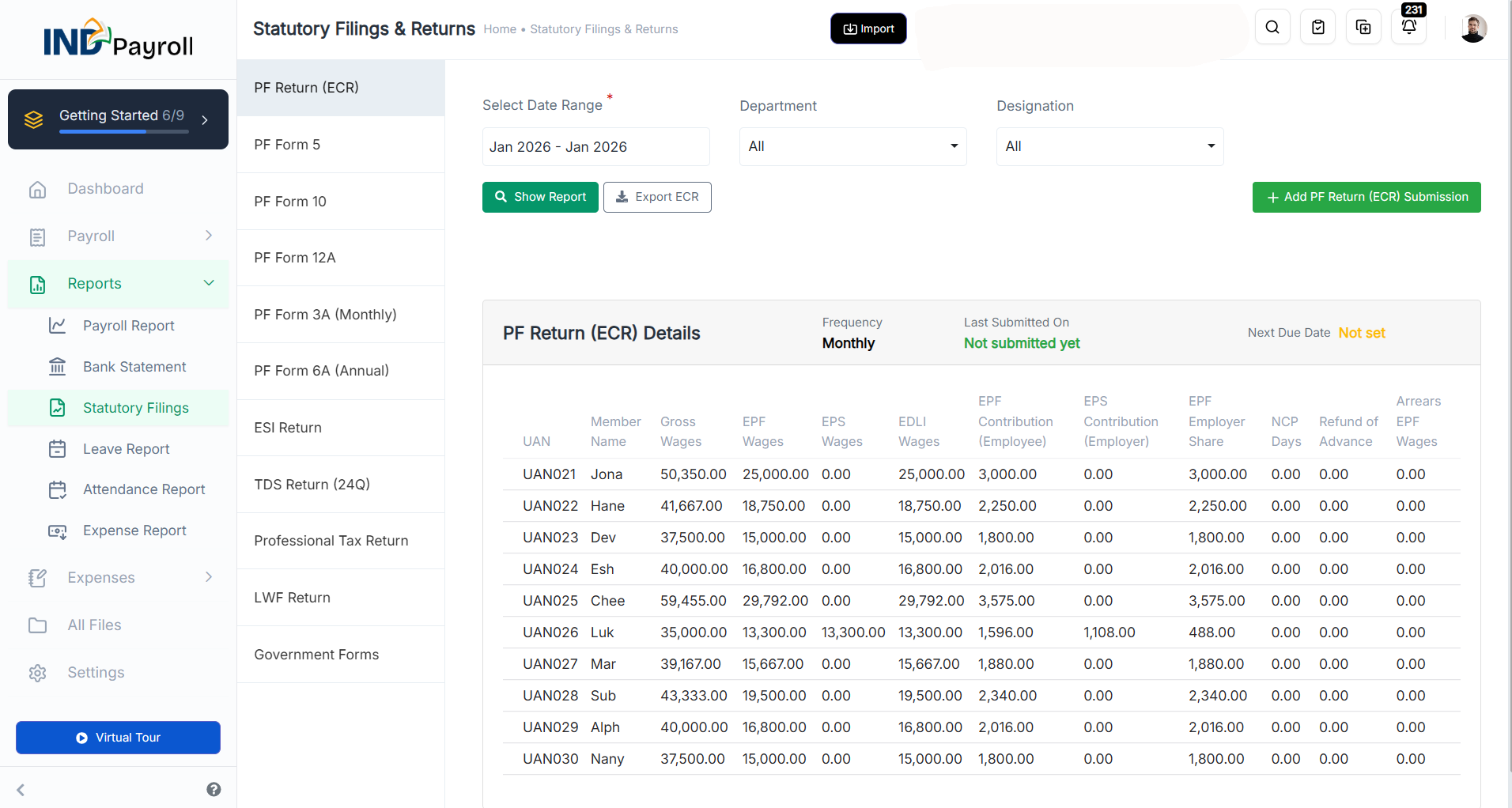
PF Challan Generator

INDPayroll also supports similar automated filing for ESI contributions. If you manage both PF and ESI for employees, refer to our guide on How to Generate ESI Challan Online for a parallel walkthrough.

Benefits of Automation

Automated systems reduce processing time compared to manual methods, improve accuracy through built-in validation, reduce manual data entry errors, prevent UAN validation failures through database verification, apply contribution rules correctly, detect errors before EPFO submission, generate audit-ready reports, and help maintain compliance records. Centralised records simplify audits, and the system scales easily for organisations of different sizes.

For HR teams looking to streamline all aspects of payroll—not just PF—our article on TDS on Salary: How to Calculate It Correctly in 2026 provides complementary guidance on managing income tax deductions alongside PF compliance.

Free Payroll, PF, ESI & TDS Software

The most trusted automation tool for modern Indian businesses.

Conclusion

PF compliance requires accuracy and timely execution at every step. Manual filing processes can lead to errors and delays. Modern payroll software helps automate calculations, validate employee data, and streamline monthly filings in accordance with EPFO standards. For organisations with multiple employees, automation can help reduce manual errors and simplify compliance processes.

Ready to eliminate PF compliance errors? Explore INDPayroll’s PF & ES Compliance module and run your first error-free ECR filing today.
PF Calculator India 2026: Calculate EPF in Minutes

Every Indian employer and employee has one recurring question: “How much PF do I contribute this month?” If you are manually calculating PF contributions, you are wasting time — and risking costly compliance errors. This 2026 guide explains exactly how to use a PF calculator in India, understand EPF contribution rates, and automate the entire process.

Whether you are an HR manager, a CA firm, or a startup founder, this guide gives you everything you need. Plus, try IndPayroll’s free PF calculator to get accurate results in seconds.

What Is a PF Calculator?

A PF (Provident Fund) calculator is a tool that computes the monthly EPF (Employee Provident Fund) contributions for both the employer and employee. Specifically, it uses the basic salary and applicable EPF rules to give accurate contribution amounts instantly.

In India, EPF is governed by the Employees’ Provident Funds and Miscellaneous Provisions Act, 1952. Moreover, every establishment with 20 or more employees must register under EPFO and make monthly contributions.

Therefore, using the right PF calculator saves time, prevents errors, and ensures full compliance with EPF regulations in 2026.

India’s #1 Free Software

Free Payroll, PF,
ESI & TDS Software

Professional compliance management for Indian businesses. 100% Free Forever.

EPF Contribution Rates in India 2026

To begin, understanding the contribution rates is the first step to calculating PF correctly. Specifically, here are the current rates:

Employee Contribution

  • 12% of Basic Salary + DA goes to the Employee Provident Fund (EPF).
  • This is deducted directly from the employee’s salary every month.

Employer Contribution

However, the employer also contributes 12% of Basic Salary + DA, but this is split as follows:

  • 3.67% → EPF (Employee Provident Fund)
  • 8.33% → EPS (Employee Pension Scheme) — capped at ₹15,000 basic salary
  • 0.5% → EDLI (Employee Deposit Linked Insurance)
  • 0.5% → EPF Administrative charges

Important Note for 2026

Importantly, as per latest Indian labor law updates, the EPS contribution is capped at a maximum pensionable salary of ₹15,000 per month. For employees earning above ₹15,000 basic, the EPS is calculated on ₹15,000 only.

PF Contribution Calculation Formula

Here’s the simple formula every HR professional must know:

Employee PF Contribution

Employee PF = 12% × Basic Salary

Employer PF Contribution (EPF portion only)

For the EPF share: EPF portion = 3.67% × Basic Salary

Employer EPS Contribution

For the EPS share: EPS portion = 8.33% × ₹15,000 (max) = ₹1,250/month (fixed cap)

Total Employer Contribution

Total Employer = 12% × Basic + 0.5% (EDLI) + 0.5% (Admin) = 13% of Basic

PF Calculation Example 2026

Let’s take a real-world example to understand how PF is calculated.

Employee Details:

  • Name: Rahul Sharma
  • Basic Salary: ₹25,000/month
  • DA: ₹2,000/month
  • Basic + DA: ₹27,000/month

PF Calculation:

Component Rate Amount
Employee PF Contribution 12% of ₹27,000 ₹3,240
Employer EPF Contribution 3.67% of ₹27,000 ₹991
Employer EPS Contribution 8.33% of ₹15,000 (cap) ₹1,250
EDLI Contribution 0.5% of ₹15,000 ₹75
Admin Charges 0.5% of ₹27,000 ₹135
Total Monthly PF ₹5,691

Therefore, for faster, error-free calculations like this, use the IndPayroll PF Calculator — free, instant, and always updated with the latest EPFO rules.

How to Use IndPayroll’s Free PF Calculator

Fortunately, using the free PF calculator on IndPayroll is straightforward. Simply follow these steps:

  • Enter Basic Salary — Input the employee’s basic salary amount.
  • Add DA — Enter the Dearness Allowance if applicable.
  • Select Employment Type — Regular or contract employee.
  • Click Calculate — Get instant results for both employee and employer contributions.
  • Download Report — Export the result for payroll records.

Additionally, the tool is available alongside other free payroll tools including the ESI calculator, CTC calculator, and payslip generator.

PF Applicability: Who Must Register Under EPF?

Notably, not every business must register for EPF. Here are the eligibility rules:

  • Every establishment with 20 or more employees must mandatorily register.
  • Establishments with fewer than 20 employees can register voluntarily.
  • Once registered, EPF contributions become mandatory for all employees earning up to ₹15,000/month basic salary.
  • Employees earning above ₹15,000 basic can opt in voluntarily.

Furthermore, for a complete guide on EPF registration and filing, visit IndPayroll’s registration and filing compliance page.

EPF vs EPS vs EDLI: What’s the Difference?

In practice, many business owners confuse these three components. Here’s a quick breakdown:

EPF (Employee Provident Fund)

Essentially, EPF is a retirement savings fund where both employee and employer contribute. As a result, the employee gets a lump sum on retirement, resignation (after 5 years), or during emergencies.

EPS (Employee Pension Scheme)

Specifically, EPS is a pension fund funded entirely by the employer at 8.33% of basic (capped at ₹15,000). Consequently, it provides a monthly pension after the employee reaches 58 years of age.

EDLI (Employee Deposit Linked Insurance)

Additionally, EDLI is an insurance scheme funded by the employer at 0.5% of basic salary (capped at ₹15,000). Therefore, it provides a lump sum life insurance benefit to the nominee in case of employee death.

For detailed help on EPF compliance, read IndPayroll’s complete EPF compliance guide.

India’s #1 Free Software

Free Payroll, PF, ESI & TDS Software

PF and ESI: How They Work Together

PF and ESI are India’s two most critical statutory compliance requirements. While EPF covers retirement and pension, ESI (Employee State Insurance) covers health and accident insurance.

ESI Applicability:

  • Applicable to employees earning up to ₹21,000/month gross salary.
  • Employee contributes 0.75% of gross salary.
  • Employer contributes 3.25% of gross salary.

Use IndPayroll’s free ESI calculator to compute contributions instantly. For full ESI compliance guidance, read the ESI compliance guide.

Fortunately, both PF and ESI are fully automated in IndPayroll’s PF & ESI compliance module — saving HR teams hours of manual work every month.

Common PF Calculation Mistakes to Avoid

Unfortunately, even experienced HR teams make these errors. Avoid them to stay compliant:

  • Calculating PF on gross salary instead of basic + DA only.
  • Not capping EPS at ₹15,000 — leading to excess deductions.
  • Forgetting admin and EDLI charges in total employer contribution.
  • Late remittance — EPFO has strict deadlines (15th of every month).
  • Not updating UAN numbers — causing issues in employee PF accounts.

For a full list of mistakes to avoid, read 15 payroll mistakes HR managers should avoid.

Why Use Payroll Software for PF Calculations?

Consequently, manual PF calculations are error-prone and time-consuming. Here’s why payroll software like IndPayroll is the smarter choice:

  • Auto-calculates PF, ESI, TDS, and PT in one click
  • Always updated with latest EPF regulations
  • Generates ECR files for EPFO portal upload
  • Produces payslips via the payslip & reports generator
  • Handles 500+ employees in minutes
  • 100% free — no subscription fees

Notably, according to EPFO data, over 6 crore active EPF subscribers exist in India as of 2024. That’s 6 crore salary calculations every month that need to be right. Therefore, payroll software ensures accuracy at scale.

Furthermore, read more: Top 10 features every Indian payroll software must have.

PF Withdrawal Rules 2026: Key Facts

Employees often ask: “When can I withdraw my PF?” Here are the 2026 rules:

  • Full withdrawal: After 2 months of unemployment or retirement at age 58.
  • Partial withdrawal: Allowed for medical emergencies, home purchase, education, and marriage — after specific service periods.
  • Online withdrawal: Possible via EPFO UAN portal if UAN is Aadhaar-linked.
  • Tax: PF withdrawals before 5 years of continuous service are taxable.

Additionally, for the latest EPFO filing and withdrawal guidance, visit IndPayroll’s EPFO registration and filing guide.

PF vs NPS: Which Is Better for Employees?

Furthermore, a common question among Indian professionals is whether PF or NPS (National Pension Scheme) offers better returns.

Key Differences:

Feature EPF NPS
Interest Rate 8.25% (2024-25) Market-linked (9-12% avg)
Employer Contribution 12% 10% (Central Govt)
Tax Benefit EEE (Exempt-Exempt-Exempt) Partial EEE
Withdrawal Flexible partial withdrawal Restricted withdrawal
Risk Low (government-backed) Moderate (market exposure)

Consequently, most Indian employees prefer EPF for its safety and guaranteed returns. Use IndPayroll’s PF calculator to plan your long-term EPF savings.

How IndPayroll Helps with Full EPF Compliance

Importantly, IndPayroll is more than just a PF calculator. It’s a complete free payroll software that handles end-to-end EPF compliance:

  • Auto-calculates employee and employer PF contributions monthly
  • Generates ECR (Electronic Challan cum Return) files for EPFO upload
  • Maintains UAN records and tracks employee PF accounts
  • Alerts for filing deadlines — never miss a due date
  • Creates salary breakup with PF deductions clearly shown
  • One-click payslips showing PF, ESI, TDS deductions

Additionally, for a deeper walkthrough, read: Run payroll in minutes — a walkthrough of IndPayroll features.

Free Payroll, PF, ESI & TDS Software

The most trusted automation tool for modern Indian businesses.

Conclusion: Make PF Calculations Simple in 2026

PF calculations don’t have to be complex or time-consuming. With the right tools, you can compute EPF contributions accurately, stay compliant, and process payroll in minutes.

Fortunately, IndPayroll gives you everything for free — a powerful PF calculator, complete PF & ESI compliance automation, and full salary processing — all in one platform.

Instead, stop spending hours on manual spreadsheets. Switch to India’s best free payroll software today.

Visit IndPayroll.com to explore all features and compliance tools designed for Indian businesses.

Frequently Asked Questions (FAQs)

1. What is the PF contribution rate in India for 2026?

Both employee and employer contribute 12% of Basic Salary + DA to EPF. The employer’s 12% is split into 3.67% (EPF) and 8.33% (EPS, capped at ₹15,000 basic).

2. How do I calculate PF on salary in India?

Simply multiply the Basic Salary + DA by 12%. For example, ₹20,000 basic → ₹2,400 employee PF. Use the free PF calculator for instant results.

3. Is PF calculated on basic salary or gross salary?

Importantly, you calculate PF on Basic Salary + Dearness Allowance (DA) only — not on gross salary. The EPF formula excludes other allowances like HRA, transport, and special allowances.

4. What is the maximum PF deduction per month?

Notably, there is no maximum cap on employee PF deduction — it is always 12% of basic + DA, regardless of salary. However, the EPS portion is capped at 8.33% of ₹15,000 = ₹1,250/month.

5. Who is exempt from EPF contribution?

Employees earning above ₹15,000 basic can opt out of EPF at the time of joining a new company. Nevertheless, existing members cannot opt out once enrolled.

6. What is the current EPF interest rate for 2025-26?

The EPFO has set an interest rate of 8.25% for 2024-25. However, the 2025-26 rate is expected to be similar, subject to EPFO board announcement. Therefore, check latest EPF regulations for updates.

7. What is ECR in EPF?

Specifically, ECR stands for Electronic Challan cum Return. Essentially, it is the monthly return filed by employers on the EPFO portal showing employee-wise PF contributions. Specifically, IndPayroll auto-generates ECR files.

8. Can I use IndPayroll’s PF calculator for free?

Yes. Fortunately, the PF calculator on IndPayroll is completely free — no signup required. Just enter the salary details and get instant results.

9. How does IndPayroll handle PF & ESI compliance automatically?

IndPayroll’s PF & ESI compliance module auto-computes contributions, generates ECR files, tracks deadlines, and ensures every deduction is accurate and filed on time.

10. What happens if PF is not paid on time?

Unfortunately, late PF payments attract penal interest at 12% per annum and damages under Section 14B of the EPF Act. Employers may also face prosecution for defaults. Therefore, use automated payroll software to never miss a deadline.

Category: EPFO & ESI

No posts in this category.

Subcategory: EPFO

Subcategory: ESI

Category: Payroll Help

No posts in this category.

Subcategory: Employee Self-Service & Engagement

Subcategory: Introduction to Payroll

Subcategory: Payroll Analytics & Reporting

Subcategory: Payroll Automation & Technology

Subcategory: Payroll for Business Growth

Subcategory: Payroll Processing & Management

Subcategory: Taxation & Compliance

Category: User Manual

No posts in this category.

Subcategory: Company Setup

Subcategory: Employee Management

Subcategory: Getting Started

Subcategory: Glossary

Subcategory: Import & Export

Subcategory: Introduction

Subcategory: Payroll Configuration

Subcategory: Payslips & Disbursement

Subcategory: Reports & Analytics

Subcategory: Running Payroll

Subcategory: Statutory Compliance & Reports

Subcategory: Troubleshooting

Subcategory: User Management & Security