How Startups in India Can Manage Payroll Without Spending a Rupee?

Every startup in India reaches a point where payroll feels unavoidable — and expensive. Salaries must go out on time. Compliance must be maintained. Records must be clean. Yet, at the early stage, spending on payroll software or consultants often feels unjustifiable. The reality is simpler than most founders believe. With the right approach, Indian startups can manage payroll without spending a rupee — without risking compliance, accuracy, or team trust.

This guide walks you through exactly how to do that, step by step, while keeping things practical and sustainable.

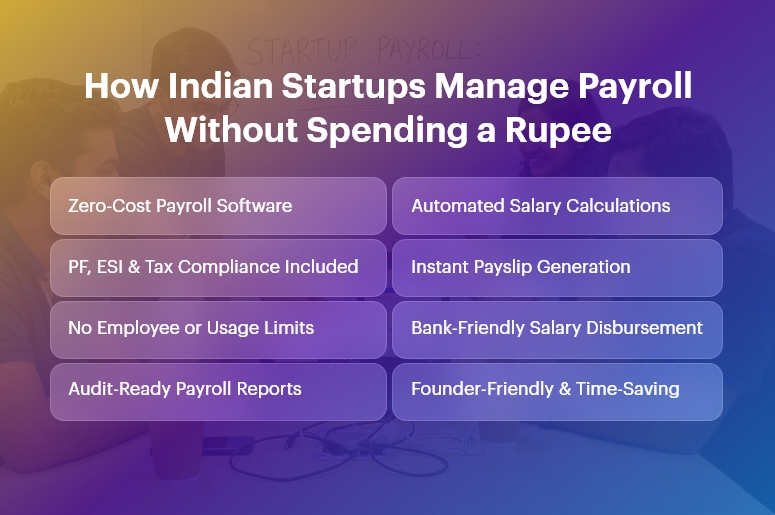
How Indian Startups Manage Payroll Without Spending a Rupee

Why Payroll Feels Expensive (Even When It Doesn’t Have to Be)

Payroll becomes expensive not because of statutory requirements, but because of fragmentation. Startups juggle spreadsheets, compliance portals, consultants, and reminders — each adding friction and hidden costs. Over time, founders end up paying for “convenience” rather than necessity.

However, once you centralize payroll logic and remove manual dependencies, it becomes entirely possible to manage payroll without spending a rupee, even as your team grows.

What It Really Means to Manage Payroll Without Spending a Rupee

Managing payroll for free does not mean cutting corners or ignoring compliance. Instead, it means removing unnecessary intermediaries while keeping statutory accuracy intact.

At a high level, when startups manage payroll without spending a rupee, they rely on:

  • Pre-built payroll logic instead of manual calculations
  • Built-in compliance handling rather than external consultants
  • One system instead of multiple disconnected tools

This shift alone eliminates most payroll-related expenses.

Understanding Payroll in the Indian Startup Context

Before implementing any system, founders must understand what payroll actually includes. Payroll is not just salary payment — it is a structured financial and compliance process.

At its core, Indian payroll consists of:

  • Salary structure (basic, allowances, deductions)
  • Statutory compliance (PF, ESI, PT, TDS)
  • Documentation (payslips, registers, reports)

Once these components are clearly defined, it becomes much easier to manage payroll without spending a rupee.

Why Manual Payroll Works — But Only Temporarily

Many startups begin with spreadsheets. Initially, this approach feels cost-effective and flexible. Founders manually calculate salaries, track attendance, and upload compliance data on government portals.

However, as months pass, cracks appear:

  • Formula errors creep in
  • Compliance dates get missed
  • Founders become bottlenecks
  • Scaling becomes painful

At this stage, startups realize that “manual” is free in money, but expensive in time. To truly manage payroll without spending a rupee, automation becomes essential.

India’s #1 Free Software

Free Payroll, PF,
ESI & TDS Software

Professional compliance management for Indian businesses. 100% Free Forever.

The Shift from Manual to Smart-Free Payroll

The smartest startups do not jump from spreadsheets to paid tools. Instead, they move to free payroll platforms designed specifically for Indian compliance.

These platforms combine automation, compliance logic, and reporting — without charging subscription fees. As a result, startups retain control while eliminating repetitive work.

This is the turning point where startups successfully manage payroll without spending a rupee, month after month.

What a Truly Free Payroll System Must Offer

Not all “free” tools are actually free. Some restrict features, others limit employee count, and many introduce paid upgrades later. To genuinely manage payroll without spending a rupee, a system must include the following at no cost:

  • Automated salary calculations based on Indian pay structures
  • Built-in PF, ESI, and tax deduction logic
  • Instant payslip generation
  • Compliance-ready reports for audits and filings
  • No employee limits or hidden charges

Without these, founders eventually end up paying — either in money or effort.

How Payroll Compliance Becomes Easier — Not Harder

One common fear is that free payroll systems compromise compliance. In practice, the opposite is true.

When payroll logic is automated:

  • Statutory deductions are calculated correctly every month
  • Compliance reports are generated instantly
  • Filing deadlines are easier to track

This allows startups to manage payroll without spending a rupee while staying audit-ready and penalty-free.

Paying Employees Without Paying Payroll Vendors

Salary disbursement does not require paid payroll services. Indian startups can easily pay employees using existing banking infrastructure.

Most teams rely on:

  • Bank transfers (NEFT/IMPS)
  • Bulk upload salary files
  • Zero-cost business banking features

When combined with automated payroll calculation, this completes the cycle of how to manage payroll without spending a rupee.

India’s #1 Free Software

Free Payroll, PF, ESI & TDS Software

Where INDPayroll Fits Naturally

Some platforms are built with monetization as the priority. Others are built with startups in mind.

INDPayroll belongs to the second category.

It allows Indian startups to:

  • Run complete payroll cycles
  • Handle PF, ESI, and tax deductions
  • Generate payslips and reports
  • Stay compliant

All without charging a single rupee.

This makes INDPayroll not a “free trial,” but a permanent free payroll solution — ideal for startups that want simplicity without compromise.

When Free Payroll Makes Strategic Sense

Free payroll is especially effective when:

  • You are bootstrapped or early-stage
  • Your team is small to mid-sized
  • You want predictable, zero-cost operations
  • You prefer clarity over complexity

In these scenarios, paying for payroll software offers little incremental value.

Final Thoughts

Indian startups no longer need to choose between accuracy and affordability. Today, it is entirely possible to manage payroll without spending a rupee — while remaining compliant, organized, and scalable.

By replacing fragmented manual processes with a unified, free payroll system, founders reclaim time, reduce risk, and preserve capital.
Payroll should not be a financial burden.

It should be invisible, reliable, and cost-free.

And now, it finally is.

Free Payroll, PF, ESI & TDS Software

The most trusted automation tool for modern Indian businesses.

Manual Payroll vs Payroll Software: What Works Best for Indian SMEs?

Managing payroll remains a critical but complex task for Indian small and medium enterprises (SMEs). Today, we compare Manual Payroll vs Payroll Software to determine what works best for Indian SMEs. We also explain the key differences, benefits, challenges, costs, and best practices.

In India, SMEs must handle salary calculations, statutory compliance, tax deductions, and employee records efficiently. Traditionally, many businesses relied on manual payroll processes. However, with rising workforce sizes and regulatory complexity, payroll software has emerged as a powerful alternative.

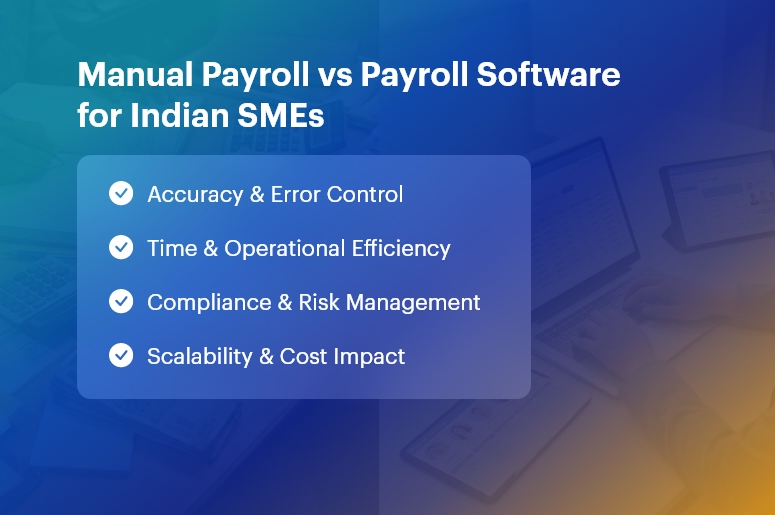
 Manual-Payroll-vs-Payroll-Software-for-Indian-SMEs

What is Manual Payroll?

Manual payroll refers to processing employee salaries, deductions, and statutory contributions by hand or using spreadsheets.

Many SMEs still choose manual payroll because it seems cheaper or familiar. Nevertheless, it carries risks and becomes less sustainable as the business grows.

How Manual Payroll Works?

  • HR or accounts personnel calculate gross salary
  • Deduct taxes, PF, ESI, professional tax manually
  • Prepare pay slips in spreadsheets
  • Record payments in books
  • Remit statutory contributions manually

What is Payroll Software?

Payroll software automates payroll processing through specialized digital tools. These systems calculate salaries, generate slips, manage compliance, and store reports automatically.

Cloud-based software further enables online access and multi-user collaboration.

Payroll software typically includes:

  • Automated salary calculations
  • Tax computation and filing support
  • Digital payslips and records
  • Compliance updates for Indian laws
  • Integration with attendance systems

Key Differences: Manual Payroll vs Payroll Software

1. Accuracy

Manual payroll often causes human errors in calculations and compliance. In contrast, payroll software uses automated formulas that reduce errors significantly.

2. Time Efficiency

Manual payroll demands extensive time for calculations and reconciliation. Conversely, payroll software completes processing within minutes, even for large teams.

3. Compliance Management

India’s statutory requirements (PF, ESI, TDS, professional tax) change frequently. Manual payroll struggles to keep up, while software updates automatically with regulatory changes.

4. Cost Considerations

Manual payroll appears inexpensive at first but generates hidden costs in:

  • Wages spent on processing
  • Error corrections
  • Penalties due to non-compliance

Payroll software requires a subscription fee but reduces long-term costs by improving accuracy and saving time.

5. Scalability

Startups and SMEs grow quickly; manual payroll cannot scale easily. Payroll software handles growth efficiently, whether you add 5 or 500 employees.

Free Payroll, PF, ESI & TDS Software

The most trusted automation tool for modern Indian businesses.

Benefits of Payroll Software for Indian SMEs

1. Improved Accuracy

Payroll software eliminates manual calculations and minimizes errors. It also maintains precise records.

2. Faster Payroll Cycles

Automated processes save hours every month, leading to faster salary disbursements.

3. Better Compliance

Software tracks regulatory updates and automatically applies new rates for PF, ESI, and taxes.

4. Secure Data Storage

Cloud payroll platforms secure sensitive payroll data and reduce risks from lost spreadsheets.

5. Real-Time Reporting

Finance teams get instant access to payroll reports, aiding planning and audits.

Challenges of Manual Payroll for SMEs

1. Human Error

Manual entry increases the likelihood of mistakes in salary calculations and compliance.

2. Time-Consuming

Processing payroll manually drains valuable HR and finance resources.

3. Compliance Risks

Manual systems often fail to capture regulatory changes, causing legal penalties.

4. Lack of Integration

Manual payroll rarely integrates with attendance, leave, or accounting systems.

When Manual Payroll Might Still Work

While payroll software is superior for most, very small businesses with fewer than 10 employees and simple salary structures may find manual processing workable initially.

However, as businesses grow, transitioning to payroll software becomes essential.

Key Features to Look for in Payroll Software

When selecting payroll software, Indian SMEs should evaluate:

  • Compliance with Indian laws
  • Automatic tax and statutory calculations
  • Integration with attendance and HR systems
  • Cloud access and mobile support
  • Secure data storage
  • Customizable payslip formats
  • Customer support and training

Cost Comparison: Manual vs Payroll Software

In most cases, payroll software provides a higher return on investment than manual payroll over time.

Transitioning from Manual to Payroll Software

To transition smoothly:

  • Evaluate current payroll needs
  • Select software that fits your budget
  • Migrate historical data carefully
  • Train HR and finance teams
  • Review and monitor during the first few cycles
India’s #1 Free Software

Free Payroll, PF, ESI & TDS Software

Conclusion

In the debate of Manual Payroll vs Payroll Software, payroll software consistently proves more efficient, accurate, and cost-effective for Indian SMEs. While manual payroll may work for very small teams, it cannot match the scalability, compliance support, and automation that payroll software delivers.

Indian SMEs that adopt payroll automation reduce errors, save time, and stay compliant in a complex regulatory environment. Therefore, payroll software is the best long-term solution for growing businesses.

Frequently Asked Questions (FAQs)

1. What is the main difference between manual payroll and payroll software?

The primary difference between manual payroll vs payroll software lies in automation and accuracy. Manual payroll depends on spreadsheets and human calculations, whereas payroll software automates salary processing, tax deductions, compliance, and reporting, thereby reducing errors and saving time.

2. Is manual payroll legal for Indian SMEs?

Yes, manual payroll is legal in India. However, SMEs must still comply with statutory regulations such as PF, ESI, TDS, and professional tax. Because regulations change frequently, manual payroll increases the risk of non-compliance and penalties.

3. Why is payroll software better for compliance in India?

Payroll software automatically updates statutory rules related to Indian payroll laws. As a result, it ensures accurate PF, ESI, and tax calculations and helps SMEs remain compliant without constantly tracking regulatory changes manually.

4. How does payroll software reduce payroll errors?

Payroll software minimizes errors by automating salary calculations, deductions, and statutory contributions. Since the system follows predefined rules, it eliminates common human mistakes that occur in manual payroll processing.

5. Is payroll software expensive for small businesses?

Payroll software is generally affordable for Indian SMEs. Although it involves a subscription cost, it reduces long-term expenses by saving time, preventing compliance penalties, and improving payroll efficiency compared to manual payroll.

6. When should an SME switch from manual payroll to payroll software?

An SME should switch to payroll software when employee strength increases, compliance becomes complex, or payroll errors start affecting operations. In most cases, businesses benefit from payroll automation as soon as they begin scaling.

7. Can payroll software handle Indian tax structures and deductions?

Yes, modern payroll software supports Indian salary structures, tax slabs, exemptions, PF, ESI, professional tax, and TDS. Therefore, it simplifies payroll processing in India and ensures statutory accuracy.

8. Does payroll software integrate with attendance and HR systems?

Most payroll software solutions integrate seamlessly with attendance, leave management, and HR systems. Consequently, salary calculations become more accurate, and HR teams gain better operational visibility.

9. Is payroll data secure in cloud-based payroll software?

Reputable payroll software providers use encryption, access controls, and regular backups. As a result, cloud payroll systems often provide higher data security than spreadsheets used in manual payroll.

10. What works best for growing Indian SMEs: manual payroll or payroll software?

For growing Indian SMEs, payroll software works best. It supports scalability, ensures compliance, reduces errors, and saves time. In contrast, manual payroll becomes inefficient and risky as business complexity increases.

India’s #1 Free Software

Free Payroll, PF,
ESI & TDS Software

Professional compliance management for Indian businesses. 100% Free Forever.

Top 15 Payroll Automation Benefits for SMEs in India

Payroll in India is a complex function because employers must handle salaries, variable pay, attendance, leave rules, deductions, and constantly changing statutory norms every single month. For SMEs running on smaller HR teams and tighter budgets, managing payroll manually is not just difficult — it is risky.

Indian SMEs often face:

  • Spreadsheets overloaded with data
  • Common miscalculations creating salary disputes
  • Outdated compliance knowledge causing penalties
  • Manual attendance reconciliation taking days
  • Slow and error-prone report generation for audits
  • Increased HR effort with zero strategic output

One mismanaged payroll cycle can damage employee trust and brand reputation.

This is why many SMEs in India are turning to Payroll Automation — a smarter, more secure, and highly efficient way to manage payroll. Automation uses technology to calculate salaries, apply statutory rules, process attendance, generate reports, and ensure compliance — with minimal human intervention.

Below is an in-depth, professional, and extensively detailed breakdown of how Payroll Automation transforms Indian businesses.

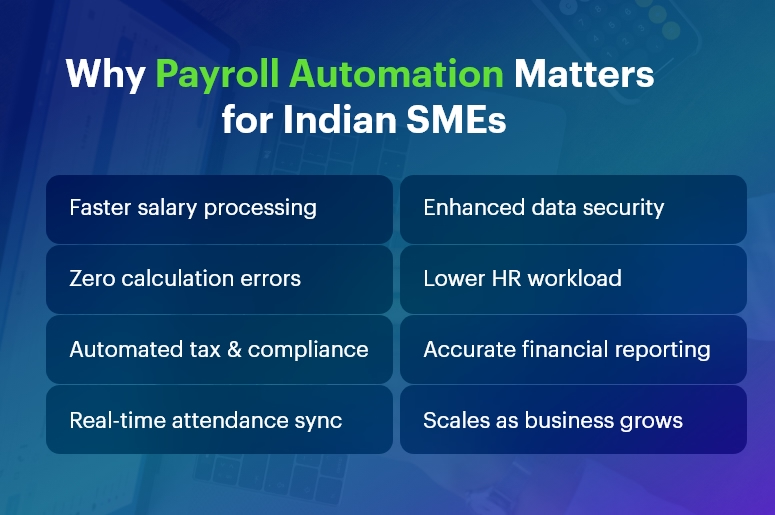
Why Payroll Automation Matters for Indian SMEs

Top 15 Payroll Automation Benefits for SMEs in India

Faster Salary Processing Means Happier Employees

Indian SMEs often spend 3–7 days every month preparing payroll manually. Automation cuts this time by more than 70%, because:

  • Salary structures are pre-configured
  • Attendance updates automatically
  • Deductions are applied instantly
  • No need to repeat data entry every month

Employees receive salaries on time — which directly improves morale, retention, and trust. In today’s competitive job market, timely salary payments can be a big differentiator.

Highly Accurate Calculations Reduce Payroll Disputes

Manual payroll often results in:

  • Incorrect salaries
  • Wrong overtime payouts
  • Missing allowances
  • Wrong TDS deductions

These mistakes are frustrating for employees and expensive for SMEs. Automation ensures accurate salary breakdowns using predefined formulas, so math errors are eliminated and employee satisfaction increases.

Seamless Statutory Compliance for Indian Labor Laws

Compliance is one of the biggest challenges for Indian SMEs. Payroll Automation always follows:

  • Latest PF, ESI calculation rules
  • Updated TDS slabs & exemptions
  • State-wise Professional Tax differences
  • Bonus, Gratuity & Minimum Wages rules
  • Labor Welfare Fund contributions

The system updates automatically with every policy change. This protects SMEs from:

  • Penalties
  • Legal issues
  • Audit failures

Businesses stay peacefully compliant.

Real-Time Attendance & Shift Management That Syncs Automatically

When Human Resources manually reconciles attendance from punch cards, emails, or Excel sheets, errors are guaranteed.

Automated payroll integrates with:

  • Biometric devices
  • Mobile GPS punch-in
  • Web attendance portals
  • Shift calendars

Every login, logout, leave, overtime hour is recorded in real time. Salary becomes 100% aligned with true productivity — no arguments later.

Full Transparency Through an Employee Self-Service Portal

An ESS portal empowers employees to:

  • Download payslips instantly
  • View salary summaries and tax calculations
  • Track attendance and leave balances
  • Claim and track reimbursements
  • Update profile details

Employees feel informed and valued. HR saves countless hours answering repetitive salary queries.

Free Payroll, PF, ESI & TDS Software

The most trusted automation tool for modern Indian businesses.

Significant Cost Savings — Immediate and Long Term

Payroll Automation reduces:

  • Administrative workload
  • Outsourced payroll expenses
  • Compliance fines
  • Paper, filing, and printing costs

SMEs operate more efficiently with the same HR team. Automation becomes a high-ROI investment — not an expense.

Ultra-Secure Protection for Payroll & Employee Data

Payroll touches the most confidential details of a business: Salaries, financials, bank information, PAN numbers, etc.

Automation offers:

  • Data encryption
  • Cloud backups
  • Role-based access control
  • Access logs & audit trails

This prevents leaks, misuse, or accidental data loss — something Excel can’t guarantee.

Instant Generation of Statutory and Payroll Reports

Preparing statutory forms manually (PF, ESI, TDS) is time-consuming and error-prone. With automation, files like:

  • ECR files for PF portal
  • TDS returns (Form 24Q/26Q)
  • Salary registers
  • Form 16 + MIS reports

are generated in seconds — accurate and ready for upload.

This reduces compliance stress and ensures filing happens before deadlines.

Productivity Boost for HR Teams

HR’s role is to develop people — not fight spreadsheets. Automation shifts HR’s energy to:

  • Employee development
  • Performance initiatives
  • Recruitment & onboarding
  • Workforce strategy

Organizations get better HR output without hiring more people.

Eliminates Fraud and Payroll Manipulation

Common fraud cases in SMEs include:

  • Ghost employees
  • Fake overtime claims
  • Modified attendance entries
  • Cash-based payout manipulation

Automation ensures every action is recorded. There is a complete audit trail — no room for hidden salary leaks.

Multi-State Payroll Handled with Ease

As SMEs open branches across India, payroll complexity increases due to state-specific:

  • PT slabs
  • Minimum wages
  • Public holidays
  • Employee categories

Automated payroll adapts for each location yet runs payroll centrally, saving tremendous regulatory effort.

Automated Digital Payslips — Professional and Paperless

Employees get legally compliant payslips:

  • On their phones
  • In the ESS portal
  • Automatically via email

No printing, no waiting, no errors. Digital payslips also give companies a modern professional impression.

Automated Leave, Loan & Reimbursement Accounting

Every leave approval or salary advance automatically flows into payroll.

The system:

  • Calculates LOP accurately
  • Tracks EMI-based repayments
  • Approves and verifies expense claims

This ensures zero disputes and complete visibility into financial adjustments.

Advanced Analytics for Better Financial Control

Owners and decision-makers get dashboards showing:

  • Salary cost trends
  • Overtime vs. productivity
  • Department-wise payroll impact
  • Budget deviation alerts

These insights help optimize hiring, scheduling, and compensation — fueling better profitability.

Easily Scalable As Your Business Grows

As SMEs expand:

  • New employees
  • New salary structures
  • New branches

…can be added effortlessly.

Payroll stays equally efficient whether managing 10 or 10,000 employees. Automation ensures payroll never becomes a growth roadblock.

India’s #1 Free Software

Free Payroll, PF, ESI & TDS Software

Final Thoughts

Payroll Automation is more than digitizing payroll —

  • It transforms how SMEs operate.
  • It builds employee trust and strengthens compliance.
  • It enables leaders to focus on growth rather than paperwork.

In India’s fast-moving economy, companies that automate will advance. Companies that remain manual will fall behind.

Payroll Automation is the foundation of a future-ready SME.

Frequently Asked Questions

  • Do small businesses really need payroll automation?

Yes. Even with 5–10 employees, automation improves transparency, efficiency, and compliance accuracy.

  • Will payroll automation reduce HR workloads?

Absolutely. Mundane tasks disappear, allowing HR to focus on employee success and culture development.

  • How does automated payroll ensure compliance?

It auto-updates tax laws and generates government-friendly files for PF, ESI, and TDS filings.

  • Is automated payroll safe for sensitive employee data?

Yes. Encryption, backups, and permissions make it far more secure than spreadsheets.

  • How long does implementation take for an SME?

Most businesses can go live in 1–7 days, depending on employee size and data format.

India’s #1 Free Software

Free Payroll, PF,
ESI & TDS Software

Professional compliance management for Indian businesses. 100% Free Forever.

Category: EPFO & ESI

No posts in this category.

Subcategory: EPFO

Subcategory: ESI

Category: Payroll Help

No posts in this category.

Subcategory: Employee Self-Service & Engagement

Subcategory: Introduction to Payroll

Subcategory: Payroll Analytics & Reporting

Subcategory: Payroll Automation & Technology

Subcategory: Payroll for Business Growth

Subcategory: Payroll Processing & Management

Subcategory: Taxation & Compliance

Category: User Manual

No posts in this category.

Subcategory: Company Setup

Subcategory: Employee Management

Subcategory: Getting Started

Subcategory: Glossary

Subcategory: Import & Export

Subcategory: Introduction

Subcategory: Payroll Configuration

Subcategory: Payslips & Disbursement

Subcategory: Reports & Analytics

Subcategory: Running Payroll

Subcategory: Statutory Compliance & Reports

Subcategory: Troubleshooting

Subcategory: User Management & Security