Best Payroll Software for Small Businesses in India

Running payroll for a small business in India is far more complex than simply cutting monthly cheques. Between calculating PF contributions, deducting TDS correctly, filing ESI returns, and generating Form 16, the compliance burden can easily overwhelm an HR team or a founder managing everything on spreadsheets.

However, the right payroll software can eliminate errors, save hours every month, and keep your business 100% compliant with Indian labour laws — without hiring a full-time payroll specialist. As a result, thousands of Indian companies are now switching from manual processes to modern, automated solutions.

In this guide, we break down exactly what to look for in payroll software for small businesses in India and explain why INDPayroll is becoming the go-to choice for Indian SMEs, startups, and CA firms.

Why Small Businesses in India Need Payroll Software

Indian payroll operates under multiple statutory laws — specifically the Employees’ Provident Funds Act, the ESI Act, the Income Tax Act, and various state-level Professional Tax rules. Because of this complexity, missing a single deadline or making a calculation error can lead to serious consequences.

For example, a late TDS deposit can attract heavy penalties under Section 234E of the Income Tax Act. Similarly, delayed PF or ESI contributions attract interest and fines from the respective government authorities. Beyond financial penalties, compliance failures also lead to failed audits, legal notices from labour authorities, and a significant loss of employee trust due to incorrect salary disbursements.

For small businesses and startups with lean finance teams, managing this manually on Excel is not just inefficient — it is genuinely risky. One wrong formula can miscalculate salaries for your entire workforce in a single month. Fortunately, payroll software solves this by automating calculations, maintaining compliance records, and generating ready-to-file statutory reports — all from one platform.

What to Look for in Payroll Software for Small Businesses

Before choosing a payroll tool, every small Indian business should evaluate these key criteria carefully.

First and most importantly, look for full statutory compliance coverage. The software must handle PF, ESI, TDS (Section 192), Professional Tax, Gratuity, and Bonus calculations automatically. Additionally, it should stay updated with the latest government notifications and tax slabs. You can learn more about EPF regulations in India and how they affect your payroll obligations.

Second, consider ease of use. Since small businesses rarely have a dedicated payroll team, the software should be simple enough for an HR generalist or even a founder to operate without technical training. Third, look for automated payslip generation — password-protected, professional payslips that can be emailed directly to employees. You can even try INDPayroll’s free payslip generator before committing to any paid plan.

Fourth, your chosen software must support both Old and New Tax Regimes, computing TDS under each and allowing employees to declare their preferred choice. Fifth, prioritise transparent pricing that scales — ideally starting with a free tier. Finally, ensure the platform produces ready-to-file statutory reports such as ECR files for EPFO, ESI challans, Form 24Q, and Form 16.

INDPayroll: Purpose-Built for Small Businesses in India

INDPayroll is a cloud-based payroll management platform built specifically around Indian compliance requirements. Currently trusted by more than 5,000 Indian businesses, it makes payroll effortless for SMEs, startups, CA firms, and growing enterprises of all sizes.

Automated Monthly Payroll Runs

With INDPayroll, you simply import attendance data, verify deductions, and process salaries for your entire team in a single click. Consequently, what used to take 3 full days now takes under 15 minutes — thanks to INDPayroll’s powerful salary processing engine.

Full Statutory Compliance

INDPayroll automatically calculates PF (EPF ECR files), ESI challans, TDS under both Old and New Tax Regimes, Professional Tax as per state slabs, Gratuity, and Bonus. Moreover, the compliance engine is updated monthly to reflect the latest changes in Indian labour law. Explore PF and ESI compliance automation in detail on the product page.

Professional Payslip Generation

Rather than emailing payslips manually, you can generate and bulk-send password-protected digital payslips to every employee in a single click. To see how it works, try the free payslip generator tool — no account needed.

Employee Self-Service Portal

Instead of fielding constant payslip requests, HR teams can direct employees to a dedicated self-service portal. Through this portal, employees can view payslips, download Form 12BB, submit investment declarations, and track leave requests — thereby reducing HR admin queries significantly.

Multi-Company Dashboard

For CA firms managing multiple client payrolls, INDPayroll provides a centralised master dashboard to oversee all entities in one place. As a result, consultants save hours every month that would otherwise be spent switching between different accounts or systems. See the full feature set on the payroll software product page.

Smart Reports and Analytics

In addition to compliance reports, INDPayroll provides actionable analytics on CTC leakage, tax liabilities, salary trends, and statutory filings — giving HR and finance teams the insights they need for better decisions. Visit the reports and payslips generator to explore all reporting capabilities.

INDPayroll Pricing Plans

One of INDPayroll’s biggest advantages for small businesses is its transparent, scalable pricing with absolutely no hidden fees. Here is a breakdown of all available plans.

Free Plan — ₹0 Forever: This plan is perfect for micro-teams and early-stage startups. It supports up to 5 employees and includes automated monthly payroll, digital payslips, standard PF compliance, basic leave tracking, and a full Employee Self-Service portal.

Startup Plan — ₹1,500/month + ₹10 per employee: Specifically designed for growing SMEs with up to 100 employees, this plan includes everything in the Free plan. In addition, it covers full TDS and income tax management, ESI and Professional Tax, Form 16 generation, custom pay components, arrears and bonus calculations, and priority email support.

Professional Plan — ₹2,500/month + ₹50 per employee: Tailored for larger teams of up to 1,000 employees, this tier adds advanced attendance with geo-tagging, shift scheduling, performance incentive processing, mobile app access, reimbursement workflows, and API integrations.

Enterprise Plan — Custom Pricing: For complex organisations that require biometric sync, ERP integration (SAP, Oracle), SSO/SAML, on-premise deployment, and a dedicated account manager. View all pricing details and compare plans here.

How INDPayroll Works in 3 Simple Steps

Getting started with INDPayroll is fast and requires no technical knowledge whatsoever. The entire process works in three straightforward steps.

Step 1, you add or import your employees along with their salary components, CTC structure, and tax declarations.

Step 2, you run payroll — with a single click, INDPayroll calculates gross pay, all statutory deductions (PF, ESI, TDS, PT), and net take-home for every employee simultaneously. In

Step 3, you generate reports and payslips — downloading compliance-ready filing reports and sending payslips to all employees instantly. Setup takes less than 10 minutes, and no credit card is required to start.

INDPayroll vs. Managing Payroll on Excel

Excel/Manual INDPayroll
Time to process 50 salaries 2–3 days Under 15 minutes
Risk of calculation errors High Near zero
PF/ESI auto-compliance No Yes
TDS (Old & New Regime) Manual Automated
Form 16 & 24Q Manual Auto-generated
Payslip distribution Manual email One-click bulk email
Annual cost (50 employees) ₹0 + risk of penalties From ₹18,000/year

Stay Compliant with Indian Labour Laws

Staying compliant is not optional — it is a legal obligation for every Indian business. The latest labour law updates directly affect how you calculate EPF, ESI, and Professional Tax each year. Therefore, INDPayroll’s compliance engine is updated monthly to reflect all changes in Indian statutory rules, so you never have to track regulation changes manually.

Furthermore, if you are new to compliance requirements, you can use INDPayroll’s free compliance calendar to track all important PF, ESI, and TDS filing deadlines throughout the year. For quick estimates, you can also use the free TDS calculator or the free ESI calculator.

Who Is INDPayroll Best For?

INDPayroll is an excellent fit for small and medium businesses across a wide range of industries. IT startups, manufacturing units, construction firms, CA firms managing multiple clients, retail chains, and educational institutions all benefit significantly from automating their payroll. In short, any Indian business that processes monthly salaries and needs to stay compliant with PF, ESI, and TDS regulations will find INDPayroll to be the most practical and affordable solution.

Conclusion

For small businesses in India, payroll is not merely an administrative task — it is a critical legal obligation with real financial consequences when done incorrectly. Therefore, investing in the right payroll software protects your business, saves your team hours every month, and gives your employees confidence in every salary cycle.

Overall, INDPayroll stands out as a top choice because it is purpose-built for Indian compliance, offers a genuinely free plan to start, and scales affordably as your team grows. Whether you are a 5-person startup or a 500-person SME, INDPayroll gives you the tools to run payroll with complete confidence.

Ready to automate your payroll? Start for free — no credit card required.
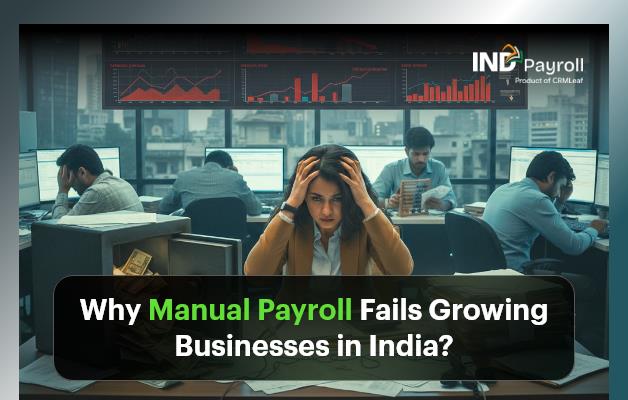
Why Manual Payroll Fails Growing Businesses in India?

At first, spreadsheets may seem manageable. However, as headcount increases, regulations tighten, and salary structures become complex, manual payroll quickly turns into a business risk.

For growing businesses in India, payroll is no longer just about salary calculation. Instead, it involves compliance, accuracy, timeliness, reporting, and employee trust. This is exactly why manual payroll starts failing — and why automation becomes unavoidable.

In this blog, you’ll learn why manual payroll fails growing businesses in India, what risks it creates, and how automation solves these challenges end to end.

What Is Manual Payroll?

Manual payroll refers to managing salary calculations, deductions, compliance, and payslips using spreadsheets, emails, and disconnected tools.

Typically, HR or finance teams:

  • Calculate salaries in Excel
  • Manually apply PF, ESI, PT, and TDS
  • Upload challans on government portals
  • Share payslips via email

Initially, this works. However, as teams grow, the system starts breaking down.

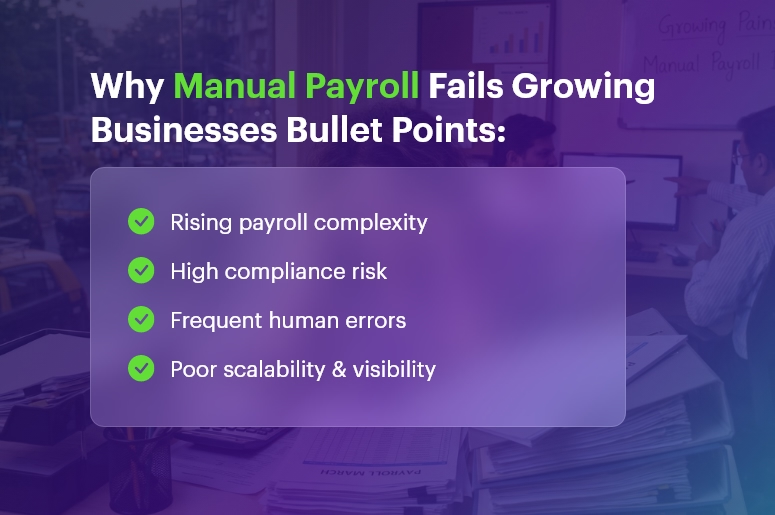
Why Manual Payroll Fails Growing Businesses Bullet Points

Why Manual Payroll Fails Growing Businesses in India

1. Payroll Complexity Increases Rapidly with Growth

As employee count rises, payroll rules multiply. New salary components, multiple pay structures, variable pay, bonuses, and deductions add complexity.

Because manual systems lack built-in logic, errors increase with every change. As a result, payroll becomes fragile and unreliable.

2. Indian Statutory Compliance Is Too Complex to Manage Manually

India’s payroll compliance landscape is demanding. Businesses must manage:

  • Provident Fund (PF)
  • Employee State Insurance (ESI)
  • Professional Tax (PT)
  • Income Tax (TDS)
  • State-wise rules and slabs
  • Monthly, quarterly, and annual filings

Since regulations change frequently, manual payroll struggles to keep up. Consequently, compliance risks grow silently.

3. Human Errors Become Inevitable

Manual payroll depends heavily on human accuracy. Unfortunately, even a small mistake can lead to:

  • Incorrect salary payouts
  • Wrong tax deductions
  • Compliance penalties
  • Employee dissatisfaction

Because spreadsheets lack validation and automation, errors often go unnoticed until employees raise concerns.

4. Payroll Processing Consumes Too Much Time

Manual payroll requires repetitive tasks every month. Teams must:

  • Verify attendance and leave data
  • Update salary changes
  • Recheck calculations
  • Prepare compliance files

As a result, HR and finance teams spend days on payroll instead of focusing on strategic work.

5. Scaling Across Locations Becomes Difficult

Growing businesses often expand across cities or states. However, each state in India has different:

Manual payroll cannot scale smoothly across locations. Therefore, complexity increases faster than control.

6. Lack of Real-Time Visibility and Reporting

Manual payroll offers limited visibility. Since data is scattered across files, managers struggle to:

  • Track payroll costs
  • Analyze salary trends
  • Prepare audit-ready reports

As a result, decision-making becomes slow and reactive.

7. Payroll Errors Damage Employee Trust

Salary accuracy directly impacts employee morale. When payroll errors happen repeatedly:

Eventually, payroll issues affect retention and employer brand.

The Hidden Cost of Manual Payroll

Although manual payroll appears cost-effective, it carries hidden costs such as:

  • Compliance penalties
  • Rework and corrections
  • Time lost on repetitive tasks
    • Employee dissatisfaction
  • Audit risks

Over time, these costs far exceed the investment in automation.

Why Payroll Automation Is the Only Sustainable Solution

Payroll automation replaces spreadsheets with a rule-driven, compliance-ready system. As a result:

  • Calculations become accurate
  • Compliance stays updated automatically
  • Processing time reduces drastically
  • Reporting becomes instant

Most importantly, payroll becomes predictable and stress-free.

How IndPayroll Solves These Challenges

IndPayroll is designed specifically for Indian businesses. It helps growing companies:

  • Automate salary calculations and deductions
  • Stay compliant with PF, ESI, PT, and TDS
  • Handle state-wise payroll rules with ease
  • Generate payslips and statutory reports instantly
  • Scale payroll without increasing workload

As a result, businesses move from payroll firefighting to payroll confidence.

When Should a Business Move Away from Manual Payroll?

You should consider automation if:

  • Employee count exceeds 20–30
  • Payroll processing takes more than a day
  • Compliance updates feel stressful
  • Errors occur frequently
  • HR spends too much time fixing payroll issues

If any of these sound familiar, manual payroll has already started failing.

Best Practices for Transitioning from Manual to Automated Payroll

To ensure a smooth transition:

  • Centralize employee and salary data
  • Standardize salary components
  • Choose India-compliant payroll software
  • Automate statutory calculations and filings
  • Train HR teams on payroll workflows

When done right, the transition feels effortless.

Final Takeaway

Manual payroll may work for very small teams. However, it fails growing businesses in India due to complexity, compliance pressure, and scalability limits.

Payroll automation is no longer a luxury. Instead, it is a necessity for accuracy, compliance, and growth.

If your business is scaling, it’s time to leave spreadsheets behind—and move to a smarter, automated payroll system.

Frequently Asked Questions (FAQs)

1. Why does manual payroll become risky as a company grows?

As companies grow, payroll complexity increases. Therefore, manual payroll becomes prone to calculation errors, compliance gaps, and delays that can directly impact employees and finances.

2. Is manual payroll legally compliant in India?

Manual payroll is not illegal. However, because Indian payroll laws change frequently, staying compliant manually becomes difficult. As a result, businesses face a higher risk of penalties and notices.

3. What are the most common errors in manual payroll?

Common errors include incorrect salary calculations, wrong PF or TDS deductions, missed filings, and outdated tax slabs. Consequently, these errors lead to rework and employee dissatisfaction.

4. How does manual payroll affect HR productivity?

Manual payroll consumes significant HR time every month. Therefore, HR teams spend less time on talent management and more time fixing payroll issues.

5. Can manual payroll handle PF, ESI, and TDS efficiently?

While it is possible, it is not efficient. Since each statutory component has different rules and deadlines, manual payroll struggles to manage them accurately and consistently.

6. Why do growing businesses struggle with multi-state payroll manually?

Each Indian state follows different professional tax and labour welfare rules. As a result, managing multi-state payroll manually increases complexity and error risk.

7. How does manual payroll impact employee trust?

Payroll errors directly affect take-home salary. Therefore, repeated mistakes reduce employee trust and increase complaints, which harms overall engagement.

8. Is manual payroll cost-effective for small teams?

Initially, it may seem cost-effective. However, as the team grows, hidden costs like errors, penalties, and time loss make manual payroll more expensive in the long run.

9. When should a business move away from manual payroll?

Businesses should switch when payroll processing becomes time-consuming, errors occur frequently, or compliance feels stressful. At that stage, manual payroll is no longer sustainable.

10. How does IndPayroll help businesses move away from manual payroll?

IndPayroll automates salary calculations, statutory compliance, and reporting. As a result, businesses eliminate manual errors, stay compliant, and scale payroll operations with confidence.

Top 15 Payroll Automation Benefits for SMEs in India

Payroll in India is a complex function because employers must handle salaries, variable pay, attendance, leave rules, deductions, and constantly changing statutory norms every single month. For SMEs running on smaller HR teams and tighter budgets, managing payroll manually is not just difficult — it is risky.

Indian SMEs often face:

  • Spreadsheets overloaded with data
  • Common miscalculations creating salary disputes
  • Outdated compliance knowledge causing penalties
  • Manual attendance reconciliation taking days
  • Slow and error-prone report generation for audits
  • Increased HR effort with zero strategic output

One mismanaged payroll cycle can damage employee trust and brand reputation.

This is why many SMEs in India are turning to Payroll Automation — a smarter, more secure, and highly efficient way to manage payroll. Automation uses technology to calculate salaries, apply statutory rules, process attendance, generate reports, and ensure compliance — with minimal human intervention.

Below is an in-depth, professional, and extensively detailed breakdown of how Payroll Automation transforms Indian businesses.

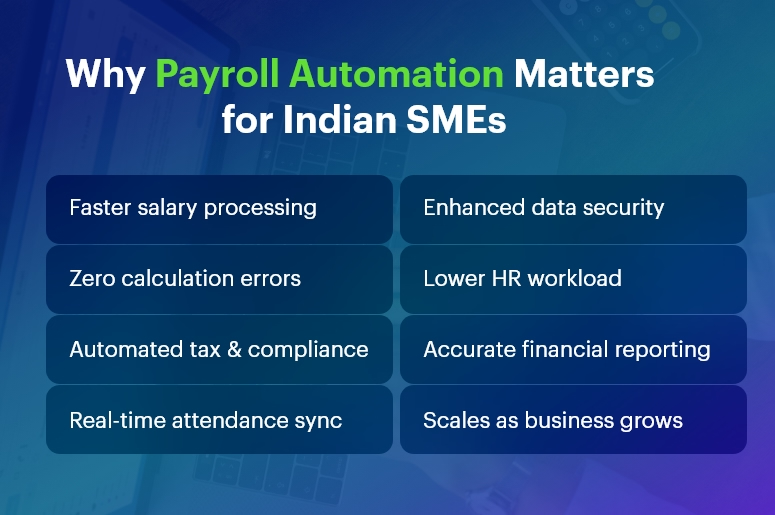
Why Payroll Automation Matters for Indian SMEs

Top 15 Payroll Automation Benefits for SMEs in India

Faster Salary Processing Means Happier Employees

Indian SMEs often spend 3–7 days every month preparing payroll manually. Automation cuts this time by more than 70%, because:

  • Salary structures are pre-configured
  • Attendance updates automatically
  • Deductions are applied instantly
  • No need to repeat data entry every month

Employees receive salaries on time — which directly improves morale, retention, and trust. In today’s competitive job market, timely salary payments can be a big differentiator.

Highly Accurate Calculations Reduce Payroll Disputes

Manual payroll often results in:

  • Incorrect salaries
  • Wrong overtime payouts
  • Missing allowances
  • Wrong TDS deductions

These mistakes are frustrating for employees and expensive for SMEs. Automation ensures accurate salary breakdowns using predefined formulas, so math errors are eliminated and employee satisfaction increases.

Seamless Statutory Compliance for Indian Labor Laws

Compliance is one of the biggest challenges for Indian SMEs. Payroll Automation always follows:

  • Latest PF, ESI calculation rules
  • Updated TDS slabs & exemptions
  • State-wise Professional Tax differences
  • Bonus, Gratuity & Minimum Wages rules
  • Labor Welfare Fund contributions

The system updates automatically with every policy change. This protects SMEs from:

  • Penalties
  • Legal issues
  • Audit failures

Businesses stay peacefully compliant.

Real-Time Attendance & Shift Management That Syncs Automatically

When Human Resources manually reconciles attendance from punch cards, emails, or Excel sheets, errors are guaranteed.

Automated payroll integrates with:

  • Biometric devices
  • Mobile GPS punch-in
  • Web attendance portals
  • Shift calendars

Every login, logout, leave, overtime hour is recorded in real time. Salary becomes 100% aligned with true productivity — no arguments later.

Full Transparency Through an Employee Self-Service Portal

An ESS portal empowers employees to:

  • Download payslips instantly
  • View salary summaries and tax calculations
  • Track attendance and leave balances
  • Claim and track reimbursements
  • Update profile details

Employees feel informed and valued. HR saves countless hours answering repetitive salary queries.

Free Payroll, PF, ESI & TDS Software

The most trusted automation tool for modern Indian businesses.

Significant Cost Savings — Immediate and Long Term

Payroll Automation reduces:

  • Administrative workload
  • Outsourced payroll expenses
  • Compliance fines
  • Paper, filing, and printing costs

SMEs operate more efficiently with the same HR team. Automation becomes a high-ROI investment — not an expense.

Ultra-Secure Protection for Payroll & Employee Data

Payroll touches the most confidential details of a business: Salaries, financials, bank information, PAN numbers, etc.

Automation offers:

  • Data encryption
  • Cloud backups
  • Role-based access control
  • Access logs & audit trails

This prevents leaks, misuse, or accidental data loss — something Excel can’t guarantee.

Instant Generation of Statutory and Payroll Reports

Preparing statutory forms manually (PF, ESI, TDS) is time-consuming and error-prone. With automation, files like:

  • ECR files for PF portal
  • TDS returns (Form 24Q/26Q)
  • Salary registers
  • Form 16 + MIS reports

are generated in seconds — accurate and ready for upload.

This reduces compliance stress and ensures filing happens before deadlines.

Productivity Boost for HR Teams

HR’s role is to develop people — not fight spreadsheets. Automation shifts HR’s energy to:

  • Employee development
  • Performance initiatives
  • Recruitment & onboarding
  • Workforce strategy

Organizations get better HR output without hiring more people.

Eliminates Fraud and Payroll Manipulation

Common fraud cases in SMEs include:

  • Ghost employees
  • Fake overtime claims
  • Modified attendance entries
  • Cash-based payout manipulation

Automation ensures every action is recorded. There is a complete audit trail — no room for hidden salary leaks.

Multi-State Payroll Handled with Ease

As SMEs open branches across India, payroll complexity increases due to state-specific:

  • PT slabs
  • Minimum wages
  • Public holidays
  • Employee categories

Automated payroll adapts for each location yet runs payroll centrally, saving tremendous regulatory effort.

Automated Digital Payslips — Professional and Paperless

Employees get legally compliant payslips:

  • On their phones
  • In the ESS portal
  • Automatically via email

No printing, no waiting, no errors. Digital payslips also give companies a modern professional impression.

Automated Leave, Loan & Reimbursement Accounting

Every leave approval or salary advance automatically flows into payroll.

The system:

  • Calculates LOP accurately
  • Tracks EMI-based repayments
  • Approves and verifies expense claims

This ensures zero disputes and complete visibility into financial adjustments.

Advanced Analytics for Better Financial Control

Owners and decision-makers get dashboards showing:

  • Salary cost trends
  • Overtime vs. productivity
  • Department-wise payroll impact
  • Budget deviation alerts

These insights help optimize hiring, scheduling, and compensation — fueling better profitability.

Easily Scalable As Your Business Grows

As SMEs expand:

  • New employees
  • New salary structures
  • New branches

…can be added effortlessly.

Payroll stays equally efficient whether managing 10 or 10,000 employees. Automation ensures payroll never becomes a growth roadblock.

India’s #1 Free Software

Free Payroll, PF, ESI & TDS Software

Final Thoughts

Payroll Automation is more than digitizing payroll —

  • It transforms how SMEs operate.
  • It builds employee trust and strengthens compliance.
  • It enables leaders to focus on growth rather than paperwork.

In India’s fast-moving economy, companies that automate will advance. Companies that remain manual will fall behind.

Payroll Automation is the foundation of a future-ready SME.

Frequently Asked Questions

  • Do small businesses really need payroll automation?

Yes. Even with 5–10 employees, automation improves transparency, efficiency, and compliance accuracy.

  • Will payroll automation reduce HR workloads?

Absolutely. Mundane tasks disappear, allowing HR to focus on employee success and culture development.

  • How does automated payroll ensure compliance?

It auto-updates tax laws and generates government-friendly files for PF, ESI, and TDS filings.

  • Is automated payroll safe for sensitive employee data?

Yes. Encryption, backups, and permissions make it far more secure than spreadsheets.

  • How long does implementation take for an SME?

Most businesses can go live in 1–7 days, depending on employee size and data format.

India’s #1 Free Software

Free Payroll, PF,
ESI & TDS Software

Professional compliance management for Indian businesses. 100% Free Forever.

Category: EPFO & ESI

No posts in this category.

Subcategory: EPFO

Subcategory: ESI

Category: Payroll Help

No posts in this category.

Subcategory: Employee Self-Service & Engagement

Subcategory: Introduction to Payroll

Subcategory: Payroll Analytics & Reporting

Subcategory: Payroll Automation & Technology

Subcategory: Payroll for Business Growth

Subcategory: Payroll Processing & Management

Subcategory: Taxation & Compliance

Category: User Manual

No posts in this category.

Subcategory: Company Setup

Subcategory: Employee Management

Subcategory: Getting Started

Subcategory: Glossary

Subcategory: Import & Export

Subcategory: Introduction

Subcategory: Payroll Configuration

Subcategory: Payslips & Disbursement

Subcategory: Reports & Analytics

Subcategory: Running Payroll

Subcategory: Statutory Compliance & Reports

Subcategory: Troubleshooting

Subcategory: User Management & Security