
Payroll might not be the first thing you think about when scaling your business — but it’s one of the first systems to break if it isn’t built for growth. Whether you’re hiring across multiple states, adding your first contract and gig workers, or simply doubling headcount, your payroll process has to scale without bottlenecks. Inaccurate payroll, compliance gaps, and poor visibility cost businesses more than money — they cost trust and morale.
In this guide, we’ll break down what actually makes a payroll system scalable in 2026, why it matters more than ever, and the concrete steps to get ahead of the problem before growth forces your hand.
Why Scalability Matters: The Business Case for a Future-Proof Payroll
As businesses grow, payroll demands compound. New hires, new locations, varying state tax rules, shift schedules, contractor payments — what worked cleanly at 10 employees can turn chaotic at 50, and unmanageable at 500.
Here’s why a scalable payroll system is a mission-critical investment, not a nice-to-have:
- Avoid compliance nightmares. Growth brings more complex labour law exposure — India’s four Labour Codes are rolling out in phases, and each new state you operate in adds its own Professional Tax slabs and minimum wage rules. A scalable system updates automatically instead of relying on someone tracking every notification.
- Reduce manual errors and admin overload. Spreadsheets and disconnected tools create duplicate entries, late submissions, and missed payments. Automation removes the manual grunt work that doesn’t scale past a certain headcount.
- Support fast-paced hiring and onboarding. Whether you’re opening a new location or bringing on seasonal workers, payroll setup should scale up in minutes, not weeks.
- Improve employee trust and retention. Timely, transparent, accurate pay builds credibility as you grow. Late or incorrect payments during a growth phase — when trust matters most — is a fast track to disengagement.
Retail, logistics, manufacturing, and tech businesses feel this pressure earliest, since high-volume hiring, distributed teams, and multi-state compliance complexity all stack on top of each other.
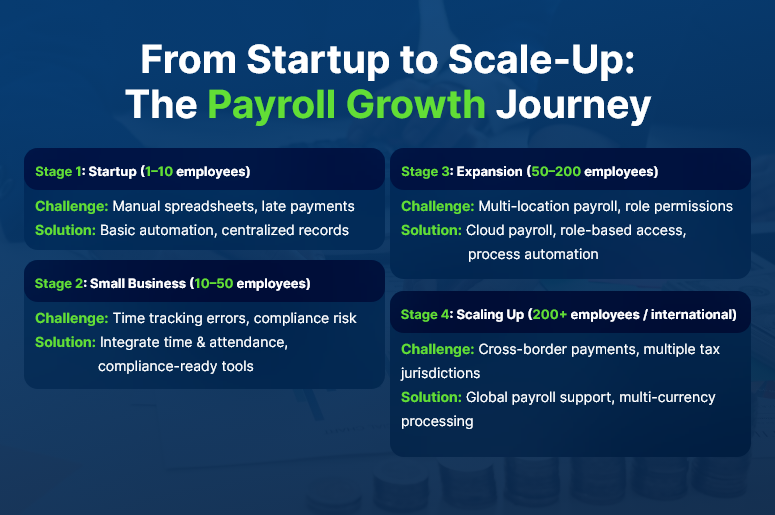
How to Build a Scalable Payroll System: 8 Actionable Strategies
1. Centralise Payroll and HR Data in One System
Avoid data silos by unifying payroll, HR, and attendance in a single platform. A centralised payroll system keeps everyone working from the same source of truth, cutting discrepancies and processing delays as headcount grows.
2. Invest in Cloud-Based Payroll Software
Cloud solutions give you real-time access, better uptime, and automatic rate and compliance updates — essential once you’re running payroll for a growing or multi-location team.
3. Automate Core Payroll Processes
From wage calculation and statutory deductions to payslip generation, automation saves time, removes human error, and keeps pace with headcount growth without adding headcount to HR.
4. Use Role-Based Access and Permissions
Restrict who can view or edit sensitive payroll data as your org chart grows. This matters more with every new manager, location, or finance hire added to the system.
5. Plan for Multi-State Compliance as You Expand
Opening in a new state means a new Professional Tax slab, new minimum wage rules, and sometimes new Labour Welfare Fund contributions. Choose a system that handles multi-state rules automatically rather than requiring manual configuration per location.
6. Integrate Time Tracking and Attendance
A scalable system syncs worked hours, shifts, overtime, and leave automatically, cutting the reconciliation headaches and disputes that multiply as team size grows.
7. Enable Flexible Pay Structures
Support full-time, part-time, contract, and gig workers in the same system, with classification-appropriate rules for each. India’s Labour Codes now formally recognise gig and platform workers, so this is quickly becoming a compliance requirement, not just a convenience.
8. Track and Forecast Payroll Costs
Get visibility into payroll cost by department, team, or project. As you scale, finance teams need this breakdown to forecast budgets accurately and catch cost overruns before they compound.
Customer Success Example
SummitTech, a fast-scaling SaaS company, used IndPayroll to streamline multi-state compliance and cut payroll processing time by 60%. With a rapidly growing, distributed team, they needed automation and shared visibility across HR and finance — and got both from a single integrated system instead of stitching one together from separate tools.
Free Payroll, PF,
ESI & TDS Software
Professional compliance management for Indian businesses. 100% Free Forever.
Key Takeaways: Future-Proofing Your Payroll Operations
- Scaling businesses can’t rely on spreadsheets or legacy tools — you need a system that grows with your headcount and your state footprint.
- Centralising HR, attendance, and payroll removes the silos that cause most scaling pain.
- Automation, multi-state compliance, and cost visibility are the three pillars of a truly scalable payroll system.
Building a scalable payroll system isn’t just about technology — it’s about giving your people and processes room to grow confidently. As your team expands, your payroll system should never be the thing holding you back.