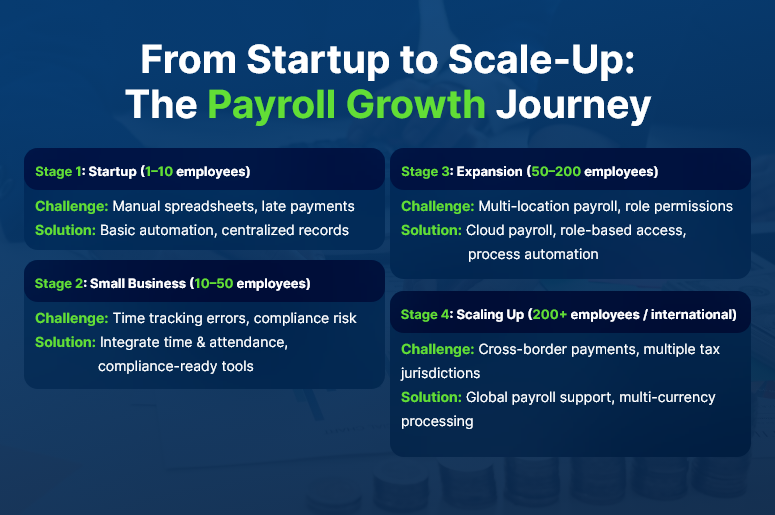
Payroll isn’t just about paying your people — it’s about staying compliant, earning trust, and keeping your team motivated. But as your business grows, running payroll manually becomes risky, slow, and error-prone. More than a third of small businesses face a payroll-related penalty at some point, and almost always it traces back to a step that got skipped, not a calculation that was wrong.
This guide walks through a practical, end-to-end payroll processing checklist for growing businesses in 2026 — where most companies slip up, what to fix, and how to make the whole cycle seamless.
The Business Case: Why End-to-End Payroll Processing Matters
Payroll goes far beyond cutting a paycheck. When it’s inaccurate or non-compliant, the ripple effects show up everywhere: employee dissatisfaction, audits, penalties, and real financial losses.
Here’s why a disciplined, end-to-end process matters across industries:
- Retail and hospitality. High turnover and hourly wages make real-time payroll updates critical — delays here translate directly into retention problems.
- Manufacturing and logistics. Overtime, shift differentials, and contract workers demand precision, or you’re carrying real compliance risk on every pay cycle.
- Professional services. Billable hours, bonuses, and project-based compensation need automation to prevent calculation errors from compounding across clients.
Whatever your industry, a streamlined payroll process improves productivity, builds employee trust, and reduces the operational burden on a small HR or finance team.
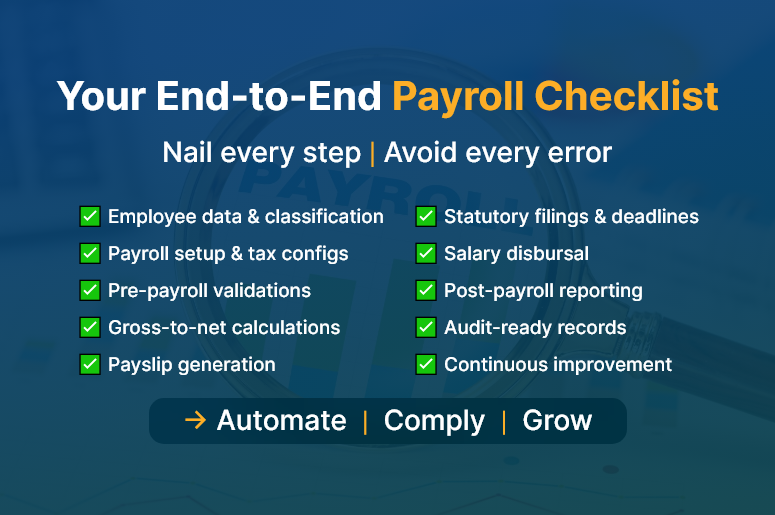
The Ultimate End-to-End Payroll Processing Checklist
Here’s the complete checklist, broken into seven actionable stages. Each one closes a gap that commonly causes errors or penalties.
1. Employee Data Collection & Classification
- Capture full employee details: PAN, UAN, bank details, job role, and benefit preferences at onboarding.
- Classify employment type correctly: Distinguish full-time, part-time, contract, and gig workers — India’s Labour Codes now formally define gig and platform worker categories, and misclassification is one of the costliest mistakes an SME can make.
- Track working hours and shifts: Use digital timesheets or biometric systems to capture accurate work data from day one.
2. Payroll Setup & Configuration
- Set pay frequencies: Define weekly, bi-weekly, or monthly cycles based on your company structure.
- Automate statutory rates and deductions: Keep PF, ESI, Professional Tax, and TDS current with the latest central and state rules, so no one is calculating from a rate table that’s a year out of date.
- Integrate attendance systems: Sync leave, holidays, and worked hours from your attendance system directly into payroll.
3. Pre-Payroll Validation
- Verify attendance data: Double-check logged hours, approved leave, and overtime entries before they hit the pay run.
- Audit pay structure changes: Validate bonuses, commissions, and raises before final processing — not after payslips go out.
- Confirm deductions: Ensure benefit, insurance, and loan-repayment deductions are accurate and approved.
4. Payroll Calculation & Review
- Run gross-to-net calculations: Automatically compute gross salary, statutory deductions, and net pay.
- Cross-check with payroll software: Use automated payroll software to eliminate spreadsheet fatigue and reduce human error at the calculation stage.
- Generate payslips: Produce detailed, downloadable payslips so every employee can see exactly how their pay was calculated.
Free Payroll, PF,
ESI & TDS Software
Professional compliance management for Indian businesses. 100% Free Forever.
5. Compliance & Statutory Filings
- Generate statutory forms: Automatically prepare PF ECR filings, ESI returns, TDS Form 24Q, and Form 16 instead of compiling them by hand at deadline time.
- Meet submission deadlines: Set reminders for every filing and deposit deadline — most payroll penalties come from being late, not from wrong amounts.
- Stay audit-ready: Maintain digital records and a complete audit trail to satisfy labour law recordkeeping requirements.
6. Payment Processing
- Schedule timely payments: Use integrated banking or payroll software to process salaries without manual intervention.
- Disburse reimbursements on cycle: Include travel or expense claims in the current pay run to avoid payment lags and employee frustration.
- Reconcile bank statements: Match every payment against the payroll run and your accounting books before closing the cycle.
7. Post-Payroll Reporting & Feedback
- Share detailed reports: Provide department-wise breakdowns and payroll summaries to finance and HR.
- Track payroll KPIs: Monitor accuracy, error rate, cycle time, and compliance status over time — not just whether the pay run finished on schedule.
- Collect employee feedback: Use it to catch recurring confusion or disputes before they become a pattern.
Why a Unified System Changes This for Scaling Teams
Disconnected tools create fragmented processes — and fragmentation is where errors hide. A unified payroll platform brings everything from employee onboarding to statutory filing into one workflow:
- HR integration: New hire data flows automatically from onboarding into payroll setup — no re-entry, no version mismatch.
- Real-time tracking: Dashboards show payroll progress, pending validations, and payment status at a glance.
- Audit-ready reports: Generate compliance reports, payslips, and tax documents on demand instead of assembling them manually each quarter.
- Scalability: Whether you have 20 employees or 200, the same system and process scale with you, minus the added manual work.
Customer Success
Finovate Solutions, a 50-person IT services company, used IndPayroll to cut payroll errors by 95% and reduce processing time from three days to four hours — by integrating employee timesheets with payroll, enabling automatic compliance checks and statutory form generation, and streamlining payouts and payslip delivery. The shift saved time and measurably reduced compliance risk.
Free Payroll, PF, ESI & TDS Software
The most trusted automation tool for modern Indian businesses.
Key Takeaways & Closing
A smooth, end-to-end payroll process doesn’t just prevent errors — it builds trust, ensures compliance, and frees up time for strategic work.
- Map your payroll process and identify exactly where bottlenecks or manual handoffs occur.
- Automate wherever possible — manual work invites the mistakes that cost the most to fix later.
- Build compliance into the workflow, not into a once-a-quarter scramble, since statutory rules change frequently.
- Unify your systems — disconnected HR, attendance, and payroll tools are where most errors originate.
With the right process and the right tools, payroll becomes a growth enabler instead of a recurring back-office risk.