
Top Payroll Challenges Small Businesses Face — And How to Overcome Them

Managing payroll is not just about calculating salaries and hitting “send.” It’s a compliance-critical function that shapes employee trust and, ultimately, business growth. Small businesses feel this pressure more than anyone — they’re expected to get payroll exactly right every month, without a dedicated compliance team or an expensive enterprise system to lean on.

In this guide, we break down the payroll challenges small businesses run into most often in 2026, why each one is riskier than it looks, and how to fix it with the right processes and automation.

Why Payroll Deserves More Attention Than It Gets

If payroll feels like a back-office task, it’s worth a second look. For small and mid-sized businesses, payroll can quietly make or break operations:

  • Cash flow and morale hinge on payroll timing. Delayed or miscalculated salaries drive dissatisfaction — and, over time, attrition.
  • Payroll errors trigger real legal exposure. Late PF/ESI filings, wrong TDS deductions, and misclassified workers all carry penalties, not just awkward conversations.
  • Manual payroll doesn’t scale. Many small teams still run payroll on spreadsheets, which work fine at 10 employees and break down at 50.

Industries with mixed or distributed workforces — retail, manufacturing, IT services, logistics — feel this most acutely, thanks to variable shifts, incentive pay, and multi-state compliance rules layered on top of the basics.
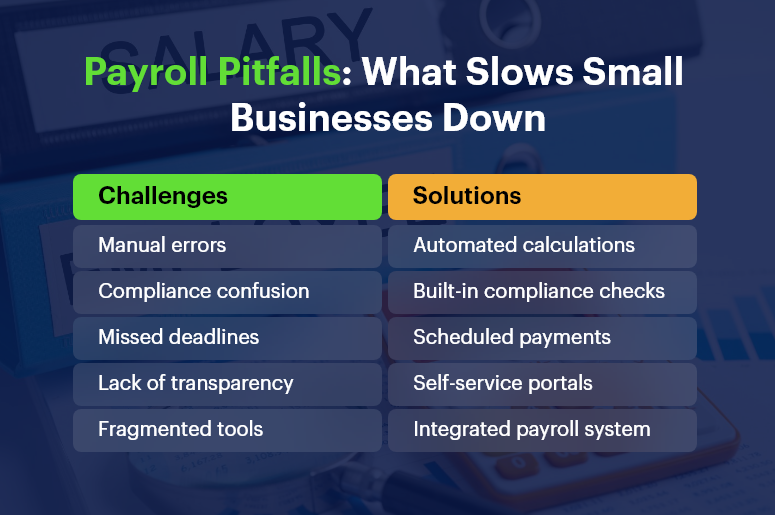
Payroll Pitfalls What Slows Small Businesses Down

The Top Payroll Challenges for Small Businesses

1. Compliance and Constantly Changing Regulations

Staying compliant with central and state rules is exhausting even for well-resourced teams. India’s four Labour Codes are rolling out in phases and reshaping definitions of wages, working hours, and benefits, while PF, ESI, and Professional Tax rules continue to evolve state by state.

What makes this hard? Small HR teams rarely have the bandwidth to track every notification, and a single missed update — a changed wage ceiling, a new filing format — can mean an incorrect deduction across an entire pay cycle. Misfiling PF or ESI returns alone can invite audits, interest, and penalties.

2. Worker Misclassification (Full-Time, Contract, and Gig)

Most small businesses run on a mix of full-time, part-time, freelance, and gig workers — and the Labour Codes now formally define gig and platform workers as a distinct category with their own obligations.

Why it’s risky: Misclassifying a worker changes which deductions, benefits, and filings apply. Treating an employee as a “consultant” to skip PF and ESI is one of the most expensive mistakes an SME can make — it can trigger back-payments, interest, and penalties during an inspection.

Free Payroll, PF, ESI & TDS Software

The most trusted automation tool for modern Indian businesses.

3. Frequent Errors From Manual Calculations

Human error during data entry, overtime calculation, or deduction updates snowballs quickly, especially without a system to catch mistakes before the pay run is finalised.

The cost: Incorrect payslips break employee trust fast, lower morale, and generate disputes that eat up HR’s time to resolve — often for issues that a rule-based system would have caught automatically.

4. Delayed Salary Disbursement

Salary delays usually trace back to approvals stuck in email threads, unclear sign-off chains, or last-minute cash flow uncertainty — not a lack of funds.

Why it matters more than it seems: Employees expect timely payment as a baseline, especially in labour-heavy sectors. Late salaries also cascade into late statutory filings, since deposit deadlines are tied to the pay date, not when you eventually process it.

5. No Integration Between HR, Attendance, and Payroll

When employee data lives in one spreadsheet, attendance in another, and salary structures in a third, errors are inevitable — someone is always working from an outdated version.

The real cost: Data silos mean leave is tracked in one place, salary calculated in another, and taxes reconciled manually at the end. Every disconnect is a chance for a number to fall through the cracks, and reporting accuracy suffers across the board.

6. Handling Bonus, Incentive, and Variable Pay

Bonuses, commissions, and performance incentives add real complexity to a process that’s already tight on time each month.

Where this goes wrong: Without a rule-based structure, variable pay calculations become inconsistent from one cycle to the next — and mistakes here hit both employee motivation and tax liability, since incentive pay has its own TDS treatment.

7. Messy Tax Filing and Year-End Reporting

Many small businesses scramble to compile a year’s worth of data at TDS filing time or when generating Form 16.

Why this keeps happening: If reconciliation only happens once a year instead of every pay cycle, small errors compound quietly until they surface as a filing headache. Manually generating Form 16 or Form 24Q from scattered records is slow and error-prone by design.

How to Overcome These Payroll Challenges

Solving all seven of these starts with the same three moves: automate, integrate, and centralise.

Classify every worker correctly, in writing

  • Map each person on payroll — employee, contractor, or gig worker — to the right category and revisit it whenever a role changes.
  • Let your payroll software apply the correct deduction and benefit rules automatically once classification is set.

Automate statutory deductions and filings

  • Use software that recalculates PF, ESI, Professional Tax, and TDS automatically whenever rates change, instead of relying on a formula someone updated once.
  • Rely on automated compliance tools to flag deadlines before they’re missed — most penalties come from being late, not from wrong amounts.

Set salary templates and variable pay rules

  • Build configurable salary structures for each role and work type, so bonus and incentive calculations follow a consistent rule rather than a one-off spreadsheet formula.
  • Standardising this once removes the guesswork every single pay cycle after.

Centralise HR, attendance, and payroll data

  • Bring employee master data, attendance, and salary processing into a single source of truth so nothing is entered twice and nothing goes stale.
  • This is where small teams recover the most time — one update flows everywhere instead of being copied across files.

Give employees self-service access

  • Let employees view payslips, tax declarations, and reimbursement status without opening a ticket with HR.
  • This builds transparency and quietly eliminates a large share of routine HR queries.

Reconcile before you file, not after

  • Match gross pay, deductions, and disbursement against your bank file every month, not just at year-end.
  • A clean monthly reconciliation makes Form 16 and Form 24Q generation almost effortless when the deadline arrives.

Case Study

A retail chain running payroll across multiple locations implemented IndPayroll to automate PF/ESI calculations, integrate leave tracking, and standardise salary structures. The result: a 60% reduction in payroll processing time, zero late-filing penalties, and a measurable improvement in employee satisfaction and retention.

India’s #1 Free Software

Free Payroll, PF, ESI & TDS Software

Key Takeaways

  • Payroll management is more than salary disbursement — it’s a business-critical, compliance-heavy operation, even at small scale.
  • Manual systems increase risk and quietly drain time that a small team can’t spare.
  • Classification, compliance, and tax filing are consistently the top pain points for small business payroll.
  • Centralising HR, attendance, and payroll into one system removes most of these challenges at the root, rather than patching each one separately.

A smart, unified payroll system transforms how small businesses manage compliance, build employee trust, and reclaim hours every month. As you grow, you need processes that scale without multiplying complexity.
The Future of Payroll: Automation, Compliance, and Employee Experience

The future of payroll is no longer a distant vision; it’s already here. Between shifting labour law, rising employee expectations, and growing scrutiny from the EPFO, ESIC, and Income Tax Department, payroll has become one of the most strategically important functions in any business. Recent industry research puts the share of businesses actively modernising payroll at well over half, driven by the same pressures: accuracy, compliance, and employee satisfaction.

If your team is still reconciling spreadsheets or juggling disconnected systems, you’re not just losing time; you’re carrying real compliance risk and frustrating the people you pay. The good news: with the right automation in place, payroll can become one of the most reliable, efficient, and employee-friendly processes in your business.

In this guide, we’ll cover:

  • Why payroll modernisation is central to business growth in 2026
  • The biggest forces reshaping payroll — from AI automation to the Labour Codes
  • Practical steps to future-proof your payroll process today
  • How INDPayroll helps you get there

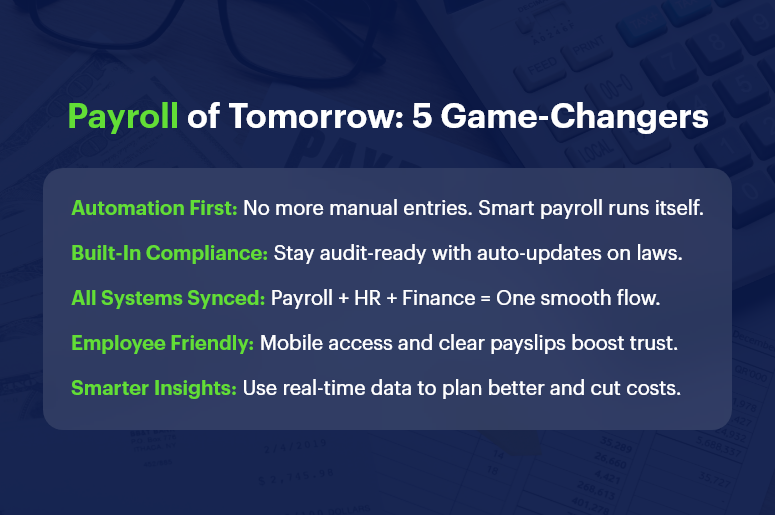
Payroll of Tomorrow 5 Game Changers

Why Payroll Modernisation Matters for Your Business

Payroll isn’t just about cutting paychecks; it’s a direct reflection of how seriously your business takes accuracy, compliance, and employee well-being. Here’s why modernising it is non-negotiable in 2026:

  • High-stakes compliance. Labour laws, tax slabs, and statutory deductions change constantly, and India’s four Labour Codes are actively being notified and rolled out state by state. Missing a deadline or misclassifying a worker can trigger audits, penalties, or back-payments. Automated payroll keeps you compliant and audit-ready without a full-time compliance team.
  • Employee trust and retention. Late or inaccurate pay erodes trust fast. A transparent, on-time payroll process signals professionalism and reliability, critical in high-turnover industries like retail, construction, and logistics, where a single bad pay cycle can drive attrition.
  • Operational efficiency. Manual payroll is slow and error-prone. Integrating payroll with your HR and attendance data removes duplicate data entry and frees your team to focus on strategy instead of reconciliation.
  • Scalability for growth. As you add employees, states, and worker types full-time, contract, gig — payroll complexity multiplies. The businesses that scale smoothly are the ones running payroll on systems built to handle that complexity from day one.
  • Data protection obligations. Payroll holds some of your most sensitive data — salaries, PAN, bank details, Aadhaar-linked identifiers. Under India’s Digital Personal Data Protection Act, 2023 (DPDP Act), securing that data is now a legal duty, not just good hygiene.
India’s #1 Free Software

Free Payroll, PF, ESI & TDS Software

What’s Driving the Future of Payroll?

Six forces are reshaping how businesses run payroll this year:

1. AI-Assisted Automation Is Now the Baseline

  • Automation eliminates repetitive data entry, making pay cycles faster and more reliable; many businesses cut processing time by more than 70% after switching from spreadsheets.
  • AI-assisted checks flag anomalies — a suspicious overtime spike, a duplicate reimbursement, a misapplied deduction before the pay run is finalised, not after employees complain.
  • Statutory rates for PF, ESI, TDS, and Professional Tax update automatically, so you’re never running payroll on a stale rate table.

2. Compliance Is Getting More Complex — and More Automated

  • India’s four Labour Codes (Wages, Social Security, Industrial Relations, and Occupational Safety) consolidate 29 central labour laws and are being implemented in phases across states, reshaping definitions of wages, working hours, and benefits.
  • The Codes formally recognise gig and platform workers, extending social security obligations to a workforce that was previously undefined.
  • Automated systems apply updated EPF, ESI, and TDS rules in real time, so a change in a wage ceiling or tax slab doesn’t require a manual formula rewrite.

3. Data Security Has Become a Compliance Requirement

  • The DPDP Act, 2023 makes access controls, encryption, and audit logs for payroll data a legal expectation, not just an IT best practice.
  • Role-based access and audit trails also address a quieter risk: internal payroll fraud, from ghost employees to manipulated attendance records.

4. Employee Experience Is Directly Tied to Payroll

  • Self-service portals — instant payslip downloads, real-time leave tracking, reimbursement visibility — cut repetitive HR queries and give employees confidence their pay is accurate.
  • On-demand and faster pay cycles are becoming a competitive differentiator, particularly for hourly, retail, and field-based teams.
  • A positive payroll experience measurably improves engagement, especially for remote and hybrid teams who have fewer informal touchpoints with HR.

5. Integrated Platforms Are Replacing Disconnected Tools

  • Businesses running separate systems for HR, attendance, accounting, and payroll are exposed to sync errors and version-control chaos.
  • Centralised payroll platforms bring employee master data, attendance, and payroll into one system, so every calculation and report reconciles automatically.

6. Workforce Complexity Is the New Normal

  • Contract, gig, remote, and multi-state employees each carry different classification, tax, and benefit rules.
  • Getting classification wrong is one of the costliest payroll mistakes a business can make — it can trigger back-payments, interest, and penalties during an inspection.
  • Payroll systems built for this complexity apply the right rules automatically instead of relying on a person to remember every exception.

Practical Tips: How to Prepare for the Future of Payroll

Ready to upgrade your payroll game? Here’s how to stay ahead:

Ready to future-proof your payroll process? Here’s where to start:

Digitise and centralise your payroll data

  • Replace spreadsheets and paper forms with one centralised system.
  • Choose a platform that integrates HR, attendance, finance, and compliance data in a single source of truth.

Automate statutory deductions and filings

  • Automate PF, ESI, Professional Tax, and TDS calculations so rate changes apply automatically.
  • Set recurring payroll schedules and deadline alerts — most payroll penalties come from missed dates, not wrong amounts.

Build compliance in from day one

  • Choose software that updates automatically with the latest EPF, ESI, and tax regulations.
  • Run periodic internal audits of classifications, salary structures, and deduction rates before an inspector does.

Empower employees through self-service

  • Give employees direct access to payslips, tax declarations, and leave balances.
  • Add mobile access for hybrid, remote, or field-based teams.

Secure payroll data by design

  • Restrict salary data access by role, encrypt sensitive records, and maintain audit logs.
  • Avoid circulating raw payroll files over email or shared drives — a habit the DPDP Act now treats as a real compliance gap.

Track payroll analytics, not just payroll output

  • Monitor KPIs like cycle time, error rate, and cost per payslip.
  • Use the data to forecast costs and support budget planning across departments.

Keep your HR and finance teams current

  • Brief teams whenever statutory rates, Labour Code notifications, or system features change.
  • Invest in training during onboarding and after major updates — a well-informed team is your best defence against manual error.

Customer Success Snapshot

GreenRoots Logistics, a fast-growing transportation company, used IndPayroll’s automation to cut salary processing time by 75%. By bringing timesheets, leave approvals, and compliance tracking into a single workflow, they achieved 100% on-time payments and a 30% drop in payroll-related employee queries — with the same HR headcount.

Free Payroll, PF, ESI & TDS Software

The most trusted automation tool for modern Indian businesses.

Key Takeaways: Shaping the Future of Payroll

The future of payroll runs on automation, real-time compliance, and a stronger employee experience. Businesses still relying on spreadsheets and manual processes won’t just fall behind on efficiency — they’ll fall behind on trust, retention, and growth.

In summary:

  • Automation is now the baseline for payroll, not a competitive edge.
  • Compliance is more complex and more automated at the same time — the Labour Codes and DPDP Act make this a legal, not just operational, priority.
  • Employee experience is directly tied to how — and how reliably — people get paid.
  • INDPayroll brings automation, compliance, and employee experience together in one system.

Investing in the right payroll system today future-proofs your business tomorrow.

Category: EPFO & ESI

No posts in this category.

Subcategory: EPFO

Subcategory: ESI

Category: Payroll Help

No posts in this category.

Subcategory: Employee Self-Service & Engagement

Subcategory: Introduction to Payroll

Subcategory: Payroll Analytics & Reporting

Subcategory: Payroll Automation & Technology

Subcategory: Payroll for Business Growth

Subcategory: Payroll Processing & Management

Subcategory: Taxation & Compliance

Category: User Manual

No posts in this category.

Subcategory: Company Setup

Subcategory: Employee Management

Subcategory: Getting Started

Subcategory: Glossary

Subcategory: Import & Export

Subcategory: Introduction

Subcategory: Payroll Configuration

Subcategory: Payslips & Disbursement

Subcategory: Reports & Analytics

Subcategory: Running Payroll

Subcategory: Statutory Compliance & Reports

Subcategory: Troubleshooting

Subcategory: User Management & Security