How to Simplify Payroll for Contract, Gig & Remote Employees

Payroll was never designed for today’s workforce. Contract professionals, gig workers, and remote employees now power modern businesses. However, most payroll processes still assume fixed salaries, single locations, and uniform tax rules. As a result, businesses struggle with errors, compliance gaps, delayed payments, and operational stress. This is exactly why organizations must simplify payroll. In this comprehensive guide, you will learn how to simplify payroll for contract, gig, and remote employees using structured processes, automation, and a single purpose-built platform: INDPayroll, a 100% free payroll software designed for growing and distributed teams.
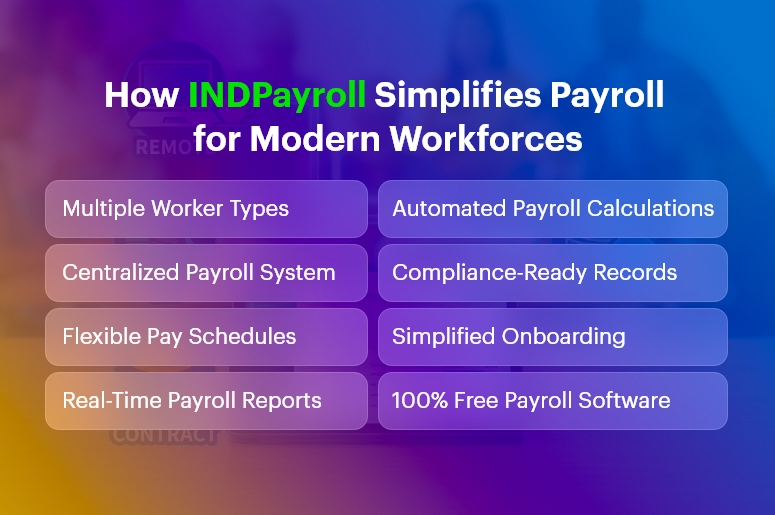
How-INDPayroll-Simplifies-Payroll-for-Modern-Workforces

Why Payroll Gets Complicated for Contract, Gig & Remote Workers

Before you can simplify payroll, you must understand why it becomes complex in the first place.

Contract, gig, and remote work introduces:

  • Multiple worker classifications
  • Variable pay structures
  • Location-based tax rules
  • Inconsistent working hours
  • Manual documentation overhead

Consequently, traditional payroll workflows break down. Teams spend more time fixing payroll issues than running payroll itself. Therefore, the first step to simplify payroll is removing manual complexity.

Free Payroll, PF, ESI & TDS Software

The most trusted automation tool for modern Indian businesses.

Step 1: Clearly Define Worker Categories

To simplify payroll, clarity comes first.

Every organization should explicitly define:

  • Contract employees – paid per agreement, responsible for their own taxes
  • Gig workers – task-based or milestone-based payments
  • Remote employees – salaried or hourly staff working from different locations

When these worker types are mixed without structure, payroll errors increase. However, when worker categories are clearly mapped inside a payroll system like INDPayroll, payroll instantly becomes easier to manage.

Step 2: Centralize Payroll in One System

Fragmented tools create fragmented payroll.

To simplify payroll, you need a single system that:

  • Manages multiple worker types
  • Automates calculations
  • Stores documentation
  • Tracks payments and compliance

INDPayroll centralizes payroll for contract, gig, and remote employees into one unified platform. More importantly, INDPayroll is 100% free, eliminating the cost barrier that prevents many businesses from upgrading their payroll processes.

By moving payroll into one system, organizations immediately simplify payroll operations and reduce dependency on spreadsheets and manual calculations.

Step 3: Automate Payroll Calculations

Manual payroll calculations are the biggest source of errors.

To truly simplify payroll, automation is non-negotiable.

INDPayroll automates:

  • Earnings calculations
  • Deductions and statutory components
  • Payment summaries
  • Payroll reports

As a result, payroll teams spend less time reconciling numbers and more time ensuring accuracy. Automation also ensures consistency, which is essential when handling contract and gig payments.

Step 4: Maintain Compliance Without Manual Effort

Compliance is where payroll usually fails.

Different employment types come with different legal obligations. If these are not tracked properly, businesses risk penalties and disputes. Therefore, to simplify payroll, compliance must be built into the system.

INDPayroll supports:

  • Structured payroll records
  • Transparent payment history
  • Audit-ready reports
  • Clear classification of worker types

By embedding compliance into everyday payroll workflows, INDPayroll removes uncertainty and helps organizations simplify payroll without relying on external tools.

India’s #1 Free Software

Free Payroll, PF,
ESI & TDS Software

Professional compliance management for Indian businesses. 100% Free Forever.

Step 5: Standardize Payroll Schedules

Unclear pay schedules create confusion and distrust.

To simplify payroll, organizations should establish consistent payment cycles for each worker type:

  • Monthly or biweekly payroll for remote employees
  • Agreed invoice-based cycles for contractors
  • Regular payout intervals for gig workers

INDPayroll allows businesses to manage these schedules within a single system. Consequently, payment delays reduce, disputes decline, and payroll communication becomes predictable.

Step 6: Simplify Documentation and Onboarding

Payroll does not start with payments. It starts with onboarding.

To simplify payroll, documentation must be standardized:

  • Contracts
  • Tax declarations
  • Payment terms
  • Bank details

INDPayroll enables centralized storage and access to payroll-related data. This ensures that payroll runs smoothly from day one and prevents repeated follow-ups for missing information.

Step 7: Gain Visibility Through Payroll Reporting

Visibility simplifies decision-making.

To simplify payroll, businesses must understand:

  • Total payroll cost
  • Payments by worker type
  • Monthly and annual payroll trends

INDPayroll provides clear payroll reports that help teams monitor expenses, forecast costs, and identify discrepancies early. With real-time visibility, payroll shifts from reactive to controlled.

Common Payroll Mistakes That Prevent Simplification

Many organizations unintentionally make payroll harder than it needs to be.

Here are common mistakes that stop teams from being able to simplify payroll:

  • Relying on spreadsheets
  • Managing contractors outside payroll systems
  • Manual tax calculations
  • No centralized payroll records
  • Paying for expensive payroll software unnecessarily

INDPayroll eliminates these issues by offering a 100% free, structured, and automated payroll platform.

Why INDPayroll Is the Best Way to Simplify Payroll

When evaluating payroll solutions, simplicity, cost, and reliability matter most.

INDPayroll stands out because:

  • It is 100% free payroll software
  • It supports contract, gig, and remote employees
  • It automates payroll calculations
  • It centralizes payroll data
  • It reduces compliance risk
  • It scales with growing teams

Instead of managing payroll through fragmented tools, INDPayroll enables organizations to simplify payroll without increasing costs or complexity.

How Simplified Payroll Impacts Business Growth

Payroll efficiency directly affects growth.

When you simplify payroll:

  • HR teams save time
  • Finance teams reduce errors
  • Workers receive timely payments
  • Compliance risks decrease
  • Leadership gains cost clarity

By removing friction from payroll, businesses can focus on expansion instead of administration.

India’s #1 Free Software

Free Payroll, PF, ESI & TDS Software

Final Thoughts

Payroll complexity is not a workforce problem. It is a system problem. To simplify payroll for contract, gig, and remote employees, businesses must adopt automation, clarity, and centralized control. INDPayroll delivers all three — without cost.

If your organization wants to simplify payroll, reduce errors, and support modern workforces efficiently, INDPayroll provides the most practical and cost-effective solution available today. Simple. Compliant. Scalable. And 100% Free.

FAQs

1. How can businesses simplify payroll for contract, gig, and remote employees?

Businesses can simplify payroll by using a centralized payroll system that supports multiple worker types, automates calculations, maintains compliance records, and standardizes pay schedules. INDPayroll enables all of this in one platform.

2. What makes payroll for contract and gig workers more complex?

Contract and gig workers often have variable pay, different tax responsibilities, and flexible schedules. Without automation and structured workflows, managing these differences manually leads to errors and delays.

3. Is INDPayroll suitable for both contract and remote employees?

Yes. INDPayroll is designed to manage payroll for contract workers, gig contributors, and remote employees within a single system, making it easier to handle diverse workforce models.

4. Is INDPayroll really 100% free payroll software?

Yes. INDPayroll is a 100% free payroll software that allows businesses to manage payroll without subscription fees or hidden costs.

5. How does INDPayroll help maintain payroll compliance?

INDPayroll helps maintain compliance by organizing payroll records, supporting clear worker classification, generating audit-ready reports, and ensuring consistent payroll documentation.

6. Can INDPayroll handle different payroll schedules?

Yes. INDPayroll allows businesses to manage multiple payroll schedules, making it easy to pay remote employees, contractors, and gig workers according to agreed timelines.

7. Does INDPayroll reduce payroll errors?

Yes. By automating payroll calculations and eliminating manual data entry, INDPayroll significantly reduces errors related to payments, deductions, and reporting.

8. How does INDPayroll help HR and finance teams save time?

INDPayroll streamlines payroll workflows, centralizes employee data, and automates repetitive tasks, allowing HR and finance teams to focus on strategic activities instead of payroll administration.

9. Can growing businesses scale payroll using INDPayroll?

Yes. INDPayroll is built to scale as businesses grow, supporting increasing headcount, multiple worker types, and higher payroll volumes without additional software costs.

10. Why should businesses choose INDPayroll over manual payroll methods?

Manual payroll methods increase errors, compliance risks, and administrative workload. INDPayroll simplifies payroll management, improves accuracy, and delivers these benefits as a 100% free payroll software.
How Automated Payroll Reduces HR Stress

Every HR professional knows payroll is one of the most stressful, detail-heavy functions in the entire organization. At the same time, HR teams must balance compliance, accuracy, timeliness, and employee satisfaction with limited time and resources. Fortunately, automated payroll reduces HR stress by eliminating repetitive tasks, reducing errors, speeding up processes, and freeing HR professionals to focus on strategic work.

In this comprehensive, practical guide, you will learn how automation reduces HR stress, why it matters, how to implement it, and how to maximize its impact across your company.

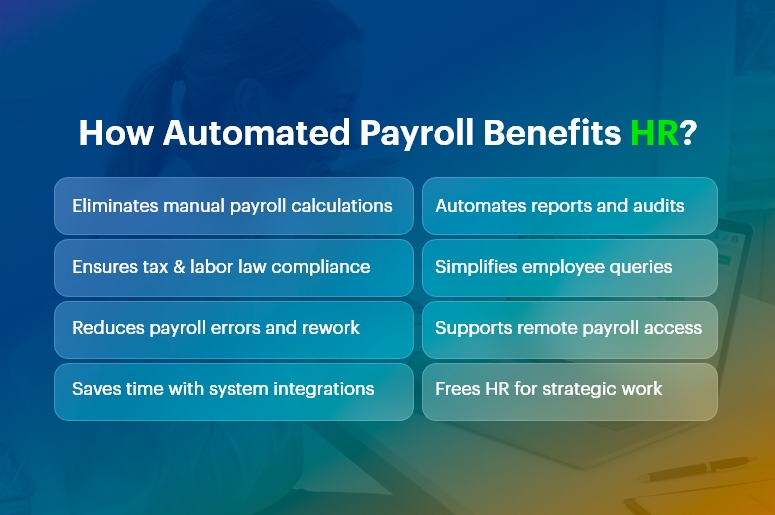
How Automated Payroll Benefits HR Stress

What Is Automated Payroll?

It is a technology-driven process that calculates wages, taxes, deductions, and benefits automatically using software.

Instead of manually calculating hours, deductions, and tax rates, an automated payroll system pulls data from time tracking tools, HR databases, and compliance libraries to produce accurate payruns with minimal human intervention.

By design, automation reduces HR stress, increases accuracy, and accelerates payroll cycles.

Why Payroll Causes Stress in HR

Payroll creates stress because it demands precision under tight deadlines. HR teams must:

  • Calculate pay accurately: This requires tracking hours, overtime, bonuses, leave, and commissions.
  • Manage taxes and compliance: Tax rates change frequently, and noncompliance carries penalties.
  • Handle benefits and deductions: Health insurance, retirement contributions, garnishments, and other deductions vary by employee.
  • Report and document: Payroll reports feed into accounting, audits, and internal planning.
  • Respond to employee questions: Employees expect clarity, speed, and transparency.

No wonder traditional payroll processes overwhelm HR teams. This is where automated payroll reduces HR stress dramatically.

India’s #1 Free Software

Free Payroll, PF,
ESI & TDS Software

Professional compliance management for Indian businesses. 100% Free Forever.

Top Ways Automated Payroll Reduces HR Stress

1. Eliminates Manual Calculations

Manual payroll calculations take hours and invite errors. In contrast, automated systems compute wages automatically based on configured rules.

By removing manual math from the equation, automation reduces HR stress and increases accuracy.

2. Ensures Compliance With Laws and Regulations

Labor laws and tax regulations change frequently. Automated payroll software updates tax tables and compliance rules automatically, ensuring your payroll is always up to date.

This means HR spends less time tracking changes and worrying about compliance penalties.

3. Reduces Errors and Risk

Human error is inevitable under pressure. Missing a decimal, misapplying a tax rate, or omitting a benefit can create costly mistakes.

Because automation reduces HR stress by catching errors upfront and enforcing consistency, HR teams can trust the numbers and avoid costly corrections.

4. Saves Time With Integrated Systems

Integration matters. When your payroll software connects with time tracking, benefits administration, and HR databases, data flows automatically. This eliminates duplicate data entry and ensures consistency.

Consequently, automation reduces HR stress by cutting administrative overhead.

5. Improves Reporting and Insights

Automated payroll systems generate reports instantly. Whether you need departmental cost breakdowns, tax filings, or historical pay data, automated reporting gives HR the insights it needs without manual assembly.

Because it reduces HR stress around data preparation, HR can focus more on analysis and decision-making.

6. Enhances Employee Experience

Employees dislike errors and delays in pay. When payroll runs smoothly and accurately, employee satisfaction rises.

It reduces HR stress by minimizing customer service issues and enabling HR to handle questions quickly and confidently.

How Automated Payroll Reduces HR Stress in Daily Operations

To understand real-world impact, let’s examine day-to-day HR operations:

  • Streamlined Payroll Runs

With automation, data flows from time-tracking systems into payroll seamlessly. HR simply reviews and approves pay runs rather than generating them from scratch.

Thus, automation reduces HR stress by shortening payroll preparation time and cutting repetitive work.

  • Faster Adjustments

Need to update an employee’s tax status or benefit enrollment? Automated systems propagate changes across all payroll modules.

This eliminates manual intervention and ensures accuracy. Because automated payroll reduces HR stress during adjustments, HR can respond swiftly to employee life events.

  • Simplified Audits

Auditors demand documentation, trails, and accuracy. Automation systems maintain logs, reports, and documentation automatically.

This transparency helps HR complete audits with less effort. In short, automation reduces HR stress when compliance checks arrive.

  • Remote and On-Demand Access

Modern payroll tools allow HR and employees to access payroll information from anywhere. This reduces dependency on paper records and ensures that HR can answer questions in real time.

Consequently, automation reduces HR stress by supporting remote and distributed teams.

India’s #1 Free Software

Free Payroll, PF, ESI & TDS Software

Key Features That Make Automated Payroll Effective

Understanding which features deliver stress relief helps you make informed choices.

  • Real-Time Calculations

Instant updates to payroll figures reduce last-minute surprises.

  • Tax Filing Automation

Automatic filing and payments save time and prevent penalties.

  • Integration With HR Systems

Connected systems ensure data accuracy and eliminate siloed information.

  • Self-Service Employee Portals

Employees can view payslips, tax forms, and benefits independently, reducing HR inquiries.

  • Alerts and Notifications

Reminders for deadlines and exceptions help HR stay proactive.

Each of these features contributes to how automation reduces HR stress, making payroll faster, smarter, and more reliable.

Choosing the Right Automated Payroll Solution

Selecting the right system matters. To ensure your payroll solution truly reduces HR stress, evaluate the following:

  • Scalability

Choose software that grows with your business and handles multiple pay schedules, classifications, and international requirements.

  • Integration Capabilities

Verify that the payroll tool integrates with your HRIS, time tracking, benefits platform, and accounting systems.

  • Compliance Support

Ensure the solution updates tax tables, legal changes, and reporting requirements automatically.

  • Support and Training

Reliable vendor support and user training help your HR team adopt the tool smoothly.

By focusing on these criteria, you increase the likelihood that automated payroll reduces HR stress—not just in theory but in practice.

Common Misconceptions About Payroll Automation

Many HR teams hesitate to adopt payroll automation due to misconceptions:

“Automation Means No Human Control”

False. Automated payroll reduces HR stress by handling calculations, but HR still reviews, approves, and oversees payroll.

“It’s Only for Large Organizations”

Not true. Small and medium businesses benefit even more because automation eliminates manual work that small teams cannot afford.

“It’s Too Expensive”

While upfront costs exist, automated payroll reduces HR stress and delivers ROI through time saved, error reduction, and improved compliance.

Clarifying these misconceptions helps HR teams embrace automation with confidence.

Real-World Impact: Case Scenarios

Consider these examples:

Case 1: Mid-Size Tech Firm

Before automation, HR spent three days per pay run reconciling time cards. After implementing payroll automation, the firm cut that to under one day and eliminated overtime miscalculations. In this case, automated payroll reduces HR stress by removing manual reconciliation.

Case 2: Retail Chain With Variable Hours

With hourly workers and seasonal fluctuations, payroll errors were common. Automated rules captured overtime, shift differentials, and compliance automatically. Here, automated payroll reduces HR stress by standardizing complex wage calculations.

These scenarios show how automated payroll reduces HR stress across different business models.

Best Practices for a Smooth Payroll Automation Transition

To get the most value:

  • Map Your Current Process – Document existing workflows to understand where automation helps most.
  • Train Your Team – Ensure all users understand how to operate and troubleshoot the system.
  • Test Before DeploymentRun parallel payroll tests to validate accuracy.
  • Set Clear Policies – Define roles, review cycles, and approval workflows.
  • Monitor and Improve Continuously – Review reports and process performance regularly.

Following these steps ensures automated payroll reduces HR stress not just initially, but over the long term.

Free Payroll, PF, ESI & TDS Software

The most trusted automation tool for modern Indian businesses.

Conclusion

Automated payroll reduces HR stress by removing manual work, increasing accuracy, ensuring compliance, and delivering faster, more reliable payroll processes.

When implemented thoughtfully — and paired with training, integration, and continuous improvement — automation transforms payroll from a stressful chore into a strategic advantage.

Whether you lead a small business or a large enterprise, understanding how automated payroll reduces HR stress equips your organization to operate more efficiently, improve employee satisfaction, and focus HR efforts where they matter most.

Frequently Asked Questions (FAQs)

Q: How soon will automated payroll reduce HR stress after implementation?

A: Many organizations see measurable reductions in administrative workload within the first payroll cycle because repetitive manual tasks disappear.

Q: Does automated payroll remove HR jobs?

A: No. It shifts HR teams from transactional work to strategic, value-added activities like employee engagement and policy development.

Q: Can automated payroll handle compliance across different regions?

A: Yes, modern solutions update tax tables and compliance rules for multiple regions, ensuring accurate and compliant payroll processing.


How Accurate Payroll Boosts Employee Satisfaction & Retention?

Payroll is more than a backend finance function. For employees, it is the most tangible expression of trust, fairness, and organisational reliability. When payroll is accurate, timely, and transparent, employees feel valued. When errors occur — even minor ones — they create frustration, distrust, and attrition risks.

In today’s competitive talent environment, accurate payroll directly impacts employee satisfaction and long-term retention. This makes it a strategic pillar for HR and business leaders who want to build a loyal, motivated, and high-performing workforce.

This guide explores why payroll accuracy matters, how it influences employee experience, and what organisations can do to strengthen payroll precision.

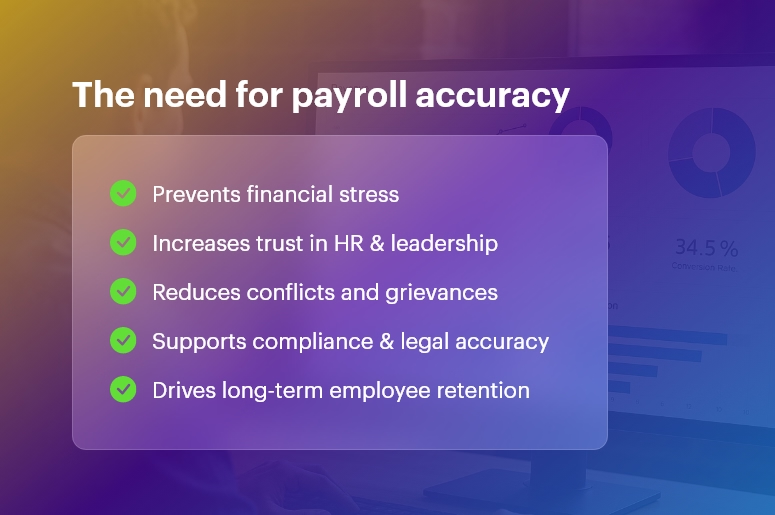
The need for payroll accuracy

Why Payroll Accuracy Matters More Than Ever

Organisations today deal with complex workforce structures — remote teams, gig workers, freelancers, contractors, variable pay cycles, flexible shifts, and compliance-heavy regulations.

Against this backdrop:

  • A single miscalculated payslip can trigger employee dissatisfaction.
  • Delayed pay cycles erode trust in leadership.
  • Incorrect statutory deductions can expose companies to compliance risks.
  • Lack of payroll transparency fuels HR grievances.

Accurate payroll ensures reliability, which is foundational to employee confidence and employer reputation.

India’s #1 Free Software

Free Payroll, PF, ESI & TDS Software

1. Accurate Payroll Strengthens Employee Trust

Accurate payroll is one of the strongest trust-building mechanisms within any organisation.

Employees may forgive operational delays, minor communication issues, or workflow bottlenecks—but they rarely forgive payroll mistakes. Salary is deeply personal, and when it arrives on time and without errors, employees feel genuinely respected by the organisation.

Consistently accurate payroll reflects the company’s seriousness toward its commitments.

When employees notice that their employer proactively ensures correct payments, they develop a perception of reliability and ethical leadership. This perception matters immensely for long-term retention.

Moreover, trust built through accurate payroll reduces internal escalations and friction across departments. HR and finance teams spend less time resolving disputes and more time building meaningful employee programs.

As trust grows, employees become more open to feedback, exhibit higher loyalty, and contribute more positively to the workplace culture.

2. Payroll Accuracy Reduces Employee Stress and Enhances Well-Being

Financial security is a foundational element of employee well-being. Even a minor discrepancy — such as a missing allowance, incorrect overtime calculation, or wrong tax deduction — can cause emotional stress.

Employees may panic, overthink, or become anxious about recurring mistakes, especially if they have financial commitments like EMIs, family expenses, or savings goals.

Accurate payroll eliminates these stress triggers. It gives employees peace of mind, knowing they can rely on their salary for their monthly responsibilities.

This sense of stability directly impacts mental well-being and overall life satisfaction.

Additionally, when payroll is error-free, employees do not need to chase HR for corrections, resubmissions, or clarifications.

This reduces frustration and allows them to maintain a balanced work-life experience. Over time, a consistently stable payroll environment enhances workforce morale and strengthens organisational loyalty.

3. Accurate Payroll Improves Productivity and Engagement

Productivity is often influenced by factors beyond skills or job roles. When employees are distracted by payroll issues — such as rectifying mistakes, seeking clarifications, or worrying about delayed payments — they lose valuable time and mental energy.

These disruptions compound over weeks and months, resulting in lower performance and disengagement.

Accurate payroll ensures employees can channel their complete focus toward deliverables and organisational goals. Without financial uncertainty, they feel motivated and more aligned with the company’s mission.

This leads to heightened engagement, reduced absenteeism, and improved team collaboration.

For HR and finance teams, accurate payroll significantly reduces operational cycles.

They are freed from repetitive error resolution tasks and can instead focus on strategic initiatives such as workforce planning, employee development, performance management, and culture-building activities. This creates a win-win situation for both employees and the organisation.

4. Payroll Accuracy Enhances Transparency and Reduces Conflicts

Transparency is a major driver of employee satisfaction. When employees clearly understand how their salary is calculated — earnings, deductions, taxes, reimbursements, overtime — they feel empowered and informed.

Inaccurate payroll, however, results in internal complaints, confusion, and disputes.

Accurate payroll supported by clear breakdowns and employee self-service access eliminates room for ambiguity. Employees can verify every component of their payslip, ensuring alignment between policy and payout.

This transparency removes guesswork and reduces friction between employees and HR teams.

Furthermore, accurate payroll prevents systemic issues from escalating across teams. Instead of dealing with recurring complaints or mistrust, HR leaders can maintain harmonious communication channels.

Conflict resolution becomes smoother, and teams feel confident approaching HR for support, not for disputes. When employees feel they are treated fairly, workplace relationships significantly improve.

5. Accurate Payroll Boosts Employer Brand & Retention Rates

Employee experience is now a critical component of employer branding. Companies known for payroll accuracy earn a positive reputation internally and externally.

Employees share their experiences with peers, on social media, and on employer review platforms.

A reputation for accurate payroll signals operational excellence, fairness, and employee-centric culture.

Candidates are more willing to join, and existing employees are less likely to leave because they feel financially secure and respected. This reduces voluntary turnover and hiring costs.

Additionally, payroll accuracy influences the employee’s perception of broader organisational systems.

If payroll is error-free, employees assume other processes — HR operations, performance management, and compliance — are also robust. This holistic positive experience plays a central role in employee retention.

6. Payroll Accuracy Supports Statutory Compliance and Reduces Legal Risk

Statutory compliance is a high-stakes area. Incorrect PF, ESI, TDS, gratuity, or bonus calculations can create liabilities for both employees and the organization.

Employees rely on payroll teams to ensure their contributions, tax deductions, and statutory benefits are accurately maintained.

Accurate payroll guarantees compliance with evolving labour laws and statutory regulations. It protects employees from tax penalties, incorrect filings, or financial discrepancies that may affect their long-term benefits.

For employers, accurate compliance management prevents legal consequences, audits, and monetary penalties.

Employees highly value an employer who safeguards their financial and legal interests. When payroll calculations and compliance filings are consistently correct, employees feel secure — and that security is a significant retention driver.

7. Accurate Payroll Helps Build a Culture of Fairness

A perception of fairness is central to employee morale. Payroll is the most visible indicator of fairness within an organisation because it directly impacts employees’ lives and reflects how the company values their work.

When payroll is accurate, employees feel fairly compensated for their time, skills, and contributions. Transparent policies ensure that overtime, incentives, shift differentials, and bonuses are correctly calculated and paid.

Fairness strengthens mutual respect and reduces the likelihood of employees feeling left out, underappreciated, or discriminated against.

A workplace that consistently demonstrates fairness through accurate payroll naturally experiences higher engagement and lower attrition. Employees are more motivated to stay in a culture where their compensation is clear, just, and timely.

8. Accurate Payroll Facilitates Better Management Decisions

Payroll data is one of the richest sources of workforce insights. With precise payroll records, HR and management teams can make informed decisions about workforce planning, budgeting, cost optimization, performance-linked incentives, and resource allocation.

Accurate payroll also supports forecasting and compensation analysis. Leadership teams can evaluate pay structures, identify inconsistencies, and optimise salary benchmarks. This ensures that the organisation remains competitive and equitable.

These data-driven decisions ultimately benefit employees as well. With better insights, companies can design more effective reward programs, improve appraisal cycles, and maintain fair compensation structures — contributing directly to employee satisfaction.

Key Causes of Payroll Inaccuracy (And How to Fix Them)

Common payroll errors

  • Manual data entry mistakes
  • Outdated spreadsheets
  • Incorrect time and attendance data
  • Policy misinterpretation
  • Poor integration between HR, attendance, and finance systems
  • Miscalculations of taxes, benefits, and statutory deductions

How to eliminate payroll errors

  • Use modern, automated payroll software
  • Integrate attendance, leave, and shift systems
  • Maintain updated statutory rules
  • Automate calculations and approvals
  • Adopt employee self-service for transparency
  • Conduct payroll audits regularly

Automation is the biggest enabler of error-free payroll.

How Technology Enables Accurate Payroll

Modern AI-powered payroll systems provide:

  • Real-time data validation
  • Automated statutory updates
  • Intelligent error detection
  • End-to-end calculation accuracy
  • Seamless integration with HRMS, attendance, shift rosters, and finance systems
  • Self-service payslips and tax statements

Organisations that invest in payroll automation see dramatic improvements in both satisfaction and retention.

Free Payroll, PF, ESI & TDS Software

The most trusted automation tool for modern Indian businesses.

Conclusion

Accurate payroll is no longer a back-office function; it is a core component of the employee experience. When employees are paid correctly and on time, trust increases. When trust increases, engagement and retention naturally rise.

Organisations that adopt automated, compliant, and transparent payroll systems create happier teams and stronger employer brands.

Payroll accuracy is not just a financial priority; it is a people strategy — and a powerful one.

FAQs

1. Why is accurate payroll important for employee satisfaction?

Accurate payroll is essential because salary is the most fundamental expectation employees have from their employer. When payroll is correct, timely, and transparent, employees feel valued and respected. It strengthens trust in the workplace and eliminates stress caused by salary discrepancies.

Key reasons include:

  • Ensures financial stability for employees
  • Reduces stress and confusion
  • Reinforces trust in HR and leadership
  • Prevents conflicts and grievances related to pay

2. How does payroll accuracy influence employee retention?

Payroll accuracy is directly tied to retention because employees are less likely to leave an organisation they perceive as fair, dependable, and respectful of their time and effort. When payroll is error-free, employees feel secure and are more inclined to stay long-term.

Retention benefits include:

  • Higher loyalty and commitment
  • Reduced attrition due to payroll frustration
  • Positive employer brand perception
  • Increased likelihood of employee referrals

3. What are the common reasons payroll mistakes happen?

Payroll errors usually stem from manual processes, miscommunication, or outdated systems. These mistakes often accumulate during monthly payroll runs and negatively impact both employees and HR teams.

Common causes include:

  • Manual data entry
  • Incorrect attendance and leave inputs
  • Mismatched shift or overtime logs
  • Outdated statutory rules
  • Spreadsheet-based calculations
  • Lack of integration between HRMS, attendance, and finance systems

4. How can payroll errors negatively impact employee morale?

Payroll errors create immediate frustration because they strike at an employee’s financial and emotional well-being. A single incorrect payslip can lead to dissatisfaction and disengagement.

Impact on morale includes:

  • Loss of trust in the employer
  • Increased stress and anxiety
  • Perception of being undervalued
  • Reduced enthusiasm and productivity
  • Complaints and strained HR–employee relationships

5. Can accurate payroll improve organisational productivity?

Yes. Accurate payroll enhances productivity across the organisation — not just for employees but also for HR and finance departments. When payroll runs smoothly, at scale, without disputes, everyone works more efficiently.

Benefits to productivity:

  • Employees focus on work instead of salary issues
  • HR teams avoid repetitive corrections and disputes
  • Finance teams get accurate financial data
  • Overall, the workflow becomes smoother and faster

6. How does accurate payroll support statutory compliance?

Accurate payroll ensures that all statutory deductions and filings — such as PF, ESI, TDS, LWF, gratuity, and bonuses — are calculated and submitted correctly. This protects both the company and employees from legal risks.

Compliance benefits include:

  • Avoids penalties and violations
  • Ensures correct employee contributions
  • Builds trust by safeguarding employee benefits
  • Makes audits and reporting easier

7. How does technology help improve payroll accuracy?

Modern payroll software automates calculations, updates statutory rules, validates data, and integrates with attendance, leave, and shift systems to ensure accuracy. By removing human error, technology delivers consistent and reliable payroll results.

Technology enables:

  • Automated error detection
  • Integrated data across HRMS and finance systems
  • Real-time statutory updates
  • Accurate overtime, bonus, and incentive calculations
  • Transparent digital payslips and tax statements

8. What role does payroll transparency play in employee satisfaction?

Transparency builds clarity and eliminates confusion. When employees understand how their salary is computed—including earnings, deductions, taxes, and benefits—they feel more informed and empowered.

Benefits of payroll transparency:

  • Reduces disputes and misunderstandings
  • Improves trust in HR operations
  • Demonstrates fairness in compensation
  • Helps employees plan better financially

9. What steps can companies take to ensure payroll accuracy?

Companies must adopt a combination of automation, strong policies, and continuous audits to deliver accurate payroll consistently.

Key steps include:

  • Implementing automated payroll software
  • Integrating attendance, leave, and shift management systems
  • Conducting periodic payroll audits
  • Providing employees with self-service access to payslips and tax data
  • Keeping statutory rules updated
  • Training HR teams on payroll processes and compliance

10. How does accurate payroll contribute to a strong employer brand?

Employees judge organisations not just on culture or perks, but on reliability. Payroll accuracy sends a powerful message that the company respects its workforce. This influences how employees speak about the company internally and externally.

  • Strong reputation as a fair and reliable employer
  • Higher employee advocacy and referrals
  • Lower public complaints that damage brand value
  • Better ability to attract high-quality talent

Monthly Payroll vs. Weekly Payroll: Which One Is Right for Your Business?

When it comes to payroll, frequency matters more than you might think. The decision between monthly payroll vs. weekly payroll isn’t just a preference — it’s a strategic lever that affects cash flow, compliance, morale, and operational efficiency.

For many HR professionals, finance teams, and small business owners, the question is this: How often should you pay your employees? And more importantly, how does that decision impact your team and bottom line?

In this blog, we’ll break down the differences between monthly and weekly payroll, explore how it affects various business models, and help you choose the option that aligns with your goals — backed by practical insights and powered by the flexibility of CRMLeaf’s CRM + ERP platform.

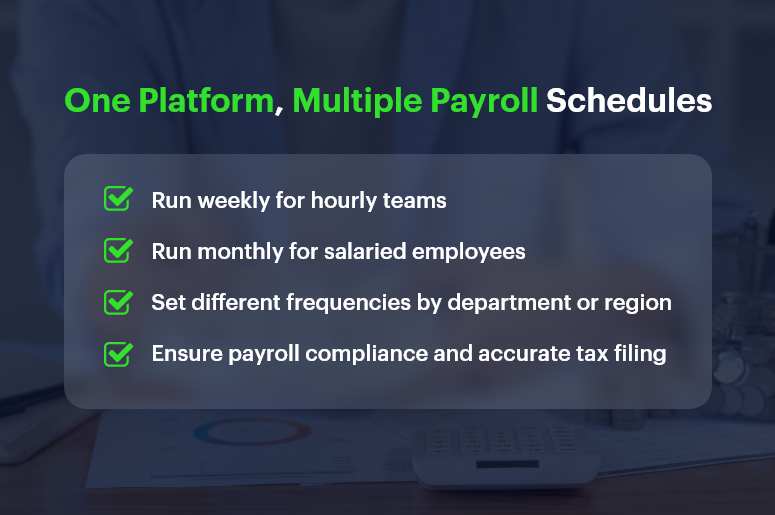
One Platform, Multiple Payroll Schedules

Why Payroll Frequency Is a Strategic Decision for Growing Businesses

Payroll isn’t just about cutting checks — it’s about financial planning, employee satisfaction, and regulatory compliance. As your business scales, choosing the right payroll schedule becomes even more critical.

1. Operational Simplicity vs. Workforce Expectations

  • Businesses often lean toward monthly payroll for its administrative simplicity and predictable cash flow cycles.
  • However, some industries require weekly payroll to meet labor expectations, especially for hourly or part-time staff.

2. Industry-Specific Norms

  • Construction, manufacturing, and retail industries often pay weekly or biweekly due to fluctuating shifts, hourly pay structures, and union rules.
  • SaaS companies, consultancies, and professional services prefer monthly payroll to reduce admin load and align payments with invoice cycles.

3. Employee Engagement and Retention

  • For many employees, pay frequency impacts satisfaction. Weekly payroll can improve morale and reduce financial stress — especially in hourly workforces.
  • On the other hand, salaried professionals often prefer predictable, consolidated monthly pay.

So, how do you decide between monthly payroll vs. weekly payroll? Let’s explore the pros and cons.

India’s #1 Free Software

Free Payroll, PF, ESI & TDS Software

Payroll Schedule Comparison: Monthly vs. Weekly Breakdown

Here’s a clear breakdown of the advantages and trade-offs for both schedules, so you can make a confident decision.

Monthly Payroll: Advantages

  • Reduced Administrative Overhead: You only process payroll 12 times a year, saving time, effort, and resource costs.
  • Simplified Tax Filing: Fewer filings mean fewer opportunities for compliance errors and smoother reconciliation processes.
  • Cash Flow Predictability: Monthly payouts help businesses better forecast cash flow, especially when managing vendor payments and invoices.
  • Better Integration with Financial Systems: Monthly payroll aligns well with CRM + ERP platforms that also operate on monthly billing and reporting cycles.

Monthly Payroll: Potential Drawbacks

  • Delayed Earnings for Employees: Waiting 30 days for pay may cause dissatisfaction among employees, especially in lower-income or hourly roles.
  • Harder to Adjust for Mid-Cycle Changes: Bonuses, terminations, and last-minute adjustments may be harder to handle without disrupting the cycle.
  • Less Flexibility: If labor hours vary significantly, reconciling hours and calculating pay can be more challenging over longer cycles.

Weekly Payroll: Advantages

  • Boosts Employee Satisfaction: Employees receive faster access to their earnings, which can reduce financial stress and improve engagement.
  • Ideal for Hourly Workforces: Weekly payroll is perfect for businesses with fluctuating schedules and overtime payments.
  • Faster Error Correction: Mistakes can be caught and corrected more quickly, limiting the window for unresolved issues.

Weekly Payroll: Potential Drawbacks

  • Higher Administrative Load: Processing payroll 52 times a year can burden HR and finance teams — unless you automate with tools like CRMLeaf.
  • Increased Processing Costs: More frequent payroll runs can increase costs related to compliance, direct deposits, and accounting.
  • Shorter Cash Flow Windows: Weekly disbursements require tighter cash management and forecasting to avoid liquidity issues.

Best Practices: How to Choose the Right Payroll Schedule

Choosing between monthly payroll and weekly payroll depends on several factors — employee type, industry, company size, and available payroll infrastructure.

1. Align Payroll with Workforce Structure

  • If your team is largely hourly, seasonal, or shift-based, weekly payroll often works best.
  • For predominantly salaried employees, monthly payroll minimizes complexity and matches performance review or bonus cycles.

2. Evaluate Internal Resources

  • If your HR and finance teams are small or overstretched, monthly payroll might reduce workload and risk.
  • However, automation with CRMLeaf levels the playing field. You can run payroll weekly without overwhelming your team thanks to built-in workflows and tax calculators.

3. Consider Cash Flow Patterns

  • Ask: Can we maintain healthy cash reserves for weekly disbursements?
  • If not, monthly payroll may give your finance team more breathing room for planning, investing, or handling emergencies.

4. Stay Compliant with Local Laws

  • Some jurisdictions mandate weekly or biweekly payments, especially for certain industries.
  • CRMLeaf helps you stay compliant by automating regional payroll compliance and alerting you to changes in tax rules or labor laws.

Real-World Case Study: Choosing the Right Schedule with CRMLeaf

For example, ShopMax, a mid-sized retail business with 300 hourly employees, switched from monthly to weekly payroll using CRMLeaf’s CRM + ERP platform.

After automating time tracking, tax deduction, and overtime calculations:

  • Payroll errors dropped by 45%
  • Employee satisfaction scores increased by 22%
  • Time spent on payroll processing decreased by 40%

By leveraging CRMLeaf’s payroll automation and analytics, ShopMax turned payroll from a pain point into a retention advantage.

India’s #1 Free Software

Free Payroll, PF,
ESI & TDS Software

Professional compliance management for Indian businesses. 100% Free Forever.

Key Takeaways: Finding Your Payroll Sweet Spot

Choosing between monthly payroll vs. weekly payroll isn’t one-size-fits-all. It’s a decision shaped by your team, your operations, and your goals.

  • Weekly payroll may suit hourly teams and high-turnover roles that require speed, transparency, and employee satisfaction.
  • Monthly payroll may suit salaried workforces, project-based companies, and cash-conscious operations.
  • The best strategy is to combine thoughtful planning with powerful automation.

With CRMLeaf’s CRM + ERP platform, you’re not stuck choosing one over the other — you get the flexibility to run different payroll schedules based on department, location, or role.

So whether you want efficiency, accuracy, or happier employees, CRMLeaf empowers your payroll process to align with business strategy.

Why Manual Payroll Processing Is Costing You More Than You Think?

On the surface, manual payroll processing might seem manageable — especially for small teams or early-stage companies. But behind the scenes, it’s a productivity drain, a compliance risk, and a hidden cost center.

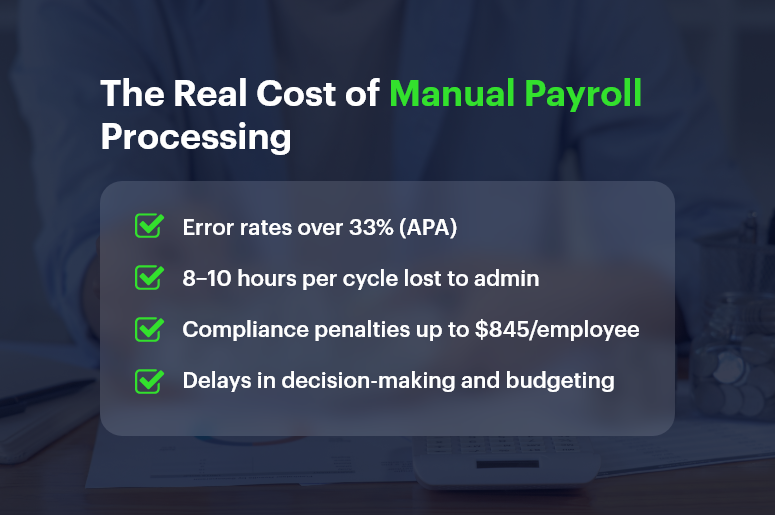
In fact, the American Payroll Association found that payroll errors affect over 33% of businesses, often costing hundreds to thousands annually per employee. And yet, many companies stick with spreadsheets and legacy systems simply because “that’s how it’s always been done.”

In this blog, we’ll explore why manual payroll processing is costing you more than you think, uncover the real-world risks, and show how platforms like CRMLeaf’s CRM + ERP help modernize payroll with automation, accuracy, and insight.

The Real Cost of Manual Payroll Processing

The Real Cost of Manual Payroll: Why This Matters to Growing Businesses

Manual processes aren’t just outdated — they’re dangerous in a fast-paced, compliance-heavy, and data-driven business world. And the impact isn’t limited to just HR.

1. Manual Means Mistakes — And Mistakes Cost Money

  • Data entry errors are common: Manually inputting hours, deductions, and tax codes opens the door to mistakes. One wrong cell and your employees get underpaid, or your business overpays taxes.
  • Fixing errors eats into productive time: HR and finance teams often spend hours fixing mistakes instead of focusing on strategic initiatives.

2. Hidden Compliance Risks Are Always Lurking

  • Tax laws change constantly: Staying updated manually across multiple jurisdictions increases the risk of fines and audits.
  • Late filings or misclassified employees can result in government penalties, legal trouble, and loss of trust.

Free Payroll, PF, ESI & TDS Software

The most trusted automation tool for modern Indian businesses.

3. Employee Experience Takes a Hit

  • Late payments or incorrect paychecks hurt morale: It’s hard to keep employees engaged if they’re constantly questioning their pay.
  • Manual processes reduce transparency: Employees may not know where to go for breakdowns, deductions, or past payslips.

4. Business Scalability Slows Down

  • Manual payroll doesn’t scale: The more employees you onboard, the harder it becomes to track benefits, bonuses, and time off accurately.
  • Disconnected systems stall decision-making: Without real-time integration between payroll, finance, and HR, you lose visibility.

From retail and manufacturing to tech startups and agencies, businesses in every industry face these bottlenecks — until they automate.

The True Costs of Manual Payroll Processing: Let’s Break It Down

You might think manual processing saves you software costs. But here’s what it’s costing:

1. Time Cost

  • Manual payroll can take 8–10 hours per cycle, depending on employee count, overtime tracking, tax calculations, and approvals.
  • Multiply that across 12–52 pay periods, and you’re talking about dozens of workdays lost annually to payroll administration.

2. Financial Risk

  • A simple mistake — like failing to withhold the correct tax — can cost businesses up to $845 per year per employee in penalties, according to the IRS.
  • Labor audits due to noncompliance often result in thousands in legal fees.

3. Opportunity Cost

  • Manual payroll drains time that could be spent on performance analysis, workforce planning, or improving employee engagement.
  • Delayed payroll insights mean you can’t react quickly to budget overruns or labor costs exceeding projections.

Best Practices: How to Eliminate the Hidden Costs of Manual Payroll

It’s time to stop treating payroll like a back-office burden and start managing it as a strategic function. Here’s how to make the shift:

1. Automate Data Collection with Integrated Time Tracking

  • Sync employee hours, leave records, overtime, and holidays with your payroll system using CRMLeaf’s unified CRM + ERP.
  • You’ll eliminate manual errors and gain real-time visibility across departments.

2. Implement Tax Rules & Compliance Workflows

  • Automate tax calculations and state-specific compliance checks within your payroll module.
  • CRMLeaf keeps tax rules up to date, so you’re always audit-ready without manual intervention.

3. Generate Reports Instantly

  • From payroll summaries to compliance reports, automation lets you run reports with one click instead of piecing together Excel sheets.
  • This makes it easier to justify expenses, analyze labor trends, and share insights with leadership.

4. Give Employees Self-Service Access

  • Empower employees with portals where they can access payslips, tax forms, and payment history — reducing HR queries by up to 40%.
  • CRMLeaf includes secure, role-based access so sensitive data stays protected.

5. Sync Payroll with Project Costs

  • When payroll data integrates with projects and budgets, you can track real-time labor costs per client or task.
  • This is crucial for consulting firms, marketing agencies, and any business with billable hours.

Customer Story: How One Business Slashed Payroll Costs with CRMLeaf

For example, TaskPro, a logistics company with 150+ employees, was managing payroll manually using spreadsheets and a legacy HR tool.

Once they switched to CRMLeaf’s payroll automation, the impact was immediate:

  • Payroll processing time dropped by 60%
  • Error rate reduced by 80%
  • Annual compliance fines went from $6,000 to zero

TaskPro also integrated payroll with its budgeting module — improving project profitability by understanding labor cost allocations in real-time.

India’s #1 Free Software

Free Payroll, PF, ESI & TDS Software

Key Takeaways: Automation Isn’t Optional Anymore

Here’s the reality — manual payroll processing is draining your time, increasing risk, and limiting your growth.

To recap:

  • Manual methods introduce more errors, which cost both money and employee trust.
  • You’re losing valuable time and missing out on insights that modern automation delivers instantly.
  • Payroll should be part of your business intelligence strategy, not just a monthly task.

With CRMLeaf’s CRM + ERP platform, payroll is integrated, automated, and optimized — so your teams can focus on strategy, not spreadsheets.

End-to-End Payroll Processing Checklist for Growing Businesses

Payroll isn’t just about paying your people. It’s about staying compliant, earning trust, and keeping your team motivated. But as your business grows, managing payroll manually becomes risky, time-consuming, and error-prone. In fact, more than 33% of small businesses face penalties due to payroll errors. In this guide, we’ll walk you through a practical end-to-end payroll processing checklist — built for modern, growing businesses. You’ll learn where most companies slip up, what to fix, and how to make the entire process seamless with CRMLeaf’s CRM + ERP platform.

The Business Case: Why End-to-End Payroll Processing Matters

Managing payroll goes far beyond cutting checks. When payroll is inaccurate or non-compliant, it creates ripple effects across your business. Think employee dissatisfaction, audits, legal trouble, and financial losses.

Let’s look at why a robust payroll system is essential for growth:

  • Retail & Hospitality: High employee turnover and hourly wages make real-time payroll updates critical. Delays lead to unhappy staff and retention issues.
  • Manufacturing & Logistics: Managing overtime, shift differentials, and contract workers demands precision — or you’ll face major payroll compliance risks.
  • Professional Services: Billing hours, bonuses, and project-based compensation require automation to prevent calculation errors.

No matter the industry, streamlined payroll automation improves productivity, builds employee trust, and reduces your operational burden.

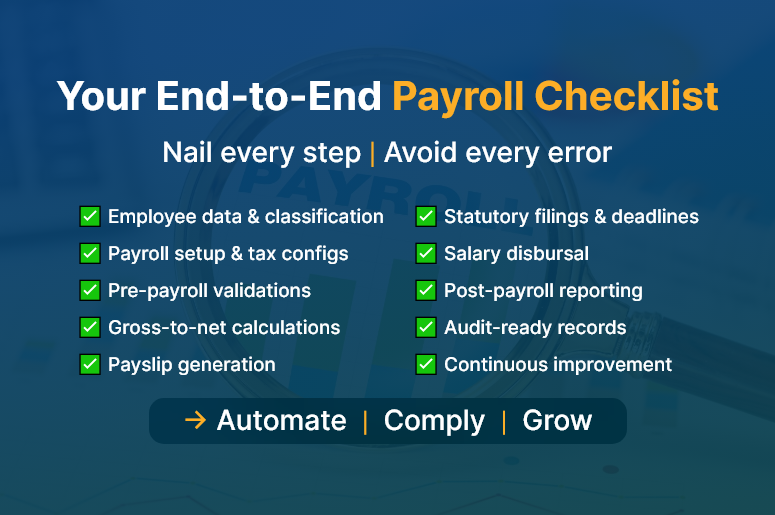
Your End-to-End Payroll Checklist

The Ultimate End-to-End Payroll Processing Checklist

Here’s your complete payroll checklist, broken down into actionable stages. Each one is critical for a smooth, accurate, and compliant payroll cycle.

1. Employee Data Collection & Classification

  • Capture full employee details: Collect tax ID, contact info, job role, bank details, and any benefits preferences at onboarding.
  • Classify employment type: Distinguish between full-time, part-time, contract, and freelance workers to ensure correct tax treatment.
  • Track working hours and shifts: Use digital timesheets or biometric systems to gather accurate work data.

2. Payroll Setup & Configuration

  • Set pay frequencies: Define weekly, bi-weekly, or monthly payroll cycles based on company structure.
  • Automate tax rates & deductions: Stay current with federal, state, and local tax laws to apply accurate deductions.
  • Integrate with attendance systems: Sync leave, holidays, and work hours from your HR tool into your payroll system.

3. Pre-Payroll Validation

  • Verify attendance data: Double-check logged work hours, approved leave, and overtime entries.
  • Audit changes in pay structure, including bonuses, commissions, and pay raises, and validate them before final processing.
  • Confirm deductions: Ensure that benefits, insurance, and loan deductions are accurate and approved.

4. Payroll Calculation & Review

  • Run gross-to-net calculations: Automatically compute gross salary, taxes, deductions, and net pay.
  • Cross-check with payroll software: Use automated payroll software to reduce human errors and eliminate spreadsheet fatigue.
  • Generate payslips: Produce detailed, downloadable payslips for employee transparency.
India’s #1 Free Software

Free Payroll, PF,
ESI & TDS Software

Professional compliance management for Indian businesses. 100% Free Forever.

5. Compliance & Statutory Filings

  • Generate tax forms: Automatically create W-2s, 1099s, PF/ESI documents, and other required tax filings.
  • Meet submission deadlines: Set reminders for tax payment and reporting deadlines to avoid penalties.
  • Stay audit-ready: Maintain digital records and audit trails to comply with labour laws.

6. Payment Processing

  • Schedule timely payments: Use integrated banking or payroll software to process salary payments without delay.
  • Disburse reimbursements: Include travel or expense claims in the current cycle to avoid payment lags.
  • Reconcile bank statements: Ensure every payment matches the payroll run and accounting books.

7. Post-Payroll Reporting & Feedback

  • Share detailed reports: Provide department-wise breakdowns and payroll summaries to finance and HR teams.
  • Analyze payroll KPIs: Track payroll accuracy, error rates, cycle time, and compliance status.
  • Collect feedback: Enable employee feedback to improve future payroll runs.

How CRM + ERP Transforms Payroll for Scaling Teams

Disconnected tools lead to fragmented processes. CRMLeaf’s CRM + ERP platform brings everything — from employee onboarding to payroll disbursal — into one unified workflow.

  • HR integration: Automatically sync new hire data from your HR module into payroll setup.
  • Real-time tracking: Use dashboards to monitor payroll progress, pending validations, and payment status.
  • Custom reports: Generate audit-ready reports, salary slips, and tax documents at the click of a button.
  • Scalability: Whether you have 20 or 200 employees, the system grows with you — minus the manual work.

Customer Success

For example, Finovate Solutions, a 50-person IT services company, used CRMLeaf’s payroll automation to reduce payroll errors by 95% and cut processing time from 3 days to 4 hours. Here’s how:

  • Integrated employee timesheets with payroll
  • Enabled automatic compliance checks and tax form generation
  • Streamlined payouts and payslip generation

This shift not only saved time but boosted employee satisfaction and reduced compliance risks.

Free Payroll, PF, ESI & TDS Software

The most trusted automation tool for modern Indian businesses.

Key Takeaways & Closing

A smooth end-to-end payroll processing workflow doesn’t just prevent errors — it strengthens trust, ensures compliance, and frees up your time for strategic growth.

  • Map your payroll process: Understand each phase and identify bottlenecks.
  • Automate wherever possible: Manual work invites mistakes. Use payroll automation tools.
  • Stay compliant: Regulations change frequently. Your system must adapt in real time.
  • Unify systems: Don’t rely on disconnected HR, time tracking, and payroll apps.

With the right tools and mindset, payroll can become a growth enabler — not a back-office burden.

Category: EPFO & ESI

No posts in this category.

Subcategory: EPFO

Subcategory: ESI

Category: Payroll Help

No posts in this category.

Subcategory: Employee Self-Service & Engagement

Subcategory: Introduction to Payroll

Subcategory: Payroll Analytics & Reporting

Subcategory: Payroll Automation & Technology

Subcategory: Payroll for Business Growth

Subcategory: Payroll Processing & Management

Subcategory: Taxation & Compliance

Category: User Manual

No posts in this category.

Subcategory: Company Setup

Subcategory: Employee Management

Subcategory: Getting Started

Subcategory: Glossary

Subcategory: Import & Export

Subcategory: Introduction

Subcategory: Payroll Configuration

Subcategory: Payslips & Disbursement

Subcategory: Reports & Analytics

Subcategory: Running Payroll

Subcategory: Statutory Compliance & Reports

Subcategory: Troubleshooting

Subcategory: User Management & Security